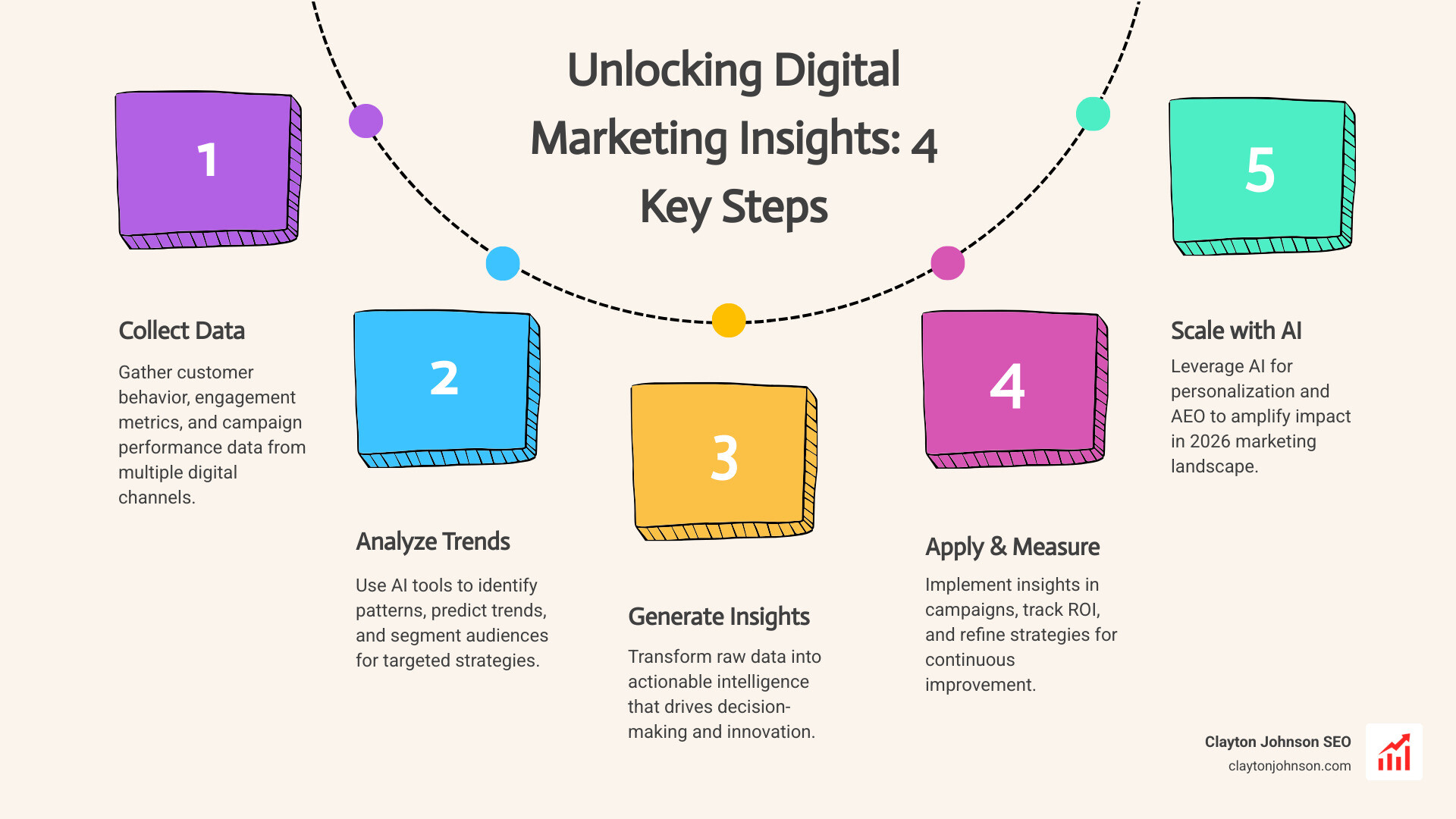
Why Digital Marketing Insights Matter More Than Ever in 2026
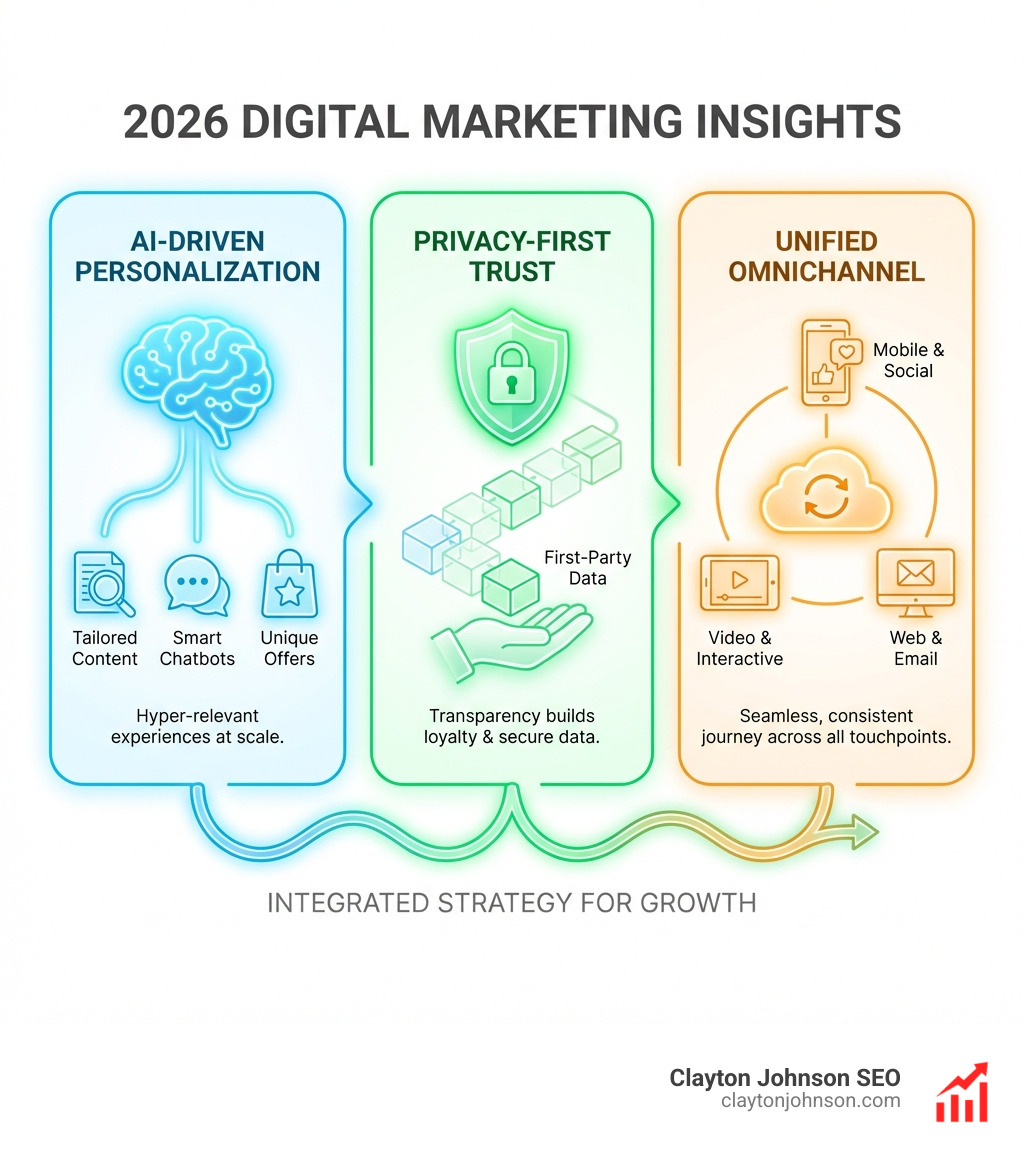
Digital marketing insights are the foundation of every successful campaign—but in 2026, the rules have fundamentally changed. Here’s what you need to know:
- AI is reshaping search behavior: 50% of consumers now use AI-powered search, and half of all Google searches include AI overviews
- Personalization drives measurable growth: 93.2% of marketers report that personalized experiences led to more leads and purchases
- Marketing teams face new pressure: 33% cite proving ROI as their top challenge, while 86.4% are already using AI in at least some capacity
- Content must adapt to Answer Engine Optimization: Traditional SEO strategies need recalibration for conversational, multimodal queries
- Human creativity remains irreplaceable: 73.4% of marketers view AI as a tool to improve—not replace—human-led strategy
The marketing landscape feels like trying to run on a slip ‘n’ slide. We surveyed over 1,500 marketers and analyzed decade-long trends from Google’s Think with Google research. What emerged is clear: the core channels—social media, email, website content—still matter, but the approach has completely transformed.
From 2012’s shift to online video through 2015’s micro-moments revolution to today’s AI-powered search ecosystem, consumer behavior has evolved faster than most marketing teams can adapt. Mobile searches with “near me” grew 136% year-over-year in 2016. By 2019, 27% of the global online population used voice search on mobile. Now, generative AI is expected to boost enterprise software revenues by $10 billion.
The gap between understanding these shifts and acting on them is costing businesses real revenue. Brands excelling in personalization are soaring past their goals, while those stuck in old SEO tactics are watching traffic vanish. Marketing budgets increased modestly in 2026, but 79.2% of teams expect further increases—mostly directed toward AI tools, short-form video, and social platforms like Instagram (which just surpassed Facebook as the #1 brand platform).
The bottom line? Marketers who master AI-assisted workflows, data-driven personalization, and human-centered creativity will thrive. Those who don’t will struggle to prove ROI, battle burnout, and lose ground to competitors who adapted faster.
I’m Clayton Johnson, an SEO and growth strategist who has spent years building scalable traffic systems and AI-augmented marketing workflows that turn fragmented efforts into coherent growth engines—exactly the kind of structured approach essential for navigating today’s digital marketing insights landscape. My work focuses on helping marketing leaders diagnose growth problems, choose strategy, and execute with measurable results through frameworks that combine technical SEO depth with strategic positioning.
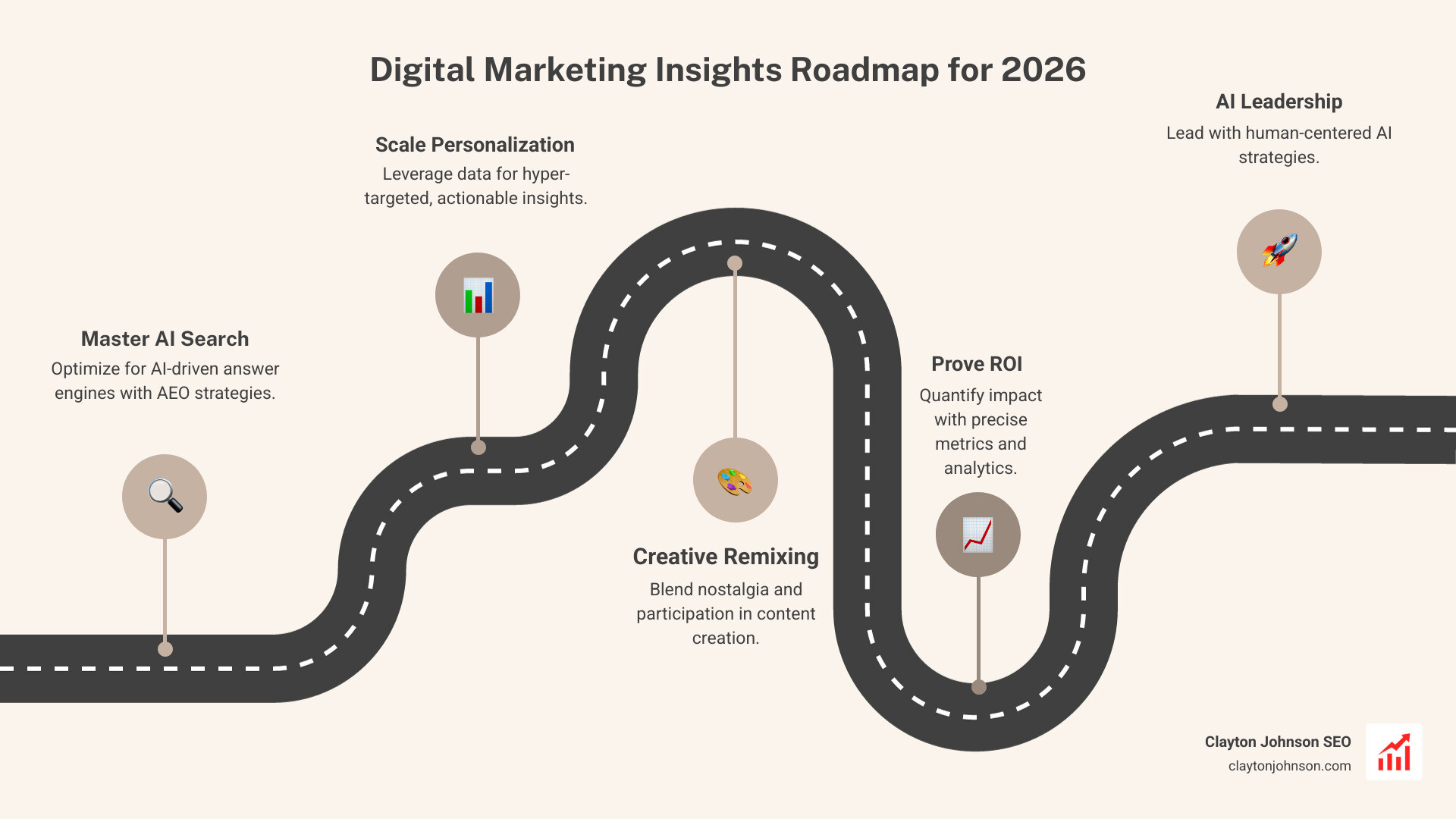
Skills 1-2: Mastering AI Search and Answer Engine Optimization (AEO)
The first and perhaps most critical skill for 2026 is the ability to optimize content for “Answer Engines.” We’ve moved past the era of simple blue links. Today, consumers use AI Mode to explore topics with unprecedented depth, combining text, images, and audio in a single query.
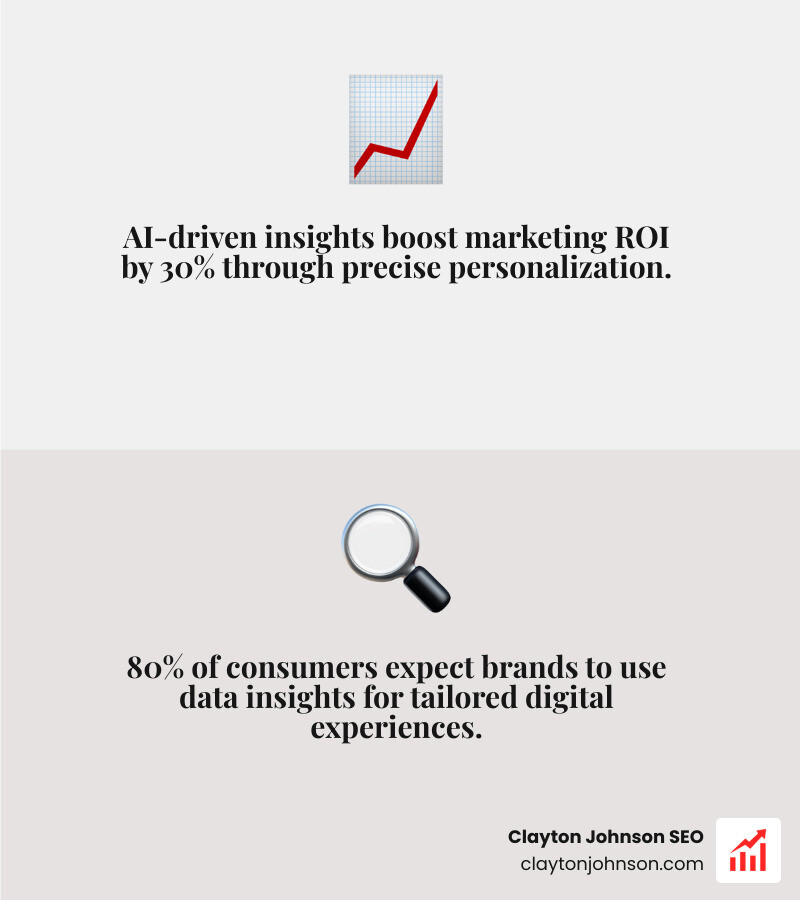
To survive this shift, we must transition from traditional keyword stuffing to building a rich ecosystem of authoritative, people-first content. This isn’t just about ranking; it’s about becoming the “key ingredient” in an AI’s conversational response.
At Clayton Johnson, we emphasize SEO Content Marketing that prioritizes “Generative Engine Optimization.” This means creating content that is structured, clear, and highly relevant to how people actually speak.
Adapting to AI-Powered Digital Marketing Insights
Search has evolved into a creative canvas. Tools like Gemini allow users to bring their queries to life, and they expect brands to provide more than just text—they want tangible, visual answers. For example, Ikea’s Kreativ AI tool allows customers to scan their rooms and visualize product swaps in real-time.
As marketers, we need to master:
- Multimodal Optimization: Ensuring our images, videos, and data are easily “readable” by AI models.
- Conversational Logic: Writing content that answers the “Why” and “How” rather than just the “What.”
- AEO Strategy: Moving beyond the search bar to show up in voice assistants and AI overviews.
Skills 3-4: Scaling Personalization and Actionable Digital Marketing Insights
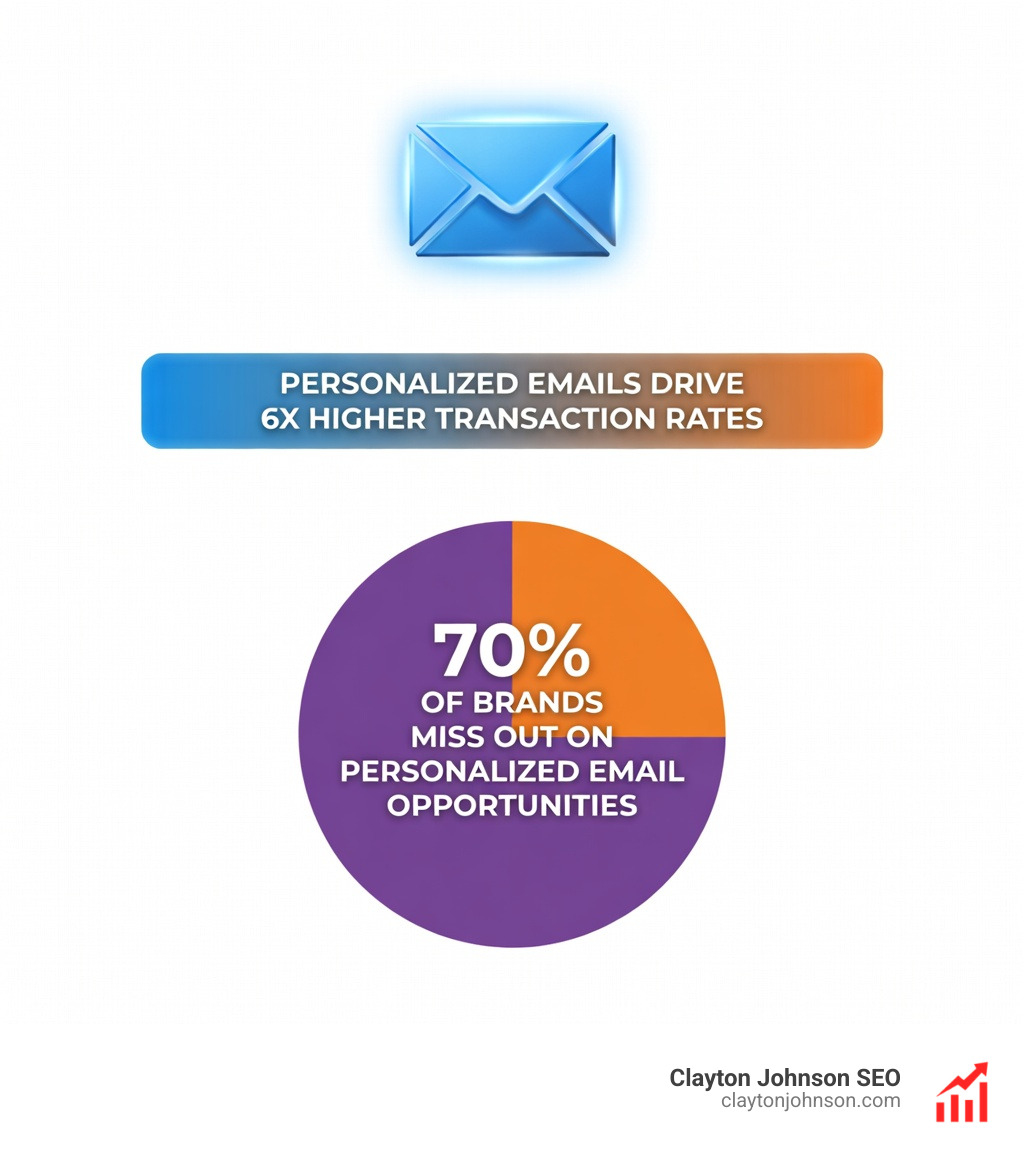
The “one-size-fits-all” approach died years ago, but in 2026, hyper-personalization is the only way to maintain relevance. Research shows that 93.2% of marketers see more leads and purchases when they segment their experiences. Yet, a massive gap remains: while 83% of marketers recognize the shift toward personalized messaging, only 1 in 4 are satisfied with how they actually use their data.
We believe that personalization isn’t just a “nice-to-have” feature; it’s a core driver of Conversion Optimization. When a customer feels understood as an individual, they buy more often and stay loyal longer. This requires a seamless HubSpot CRM integration with Clayton Johnson services to ensure that every touchpoint—from email to ad—is fueled by real-time data.
Leveraging Data-Driven Digital Marketing Insights for ROI
To drive real ROI, we have to look beyond raw numbers. Good digital marketing insights are a blend of quantitative data (the “what”) and qualitative insights (the “why”).
- Quantitative Data: Use Analytics Data to track customer journeys and identify where the “leaks” are in your funnel.
- Qualitative Insights: Don’t guess what your customers want. Use interviews, focus groups, and customer feedback questions to get the “juiciest” insights directly from the source.
- Predictive Analytics: Leverage AI to forecast future behavior. If you know a customer is likely to churn before they do, you can intervene with a personalized offer.
Skills 5-6: Creative Participation and Nostalgic Remixing
In 2026, the audience isn’t just consuming your brand—they want to build it with you. Today’s young audiences are digitally-native creators who crave creative maximalism. They don’t want to be talked at; they want to participate.
Take the example of “EPIC: The Musical.” By giving the community agency to cast and commission animated videos, the creator sparked over 50,000 related uploads on YouTube. This is the “co-creation engine” in action. As marketers, we must learn to provide the “raw materials”—the assets, the stems, the templates—that allow our fans to remix our brand story.
Our approach to Social Media Marketing focuses on this movement of participation. We use generative AI tools like Veo 3 to produce high-impact video assets at scale, giving communities the fuel they need to create.
Building Brand Trust through Nostalgia
While we look forward, we must also look back. Interestingly, 81% of consumers need to trust a brand before they even consider buying. In a chaotic world, nostalgia has become a powerful economic engine, with nostalgic campaigns proven to increase brand likability by up to 20%.
But 2026 isn’t about simple re-releases. It’s about the “nostalgic remix.”
- The Nintendo Strategy: Using actor Paul Rudd to reprise his 1991 commercial role for a new console bridged a 34-year gap, connecting generations through a shared feeling.
- The Archive Audit: We help brands audit their archives for nostalgic assets and remix them with modern partners to create fresh, yet familiar, experiences.
These efforts fall under the broader Digital Marketing Pillars of building long-term brand equity and trust.
Skills 7-8: Proving ROI and Human-Centered AI Leadership
The final set of skills involves the “hard” side of marketing: the math and the leadership. Proving marketing’s value remains a top challenge for CMOs. With Marketing attribution becoming more complex due to privacy regulations, we need to be experts in data unification.
| Feature | AI Automation | Human-Led Creativity |
|---|---|---|
| Speed | Near-instant execution | Thoughtful deliberation |
| Scale | Unlimited personalized outputs | Focused, high-impact assets |
| Empathy | Pattern-based simulation | Genuine emotional connection |
| Strategy | Data-driven optimization | Visionary “big picture” thinking |
For Paid Advertising, this means using AI to handle the heavy lifting of ad buying and predictive modeling, while humans focus on the high-level strategy and creative hooks that AI simply cannot replicate.
Future-Proofing with Advanced Digital Marketing Insights
Leadership in 2026 means navigating regulatory demands and social expectations. The era of vague sustainability pledges is over. Consumers want “tangible value.”
For instance, this collaboration between Vinted and a YouTuber succeeded because it focused on the benefit to the consumer (saving money and finding style) rather than just corporate virtue-signaling.
As leaders, we must also master:
- AI Prompting: Learning to “coach” AI to produce on-brand content.
- Operational Efficiency: Using AI to save 10-15+ hours a week on repetitive tasks, freeing up the team for deep work.
- Unified Messaging: Ensuring that Email Marketing and social channels aren’t operating in silos.
Frequently Asked Questions about AI Marketing
What is the difference between marketing automation and AI?
Marketing automation follows predefined rules (e.g., “if a user clicks this, send that email”). AI, on the other hand, learns and adapts. It can analyze vast amounts of digital marketing insights to predict what a user might want before they even take an action, allowing for dynamic, real-time personalization.
How can brands optimize content for AI search engines?
The key is “Answer Engine Optimization” (AEO). You need to create a rich ecosystem of authoritative, people-first content. Use structured data, answer conversational queries directly, and focus on being the most helpful source for a specific topic. AI search engines like Google’s AI Overviews prioritize content that is clear, factual, and easy to parse.
Why is proving marketing ROI a top challenge for CMOs?
As the customer journey becomes increasingly fragmented across multiple devices and platforms (multiscreen behavior), traditional attribution models are failing. CMOs are under pressure to show exactly how every dollar spent contributes to profitability. This is why data unification and advanced analytics tools are more important than ever.
Conclusion
The future of marketing isn’t a battle of Humans vs. Machines. It’s about the “Human-in-the-loop”—marketers who use AI to amplify their creativity, not replace it. By mastering these eight skills, from AEO to nostalgic remixing, you won’t just survive 2026; you’ll lead it.
At Clayton Johnson, we specialize in helping businesses in Minneapolis and beyond steer these shifts. Whether you need to diagnose a growth problem or build an AI-assisted workflow that actually delivers results, we are here to help.