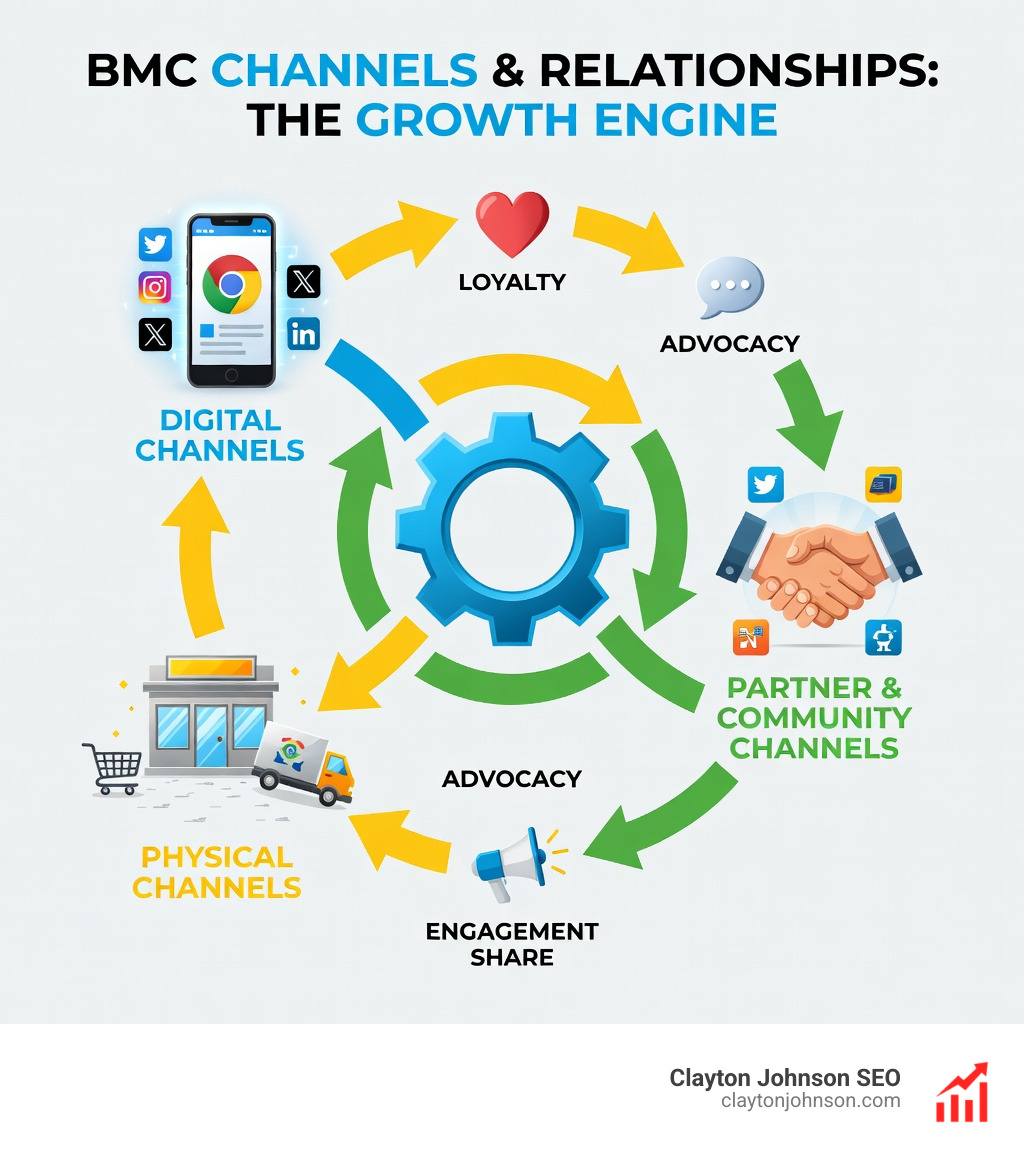
BMC channels and relationships are the two critical building blocks in the Business Model Canvas that determine how you reach customers and what type of interactions you establish with them throughout their journey.
Quick Answer:
- Channels = How you communicate with and deliver value to customers (awareness -> evaluation -> purchase -> delivery -> support)
- Relationships = The type of interactions you establish with each customer segment (personal assistance, self-service, automated, community-driven, etc.)
- Integration = Channels and relationships must align with your value propositions and customer segments to drive acquisition, retention, and growth
These two blocks work together as your go-to-market system. Channels get your offering in front of the right people through the right touchpoints. Relationships define the experience those people have when they interact with you.
Most businesses struggle here because they design channels and relationships in isolation-without considering customer habits, segment preferences, or cost-efficiency. The result? Misaligned touchpoints, wasted marketing spend, and customer experiences that fail to drive loyalty or revenue.
Why this matters: According to the Business Model Canvas framework, customers are the heart of any business model. Without profitable customers reached through effective channels and served through intentional relationships, no company survives long. The companies that get this right-like those in the Forbes Global 100-build competitive advantages through optimized channel mix and relationship strategies custom to each segment.
I’m Clayton Johnson, an SEO and growth strategist who helps founders and marketing leaders build scalable systems around customer acquisition and retention. I’ve spent years designing BMC channels and relationships strategies that align search intent, content architecture, and customer journey mapping to drive measurable growth.
Understanding the BMC Channels and Relationships Framework
To master BMC channels and relationships, we first need to see them as the connective tissue of our business. If Customer Segments are the “who” and Value Propositions are the “what,” then Channels and Relationships are the “how.” They represent the interface between our company and the market.
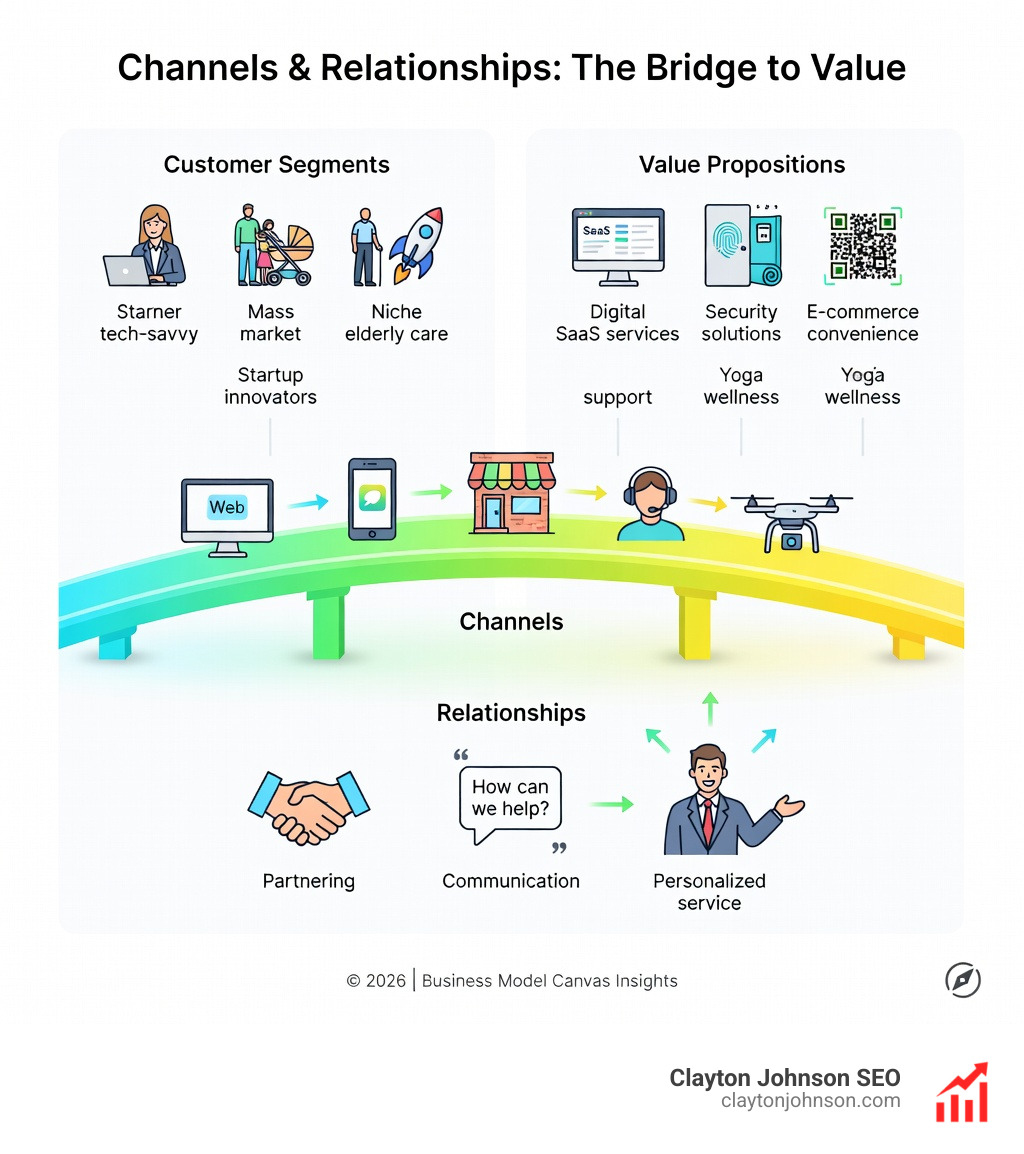
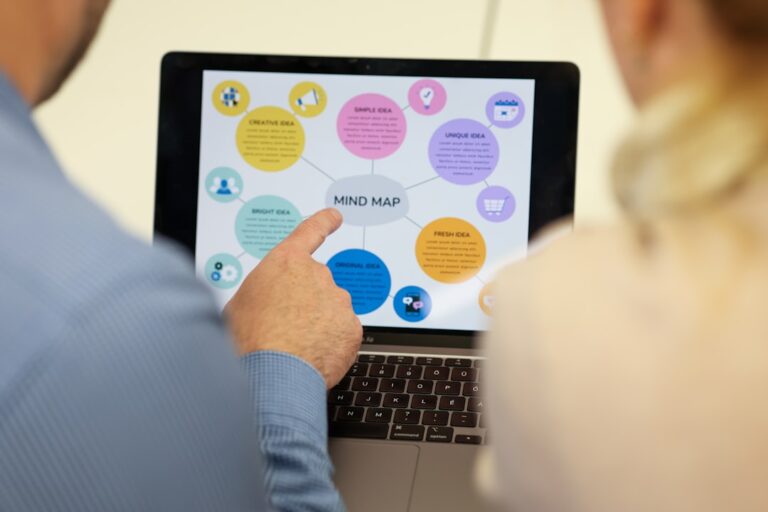
When we create a business model canvas in Confluence whiteboards for free, we can visually map how these touchpoints integrate. Every channel we choose and every relationship we foster should tell a cohesive business story. If our story is about “luxury and exclusivity,” but our channel is a discount vending machine, the narrative breaks.
A sophisticated approach to this framework involves neurolinguistic programming principles in customer profiles. By understanding the psychological drivers—the rational and emotional triggers—of our segments, we can design channels that feel intuitive and relationships that build genuine trust.
Integrating BMC Channels and Relationships with Value Propositions
Our value proposition is a bundle of benefits that solves a specific problem. However, that value is useless if it doesn’t reach the customer. This is where integration becomes vital. We must ask: Through which channels do our customer segments want to be reached?
Effective integration requires a deep dive into Customer Strategy. We need to align our delivery mechanics with customer habits. For example, if we are targeting busy professionals, a high-touch, time-consuming relationship might actually decrease the perceived value of our product, even if the product itself is excellent.
The Evolution of the Business Model Canvas
The BMC isn’t a static document; it’s a living tool. In the age of digital change, we use iterative testing to refine our blocks. We leverage psychological research on choice architecture to understand how customers make decisions at various touchpoints. By using visual collaboration tools, teams can move away from siloed thinking and ensure that the sales team, the marketing department, and the product developers are all looking at the same map of the customer journey.
The Strategic Functions of Channels in the BMC
Channels serve five distinct phases in the customer journey. Mastering BMC channels and relationships means optimizing each phase:
- Awareness: How do we raise awareness about our products and services?
- Evaluation: How do we help customers evaluate our Value Proposition?
- Purchase: How do we allow customers to purchase specific products/services?
- Delivery: How do we deliver the Value Proposition to customers?
- Post-purchase: How do we provide post-purchase customer support?
A robust Sales Strategy balances direct channels (like an in-house sales team or a website) with indirect channels (like retail stores or partner distributors). While owned channels often offer higher margins, partner channels can provide a much broader reach.
Optimizing Reach Through Diverse Channel Types
Modern businesses rarely rely on a single channel. We see a mix of digital platforms, physical storefronts, and specialized solution providers. The goal is to integrate these channels into the customer’s daily routine. If our customer spends four hours a day on LinkedIn, that digital platform becomes a primary channel for awareness and evaluation.
Measuring Channel Effectiveness and Cost-Efficiency
Not all channels are created equal. Some are great for reach but terrible for conversion; others are expensive but build incredible loyalty. To manage this, we use metrics to track performance.
By utilizing Customer Segmentation Product Insight, we can allocate resources to the channels that yield the highest ROI for specific segments. For instance, a high-value B2B segment might justify the cost of a direct sales team, while a mass-market B2C segment is better served through automated digital channels.
Cultivating High-Impact Customer Relationships
Customer relationships are driven by three main motivations: acquisition, retention, and upselling. The type of relationship we establish can range from high-touch human interaction to fully automated systems.
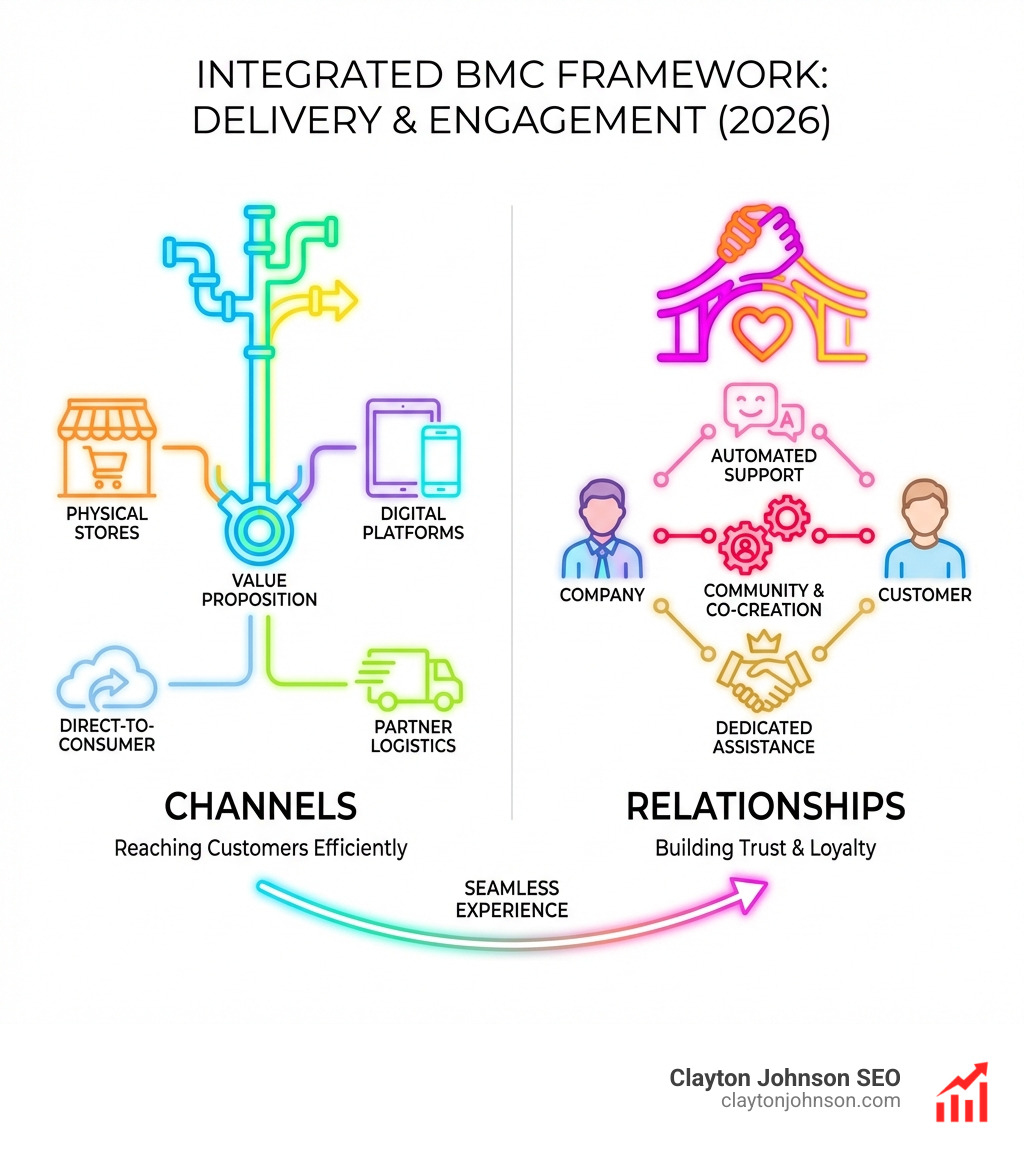
Common types include:
- Personal Assistance: Human interaction (email, phone, in-person).
- Dedicated Personal Assistance: A specific representative for a specific client (common in private banking).
- Self-Service: No direct relationship; the company provides the tools for customers to help themselves. Vending machine and gas station self-service examples show how efficiency can be a value in itself.
- Automated Services: A sophisticated form of self-service with automated processes (like personalized recommendations on Netflix).
- Communities: Online forums where users help each other.
- Co-creation: Engaging customers to create value with the company (e.g., YouTube creators or LEGO Ideas).
We use Buyer Personas to decide which relationship model fits best. A “Startup Founder” might value a community of peers, while a “Marketing Manager” might prioritize dedicated support to ensure their campaigns run smoothly.
Driving Growth via Acquisition and Retention
Strong relationships create “switching costs.” If a customer feels deeply integrated into your community or has a dedicated assistant who knows their business out, they are much less likely to leave for a competitor.
Using motivation science, we can design incentive programs that drive long-term loyalty. For example, look at the Buyer Persona Example: Startup Founder Sam. Sam doesn’t just want a tool; he wants growth. By establishing a relationship that provides growth insights, we move from being a vendor to a partner.
The Role of Partnerships in BMC Channels and Relationships
Partnerships are a cornerstone of modern business models. They allow us to extend our reach without the massive overhead of building every channel ourselves.
Take enterprise partner programs as an example. By engaging an ecosystem of worldwide partners, companies can provide localized services and specialized expertise that would be impossible to manage centrally. This also involves strict supplier governance to ensure that the partner’s interaction with the customer matches our brand standards.
Leveraging Technology to Improve Interaction
Technology has revolutionized BMC channels and relationships. We are no longer limited by the number of hours our staff can work.
Automation and AI technologies allow us to provide 24/7 support and personalized experiences at scale. By integrating these with a CRM, we can make data-driven decisions. This leads to Change Sales Decision Consulting Enablement, where technology helps us identify exactly when a customer is ready for an upsell or when they are at risk of churning.
Modernizing the Customer Journey with AI
AI doesn’t just answer questions; it predicts them. Automated personalization uses algorithms to analyze viewing or purchasing history to suggest the next best action. Whether it’s providing technical support or suggesting a new marketing tool, AI ensures the relationship remains relevant.
Avoiding Common Mistakes in BMC Design
The most common mistake is over-complexity. A Business Model Canvas should be a clear map, not a messy maze. Avoid siloed development where the product team creates a value proposition that the sales team’s channels can’t actually deliver.
Always be testing. A static BMC is a dead BMC. Learn more about partner program awards to see how top-tier companies constantly refine their partner relationships to stay competitive. If you aren’t listening to customer feedback, your channels will eventually lead to nowhere.
Frequently Asked Questions about BMC Channels and Relationships
How do channels differ from customer relationships in the BMC?
Think of Channels as the pipes and Customer Relationships as the water flowing through them. Channels are the physical or digital touchpoints (the website, the store, the salesperson). Relationships are the nature of the interaction (Is it friendly? Is it automated? Is it one-on-one?). You need both to deliver value.
What are the most effective channels for B2B software companies?
For B2B software, a hybrid approach is usually best. Digital channels (SEO, content marketing, webinars) are excellent for the Awareness and Evaluation phases. However, for the Purchase phase of high-ticket enterprise software, a direct sales team or specialized solution providers are often required to handle complex negotiations and technical requirements.
How can a business measure the ROI of its customer relationship strategy?
ROI can be measured through Customer Lifetime Value (CLV), churn rate, and net promoter scores (NPS). If your relationship strategy is working, you should see a decrease in the cost of retention and an increase in revenue from upselling and referrals.
Conclusion
Mastering BMC channels and relationships is about more than just filling out a chart; it’s about designing a seamless experience that turns strangers into advocates. By aligning your channels with customer habits and choosing relationship models that fit your segments’ psychological drivers, you create a business that is both scalable and resilient.
At Clayton Johnson, we specialize in helping businesses steer these complexities. From developing an airtight SEO strategy to building content systems that support every phase of your channels, our goal is to help you achieve measurable results. When your value proposition is backed by a world-class delivery system, you don’t just compete—you lead.
If you’re ready to optimize your digital touchpoints, explore our social media marketing services to see how we can improve your channel strategy today.