Why Strategic Alignment Matters More Than Ever
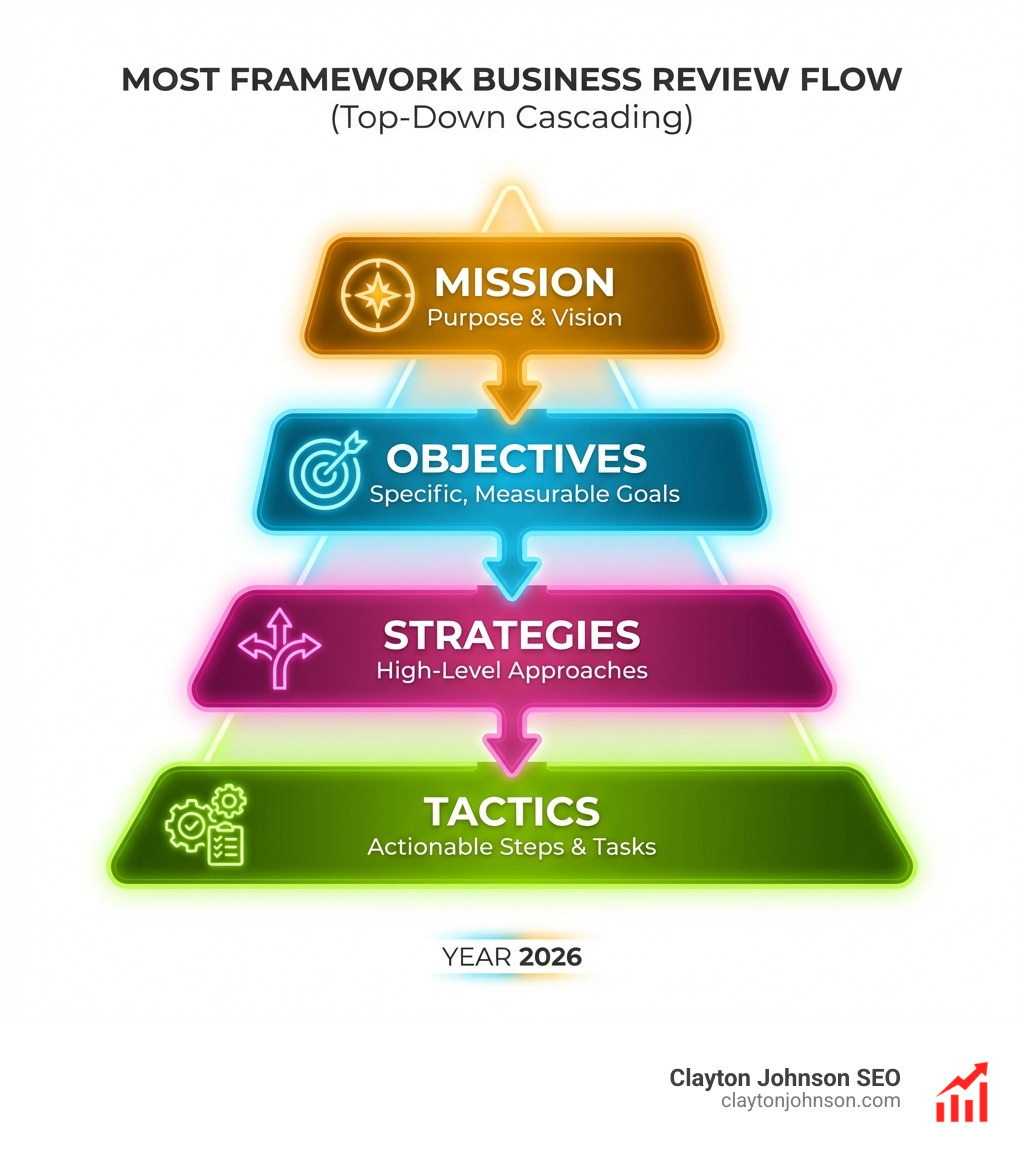
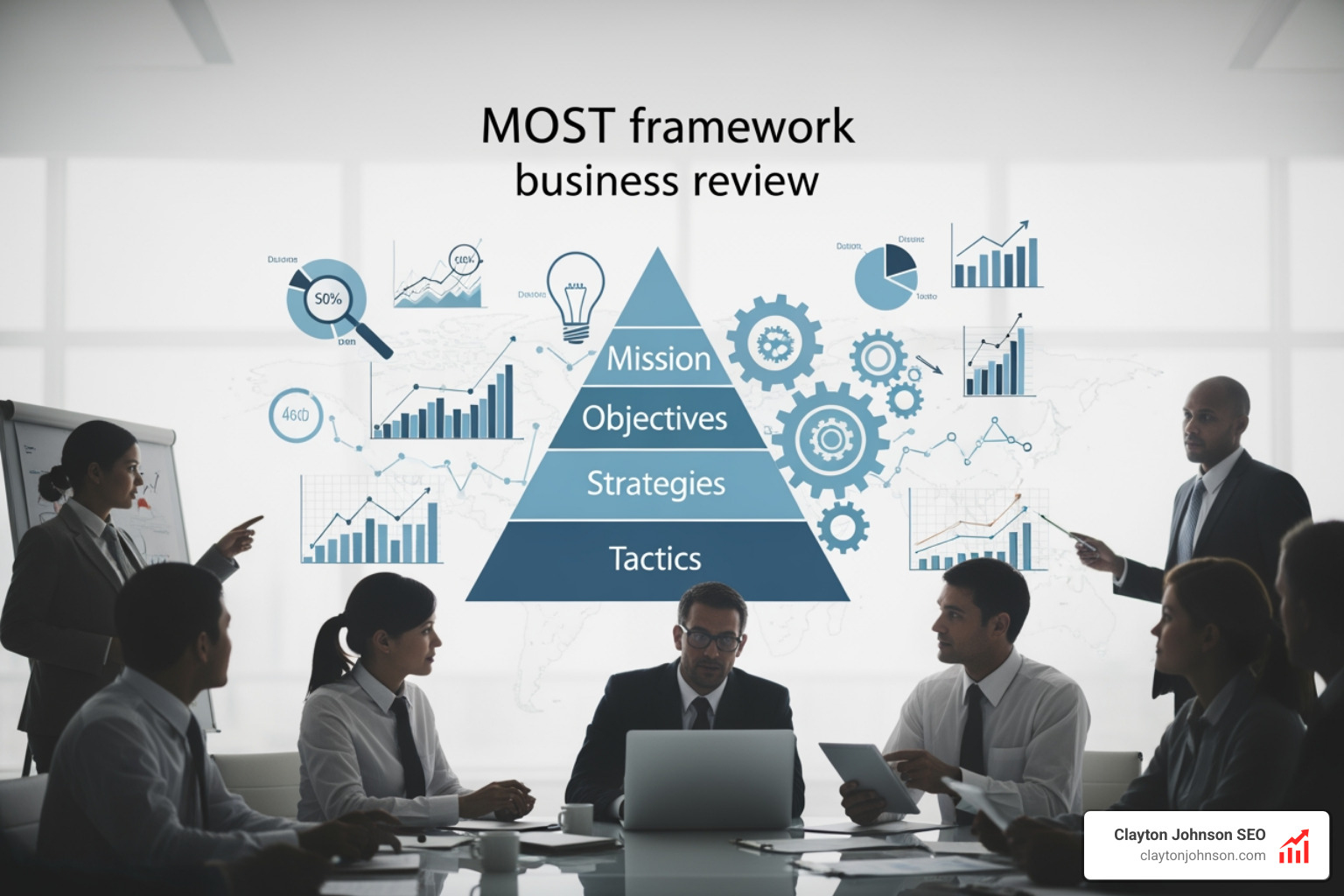
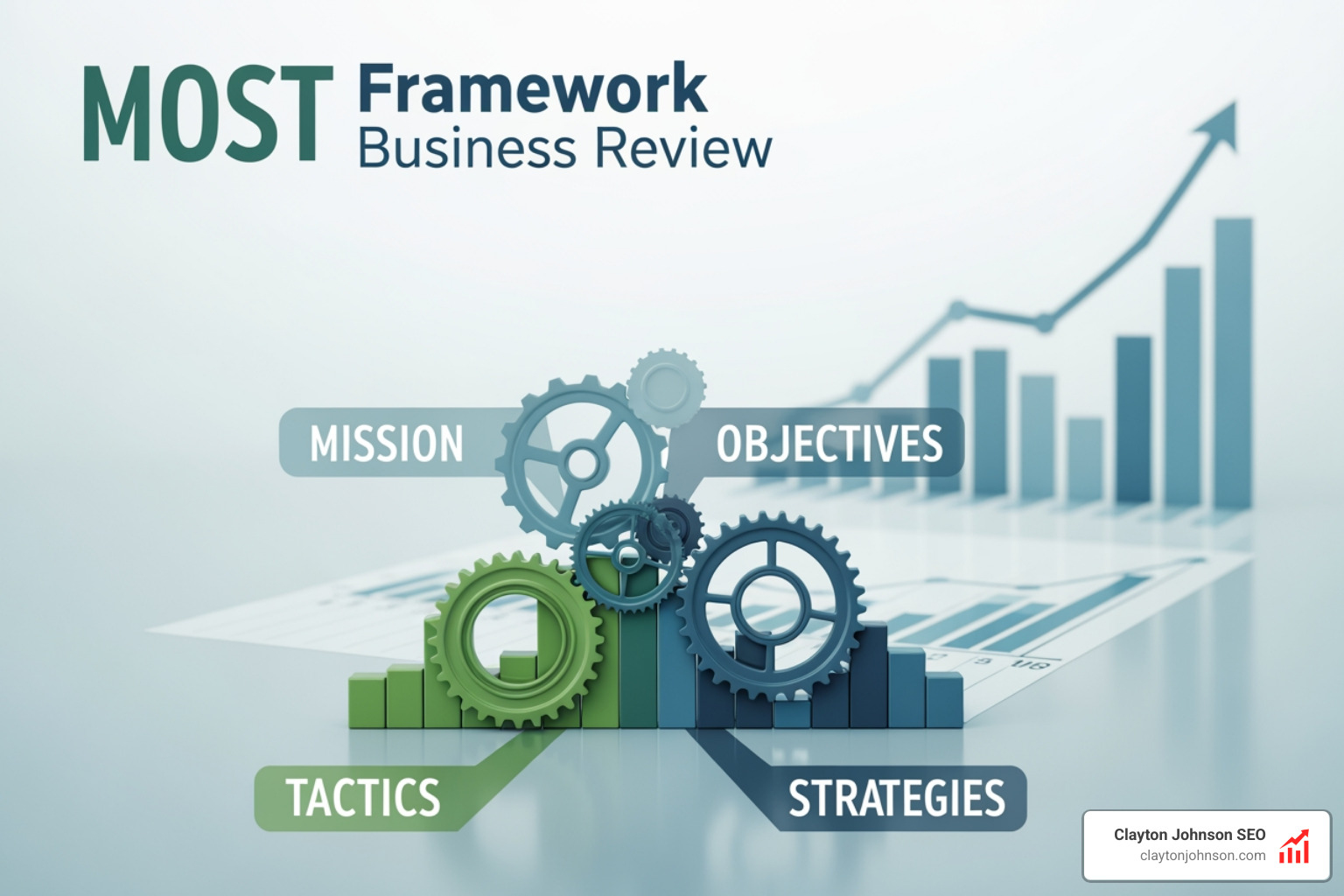
A MOST framework business review helps businesses align their mission, objectives, strategies, and tactics into a coherent plan that turns vision into measurable results. Here’s what you need to know:
MOST Framework Components:
- Mission – Your organization’s core purpose and direction
- Objectives – SMART goals that support the mission (Specific, Measurable, Achievable, Relevant, Time-bound)
- Strategy – High-level approaches to achieve objectives
- Tactics – Detailed, actionable steps for day-to-day execution
Key Benefits:
- Aligns teams around a unified vision
- Prevents strategic drift and wasted resources
- Bridges the gap between long-term goals and daily operations
- Provides a structured review process for performance evaluation
Only 1 out of 4 businesses survive their first 15 years. And 20% close within their first two years.
The numbers tell a harsh truth about business survival. But companies that implement structured frameworks like MOST create the alignment and resilience needed to beat these odds.
Most organizations struggle with the same problem: they have ambitious visions but lack the structured path to get there. Teams work on tactics that don’t connect to strategy. Objectives drift away from the core mission. Resources get scattered across initiatives that don’t drive meaningful results.
The MOST framework solves this by creating a cascading alignment from your highest-level purpose down to the specific actions your team takes every day. It’s not just theory—companies like Morning Star, a food manufacturing business with over $700 million in annual revenue, have used MOST analysis to create radical organizational structures where mission replaces traditional management hierarchy.
I’m Clayton Johnson, and I’ve spent years building strategy frameworks and growth systems that help businesses move from fragmented efforts to coherent execution. The MOST framework business review is one of the most practical tools I’ve seen for turning strategic intent into operational reality.
What is the MOST Analysis Framework?
At its heart, the MOST framework is an internal analysis tool. While tools like PESTLE look at the world around you, a MOST framework business review looks at the world inside your office walls. It’s designed to ensure that every gear in your corporate machine is turning in the same direction.
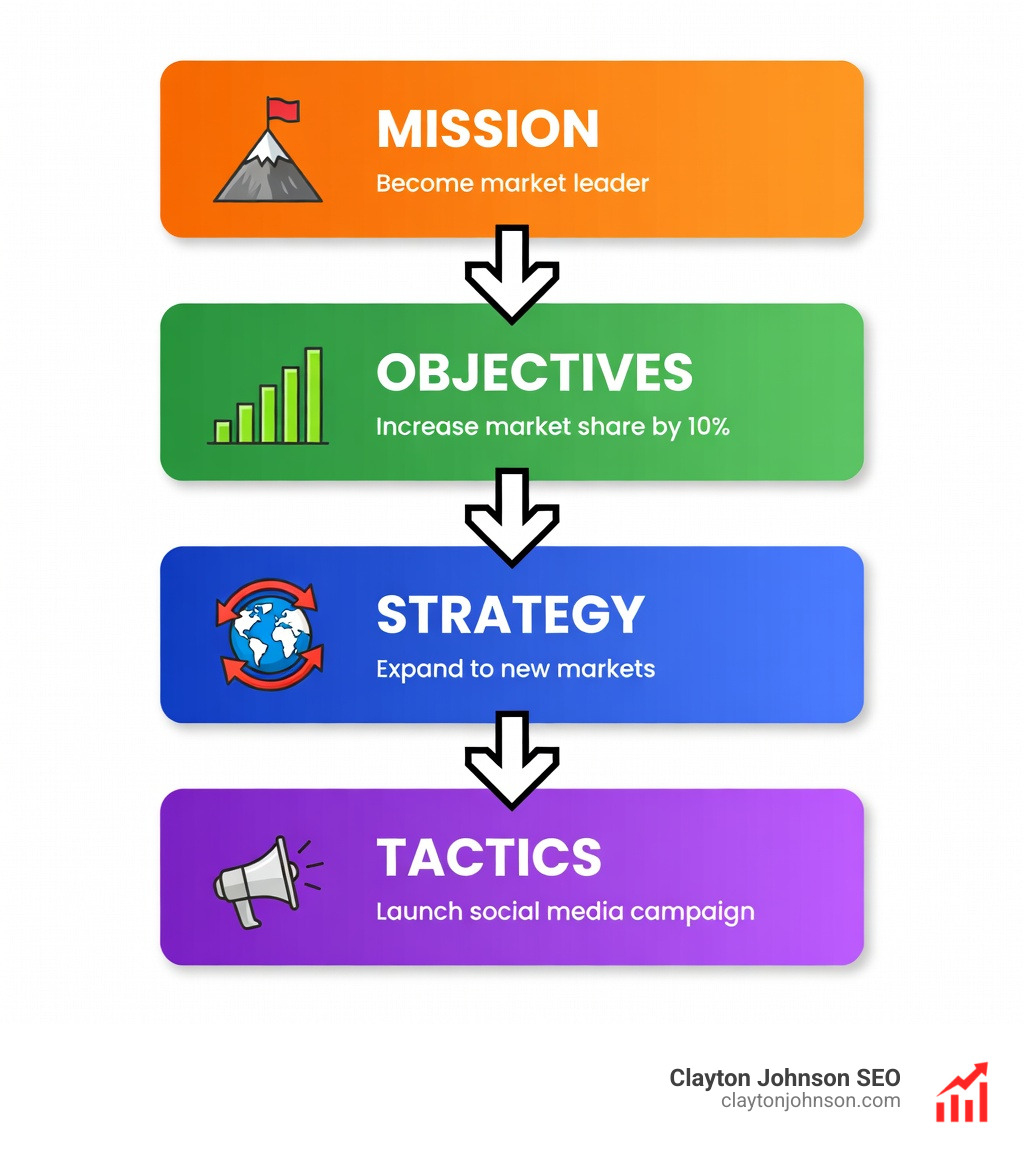
The acronym stands for:
- Mission: This is the “big picture.” It defines what your business wants to achieve and why it exists. It’s the North Star that guides every other decision.
- Objectives: These are the specific milestones you need to hit to fulfill your mission. Think of these as the “what.”
- Strategy: This is the “how.” It’s the medium-to-long-term plan of action that will move you toward your objectives.
- Tactics: These are the “who, when, and where.” They are the short-term, daily activities that implement your strategy.
Why do we love it? Because it forces operational alignment. Without this alignment, a business is just a group of people doing things, hoping for the best. With it, every tactic is justified by a strategy, which is fueled by an objective, which is anchored by a mission.
According to MOST Analysis – Business Tool for Strategic Direction, this framework is extremely powerful because it empowers businesses with a new sense of capability and purpose. It takes that dusty mission statement on the wall and turns it into a living, breathing roadmap.
Conducting a MOST Framework Business Review Step-by-Step
Performing a MOST framework business review isn’t a one-and-done task; it’s a process of refinement. Here is how we recommend walking through it to ensure your business stays on track.
1. Defining the Mission
Start by asking: “Why are we here?” Your mission should be ambitious but relatable. If you’re a coffee shop in Minneapolis, don’t just say “to sell coffee.” Say “to provide the most welcoming community space for local creators in the Twin Cities.” A specific mission makes it easier for employees and customers to buy in.
2. Establishing Objectives
Once the mission is set, you need markers of success. If your mission is to be the top community space, an objective might be “to host four community events per month with at least 50 attendees each.” We’ll dive deeper into making these “SMART” in the next section.
3. Formulating Strategies
Strategy is the bridge. If your objective is to host events, your strategy might be “to partner with local Minneapolis influencers and non-profits to co-host workshops.” Strategy is about making choices on where to play and how to win. You can learn more about this in this Free E-Book: How to Formulate a Successful Business Strategy.
4. Planning Tactics
Now, get into the weeds. Tactics are the items on your Trello board. “Email the local pottery guild about a Tuesday workshop,” or “Post an Instagram Reel promoting the open mic night.” Tactics are the boots-on-the-ground work.
5. Review and Adjust
This is the most critical step. A strategy that worked last quarter might not work today. Regular reviews help you see where the chain is breaking. Are your tactics failing to meet objectives? Or is your strategy fundamentally flawed? Using execution roadmaps can help visualize this progress.
Setting SMART Objectives in a MOST Framework Business Review
We’ve all seen businesses set goals like “get more customers.” That’s not an objective; that’s a wish. For a MOST framework business review to be effective, your objectives must be SMART.
- Specific: Don’t be vague. Instead of “grow sales,” use “increase revenue from our SEO services.”
- Measurable: You need a number. “Increase revenue by 15%.”
- Achievable: Be realistic. If you’re a startup, aiming for $100M in month two is probably a recipe for burnout.
- Relevant: Does this goal actually support your mission?
- Time-bound: Set a deadline. “By the end of Q4.”
Using this Guide to SMART goals ensures that your team knows exactly what success looks like. When everyone is clear on the “what,” it makes business model visualization much more effective.
Developing Strategies and Tactics for Growth
Developing strategies and tactics is where the rubber meets the road. Strategy is about resource allocation—deciding where to spend your time and money to get the biggest bang for your buck.
In the 1970s, BCG grew from 62 consultants to 277 consultants by focusing on structured growth frameworks. They understood that scaling requires more than just “working harder”; it requires a system.
When we look at frameworks for business innovation, we see that the most successful companies are those that can break a high-level strategy into tiny, actionable tactics. If your strategy is “market penetration via price reduction,” your tactics might include “negotiating 10% lower rates with suppliers” and “launching a ‘Price Match’ marketing campaign.”
MOST Analysis vs. SWOT, PESTLE, and Balanced Scorecard
It’s easy to get lost in the “alphabet soup” of business frameworks. How does MOST fit in with the others?
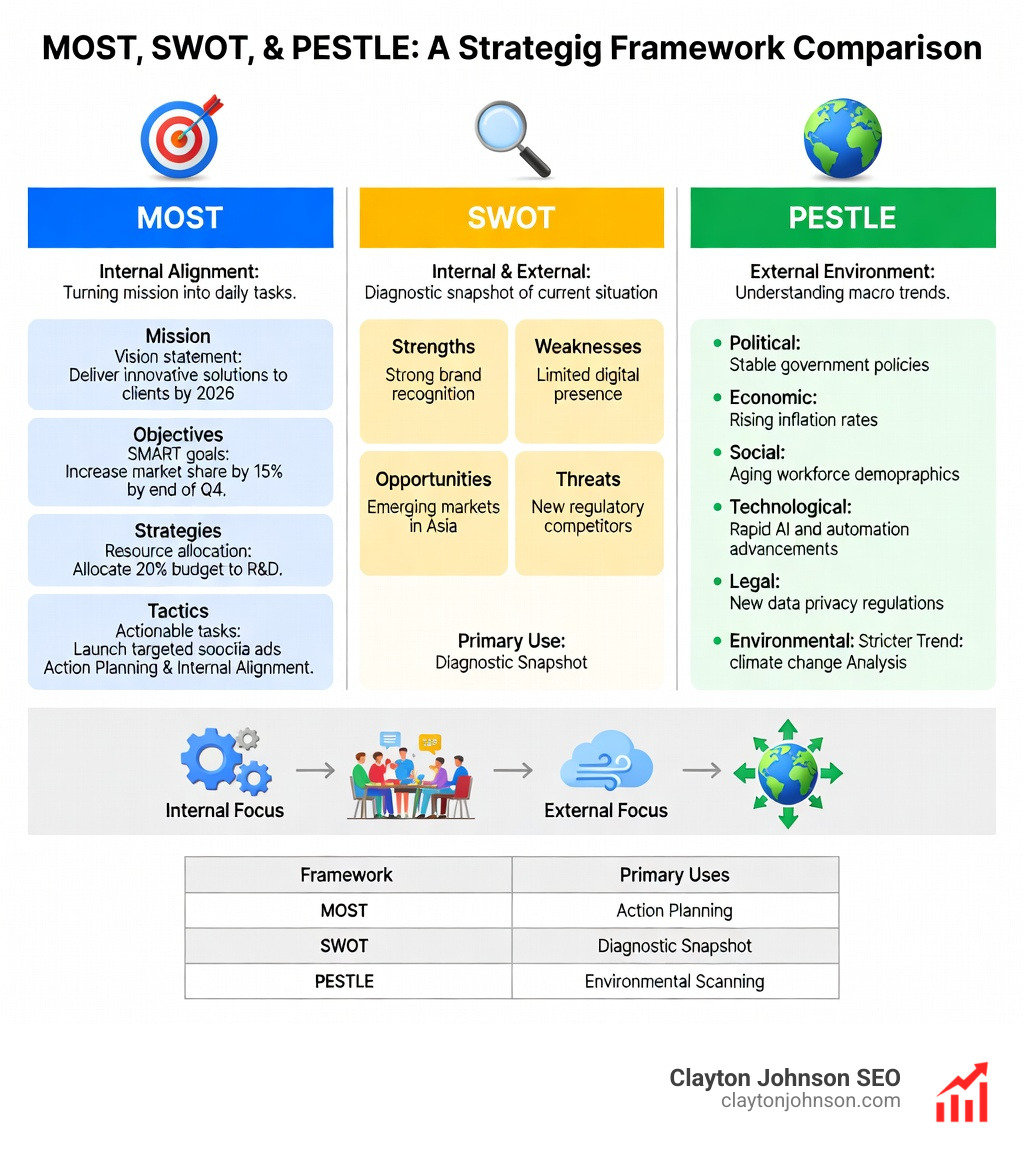
| Framework | Focus | Best For… |
|---|---|---|
| MOST | Internal Alignment | Turning a mission into daily tasks. |
| SWOT | Internal & External | Diagnostic “snapshot” of the current situation. |
| PESTLE | External Environment | Understanding macro trends (Political, Economic, etc.). |
| Balanced Scorecard | Measurement | Tracking performance across four perspectives. |
MOST is unique because it is inherently actionable. While a SWOT analysis might tell you that “poor social media presence” is a weakness, the MOST framework business review provides the structure to fix it.
You can even combine them! Use SWOT to identify your strengths, then use the MOST framework to build a plan that leverages those strengths to achieve your mission. For more on this, check out our guide on BMC and SWOT integration.
Integrating MOST with Other Strategic Tools
To get a truly holistic view of your business, you shouldn’t rely on just one tool. We often use PESTLE to scan the horizon for threats (like new regulations in Minnesota) and then use MOST to align our internal response.
One of our favorite ways to structure the “Mission” and “Objective” parts of MOST is using the Minto Pyramid Principle. Barbara Minto, an expert in structured thinking, developed this method to ensure that ideas are logically grouped and supported. According to Barbara Minto and MECE logic, your thinking should be “Mutually Exclusive and Collectively Exhaustive” (MECE).
Applying MECE to your MOST analysis ensures that your objectives don’t overlap and that you haven’t missed any critical steps in your customer discovery process.
Real-World Success: The Morning Star Case Study
One of the most famous examples of the MOST framework business review in action is the Morning Star company. They are a massive food manufacturing business that generates over $700 million in annual revenue.
What makes them special? They have a “manager-free” hierarchy. Instead of bosses telling people what to do, they use mission-driven alignment. Every employee writes their own “Personal Mission Statement” that aligns with the company’s overall mission.
At Morning Star, the mission is the boss. Employees self-implement their own objectives, strategies, and tactics based on that mission. This radical level of autonomy is only possible because they have a crystal-clear MOST structure. As Robert Simons writes in the Harvard Business Review, “If you get the settings right, you can design a job in which a talented individual can successfully execute your company’s strategy.”
Benefits and Pitfalls of the MOST Framework Business Review
Like any tool, the MOST framework is only as good as the person using it.
The Benefits:
- Conflict Avoidance: When everyone agrees on the mission and strategy, there are fewer arguments about tactics.
- Career Planning: It’s not just for businesses! You can use MOST for your own career to ensure your daily work is moving you toward your long-term goals.
- Clarity: It removes the “autopilot” mode that many businesses fall into.
Common Pitfalls:
- Vague Missions: “To be the best” means nothing. Be specific.
- Unrealistic Goals: Setting objectives that your team can’t possibly hit will kill morale.
- Lack of Review: The world changes fast. If you don’t perform a regular MOST framework business review, your tactics will quickly become irrelevant.
- Skipping Strategy: Many businesses go straight from “Objective” to “Tactics.” This is a mistake. Without a strategy, your tactics are just a series of disconnected experiments.
To stay ahead of these pitfalls, many modern organizations are leaning into digital innovation to track their progress in real-time.

Frequently Asked Questions about MOST Analysis
How often should a business perform a MOST framework business review?
We recommend a deep dive once a year during annual planning, with “pulse checks” every quarter. Market volatility means you might need to adjust your tactics or even your strategy more frequently than you think. Success isn’t just about hitting a number; it’s about staying aligned with your mission.
Can small businesses use the MOST framework?
Absolutely. In fact, small businesses often benefit the most from it because they have limited resources. You can’t afford to waste time on tactics that don’t drive your strategy. It’s a great way to ensure scalability from day one. You can even use a tech startup template for growth to get started.
What tools help track MOST analysis?
You don’t need fancy software to start—a whiteboard or a simple spreadsheet will do. However, for ongoing tracking, we love tools like:
- Trello/Asana: Great for managing the “Tactics” level.
- Lucidchart/Microsoft Visio: Perfect for visualizing the hierarchy.
- Strategy Software: Specialized tools like ClearPoint Strategy can help automate the data collection for your objectives.
Conclusion
The MOST framework business review is more than just an academic exercise. It’s a survival tool. When 80% of businesses fail in their first two years, having a structured way to align your daily actions with your long-term vision is the difference between thriving and just surviving.
At Clayton Johnson SEO, we focus on building these types of growth systems. Whether it’s through SEO content marketing services or interactive strategy tools, our goal is to help you move from “autopilot” to “intentional.”
By mastering your Mission, Objectives, Strategy, and Tactics, you aren’t just running a business—you’re building a legacy. Ready to align your team and scale your growth? Let’s get to work.