Why AI Marketing Tools Are Changing Business Strategy in 2026
AI marketing tools are software platforms that use artificial intelligence—including generative AI, machine learning, and predictive analytics—to automate, optimize, and scale marketing activities across content creation, customer insights, advertising, email, social media, and analytics.
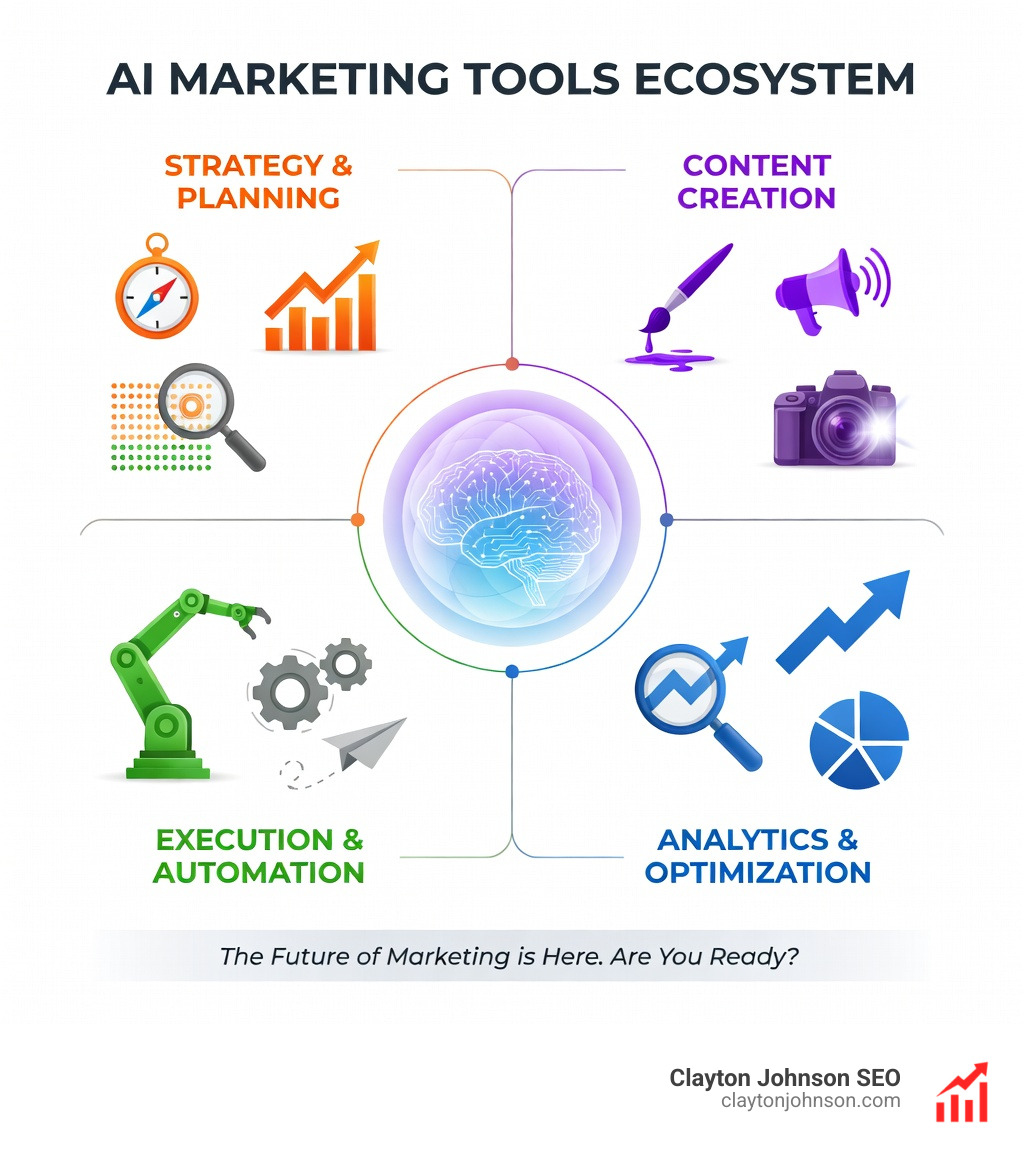
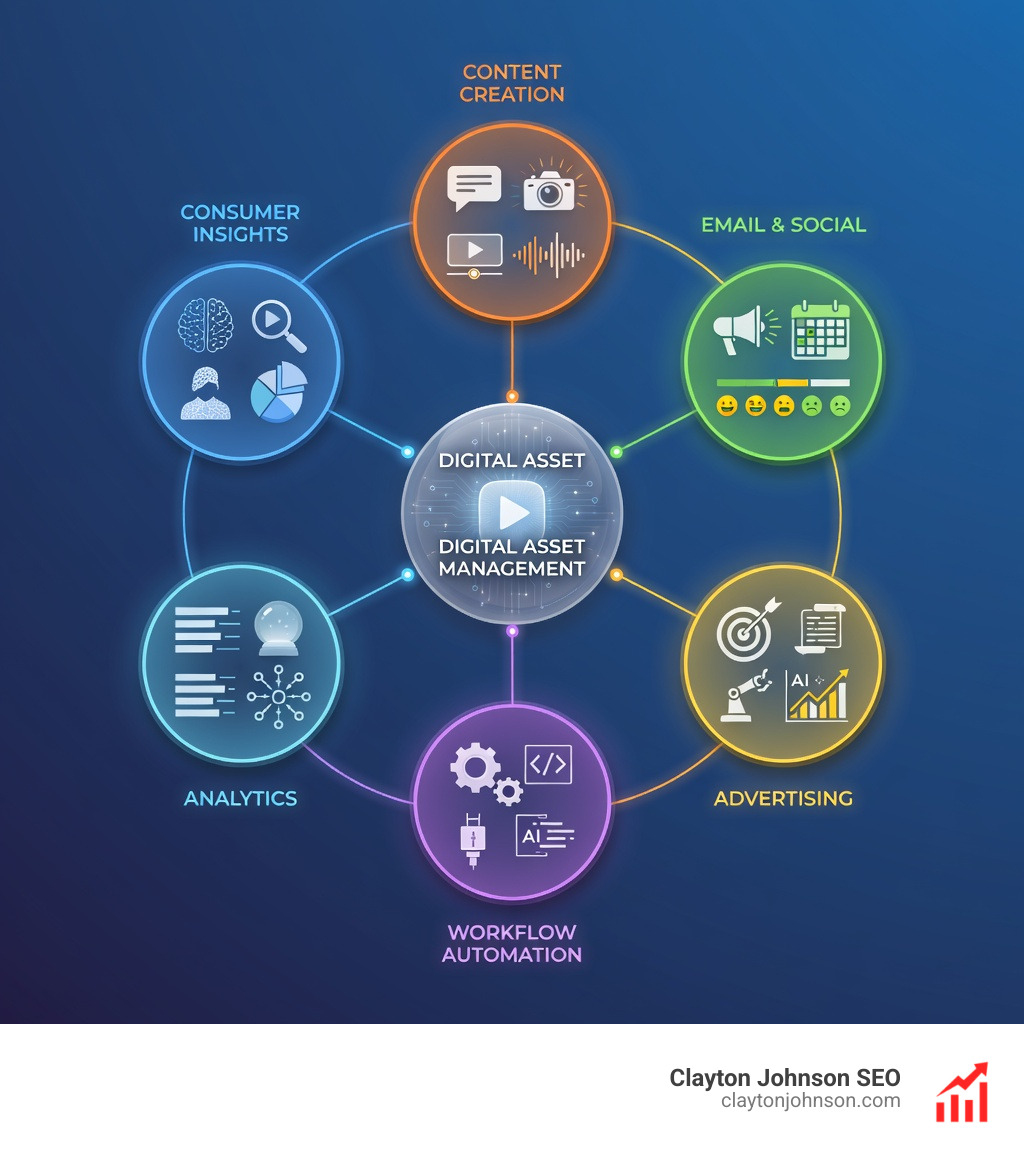
Here are the top AI marketing tools by category:
- Consumer Insights: Agent Spark, Adobe Experience Platform, Salesforce Customer 360
- Content Creation: Jasper AI, ChatGPT, Canva, Lumen5, Adobe Firefly
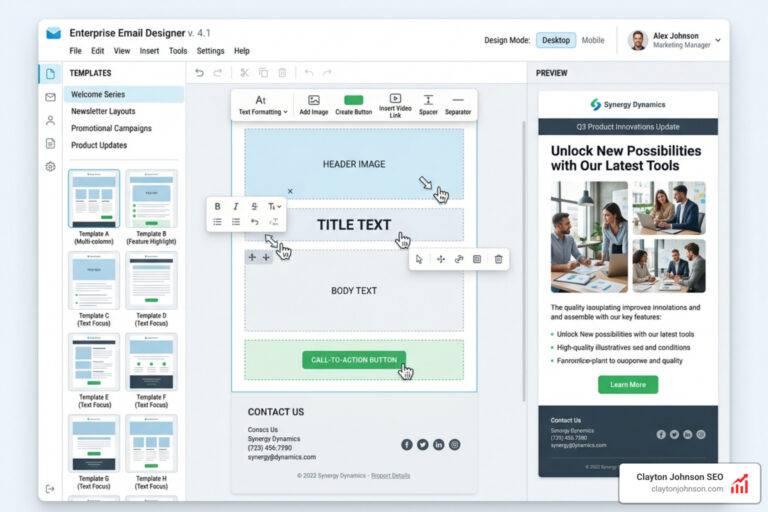
- Email Marketing: ActiveCampaign, Klaviyo, Blueshift
- Social Media: Hootsuite, Brandwatch, BuzzSumo, Buffer
- Advertising: The Trade Desk, HubSpot, Albert.ai, Meta Advantage+
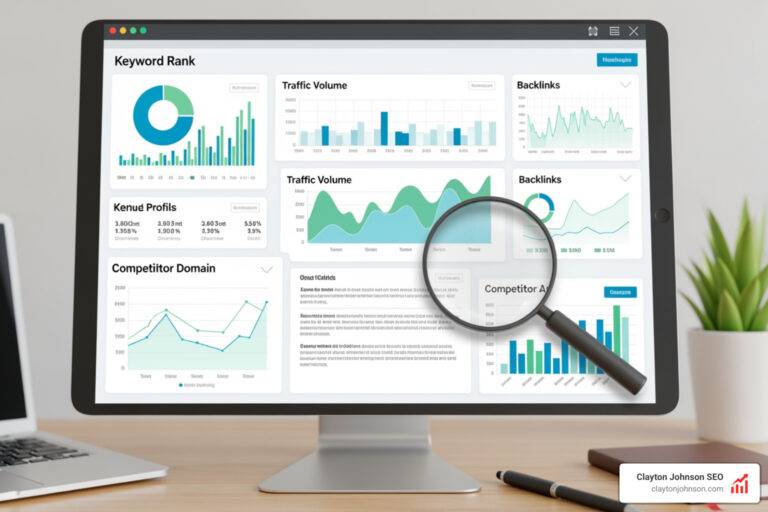
- Analytics: DataRobot, Tableau, Triple Whale, Improvado
- Workflow Automation: Zapier, Gumloop, Make
The marketing landscape has changed dramatically. 74% of marketers now use AI in their roles, up from just 21% in 2023. This isn’t hype—it’s operational reality.
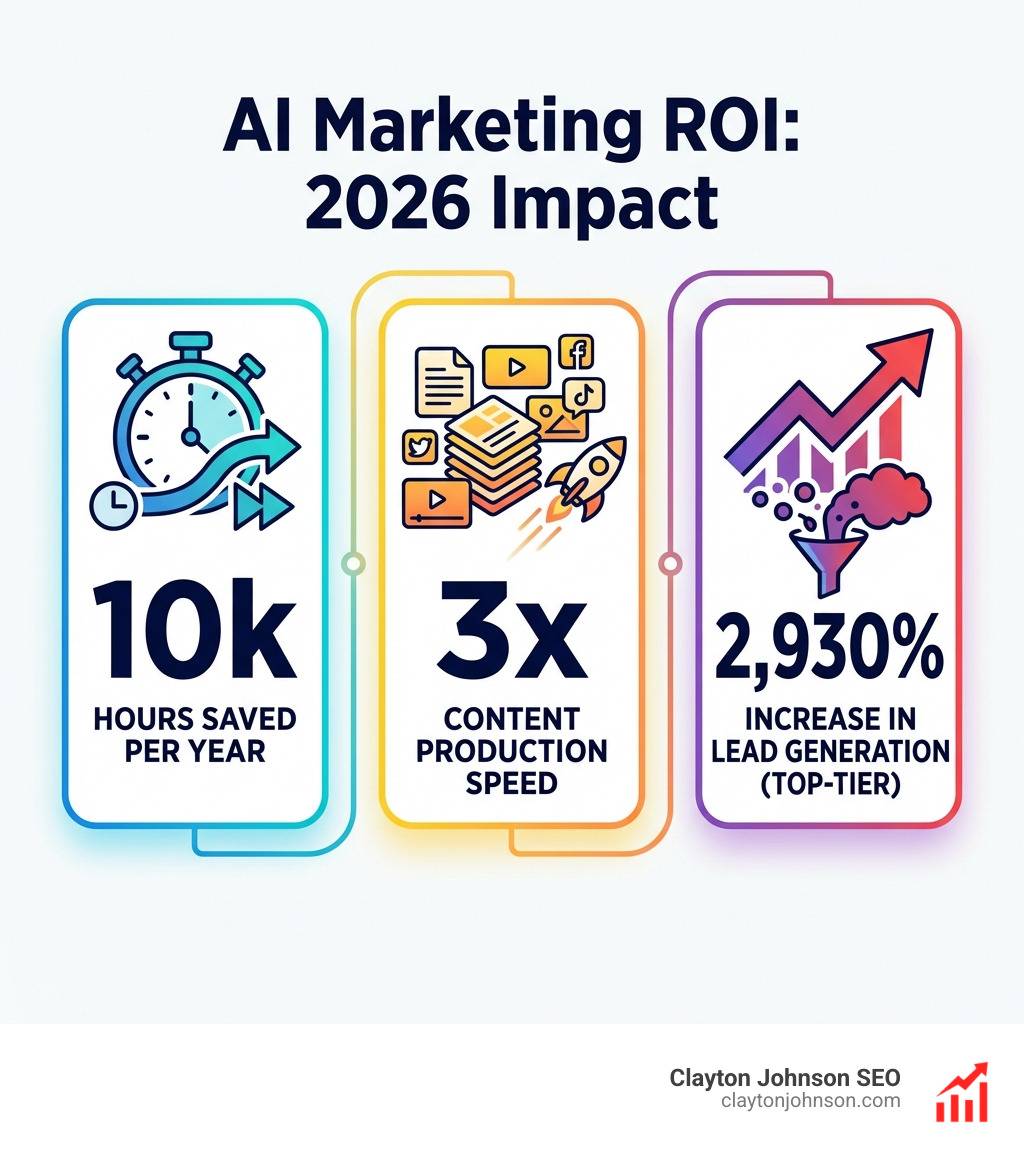
AI tools are delivering measurable results. Companies like Cushman & Wakefield save 10,000+ hours annually using AI-powered content platforms. Adidas automated 60% of its SEO processes. One brand generated 7,500 product descriptions in 24 hours.
But the ecosystem is complex. With over 14,000 martech products and thousands of AI-specific solutions, choosing the right tools is harder than ever.
The real challenge isn’t adopting AI—it’s scaling it effectively across teams, channels, and workflows while maintaining brand consistency and strategic alignment.
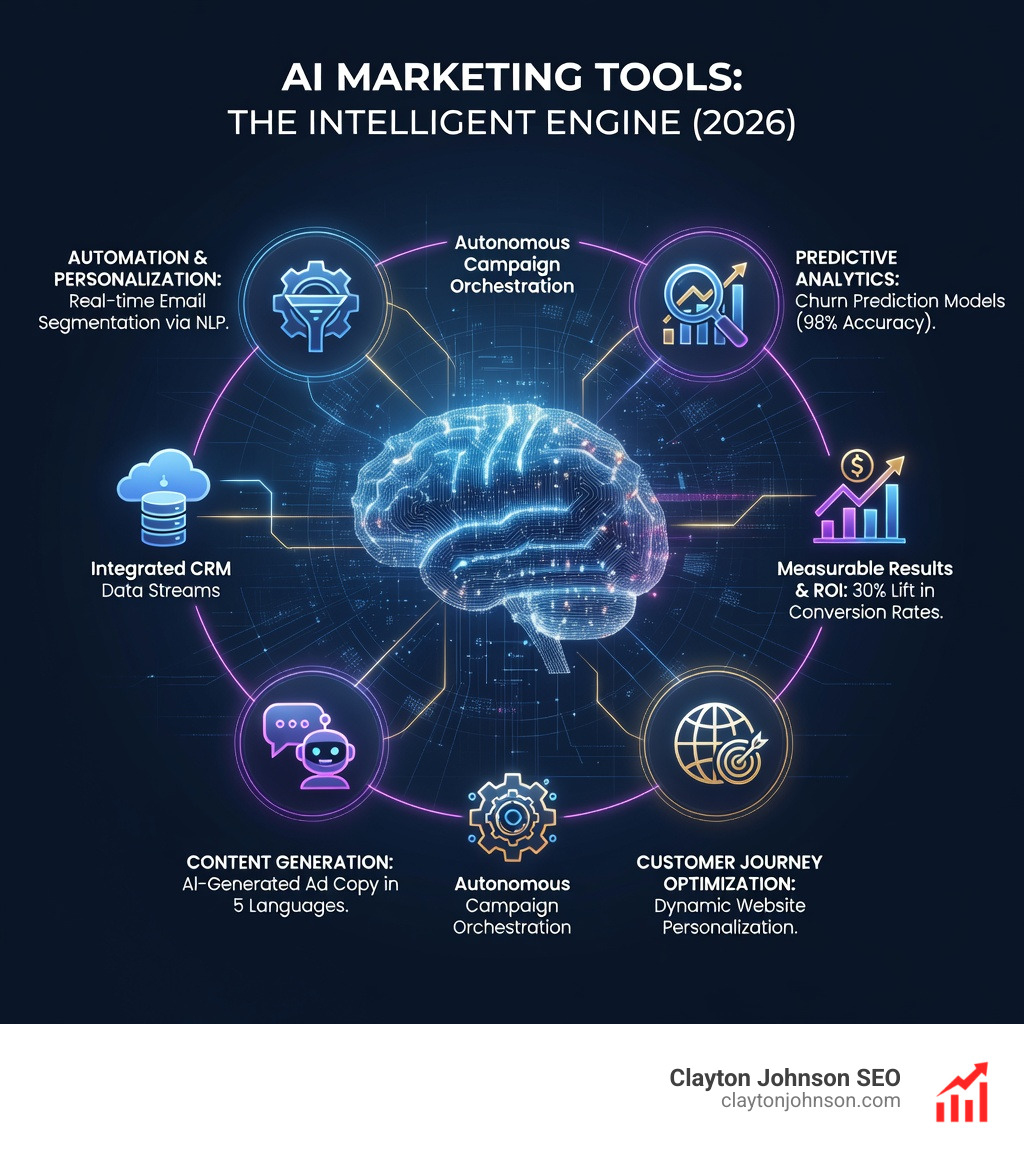
Modern AI marketing tools span the full funnel. They analyze consumer behavior in real time. They generate content that matches your brand voice. They personalize email send times for individual subscribers. They optimize ad budgets autonomously. They unify data from dozens of sources into actionable dashboards.
The best implementations don’t treat AI as a standalone tactic. They integrate it into a unified marketing system—where insights flow into strategy, strategy informs content, content feeds campaigns, and campaigns generate data that refines the cycle.
This guide breaks down the AI marketing landscape into practical categories. You’ll see which tools solve which problems, how leading teams deploy them, and what factors matter when building your stack.
I’m Clayton Johnson, an SEO and growth strategist who builds scalable marketing systems using AI marketing tools, structured frameworks, and data-driven workflows. I’ve helped companies across industries implement AI-augmented strategies that turn fragmented efforts into compounding growth engines.
The Evolution of Generative AI and Predictive Analytics
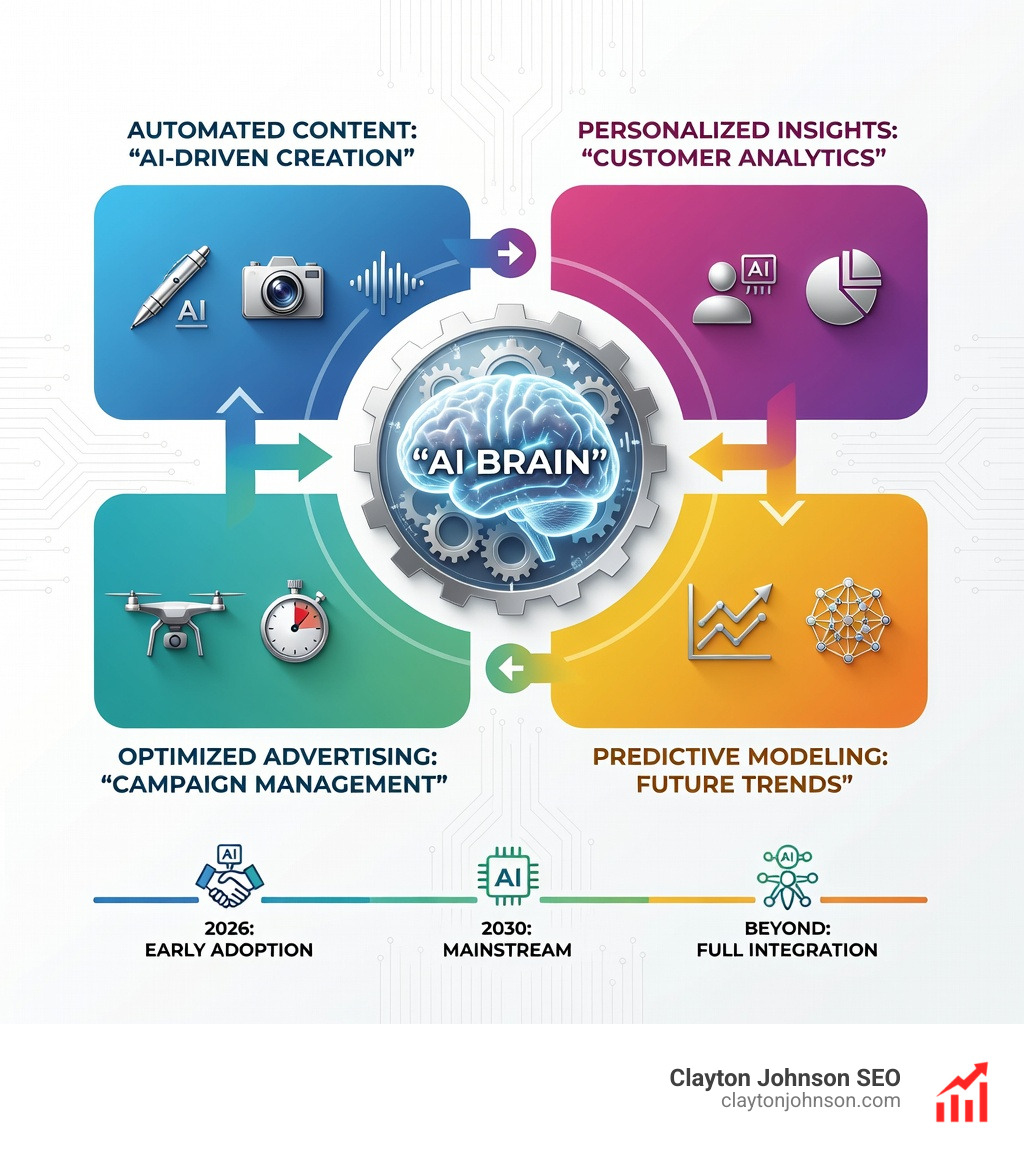
The transition from simple automation to the sophisticated AI we use today has been a quantum leap. In the early days, “AI” in marketing usually meant basic rule-based triggers—if a user clicks X, send email Y. By 2026, we have moved into the era of Generative AI and Predictive Analytics.
Generative AI, powered by Large Language Models (LLMs), doesn’t just follow rules; it creates. Whether it’s a 2,000-word deep-dive article or a hyper-realistic product image, these tools have democratized high-quality production. Meanwhile, Machine Learning (ML) algorithms have become experts at “grounding”—connecting AI to your specific company data to avoid hallucinations and ensure accuracy.
Predictive analytics has shifted marketing from being reactive to proactive. Instead of looking at last month’s report to see what happened, we use tools to forecast what will happen. According to The State of AI in Marketing 2026 report, the focus has moved toward hyper-personalization. We can now predict which customer cohorts are at risk of churn or which leads are most likely to convert based on real-time behavioral signals.
For businesses in Minneapolis and beyond, this evolution means that “good enough” content is no longer the benchmark. To compete, you need a strategy that leverages these technologies to create meaningful, data-backed connections. If you’re looking to refine your approach, exploring our SEO & Content Marketing Services can help you integrate these advanced workflows into your growth plan.
Top AI Marketing Tools by Category
Navigating the sea of AI marketing tools requires a categorized approach. We don’t just need “AI”-we need specific solutions for specific problems. When we look at the leaders in the space, we see a trend toward “agentic” AI-tools that don’t just assist but actually execute multi-step workflows.
The impact is staggering. Jasper’s creators claim the AI has “read” 10% of the internet, allowing it to assist in achieving 3x content production speeds. In the advertising world, Harley Davidson saw a 2,930% increase in leads per month by using Albert.ai to manage their digital spend.
Comparison of AI Marketing Tool Features
| Category | Key AI Benefit | Top Tool Example |
|---|---|---|
| Content | Scale & Brand Voice | Jasper AI |
| Send-Time Optimization | ActiveCampaign | |
| Advertising | Autonomous Bidding | Albert.ai |
| Social | Sentiment Analysis | Brandwatch |
To maximize the ROI of these tools, they must be paired with expert strategy. Our Paid Advertising Services use these cutting-edge optimizations to ensure your ad spend isn’t just a cost, but a high-performing investment.
AI Marketing Tools for Consumer Insights
Before you write a single word of copy, you need to know who you’re talking to. AI has revolutionized Market Analysis by moving beyond generic demographics.
- Agent Spark: Unlike tools that rely on messy web scraping, Agent Spark uses proprietary survey data from nearly a million consumers across 50+ markets. This provides “human insights” that are grounded in actual consumer sentiment.
- Adobe Experience Platform: This is a powerhouse for consolidating B2B and B2C data. It creates a “single source of truth,” allowing you to see the entire customer journey in one place.
- Salesforce Customer 360: This platform flips the script on CRM by giving every department-sales, marketing, and IT-a unified view of the customer. It ensures that your interactions feel cohesive rather than fragmented.
Content Creation and Generative Media
Content is where most teams start their AI journey. The goal here is to move fast without losing the “human” touch that builds trust.
- Jasper AI: Designed specifically for marketing teams, Jasper is the gold standard for maintaining brand voice. With features like “Jasper IQ,” it remembers your brand’s specific facts and style guidelines, preventing the generic “AI-sounding” output.
- ChatGPT: The original breakthrough of the current AI wave. It remains a versatile tool for brainstorming, using AI to write simple scripts for data pulling, and drafting quick marketing copy.
- Canva: You don’t need a design degree anymore. Canva’s “Magic Studio” uses AI to remove backgrounds, resize posts for different platforms instantly, and even generate images from text prompts.
- Lumen5: This tool is a lifesaver for content repurposing. It can take a blog post and automatically turn it into an engaging social media video, selecting relevant clips and music along the way.
- Speechify & LOVO AI: These tools handle the audio side of the business. Speechify turns text into natural-sounding audio for on-the-go consumption, while LOVO AI provides high-quality voiceovers in over 100 languages.
- Adobe Firefly: For those worried about copyright, Firefly is trained on Adobe Stock and public domain images, making it safe for commercial use. It’s particularly good at rendering realistic human features without the distortions common in earlier models.
Email, Social Media, and Advertising Optimization
Once the content is created, it needs to be distributed and optimized. This is where automation meets intelligence.
- ActiveCampaign & Klaviyo: These platforms use AI to move beyond simple “drip” campaigns. They analyze subscriber behavior to determine the best time to send an email and which products to recommend, significantly boosting conversion rates.
- Hootsuite & Brandwatch: Social media moves too fast for manual monitoring. Brandwatch uses AI to track sentiment-are people happy or annoyed with your brand?-while Hootsuite recommends the best times to post to maximize engagement.
- The Trade Desk: A leading demand-side platform (DSP) that uses AI for real-time bidding across display, video, and mobile channels. It ensures your ads reach the right person at the price that makes sense for your budget.
For a deeper dive into how we handle these high-stakes channels, check out our Email Marketing Services.
How to Choose the Right AI Marketing Tool for Your Team
With thousands of options, it’s easy to get “shiny object syndrome.” To avoid wasting budget, we recommend a structured evaluation process.
- Goal Alignment: Are you trying to save time on production, or are you trying to increase the accuracy of your targeting?
- Integration: Does the tool play nice with your existing tech stack? A tool that creates a data silo is a liability, not an asset.
- Team Skillsets: Some tools (like DataRobot) require a steeper learning curve, while others (like Canva) are built for the average user.
- Budget: AI costs can scale quickly. Look for tools that offer clear ROI, like Jasper’s ability to achieve 3x content production.
Before selecting a tool, you must have a clear understanding of your Buyer Personas. A tool is only as good as the data and strategy you feed it. By combining Customer Segmentation & Product Insight with the right AI, you create a marketing engine that actually moves the needle.
Unifying Workflows with DAM and Automation
The biggest mistake teams make is using AI in isolation. If your design team uses one tool and your social team uses another, your brand voice will eventually fracture. This is where Digital Asset Management (DAM) and orchestration tools come in.
A DAM platform acts as the “operational backbone,” centralizing all AI-generated assets so they can be reviewed, approved, and distributed from one place. To connect these disparate tools, we use Zapier. Zapier acts as the building blocks of your tech stack, allowing you to build custom “Zaps” that move data between over 5,000 apps. For example, you can set a trigger so that when a new lead comes in from a LinkedIn ad, it’s automatically sent to your CRM and a personalized “welcome” email is drafted in Jasper.
Achieving this level of Operational Alignment is what separates the winners from the losers in 2026. We help teams build Execution Roadmaps & Operational Alignment to ensure their AI tools are working toward a unified goal.
Frequently Asked Questions about AI Marketing Tools
What are the best AI marketing tools for small businesses?
For small businesses, especially those in the Minneapolis area, budget and ease of use are key. We often recommend starting with “all-in-one” assistants and adding specialist tools only when you have clear ROI targets. (Note: Some free tools are provided by larger ad platforms; they can be helpful for generating drafts, but long-term performance still depends on strategy, testing, and clean data.) Combining lightweight AI tooling with Social Media Marketing Services allows small teams to compete with much larger organizations.
How do AI marketing tools ensure brand consistency?
Consistency is maintained through “Brand Voice” training. Tools like Jasper allow you to upload your style guide and past content examples. Its “Jasper IQ” feature ensures that every piece of content-from a tweet to a whitepaper-sounds like your brand. This is a core part of Strategic Design: ensuring that your visual and written identity remains unshakable across all channels.
Will AI replace marketing teams in 2026?
The short answer: No. The nuanced answer: AI won’t replace you, but a marketer who knows how to use AI will. We are seeing a shift toward human-AI collaboration. AI handles the heavy lifting of data analysis and first-draft generation, while humans focus on high-level strategy, creativity, and empathy. As an SEO Expert Clayton Johnson, I focus on teaching teams how to use these tools to augment their natural talents rather than replace them.
Conclusion
The era of manual, “guess-and-check” marketing is over. By 2026, AI marketing tools have become the primary engine for business growth, offering a 2,930% lead increase for those who use them correctly and a 60% automation rate for tedious SEO tasks.
However, tools alone aren’t a strategy. To truly scale, you need a partner who understands how to weave these technologies into a cohesive growth system. Whether you are looking for a complete SEO Services Minneapolis overhaul or a more efficient content production pipeline, the goal remains the same: turning strategy into content and insights into growth.
Ready to put AI agents to work for your business? Let’s build a system that delivers speed, control, and measurable impact.