Why Strategic Partnerships Are the Backbone of Your Business Model
BMC partnership strategy canvas development starts with understanding that no business succeeds alone. Whether you’re a startup seeking critical resources or an established company optimizing costs, choosing the right key partners determines how efficiently you deliver value to customers.
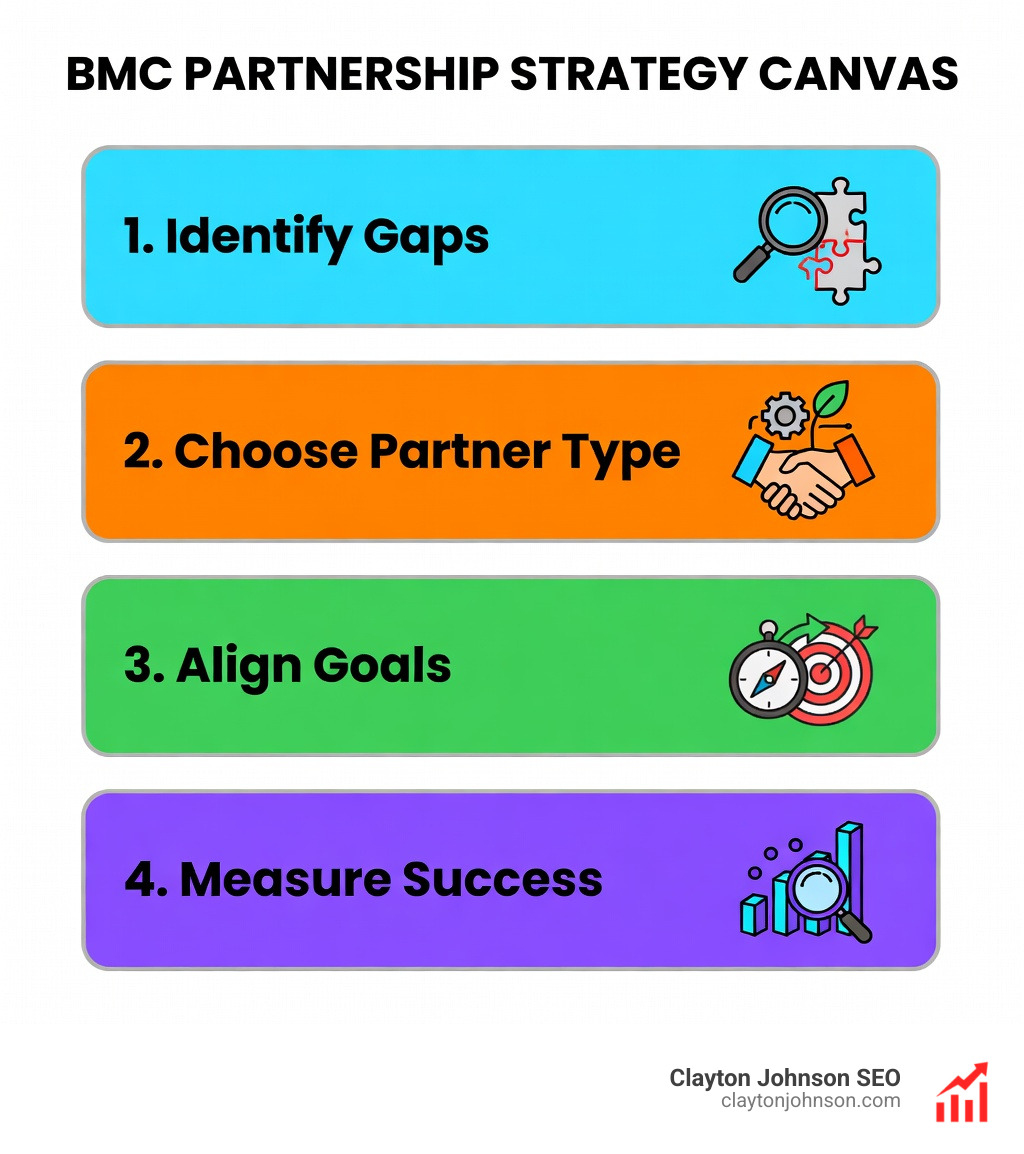
Quick answer for developing strategic partnerships using the BMC:
- Identify partnership needs – Map gaps in Key Resources, Key Activities, and Value Propositions
- Choose partnership types – Strategic alliances, co-opetition, joint ventures, or buyer-supplier relationships
- Select partners based on – Goal alignment, reliability, and complementary strengths
- Evaluate interconnections – How partners affect Cost Structure, Revenue Streams, and customer delivery
- Measure and optimize – Track performance metrics and iterate for long-term mutual benefit
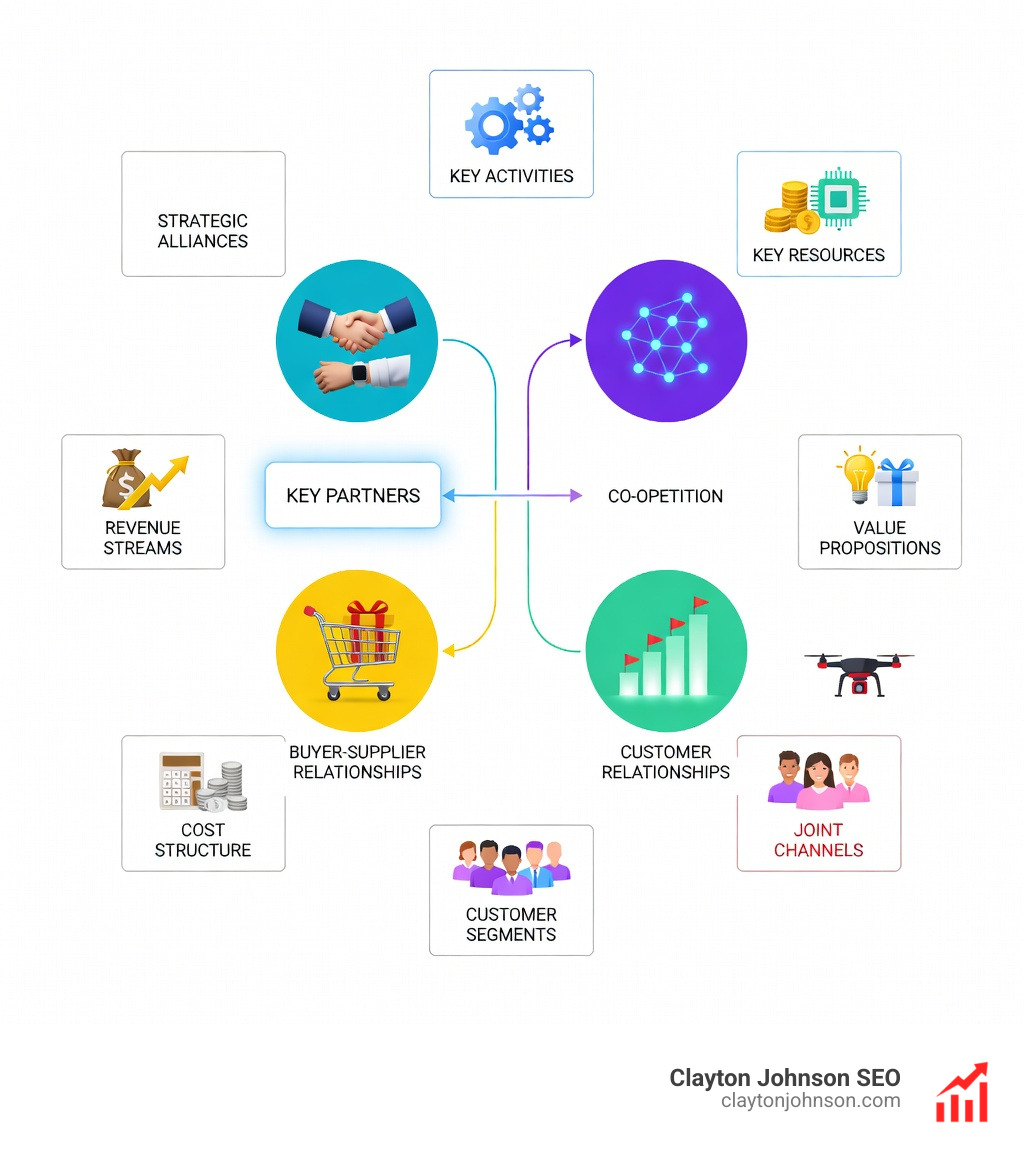
The Key Partners building block sits in the left column of the Business Model Canvas, alongside Key Activities and Key Resources. It answers one critical question: Who are the external entities that help your business model work?
These partnerships aren’t just nice-to-haves. They enable three core benefits:
- Shared resources and skills – Access expertise or assets you don’t need to build internally
- Risk reduction – Distribute uncertainty across multiple entities
- Cost efficiency – Lower operational expenses through economies of scale
Real companies prove this daily. Starbucks partnered with PepsiCo to distribute bottled beverages. Apple relies on Foxconn for manufacturing at scale. Toyota built its reputation partly on deep supplier relationships that ensure quality and reliability.
Yet most businesses struggle with partner selection. They chase partnerships that look impressive on paper but don’t align with their business model’s actual needs. The result? Misaligned goals, communication breakdowns, and partnerships that drain resources instead of multiplying them.
I’m Clayton Johnson, and I’ve spent years building SEO and growth systems that depend on strategic partnerships—from content networks to technology integrations. Throughout my work with the BMC partnership strategy canvas, I’ve seen how the right partner choices transform business models from fragile to resilient.
BMC partnership strategy canvas terms at a glance:
The Role of Key Partners in the Business Model Canvas
The Business Model Canvas (BMC), first developed by Alexander Osterwalder, is a visual framework that allows us to Map our entire business infrastructure on a single page. Within this framework, the “Key Partners” block represents the network of suppliers and partners that make the business model work.
When you Download The Business Model Canvas, you’ll notice that Key Partners are positioned on the “Efficiency” side of the canvas. This is because partnerships are primarily about optimization. Most businesses aren’t “lone wolves”; they rely on external entities to perform specific activities or provide certain resources that the company doesn’t possess or doesn’t want to manage internally.
Why We Seek Partners
We don’t just partner for the sake of collaboration. In a professional BMC partnership strategy canvas, we look for three specific outcomes:
- Optimization and Economy of Scale: It is often illogical for a company to own all resources or perform every activity. Partnerships allow us to reduce costs by outsourcing infrastructure or sharing it with others.
- Reduction of Risk and Uncertainty: In competitive or volatile markets, partnerships can help reduce risk. For example, several electronics companies might form an alliance to develop a new technology standard, sharing the burden of potential failure.
- Acquisition of Particular Resources and Activities: A company might rely on another firm to provide a specific license, reach a customer segment, or perform a technical task. This allows us to focus on our core competencies while leveraging the “shared skills” of our partners.
Types of Partnerships in the BMC Partnership Strategy Canvas
To Explore the full potential of your business model, you must understand the different flavors of partnerships. Not every partner relationship is a deep, equity-sharing marriage; some are simple transactions, while others are complex strategic maneuvers.
| Partnership Type | Definition | Primary Goal |
|---|---|---|
| Strategic Alliances | Agreements between non-competitors. | Resource sharing and market expansion. |
| Co-opetition | Strategic partnerships between competitors. | Developing industry standards or sharing infrastructure costs. |
| Joint Ventures | Two or more parties creating a new, separate entity. | Developing a new business or entering a new market. |
| Buyer-Supplier | Standard relationship with reliable vendors. | Ensuring a stable supply of materials or services. |
1. Strategic Alliances
These occur between companies that don’t directly compete. Think of a software company partnering with a hardware manufacturer. They both benefit from the other’s product without stealing each other’s customers.
2. Co-opetition
This is a more nuanced strategy where we collaborate with our rivals. Why? Perhaps to lobby for favorable regulations or to share the massive costs of R&D. It’s the “rising tide lifts all boats” approach.
3. Joint Ventures
When two companies see a massive opportunity that neither can tackle alone, they might form a third, independent company. This allows for focused investment and shared risk in a specific niche.
4. Buyer-Supplier Relationships
The most common type. These are essential for ensuring that your “Key Resources” are always available. Building long-term, trust-based relationships here is better than constantly hunting for the lowest price, as it ensures stability.
Identifying Candidates for Your BMC Partnership Strategy Canvas
When you begin to Analyze potential candidates, you should look for three pillars:
- Complementary Strengths: Do they have what we lack? (e.g., we have the tech, they have the distribution).
- Reliability: Can they deliver on time and at the right quality?
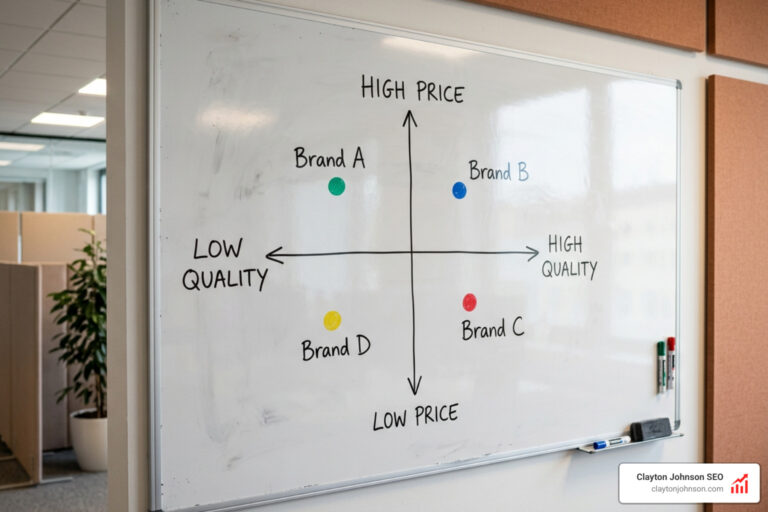
- Goal Alignment: Does their long-term vision match ours? If we want to be a premium brand and they are focused on “race-to-the-bottom” pricing, the partnership will eventually fracture.
A Strategic Guide to Selecting and Interconnecting Key Partners
Choosing a partner is only half the battle. The real magic happens when you Assess how that partner fits into the rest of your canvas. A BMC partnership strategy canvas isn’t a set of isolated boxes; it’s a living ecosystem.

Step 1: Identify Resource Gaps
Look at your Key Resources and Key Activities. Which ones are you currently doing that aren’t your “superpower”? If you are a world-class design firm, why are you spending half your time managing a server farm? That’s a gap that a partner should fill.
Step 2: Align with the Value Proposition
Every partner should somehow enhance the value you deliver to the customer. If a partner provides faster shipping, they are strengthening your Value Proposition of “speed.” If they provide high-quality raw materials, they are supporting your “quality” claim.
Step 3: Map the Financial Impact
Partnerships directly affect your Cost Structure and Revenue Streams.
- Costs: Does the partner help you switch from a “fixed cost” (like owning a factory) to a “variable cost” (paying per unit produced)? This is often a smart move for Operational Alignment.
- Revenue: Can a partner open up new Channels? For example, a partnership with a major retailer might allow you to reach a customer segment you could never access via your website alone.
Step 4: Choose the Right Fit
Once you’ve mapped the needs, you must Choose based on more than just a brochure. Use a “Partnership Strategy Canvas” approach to vet them:
- Mutual Benefit: What do they get out of it? If it’s one-sided, it won’t last.
- Communication: How will you talk? Silos kill partnerships.
- Legal and IP: Who owns what? Clarify these expectations early to avoid messiness later.
Evaluating the Success of Your BMC Partnership Strategy Canvas
Don’t set it and forget it. We recommend using specific performance metrics to optimize your network:
- Lead Time: How fast do they deliver?
- Quality Score: What percentage of their output meets your standards?
- Innovation Contribution: How many new ideas or improvements have they suggested?
- Trust Index: (Qualitative) Do you feel comfortable sharing sensitive data with them?
Real-World Success Stories and Case Studies
Looking at how giants use the BMC partnership strategy canvas provides a Guide for our own strategies.
Starbucks and PepsiCo: The Power of Distribution
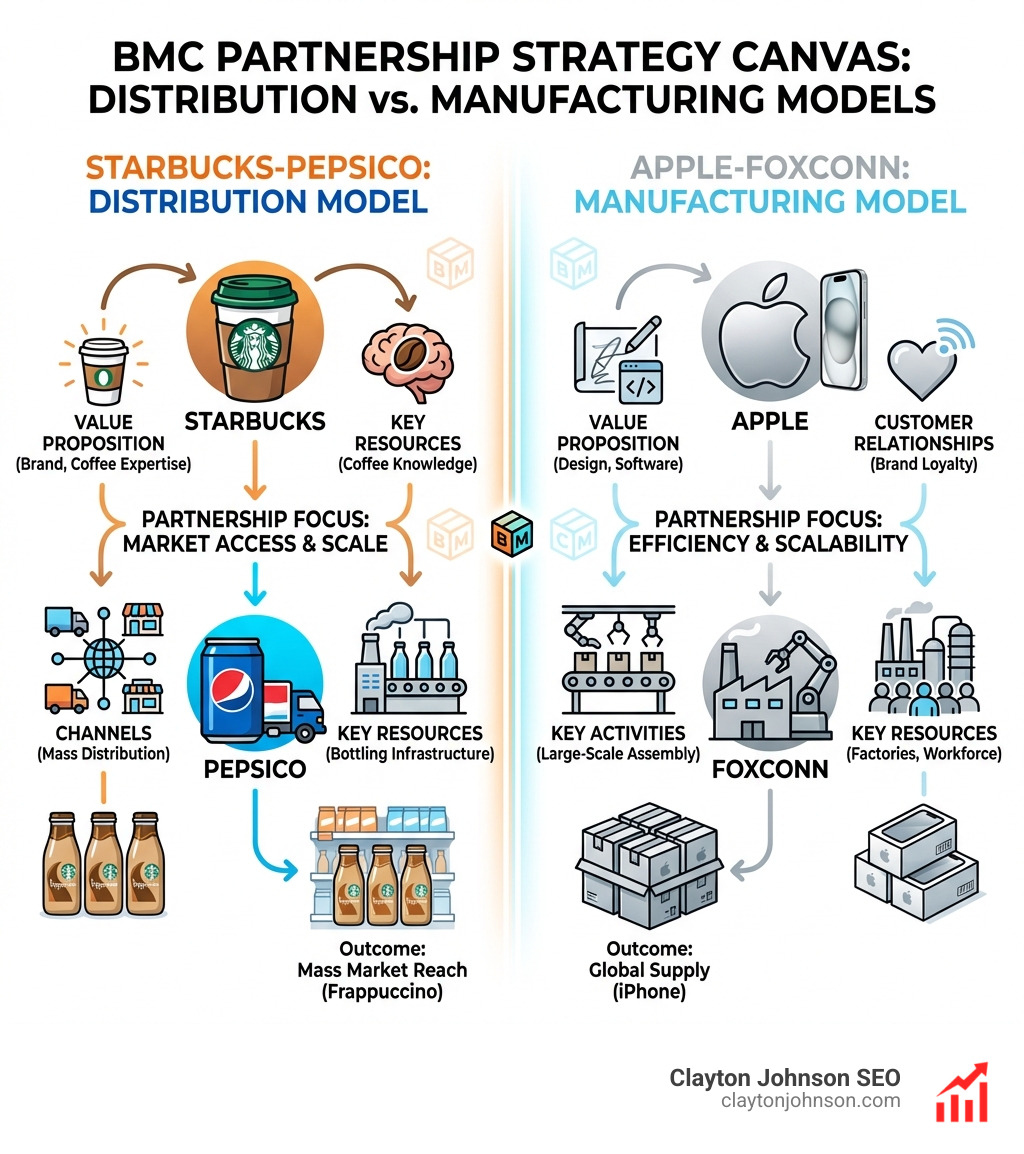
In 1994, Starbucks and PepsiCo formed a strategic partnership to create the North American Coffee Partnership. Starbucks had the brand and the coffee expertise; PepsiCo had the massive distribution network and bottling infrastructure. This allowed Starbucks to put Frappuccinos in every grocery store in America—something they couldn’t have done alone without massive capital investment.
Apple and Foxconn: Strategic Outsourcing
Apple partnered with Foxconn to handle the heavy lifting of electronics manufacturing. This collaboration is a classic BMC move: Apple focuses on its core strengths (design, marketing, software) while Foxconn provides the Key Resources (factories, workforce) and Key Activities (large-scale assembly). This reduces Apple’s capital risk while ensuring they can meet global demand.
Sony-Ericsson: A Joint Venture for Innovation
Back in the early 2000s, Sony and Ericsson joined forces to create mobile phones. Sony brought consumer electronics expertise, and Ericsson brought telecommunications technology. By forming a Joint Venture, they pooled resources to compete in a rapidly evolving market that neither could dominate alone.
Toyota: Deep Supplier Integration
Toyota is famous for its “Keiretsu” style relationships. They don’t just buy parts; they work with suppliers to improve their manufacturing processes. This deep integration ensures that Toyota’s Key Resources are of the highest quality, directly supporting their Value Proposition of reliability. When you Compare this to companies that constantly switch suppliers for the lowest price, Toyota’s long-term stability clearly wins out.
Managing Challenges and Optimizing for Long-Term Growth
Even the best-laid plans on a BMC partnership strategy canvas can hit snags. You must be prepared to Diagnose friction before it becomes a failure.
Common Pitfalls
- Communication Barriers: If your teams aren’t talking to their teams, assumptions will lead to errors. Establish a regular “sync” cadence.
- The “Lone Wolf” Mentality: Some founders struggle to let go. Investors want to see a partner network because it proves you aren’t a single point of failure.
- Over-Complexity: Don’t fill your canvas with 50 “partners” who are just vendors. Focus on the Key partners—the ones that actually move the needle for your business model.
Startups vs. Established Firms
- Startups: Your partnership strategy is often about survival and agility. You might partner to get “credibility” or to access a distribution channel you can’t afford to build. You need partners who can move as fast as you do.
- Established Firms: Your strategy is about efficiency and scalability. You are looking to optimize costs or enter new markets. Your challenge is often “partner inertia”—staying with a legacy partner who is no longer the best fit. Always Scan for new opportunities to refresh your network.
Legal and Ethical Considerations
Always have clear agreements. Who owns the data? Who owns the intellectual property (IP) created during the partnership? While trust is the foundation, a solid contract is the insurance policy.
Frequently Asked Questions about BMC Partnership Strategy Canvas
How do startups differ from established businesses in partnership strategy?
Startups typically use partnerships to acquire “Key Resources” they lack—like brand name or distribution—to gain traction quickly. Established businesses use partnerships to optimize their “Cost Structure” or “Key Activities” through economies of scale. Startups need flexibility, while established firms prioritize stability and volume.
What are the most important metrics to track for BMC partners?
The most critical metrics are Contribution to Value Proposition (does the partner actually help the customer?), Reliability/Quality, and Cost Impact. You should also track Strategic Alignment—are they still moving in the same direction as your business?
Can a competitor really be a key partner in the BMC?
Yes, this is called “co-opetition.” It’s very common in tech (e.g., Apple and Samsung, where Samsung provides screens for iPhones) or in industries that need to set common standards. By collaborating on the “Infrastructure” level, competitors can reduce costs while still competing on the “Value Proposition” level.
Conclusion
Mastering the BMC partnership strategy canvas is about recognizing that your business is part of a larger ecosystem. By identifying your resource gaps, selecting the right types of alliances, and ensuring they interconnect with your overall business model, you can build a company that is more efficient, less risky, and significantly more scalable.
At Clayton Johnson, we focus on helping founders and marketing leaders Diagnose their growth problems and Choose the right strategies to win. Whether you’re looking for SEO strategy or a complete overhaul of your Customer Strategy, we provide the actionable frameworks you need.
Ready to take your strategic planning to the next level? More info about social media marketing services and our growth frameworks can help you turn your Business Model Canvas into a roadmap for long-term success.