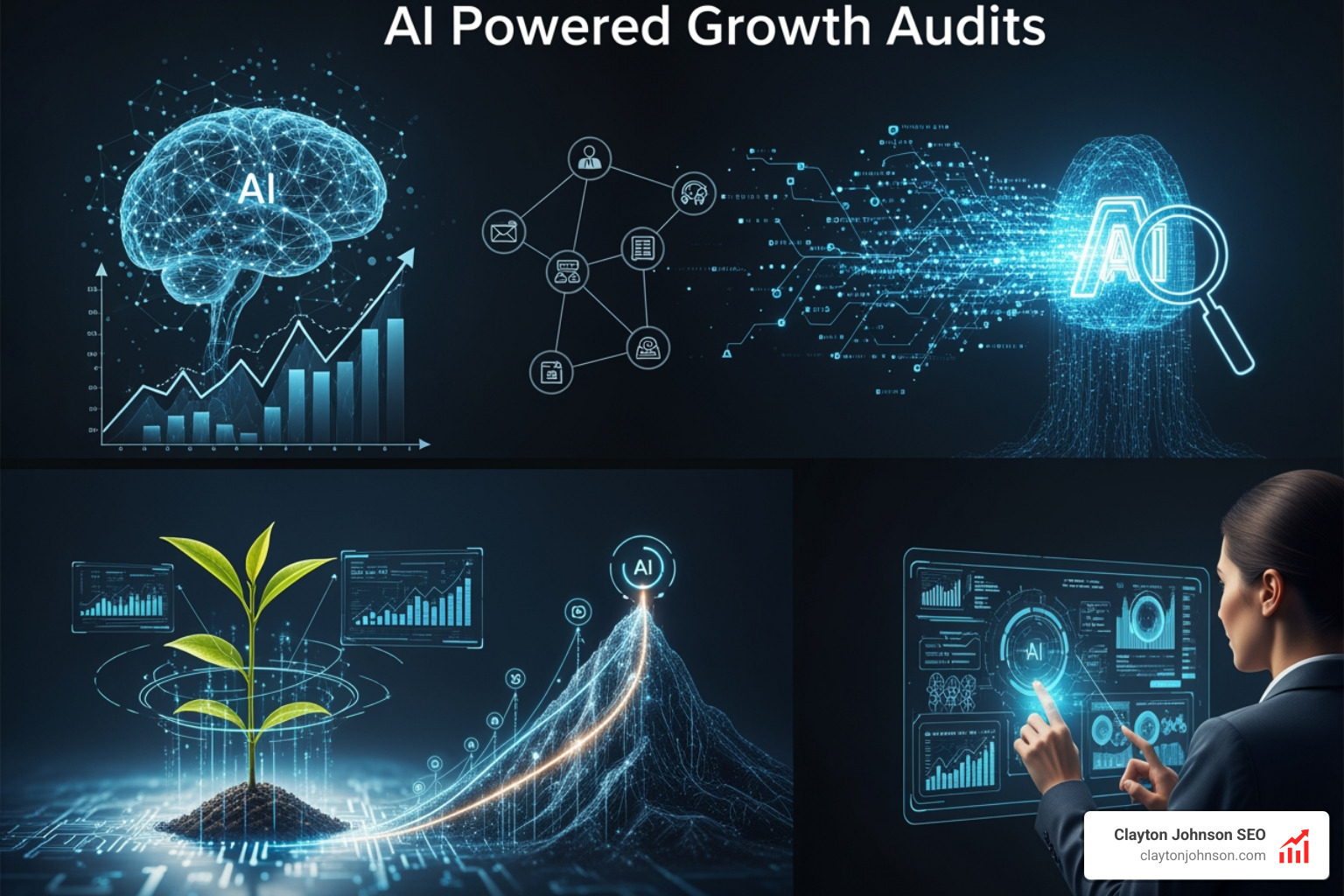
Why Modern Businesses Need AI Powered Growth Audits
AI powered growth audits are changing how businesses identify revenue leaks, optimize marketing systems, and scale efficiently. Here’s what you need to know:
| What It Is | Key Benefits | What You Get |
|---|---|---|
| An AI-driven diagnostic of your entire marketing and growth system | 40% fewer errors, 30% faster completion, 80% efficiency gains | Decision-ready insights on wasted spend, missed opportunities, and priority actions |
Traditional marketing audits take weeks, rely heavily on manual spreadsheet analysis, and often miss critical patterns hidden in massive datasets. They’re episodic snapshots that become outdated the moment they’re delivered.
AI powered growth audits flip this model entirely.
Instead of waiting for quarterly reviews, AI systems continuously monitor your marketing performance across channels—analyzing thousands of data points in seconds, flagging conversion bottlenecks instantly, and surfacing optimization opportunities before they cost you revenue. Leading firms report 11-16% conversion rate increases within weeks of implementing AI audit recommendations, with some seeing checkout improvements of 14% and sign-up lifts of 9%.
But the efficiency gains tell only part of the story. AI audits shift from reactive problem-solving to proactive growth intelligence. They detect algorithmic bias in your targeting, identify content gaps that AI search engines penalize, and benchmark your brand visibility across ChatGPT, Perplexity, and other AI platforms where buyers increasingly start their research.
The challenge isn’t whether to adopt AI powered growth audits—it’s how to implement them without sacrificing strategic oversight or drowning in false positives.
I’m Clayton Johnson, and I’ve spent years building SEO and growth systems that combine AI-driven diagnostics with strategic frameworks for measurable business impact. Through my work with AI powered growth audits, I’ve developed structured methodologies that turn fragmented marketing data into coherent action plans—balancing automation’s speed with human judgment’s nuance.
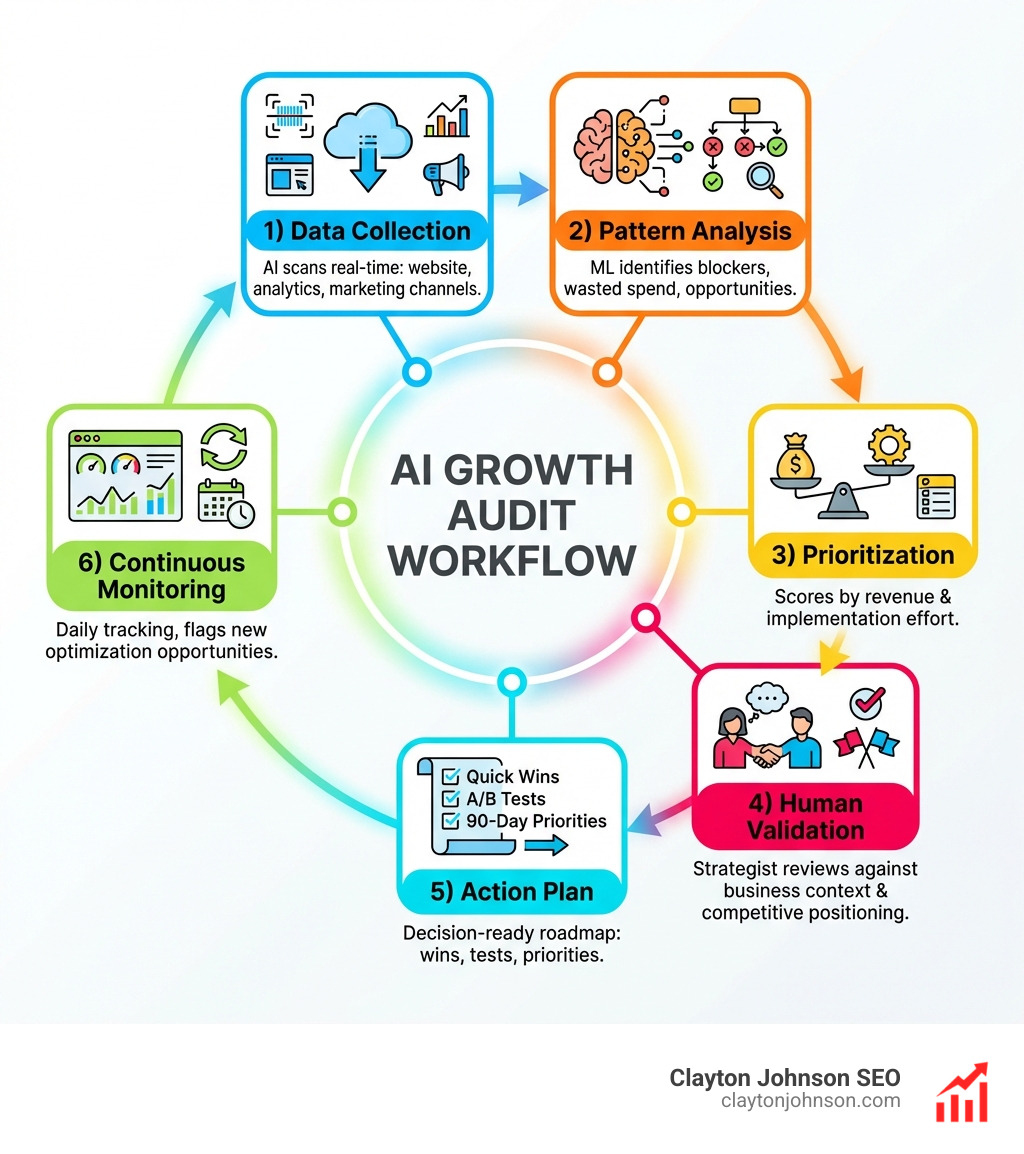
Defining AI Powered Growth Audits vs. Traditional Methods
To understand why AI powered growth audits are a game-changer, we have to look at what they are replacing. Traditional audits are often “static.” A consultant spends 40 hours looking at your Google Analytics, writes a 50-page PDF, and by the time you read it, your traffic patterns have already shifted.
An AI-powered approach is “dynamic.” It doesn’t just look at what happened; it uses pattern recognition to identify why it happened and what is likely to happen next.
| Feature | Traditional Manual Audit | AI Powered Growth Audit |
|---|---|---|
| Speed | 2–4 weeks | Under 60 seconds for initial scan |
| Data Scope | Limited samples/spreadsheets | Full population analysis (100% of data) |
| Accuracy | Prone to human fatigue/oversight | 40% reduction in review errors |
| Insight Type | Descriptive (What happened?) | Prescriptive (What should we do?) |
| Cost Efficiency | High billable hours | 80% efficiency gains in resource use |
By using AI Competitive Insights to Outsmart Your Rivals, these audits look beyond your own site. They analyze the entire market landscape to find missed opportunities. For B2B SaaS companies, this might mean identifying a specific feature gap that competitors are exploiting. For E-commerce brands, it could mean spotting a 12% drop-off in the checkout flow that only occurs on specific mobile devices.
The Shift from Episodic to Continuous Oversight
The biggest breakthrough in AI powered growth audits is the move from “one-and-done” projects to continuous oversight. In the past, auditing was episodic—something you did once a year or when sales plummeted.
AI allows for real-time insights. We can now connect auditing tools directly to your marketing stack to provide proactive management. Instead of finding out three months later that a tracking pixel broke and wasted $5,000 in ad spend, AI flags the anomaly the hour it happens. This breaks down data silos, ensuring that your SEO, paid media, and UX teams are all working from the same “source of truth.”
The Core Benefits of AI Powered Growth Audits
When we talk about the benefits of AI in auditing, we aren’t just talking about “cool tech.” We are talking about bottom-line business results. Research into large-scale implementations shows staggering numbers:
- Efficiency Gains: Firms have reported cutting casting time for financial and data reviews from 25 minutes down to 12.
- Accuracy Improvement: Platforms like Deloitte’s Omnia have shown a 40% reduction in audit review errors.
- Scalability: AI allows a small team to audit thousands of pages or transactions simultaneously, something that would require an army of analysts manually.
According to a report on putting the AI in audit, these tools allow auditors to move away from repetitive rework and focus on high-risk areas. In our experience, this translates to a 30% reduction in audit duration, allowing businesses to pivot their strategy much faster.
Maximizing ROI with AI Powered Growth Audits
The ROI of AI powered growth audits is often immediate. Because the AI can scan for “quick wins,” businesses see jumps in performance almost instantly after implementing fixes.
Real-world data points to these specific outcomes:
- 11-16% conversion jump within one month of fixing AI-identified UX issues.
- 14% checkout lift by reducing friction points that humans often overlook.
- 9% increase in sign-up rates through copy optimization suggested by LLM analysis.
- 100+ hours saved per audit cycle by using generative AI to draft reports and prioritize tasks.
Even Average Order Value (AOV) has been shown to climb by up to 11% when AI identifies better cross-sell opportunities during the audit process.
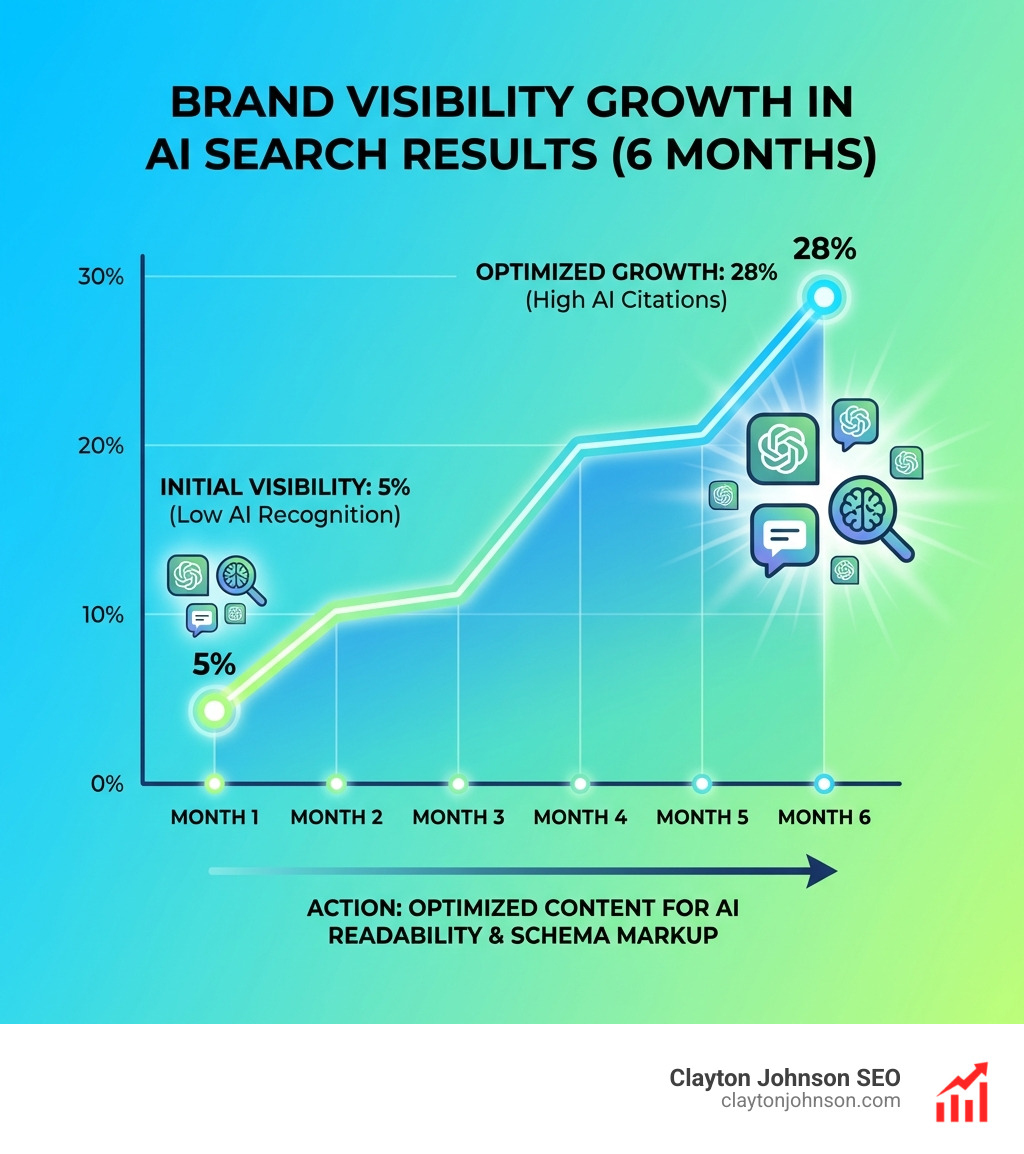
Enhancing Visibility in AI Search Environments
We are entering a new era of search. It’s no longer just about Google; it’s about ChatGPT, Perplexity, Gemini, and Grok. If these models don’t cite your brand when a user asks for a recommendation, you effectively don’t exist in that channel.
AI powered growth audits now include an “AI Visibility Score.” This benchmarks how often your brand appears in AI-generated answers compared to your competitors. By auditing your content’s “readability” for LLMs, we can identify gaps in your authority and ensure your brand is the one being recommended to high-intent buyers.
Essential Features of an AI Powered Growth Audit Tool
If you’re looking to invest in an audit tool or service, you need to know what makes a “good” one. It’s not just about a pretty dashboard; it’s about the underlying engine.
- Domain Validation: The AI must be trained on actual marketing and growth data, not just general internet text.
- Evidence Management: The tool should provide clear “proof” for every recommendation, linking directly to the page or data point in question.
- Configurable Oversight: You should be able to adjust the AI’s “strictness” based on your organization’s specific risk appetite.
- Vector Analysis: Advanced audits use embedding-based analysis to see how well your content matches the intent of high-value search prompts.
- Schema.org Markup: The audit should automatically check if your technical SEO is helping AI crawlers understand your site structure.
How Clayton Johnson SEO Delivers AI Powered Growth Audits
At Clayton Johnson SEO, we don’t believe in “black box” AI. Our proprietary audit frameworks are designed to be “decision-ready.” We use AI to do the heavy lifting—scanning thousands of keywords and UX paths—but we filter those findings through our custom reporting system.
We provide:
- A Marketing Readiness Score: A 0-100 metric that tells you exactly where your system stands.
- Strategic Recommendations: Not just a list of bugs, but a 90-day roadmap prioritized by revenue impact.
- Ongoing Optimization: We don’t just audit once; we integrate AI into your workflow to ensure growth is sustained.
The Role of Human Oversight in AI Outcomes
One of the biggest mistakes businesses make is “setting and forgetting” their AI tools. AI is a capacity multiplier, but it lacks the professional skepticism of a senior strategist.
Human-led AI is the gold standard. We use AI to find the patterns, but our experts provide the strategic validation. We ask the “Should we?” questions that AI can’t answer. Is this recommendation ethical? Does it align with the brand’s long-term positioning? This ensures that the audit outcomes are not just accurate, but also responsible and strategically sound.
Overcoming Implementation Challenges and Risks
While the benefits are clear, implementing AI powered growth audits isn’t without problems.
- Data Privacy: Many businesses are rightfully concerned about feeding proprietary data into AI models.
- Algorithmic Bias: If your historical data is biased (e.g., targeting only one demographic), the AI might recommend doubling down on that bias rather than finding new growth markets.
- Legacy Integration: Connecting modern AI tools to older CRM or ERP systems can be technically challenging.
As highlighted in the Journal of Accountancy, the key is to establish clear governance frameworks early. This involves training employees to understand AI outputs rather than blindly following them.
Addressing Data Security and Compliance
Security is paramount. When we conduct an audit, we look for tools that use strong encryption and access controls. Interestingly, using AI can actually improve security; some firms have seen a 50% decrease in compliance breaches because AI is much better at spotting unauthorized data access than human monitors.
Following a “Trusted AI” framework—focusing on transparency, explainability, and data integrity—ensures that your growth audit doesn’t become a liability.
A Step-by-Step Guide to Starting Your AI Growth Audit
Ready to dive in? Here is how we recommend businesses in Minneapolis and beyond get started.
- Readiness Assessment: Determine your “AI ambition.” Do you want to be an industry leader in automation, or do you just need to fix your current conversion leaks?
- Data Foundation: AI is only as good as the data you give it. Clean up your tracking, implement ETL pipelines, and ensure your metadata is tagged correctly.
- Tool Selection: Choose a tool or partner that offers a “pilot” phase. Don’t commit to a massive enterprise contract until you’ve seen a small-scale win.
- Pilot Testing: Start with one high-impact area, like your checkout flow or your top 10 SEO landing pages.
For more on why this matters now, check out Why Your Brand Needs an AI Growth Strategy Right Now.
Measuring Success and Future Trends
How do you know if your AI powered growth audits are working? We track several key metrics:
- Marketing Readiness Score: Is your overall score improving month-over-month?
- Anomaly Detection Rate: How many “revenue leaks” did the AI catch before they became major problems?
- Predictive Revenue: Are your revenue forecasts becoming more accurate as the AI learns your data patterns?
The future of this technology lies in “Generative Copilots” that don’t just find problems but actually draft the code or copy to fix them instantly. We are also seeing a shift toward ESG (Environmental, Social, and Governance) reporting being integrated into growth audits, helping brands scale sustainably.
Frequently Asked Questions about AI Growth Audits
How do AI growth audits differ from traditional SEO audits?
Traditional SEO audits focus on technical checkboxes (meta tags, site speed). AI powered growth audits look at the “full picture,” including brand sentiment, content depth compared to AI search models, and user behavior patterns that indicate intent.
Is my data safe when using AI audit tools?
Yes, provided you use enterprise-grade tools with SOC2 compliance and data-sharing opt-outs. We prioritize tools that do not use your proprietary data to train their public models.
What is a good Marketing Readiness Score?
While it varies by industry, a score of 70+ indicates a healthy, data-driven system. Anything below 50 suggests significant “growth leaks” where you are likely wasting ad spend or losing traffic to competitors.
Conclusion
The era of manual, slow-motion auditing is over. To compete in today’s market, businesses must leverage the speed and precision of AI powered growth audits. Whether you are looking to plug revenue leaks in your funnel or ensure your brand is visible in the new world of AI search, these diagnostics provide the decision-ready insights you need to scale.
At Clayton Johnson SEO, we specialize in building the systems and frameworks that make this possible. From our Demandflow platform to our deep-dive strategic audits, we help founders and marketing leaders move from guesswork to measurable results.
Ready to see what’s holding your business back? Scale your business with SEO Services Minneapolis and let’s build a growth engine that actually works.