Why Scalable Marketing Frameworks Are Essential for Growth
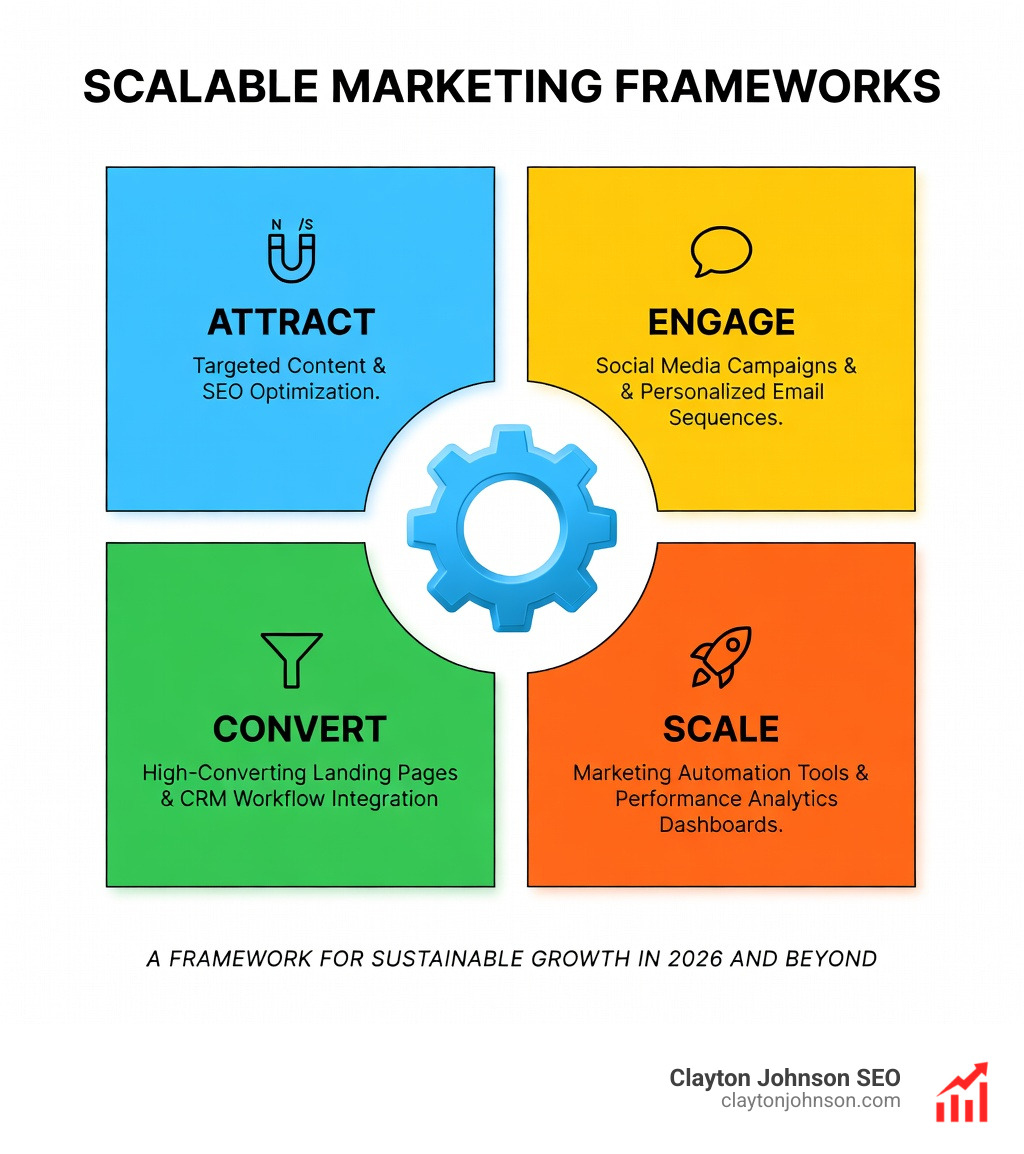
Scalable marketing frameworks are structured systems that enable businesses to grow their marketing operations efficiently without losing quality or control. They combine strategy, process, technology, and measurement to deliver consistent results as demand increases.
Key components of a scalable marketing framework:
- Clear strategic goals tied to business outcomes
- Standardized processes that can be repeated across teams and channels
- Integrated technology stack connecting CRM, automation, and analytics
- Data governance ensuring clean, accessible, actionable insights
- Defined roles and workflows that support cross-functional alignment
- Continuous measurement with feedback loops for optimization
Research from Gartner shows that companies with mature marketing operations achieve 25% higher revenue growth compared to peers with less developed systems. The difference isn’t just scale—it’s the ability to maintain coherence under pressure while adapting to new markets, channels, and customer behaviors.
Most marketing teams start with ad-hoc tactics. Email campaigns here. A few social posts there. Maybe some paid ads when budget allows. This works early on, but as the business grows, the cracks appear. Campaigns launch late. Data doesn’t match across systems. Nobody knows which efforts actually drive revenue. What worked at 10 customers breaks at 100—and collapses entirely at 1,000.
The solution isn’t working harder. It’s building systems that work for you—frameworks that turn marketing from a cost center into a predictable growth engine.
I’m Clayton Johnson, and I’ve spent years building scalable marketing frameworks for companies at different stages of growth, from early-stage startups to established brands navigating complex competitive landscapes. My focus is on turning fragmented marketing efforts into coherent systems that combine SEO strategy, content architecture, competitive positioning, and AI-assisted workflows to drive measurable outcomes.
The Core Pillars of Scalable Marketing Frameworks
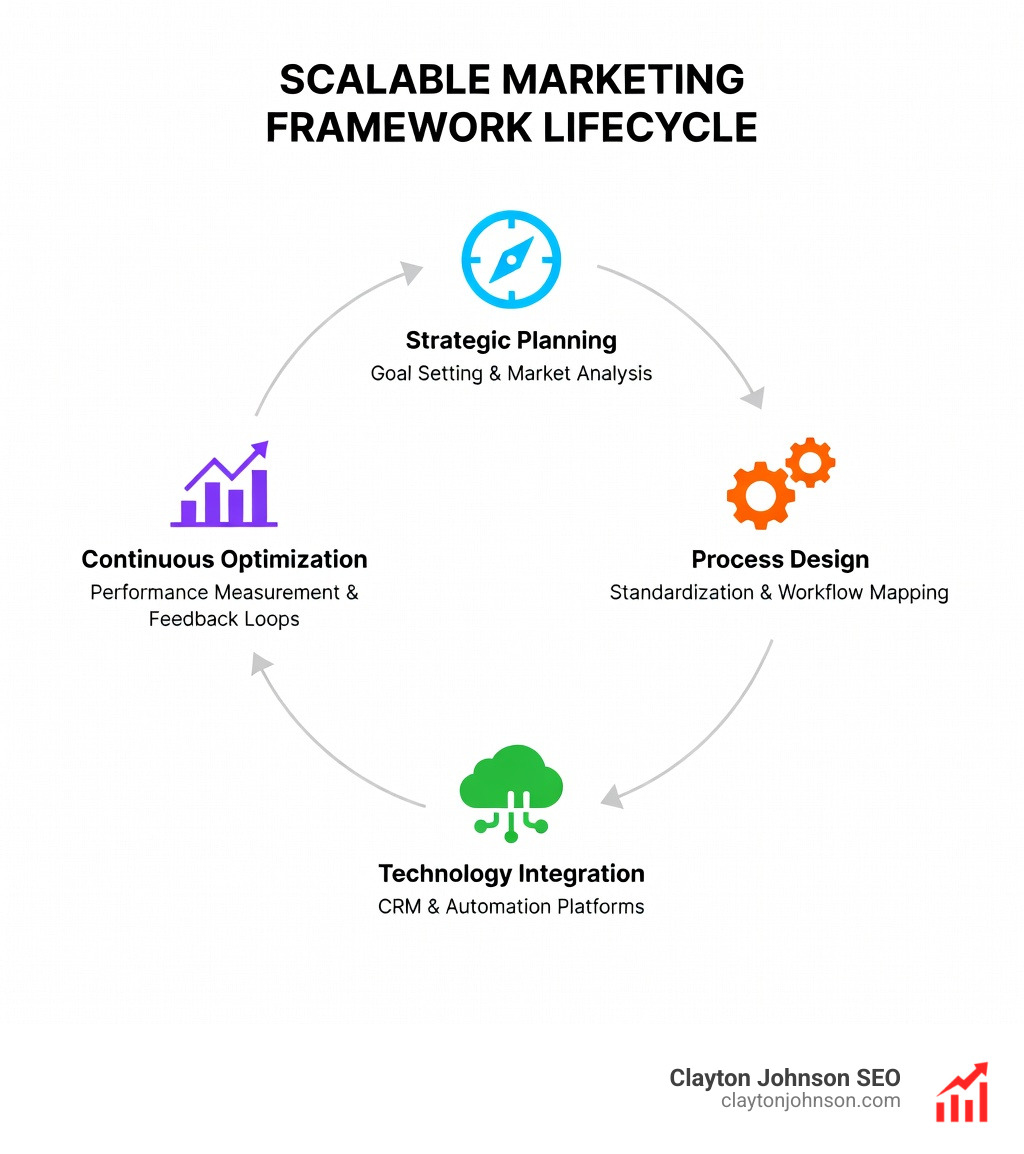
To build a framework that doesn’t crumble the moment you double your budget, we need to focus on four foundational pillars. Think of these as the legs of a very sturdy (and very profitable) table.

- Process Design: This is about converting efficiency into results. We map out workflows so that every team member knows exactly what happens from “great idea” to “published campaign.”
- Technology Backbone: The right tools can boost your scalability. We look for platforms that are integratable and designed to grow with us. Foundational systems include WordPress or Drupal for content management, and CRMs like HubSpot or Salesforce.
- Data Management: Data is the strategic engine. Without it, we’re just guessing. We need a “single source of truth” where marketing, sales, and service data live together. Companies that break down data silos see a 15-25% increase in marketing productivity.
- The Human Element: Even the best AI needs a pilot. We define clear roles and foster a collaborative culture. This ensures Operational Alignment across the entire organization.
| Pillar | Role in Scalability | Key Outcome |
|---|---|---|
| Process | Standardizes execution | 40% reduction in campaign cycles |
| Tech | Automates repetitive tasks | 12.2% reduction in overhead |
| Data | Informs strategic pivots | 18% improvement in lead conversion |
| People | Drives innovation and culture | 24% higher profit margins |
Building a Scalable Marketing Framework with the GSTIC Model
Most marketing initiatives fail not because the product is weak, but because they lack a structured plan. We use the GSTIC Framework, popularized by Strategic Marketing Management expert Alexander Chernev, to ensure every move is calculated.
- Goals: We don’t just say “we want more sales.” We define focus (e.g., net profit), benchmarks (e.g., $1M by Q4), and persuasion tasks (e.g., moving customers from awareness to trial).
- Strategy: This involves deep Market Analysis to identify target customers, their specific needs, and our unique competitive advantage.
- Tactics: These are the “seven levers” of the marketing mix: product, service, brand, price, incentives, communication, and distribution.
- Implementation: How we actually execute—sequencing tasks and allocating resources.
- Controls: How we measure success in real-time to optimize as we go.
The Four Fits: Achieving Product-Market Alignment in the AI Era
In modern marketing, having a great product isn’t enough. We need to achieve the “Four Fits,” a concept from Brian Balfour at Reforge. This is especially critical as AI disrupts traditional channels.
- Product Market Fit: Does a meaningful segment of customers desperately want what we’ve built?
- Product Channel Fit: Products are built for channels, not the other way around. If we’re using SEO Services, our content must be architected for search intent.
- Channel Model Fit: Does our business model (pricing/ARPU) work with our CAC (Customer Acquisition Cost)? You can’t use an enterprise sales team to sell a $5/month app.
- Model Market Fit: Does the market have enough customers to support our $100M+ revenue goals?
AI is currently breaking the math on these fits. For example, search traffic—a staple for many—is shifting toward AI-driven findy, requiring us to pivot our strategies instantly to avoid “Product Market Fit collapse.”
Implementing the Growth Hacking Loop for Continuous Execution
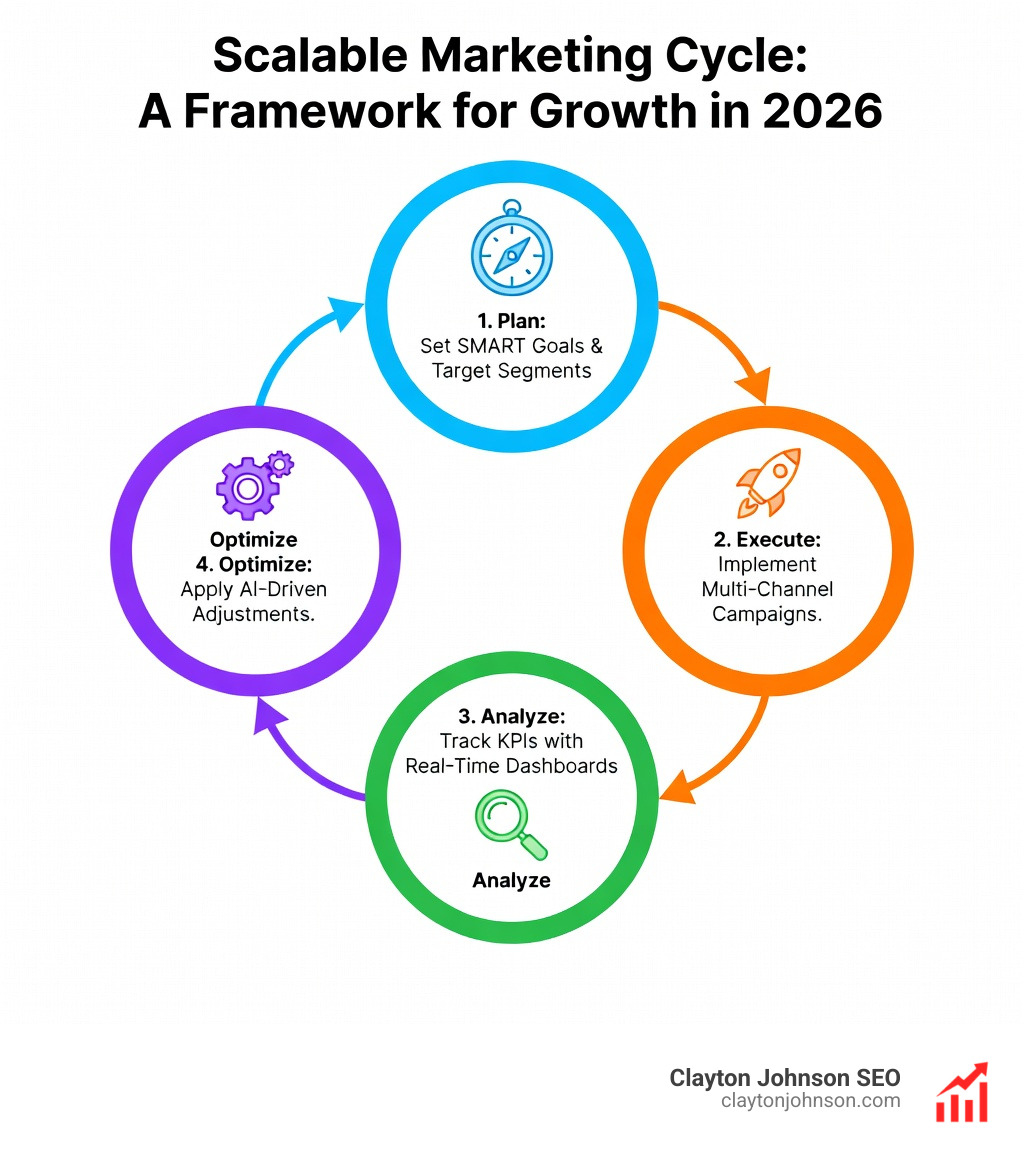
Once the strategy is set, we need a rhythm for execution. We use the Growth Hacking Loop (also known as the IPTA loop) to keep the momentum going.
- Ideate: We source ideas from everyone—sales, support, and even AI pattern-spotting.
- Prioritize: We use the RICE (Reach, Impact, Confidence, Effort) score to decide what to work on first. No more “whoever shouts loudest wins.”
- Test: We run controlled experiments. For valid results, we recommend a minimum run time of two weeks. You can use this Bayesian A/B Test Duration & Sample Size Calculator to ensure your data is statistically significant.
- Analyze: Did it work? We document the “why” behind the win or loss in our Execution Roadmaps.
Leveraging Automation and AI in Scalable Marketing Frameworks
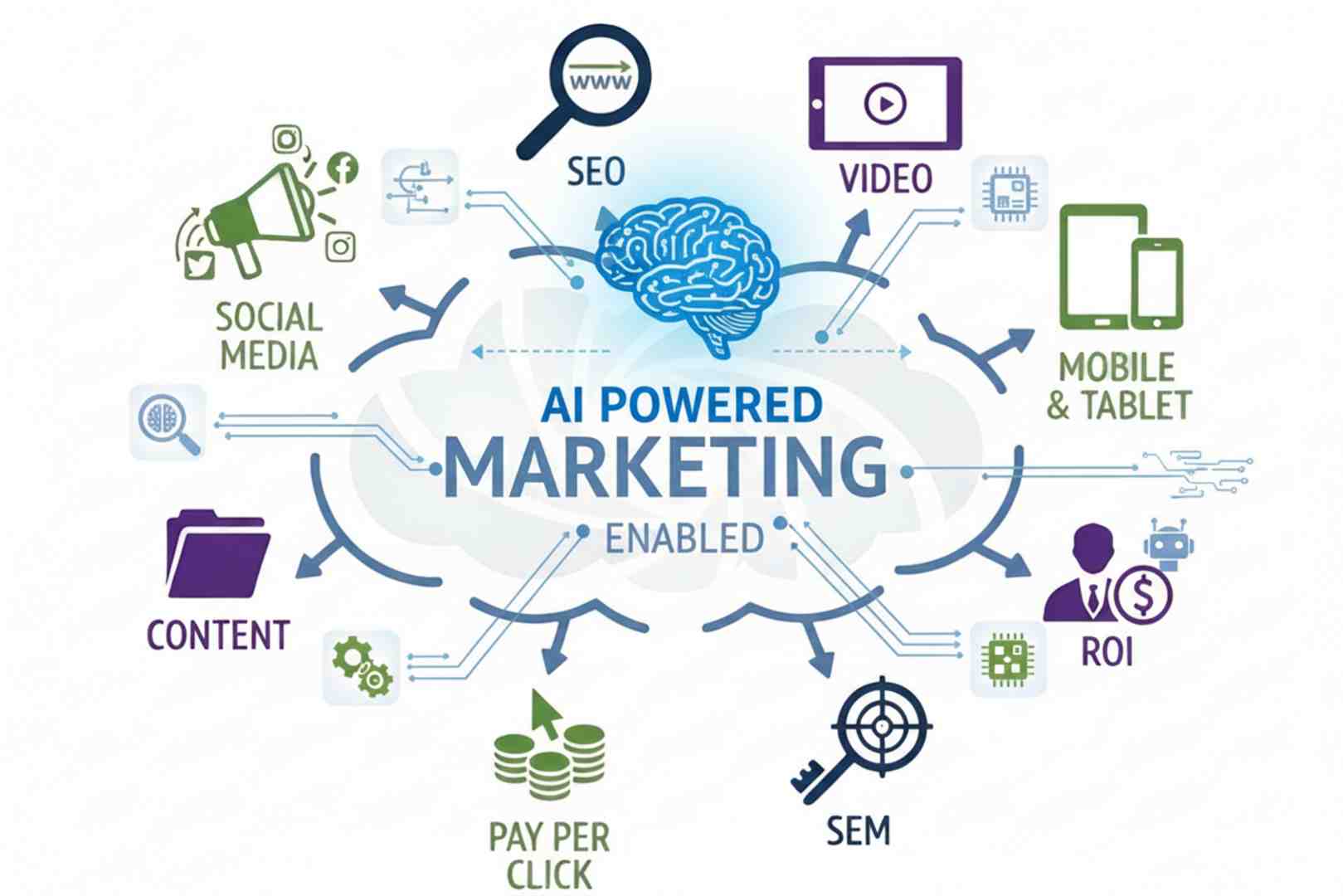
Automation is the secret sauce of scalability. It reduces marketing overhead by 12.2% while increasing sales productivity by 14.5%. By standardizing workflows, we ensure that a campaign looks and performs the same whether it’s our first or our fiftieth.
We integrate AI-assisted workflows into:
- Paid Advertising: Using AI for real-time bid optimization and creative testing.
- Email Marketing: Automating nurture sequences based on user behavior triggers.
- Content Systems: Using LLMs to assist in drafting, though we always keep a human in the loop for brand voice and accuracy.
The Race Car Model: Engines, Turbo Boosts, and Fuel
Think of your growth strategy like a race car. This analogy helps us understand how different activities work together.
- Growth Engines: These are self-sustaining loops, like virality or content-driven SEO. They are the primary way we grow.
- Turbo Boosts: These are one-time events like a big PR launch or a celebrity mention. They give us a spike, but they aren’t sustainable engines.
- Lubricants: These are optimizations that make the engine run smoother, such as improving retention or Social Media Marketing engagement.
- Fuel: The inputs required, such as capital, content, or user data.
When we follow a playbook for customer acquisition, we focus on picking the right “lane” (Performance, Virality, or Content) and mastering it before layering on a second engine.
Overcoming Challenges in Marketing Scalability and Data Management
Scaling isn’t always smooth sailing. The biggest hurdle? 67% of companies struggle with integrating disparate systems. We call this the “Franken-stack” problem—where tools don’t talk to each other, leading to data silos.
To overcome this, we focus on:
- System Integration: Using APIs or middleware like Zapier to connect our tools.
- Data Governance: Establishing clear rules for how data is entered and maintained.
- Performance Management: As noted in a McKinsey article, companies with effective performance management are 4.2x more likely to outperform peers.
By leveraging Analytics & Data correctly, we can see exactly where the funnel is leaking and fix it before it becomes a crisis.
Adapting Scalable Marketing Frameworks Across Diverse Industries
A framework must be flexible enough to work whether you’re selling software in Minneapolis or coffee beans globally.
- Healthcare: 77% of patients search online before booking. Here, scalability means dominating local SEO and managing online reviews, which influence 68% of patient choices.
- Real Estate: With 97% of buyers searching online, we focus on automated lead nurturing and high-quality content systems.
- E-commerce: Conversion rates usually sit between 1-4%. Scaling here requires aggressive A/B testing and abandoned cart automation.
- B2B: The sales cycle is longer, so we focus on building detailed Buyer Personas and using PESTLE Analysis to steer market shifts.
Bridging the Gap Between Strategy and Tactical Implementation
The “strategy-execution gap” is where good ideas go to die. Marketing teams that bridge this gap achieve 17% higher return on marketing investment (ROMI).
We bridge this by:
- Messaging: Ensuring our brand voice is consistent across every touchpoint.
- Pipeline Motions: Defining how leads move from marketing to sales.
- Execution Layer: Using The Scale Marketing Framework to align high-level goals with daily tasks.
- Sales Strategy: Aligning marketing goals with what the sales team actually needs to close deals.
Measuring Success and ROI of Operational Excellence
If you can’t measure it, you can’t scale it. We track metrics that actually matter to the bottom line, not just “likes” or “shares.”

Key metrics we watch:
- Revenue Growth: Mature operations see 25% higher growth.
- Sales Productivity: Automation can boost this by 14.5%.
- Campaign Launch Time: Vodafone UK reduced this by 40% through better process design.
- Lead Conversion: Dell saw an 18% improvement by integrating CRM with marketing tools.
For a deeper dive into how top marketers measure success, you can Download the slideshow from BCG. We also prioritize Conversion Optimization to ensure that every dollar spent on traffic results in the highest possible return.
Continuous Improvement and the Feedback Engine
A scalable framework is a living system. It requires a “test-and-learn” culture where failure is seen as data.
- Performance Audits: We conduct quarterly audits to find bottlenecks.
- Upskilling: Companies that invest in training see 24% higher profit margins. Programs like Unilever’s Marketing Academy have shown that a dedicated learning path can speed up campaign execution by 30%.
- SWOT Analysis: We regularly revisit our Strengths, Weaknesses, Opportunities, and Threats to adapt to evolving market conditions.
Frequently Asked Questions about Scalable Marketing
What is the primary role of marketing operations?
Marketing operations acts as the infrastructure of the marketing department. It bridges the gap between high-level strategy and tactical execution by managing the people, processes, technology, and data needed to drive efficient and predictable growth.
How do you measure the success of a scalable framework?
Success is measured through a mix of efficiency (reduced campaign setup time), effectiveness (higher conversion rates and ROI), and business impact (overall revenue growth and sales productivity).
What technologies are essential for marketing scalability?
At a minimum, you need a robust CRM (like HubSpot or Salesforce), a marketing automation platform (like Marketo or Pardot), a flexible CMS (like WordPress), and an analytics suite to track cross-system data.
Conclusion
Building scalable marketing frameworks isn’t a one-time project—it’s a fundamental shift in how your business approaches growth. By focusing on the four pillars of process, tech, data, and people, you can move away from “random acts of marketing” and toward a system that delivers predictable, compounding results.
At Clayton Johnson, we specialize in helping founders and marketing leaders in Minneapolis and beyond diagnose their growth problems and build the frameworks necessary to win. Whether you need a deep dive into your SEO Services Minneapolis, a revamped content system, or AI-assisted workflows to boost your team’s productivity, we’re here to help you execute with clarity and precision.
Ready to turn your marketing into a scalable engine? Let’s get to work.