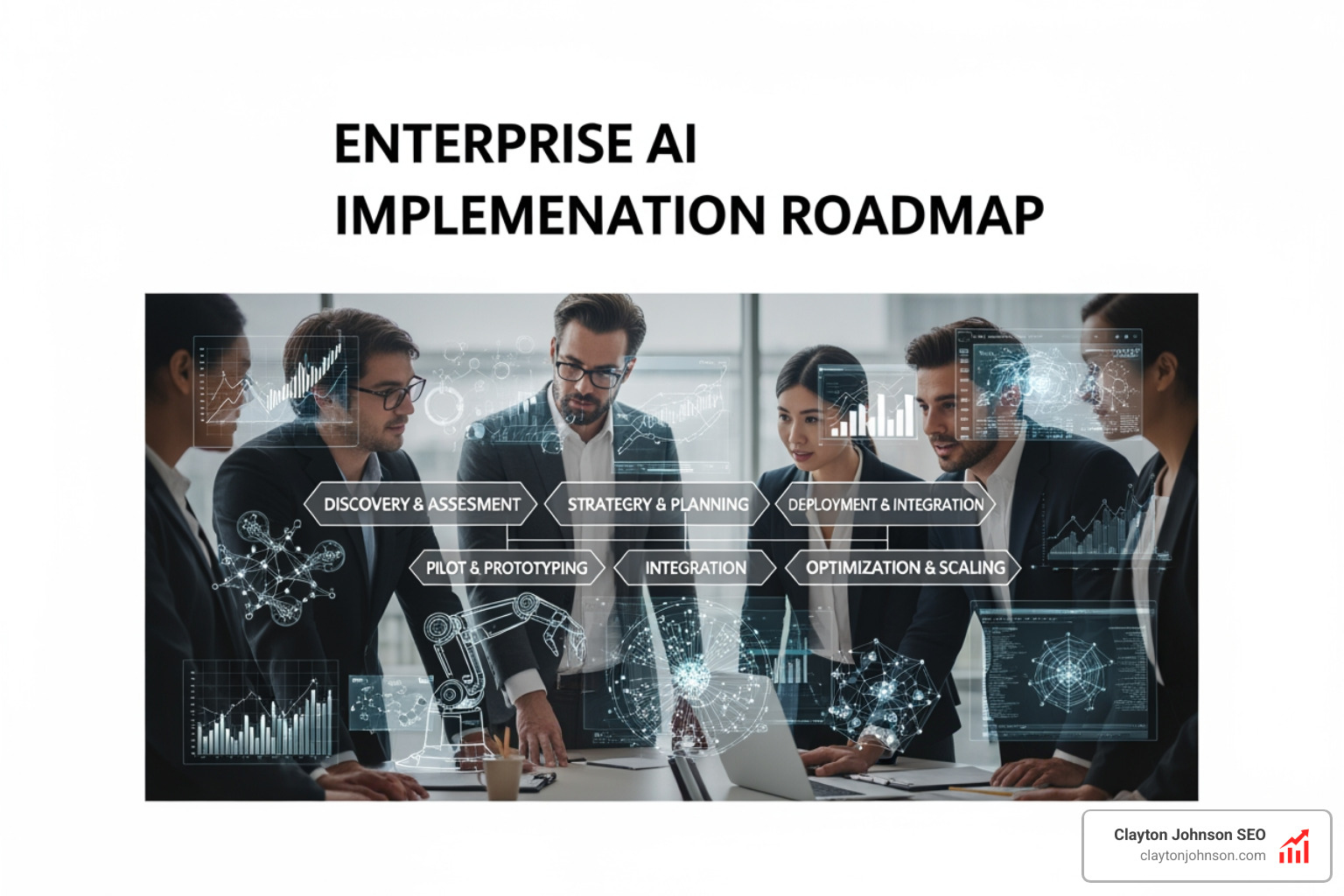
Why Most Enterprise AI Projects Fail (And How a Roadmap Fixes That)
A solid enterprise AI implementation roadmap is a structured, phased plan that guides your organization from AI experimentation to scaled, production-ready deployment — with clear use cases, data foundations, governance, and measurable business outcomes at every stage.
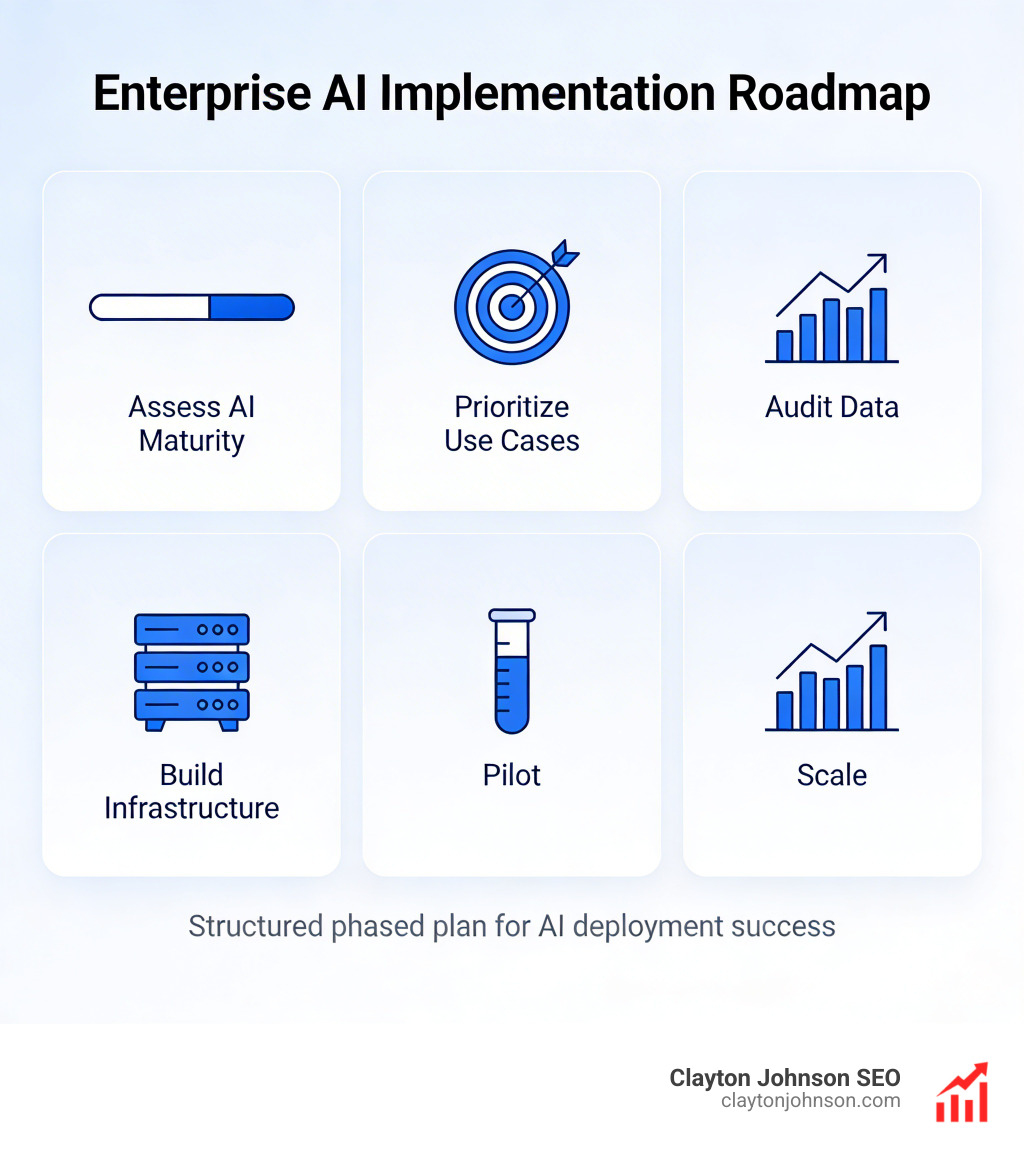
Here is the core framework at a glance:
- Assess AI maturity – Know where you stand before you plan where to go
- Identify and prioritize use cases – Focus on high-impact, low-complexity opportunities first
- Audit your data – Fix data quality issues before building anything
- Build infrastructure and governance – Set up the technical and ethical guardrails
- Run focused pilots – Prove value in 4-8 weeks before scaling
- Scale and optimize – Roll out with monitoring, retraining, and continuous improvement
The numbers tell a hard story. Between 70 and 85 percent of AI projects fail to meet expected outcomes. Nearly two-thirds of organizations struggle to move pilots into production. And only 34 percent of enterprises report measurable financial impact from their AI programs.
The root cause is almost never the technology. It is the absence of a structured plan.
Most organizations chase AI tools before solving business problems. They underestimate data preparation, which consumes 40 to 60 percent of implementation time and budget. They skip governance until problems appear. They set timelines that collapse under real-world complexity.
A well-built roadmap changes all of that. It forces strategic alignment first, builds the right foundations, and sequences execution in a way that compounds value over time rather than burning budget on stalled pilots.
I’m Clayton Johnson, an SEO strategist and growth operator who builds scalable systems at the intersection of strategy, content architecture, and AI-assisted workflows — and developing a clear enterprise AI implementation roadmap is one of the highest-leverage moves I’ve seen organizations make when shifting from reactive experimentation to systematic, measurable AI adoption. The sections below break down every phase of that process so you can build a roadmap that actually ships.
Enterprise ai implementation roadmap definitions:
Phase 1: Assess Your Current AI Maturity and Readiness
Before we start picking out fancy Large Language Models (LLMs), we need to look in the mirror. Most organizations overestimate their readiness, which is a primary reason 42% of businesses scrapped most AI initiatives recently due to aggressive, unrealistic timelines.
The MIT CISR Maturity Model
To build a realistic enterprise AI implementation roadmap, we often look at the MIT CISR Enterprise AI Maturity Model. It identifies four distinct stages:
- Exploring: Roughly 15% of enterprises. You are running small experiments, but they are isolated.
- Building Capabilities: About 45% of large organizations. You are creating a central team and standardizing tools.
- Scaled Ways of Working: About 30% of enterprises. This is the “inflection point” where financial performance starts to beat industry averages.
- AI-Integrated Enterprise: Only around 10% of companies. AI is woven into the core business DNA.
Conducting a Readiness Audit
We recommend evaluating your organization across five “readiness thresholds”:
- Strategic Alignment: Do your executives agree on the problems AI should solve?
- Data Maturity: Is your data accessible, clean, and governed?
- Infrastructure: Do you have the computing power and cloud architecture to scale?
- Team Capability: Do you have the talent (or partners) to execute?
- Governance: Do you have ethical and risk frameworks in place?
If you can’t answer “yes” to these, your roadmap needs to prioritize foundational work before you ever touch a line of code.
Phase 2: Identifying and Prioritizing High-Value Use Cases
The biggest mistake we see is “technology-first thinking.” Leaders buy a tool and then go hunting for a problem to solve. A winning enterprise AI implementation roadmap flips this. We start with the business problem.
How to Qualify a Use Case
Every potential AI project should be run through a “Qualification Filter.” You need to define:
- The Problem Statement: What specific inefficiency are we fixing?
- Business Value: Will this increase revenue, reduce costs, or improve customer experience?
- Feasibility: Do we have the data and technical ability to do this now?
- Success Metrics: How will we know it worked? (e.g., “Reduce support ticket resolution time by 20%”).
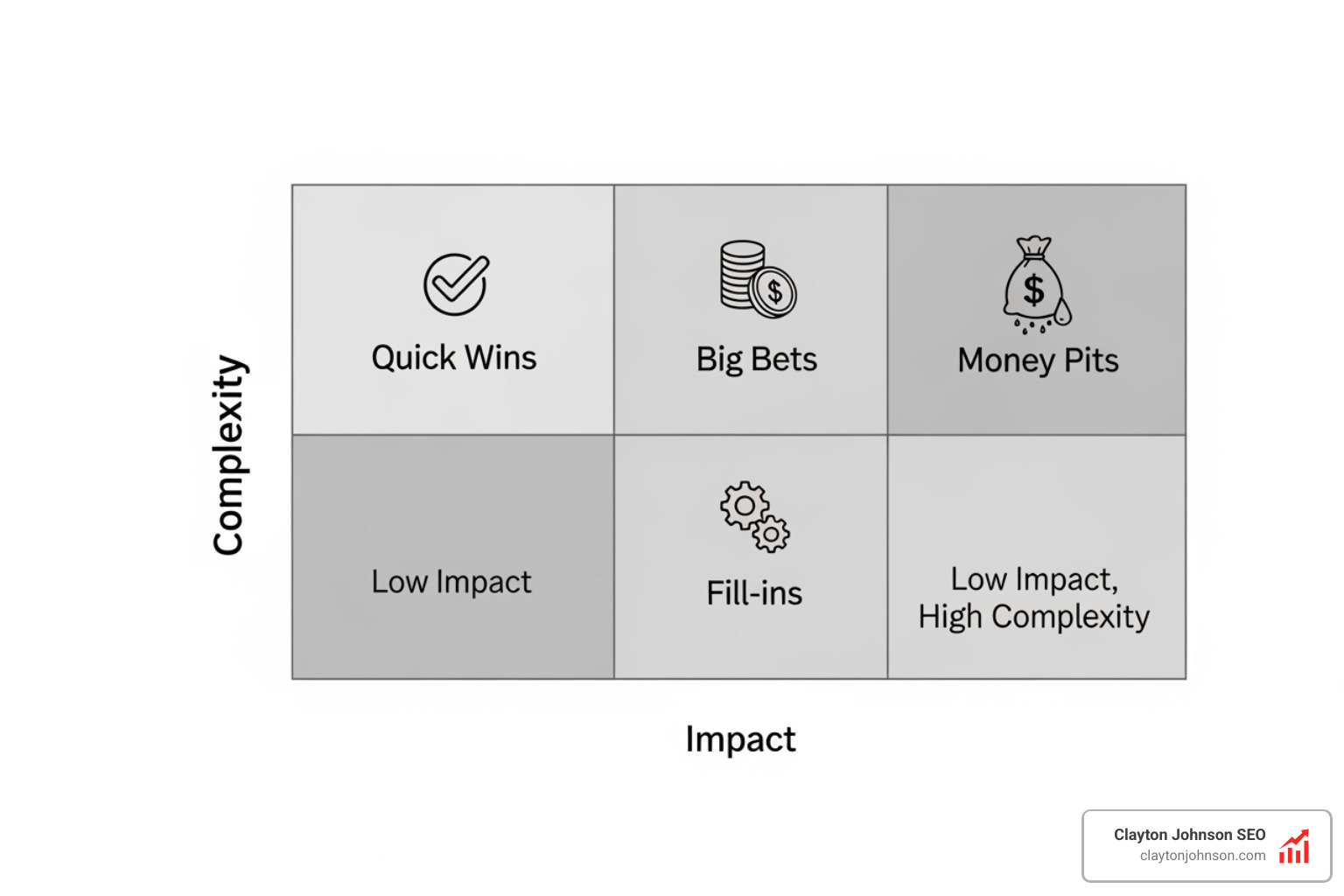
The 2×2 Prioritization Matrix
We use a simple matrix to sequence your roadmap:
- Quick Wins: High Impact, Low Complexity. These are your Phase 1 pilots (e.g., internal knowledge assistants or document summarization).
- Big Bets: High Impact, High Complexity. These are long-term strategic differentiators.
- Fill-ins: Low Impact, Low Complexity. Automate these only if resources are idle.
- Money Pits: Low Impact, High Complexity. Avoid these at all costs.
Research shows that high-performing organizations achieve 5:1 returns on AI investments, compared to an average of 3:1, specifically because they are ruthless about use case selection.
Phase 3: The Data Foundation — Why 70% of Projects Fail Here
You’ve heard the phrase “garbage in, garbage out.” In AI, it’s more like “garbage in, total system collapse.” 70% of AI failures originate from unresolved data issues, making this the most critical phase of your enterprise AI implementation roadmap.
The Cost of Poor Data
Poor data quality costs organizations $12.9 million annually. Even more staggering, 99% of AI/ML projects encounter data quality issues at some point.
Data Readiness Steps
- Audit: Identify where your authoritative data lives.
- Clean: Remove duplicates, fix errors, and handle missing values.
- Govern: Establish data lineage (knowing where data came from) and security protocols.
- Pipeline: Build automated flows to get data from your CRM/ERP into your AI models.
Expect data preparation to take 40-60% of your total project time. If your roadmap says you’ll be done with data in two weeks, you’re setting yourself up for the “Pilot Purgatory” we see so often.
Phase 4: Building the Right Team and Infrastructure
Who is actually going to build this? You have three main choices: Build, Buy, or Partner.
The Team Structure
57% of organizations cite skill gaps as their primary barrier. To overcome this, we recommend a “Hub-and-Spoke” model:
- The Hub: A central AI Center of Excellence (CoE) that sets standards, selects tools, and manages governance.
- The Spokes: AI “Champions” embedded within business units (Marketing, Finance, Ops) who identify specific opportunities and drive adoption.
When hiring, look for the “6-11 years of experience” sweet spot. These are people who can still execute but understand the broader business context.
Infrastructure: Cloud vs. On-Premises
Most enterprises use a hybrid approach. You might use the public cloud for scalability but keep sensitive data in a private, scoped environment to manage privacy and security concerns. Gartner warns that over 50% of enterprise AI initiatives fail because the foundational architecture was missing. Don’t let “tech sprawl” happen — choose a stack that integrates with your existing SEO and marketing workflows.
Phase 5: From Pilot to Production — Escaping “Pilot Purgatory”
Nearly two-thirds of organizations struggle to transition pilots into production. They get a “cool” demo working, but it fails when 5,000 employees try to use it at once.
The Phased Rollout Strategy
Organizations utilizing phased rollouts report 35% fewer critical issues during implementation. Your enterprise AI implementation roadmap should look like this:
- Proof of Concept (POC): 4 weeks. Does the tech actually work?
- Pilot: 8-12 weeks. Does it solve the business problem for a small group?
- MVP Rollout: 3-6 months. Deploy to one department with human-in-the-loop oversight.
- Full Scale: 6-18 months. Enterprise-wide integration with MLOps (Machine Learning Operations) for continuous monitoring.
Measuring ROI
Don’t just track “accuracy.” Track business metrics. If you’re using AI for SEO content architecture, measure organic traffic growth and lead quality. If you’re using it for customer service, measure Average Handling Time (AHT) and CSAT scores. Only 34% of enterprises say their AI programs produce a measurable financial impact — make sure you are in that 34% by defining KPIs early.
Phase 6: Governance, Ethics, and Risk Management
As AI starts making decisions, the risk profile changes. McKinsey’s State of AI survey finds that only 28% of organizations have their CEOs actively involved in AI governance. This is a mistake.
Essential Governance Pillars
- Transparency: Can you explain why the AI made a specific decision?
- Bias Mitigation: Are you regularly auditing models for unfair outcomes?
- Compliance: Does your AI meet the standards of the EU AI Act or industry-specific regulations like HIPAA?
- Security: How are you preventing “prompt injection” or data leaks?
At Demandflow, we believe clarity and structure are the keys to leverage. Without a responsible AI framework, your implementation is a liability, not an asset.
Realistic Timelines and Budgeting
How much does this cost? Typically, enterprises allocate 3-5% of annual revenue to AI transformation.
The Investment Breakdown
- Talent: 30-40% (Data scientists, engineers, change managers)
- Technology & Infrastructure: 20-30% (Cloud costs, software licenses)
- Data Preparation: 20-30% (Cleaning, labeling, integration)
- Governance & Training: 10-15%
Typical Roadmap Timeline
- Foundations (Strategy & Data): 3-6 months
- Initial Pilots: 3-4 months
- Scaling First Use Cases: 6-12 months
- Full Enterprise Integration: 18-36 months
Organizations with clean historical data can reduce implementation timelines by up to 40%.
Change Management: The Human Element
57% of organizations cite skill gaps as a barrier, but the bigger barrier is often culture. People fear AI will replace them. UPenn research shows 80% of knowledge worker jobs will be influenced by AI.
Your roadmap must include a communication plan. Focus on “Augmentation, not Replacement.” Show how AI handles the “grunt work” so your team can focus on high-value strategy. DBS Bank’s success with AI was driven by a culture that encouraged experimentation and role-based training.
Industry-Specific Roadmap Considerations
Every industry has a different “North Star” for their enterprise AI implementation roadmap:
- Retail: Focus on inventory prediction and supply chain optimization. (e.g., Target and Walmart).
- Finance: Focus on fraud detection and compliance monitoring.
- Manufacturing: Focus on predictive maintenance and automated quality assurance.
- Marketing/SEO: Focus on AI-augmented workflows and competitive intelligence.
Common Pitfalls to Avoid
- Analysis Paralysis: Spending a year on a strategy deck without shipping a single pilot.
- Underestimating Data Work: Thinking your data is “fine” when it hasn’t been audited in years.
- Siloed Execution: Letting IT build AI in a vacuum without input from the business units.
- Ignoring Shadow AI: Ignoring the fact that your employees are already using unmanaged AI tools, creating massive security risks.
Next Steps: Starting Your Roadmap Today
If you are ready to move from “AI curiosity” to “AI capability,” here are your immediate next steps:
- Secure an Executive Sponsor: You need P&L-level support to clear roadblocks.
- Conduct a 48-Hour Data Audit: Identify your three most important data sources. Are they ready for AI?
- Identify Three “Quick Wins”: Use the 2×2 matrix to find low-complexity, high-impact pilots.
- Establish a Cross-Functional Task Force: Get IT, Legal, and Business leaders in one room.
At Clayton Johnson SEO and Demandflow, we help founders and marketing leaders build the structured growth architecture required to scale. Most companies don’t lack tactics; they lack the systems to execute them. A winning enterprise AI implementation roadmap is that system.
Build your architecture. Scale your leverage. Start your roadmap.
Related Resources for Your AI Journey:
- mastering enterprise ai governance
- how to escape pilot purgatory
- ai infrastructure best practices
- scaling ai: a strategic framework
Need a partner to help design your growth architecture?
Explore our Enterprise AI Solutions at ClaytonJohnson.com