AI Services and Consulting: From Sci-Fi Dreams to Scalable Realities

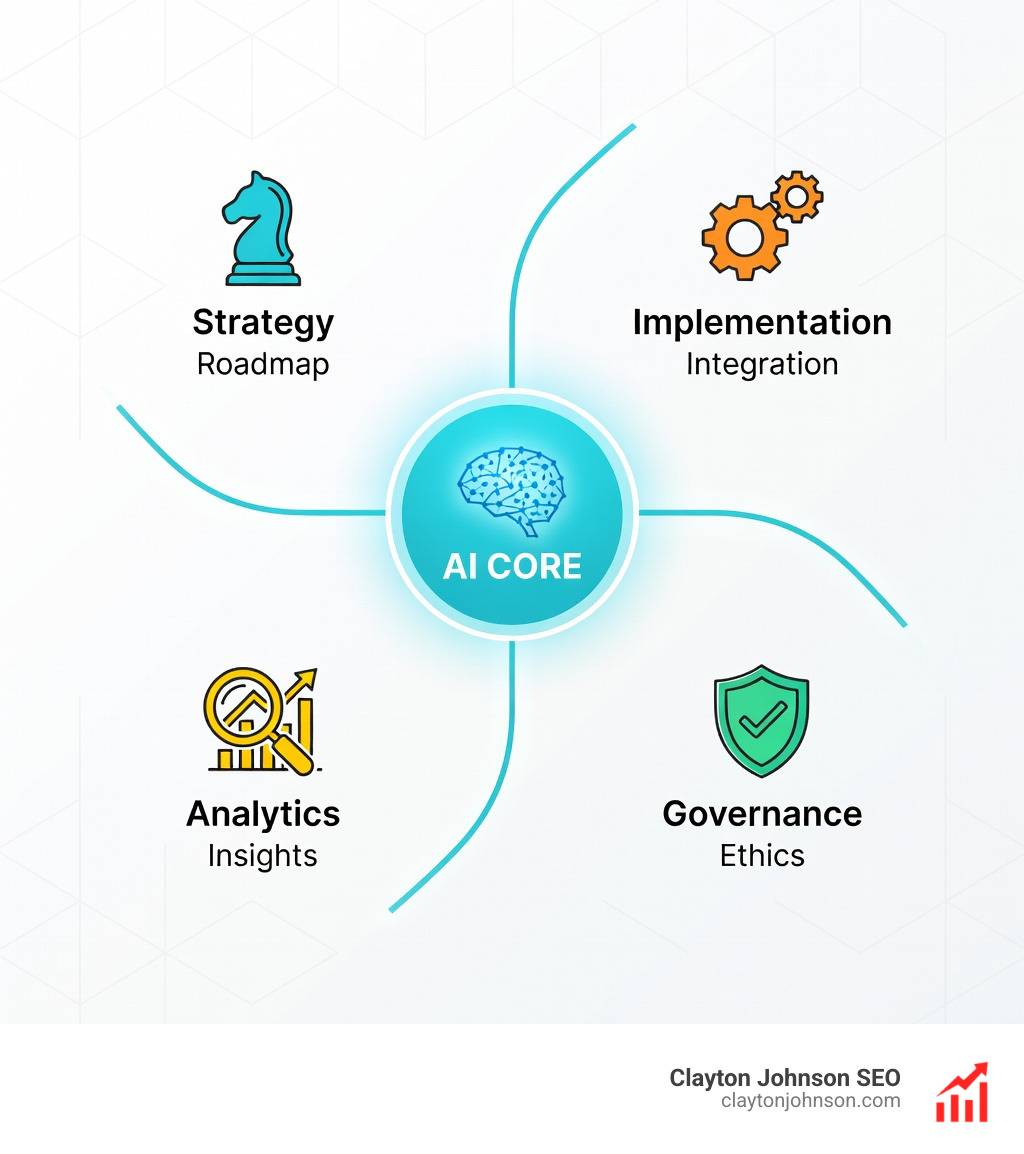
Artificial Intelligence (AI) Services and Consulting help organizations design, build, and scale AI solutions that deliver measurable business impact. These services include strategic guidance, technical implementation, data engineering, governance frameworks, and ongoing model management—ensuring AI moves from pilot to production responsibly and effectively.
What AI consulting typically includes:
- Strategic planning – Assessing readiness, aligning AI with business goals, and prioritizing high-value use cases
- Technical delivery – Building custom models, integrating platforms, and deploying solutions
- Operational support – Monitoring performance, retraining models, ensuring compliance, and scaling across the organization
- Governance and ethics – Establishing responsible AI frameworks, managing bias, and building Centers of Excellence
AI is expected to drive trillions of dollars in annual productivity gains. Yet many companies struggle to move beyond experimentation. AI consulting bridges that gap—turning potential into operational advantage through structured implementation, proven frameworks, and cross-industry expertise.
The challenge isn’t whether to adopt AI. It’s how to implement it without wasting resources, creating compliance risk, or deploying systems that fail to deliver ROI. Organizations that treat AI as infrastructure—not just tooling—position themselves to compete in markets increasingly shaped by intelligent automation, predictive analytics, and AI-enhanced decision-making.
I’m Clayton Johnson, and I’ve spent years helping organizations build scalable AI-augmented marketing systems and strategic frameworks that align technical capability with business outcomes. My work in Artificial Intelligence (AI) Services and Consulting focuses on turning fragmented AI efforts into cohesive growth engines that compound over time.
What are Artificial Intelligence (AI) Services and Consulting?
In the simplest terms, Artificial Intelligence (AI) Services and Consulting act as the bridge between a company’s raw data and its future competitive advantage. While many business leaders see AI as a “black box” of mysterious algorithms, consultants provide the strategic guidance and technical expertise needed to open that box and make it work for a living.
We view AI not as a standalone tool, but as a layered business enabler. To turn AI into enterprise impact, organizations must embed intelligence directly into core workflows. This isn’t just about writing code; it’s about project management, data engineering, and creating a long-term AI roadmap that ensures every dollar spent on technology correlates to a dollar earned in efficiency or growth.

Core Offerings within Artificial Intelligence (AI) Services and Consulting
When you engage with professional AI services, you aren’t just getting a chatbot. You are accessing a suite of sophisticated technologies designed to solve specific business problems. These offerings typically fall into several key buckets:
- Predictive Analytics: Using historical data to forecast future trends, such as customer churn or supply chain disruptions.
- Natural Language Processing (NLP): Enabling machines to understand, interpret, and generate human language—essential for sentiment analysis and automated customer support.
- Computer Vision: Training systems to identify and process images and videos, often used in quality control for manufacturing.
- Intelligent Automation: Combining AI with Robotic Process Automation (RPA) to handle complex, end-to-end business processes without human intervention.
How AI Strategy Consultants Demystify Value
The biggest hurdle for most organizations is simply knowing where to start. AI strategy consultants help by performing a thorough “readiness assessment.” They look at your current data stack, your team’s skills, and your existing technology to assess readiness and align on goals, and build a roadmap.
By mapping capabilities to specific business challenges, consultants mitigate the risk of “shiny object syndrome.” They ensure that the AI solutions you build are designed to solve real problems—not just to showcase cutting-edge technology for its own sake.
Overcoming the Barriers to AI Adoption
Even with a clear vision, the path to AI maturity is often blocked by legacy hurdles. Data fragmentation is a primary culprit; when information is trapped in silos across different departments, AI models cannot “see” the full picture. Furthermore, the talent gap remains a significant issue—there simply aren’t enough data scientists to go around.
This is where organizations can benefit from the knowledge of AI strategy consultants. Consultants bring structured methodologies and proven frameworks that help bridge the gap between a successful pilot project and an enterprise-wide rollout. They help navigate the “valley of death” where many AI experiments fail due to ROI uncertainty or poor integration with legacy systems.
Navigating AI Governance, Ethics, and Security
As we lean more heavily on autonomous systems, the ethical aspects of AI become paramount. Responsible AI isn’t just a buzzword; it’s a business necessity. Without proper governance, AI models can inherit human biases, leading to reputational damage or legal liabilities.
Consulting firms help establish an AI Center of Excellence (COE). This internal body oversees data privacy, manages compliance requirements, and implements bias detection protocols. By building “governance by design,” we ensure that AI remains a source of value rather than a liability.
Building an AI-Ready Culture
Technology is only half the battle. To truly succeed, leaders must learn how to build an AI-ready culture. This involves comprehensive workforce upskilling and change management. We believe the future belongs to “hybrid intelligence”—the seamless collaboration between human creativity and machine precision.
Industry Impact and Real-World Applications
The impact of Artificial Intelligence (AI) Services and Consulting is no longer theoretical. The expected multi-trillion dollar annual productivity gain will be felt across every sector of the economy.
The Business Value of Artificial Intelligence (AI) Services and Consulting
The numbers tell a compelling story of what happens when strategy meets execution:
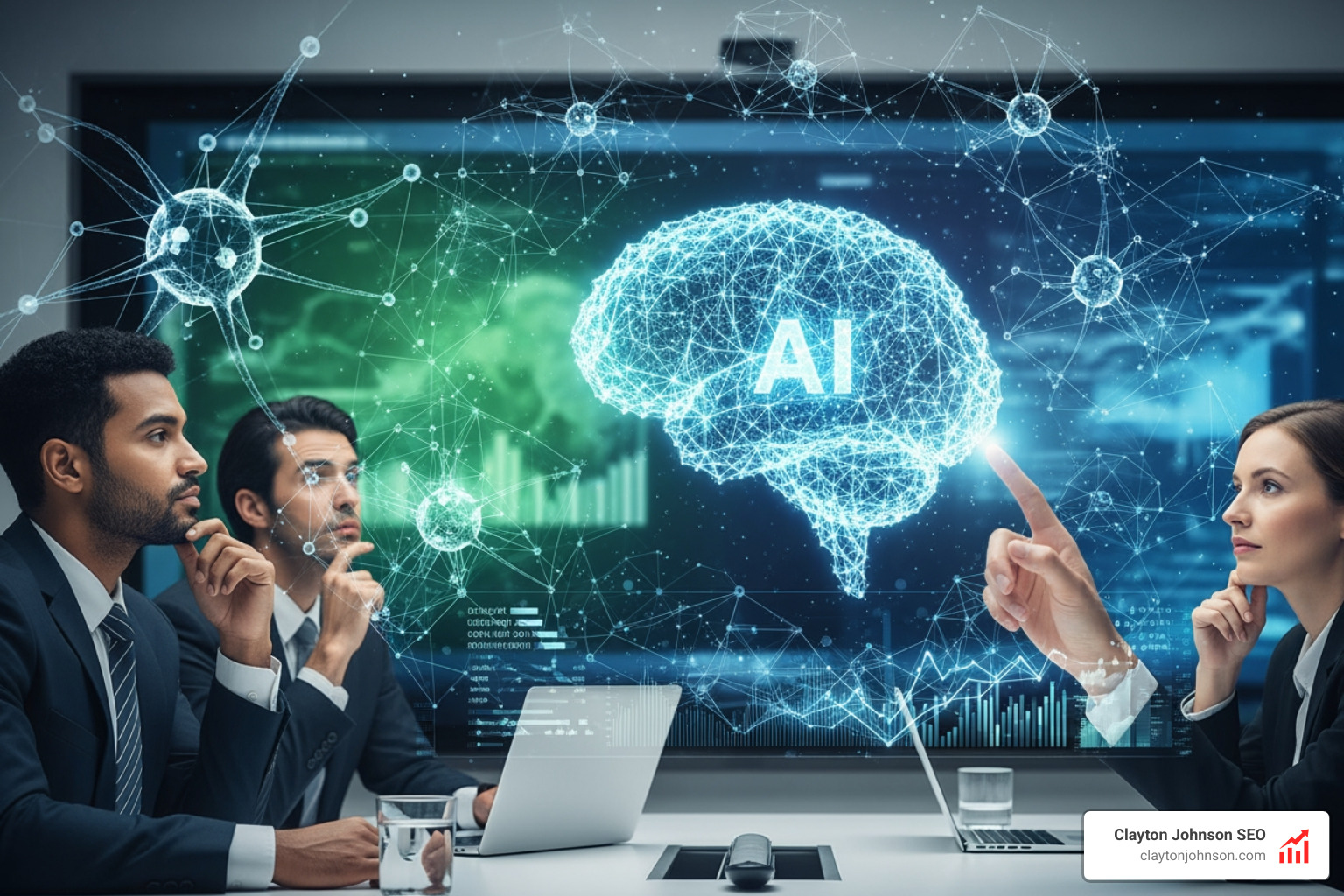
- Healthcare Accuracy: A cancer regimen reclassification model resulted in an 85% classification accuracy, drastically improving patient care.
- Speed to Insight: In the telecommunications sector, a GenAI-powered text-to-SQL query generator reduced query completion time from two days down to just 45 seconds.
- Financial Efficiency: AI/ML models in credit and collections have dropped call-center dependency by 12% while increasing total payments by 5–10%.
These statistics demonstrate that AI isn’t just about saving time; it’s about unlocking entirely new levels of performance.
Sector-Specific AI Solutions
Different industries require different approaches. In healthcare, “Digital Teammates” are being deployed to answer patient questions 24/7, picking up on verbal and non-verbal cues to provide human-like interaction. In manufacturing, predictive maintenance models anticipate equipment failure before it happens, saving millions in downtime.
The rise of “Agentic AI”—systems that can autonomously take actions to achieve a goal—is the next frontier for sectors ranging from finance to energy utilities.
The AI Implementation Lifecycle: From Strategy to Scale
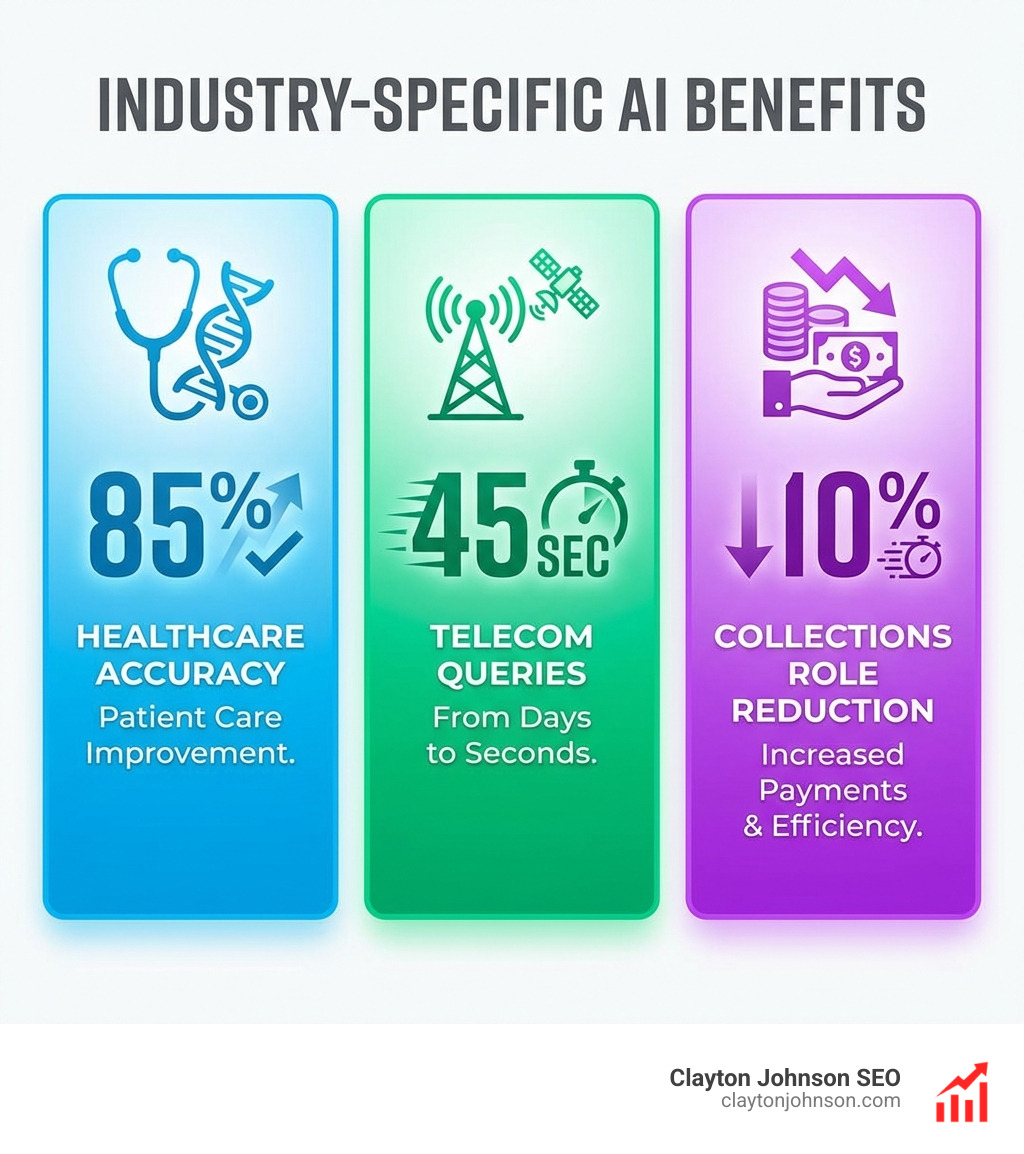
Successful AI implementation follows a rigorous lifecycle. It’s a marathon, not a sprint.
| Feature | AI Strategy | AI Execution |
|---|---|---|
| Focus | Opportunity & Risk | Building & Deploying |
| Goal | Alignment & Roadmap | Value Creation & ROI |
| Key Activity | Discovery Workshops | Model Development |
| Outcome | Prioritized Use Cases | Scalable Production Systems |
Phase 1: Define and Strategize
We start by aligning AI plans with organizational goals. This involves discovering where AI creates real value—given your specific challenges—and identifying the “smallest viable production slice” that can provide immediate feedback. This is the foundation of building an AI-ready culture.
Phase 2: Build and Deploy
This phase is where the heavy lifting happens. We move from rapid prototyping to custom model development. Whether it’s integrating with existing enterprise platforms or building bespoke MLOps pipelines, the goal is to get a working solution into the hands of users as quickly as possible.
Phase 3: Operate and Scale
Post-launch management is critical. AI models are not “set and forget.” They require continuous monitoring for “model drift,” regular retraining with new data, and constant performance benchmarking to ensure they stay aligned with business needs.
Frequently Asked Questions about AI Consulting
How do I choose the right AI consulting partner?
Look for a partner with deep industry experience in Minneapolis and a focus on outcomes rather than just “cool tech.” A good firm offers full-lifecycle support—from the initial strategy to long-term scaling—and acts as an extension of your internal team.
What is the typical engagement process for AI services?
Most engagements begin with a discovery call or workshop to assess technical feasibility. This is followed by a Proof of Concept (PoC) to demonstrate value. Once proven, the solution is scaled enterprise-wide with ongoing maintenance and governance support.
How do AI services cater to different maturity levels?
- Beginners: Focus on foundational data cleanup and executive education.
- Intermediate: Move from pilot experimentation to building a centralized AI Center of Excellence.
- Mature: Focus on advanced autonomous orchestration and “Agentic” solutions that drive compounding growth.
Conclusion: Building Your Structured Growth Architecture
At the end of the day, using AI is no longer a choice; it’s a necessity. But the goal isn’t just to “have AI”—the goal is to have AI that does useful work. Most companies don’t lack the desire to innovate; they lack the structured growth architecture to make it happen.
At Clayton Johnson, we are building Demandflow.ai to solve this exact problem. We believe that clarity leads to structure, which leads to leverage, and ultimately, compounding growth. Our approach combines taxonomy-driven SEO systems with AI-augmented marketing workflows to turn your AI ambitions into a scalable reality.
Whether you are looking for a More info about SEO content marketing or a complete overhaul of your growth infrastructure, we help you bridge the gap between sci-fi dreams and measurable business results.
Let’s build the infrastructure for your next decade of growth. Reach out to us in Minneapolis, Minnesota, and let’s turn your data into your most powerful competitive advantage.