Chill Out and Prioritize with the ICE Framework


Why Product Backlogs Need Simple Prioritization
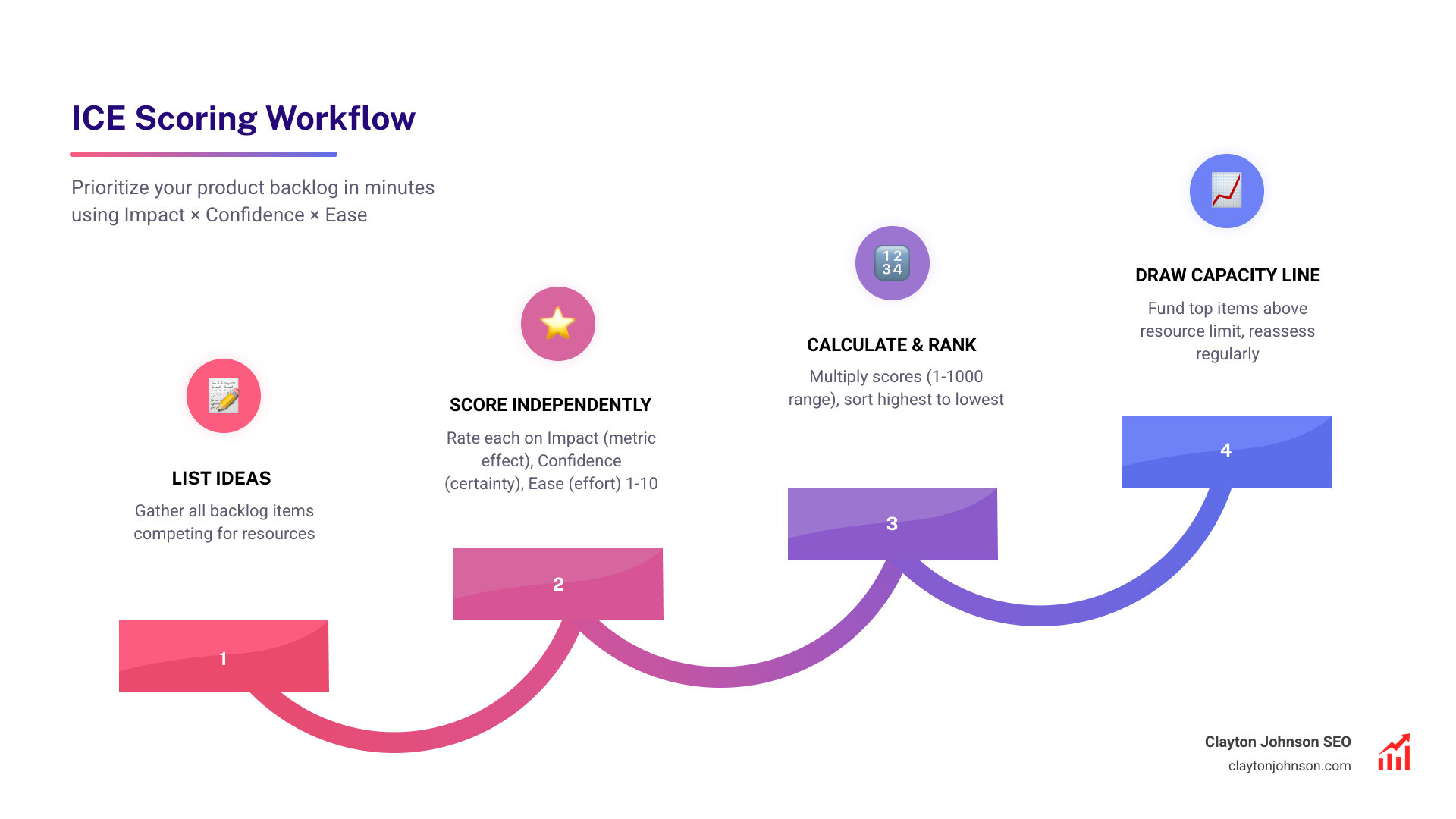
ICE framework product backlog prioritization helps teams quickly score and rank features, experiments, or initiatives by multiplying three factors: Impact (how much it moves your key metric), Confidence (certainty it will work), and Ease (how simple it is to implement). Each factor is rated 1-10, producing scores between 1 and 1,000 that reveal which work delivers the most value with the least effort.
Quick ICE Scoring Steps:
- List all backlog items competing for resources
- Score each on Impact (1-10), Confidence (1-10), and Ease (1-10)
- Multiply the three scores: Impact × Confidence × Ease
- Rank items from highest to lowest score
- Fund the top items within your capacity line
Here’s the inconvenient truth about most prioritization frameworks: they demand data you don’t have. RICE wants reach estimates, but your product hasn’t launched yet. WSJF needs business value quantification, but you’re pre-revenue. MoSCoW assumes you know what’s a must-have, but the market just pivoted last week.
Sean Ellis invented the ICE framework to solve exactly this problem. As the growth hacker who coined “growth hacking” itself, Ellis watched teams spend weeks arguing about perfect priority scores while competitors shipped. He designed ICE to be deliberately simple—a minimally viable prioritization framework that moves teams from analysis paralysis to execution velocity.
The brilliance isn’t just speed. It’s that ICE forces brutal honesty without demanding data you don’t have. You can score an entire backlog in a 90-minute workshop rather than 90 days of estimation theater. Features can be evaluated in 90 seconds each. The framework surfaces which ideas deserve resources now based on what you know today, not what you wish you knew.
But speed creates risk. Without discipline, ICE scoring collapses into gut feelings dressed as numbers. Impact becomes wishful thinking. Confidence inflates to avoid looking uncertain. Ease gets gamed to favor pet projects. The result? Your backlog stays prioritized, but the wrong work gets built.
This guide shows you how to implement ICE framework product backlog prioritization correctly—with scoring rubrics that reduce subjectivity, distribution constraints that prevent inflation, and portfolio balance rules that keep you from incrementally improving yourself into irrelevance.
I’m Clayton Johnson, and I’ve helped founders build SEO and growth systems that compound rather than spike. I’ve seen teams use ICE framework product backlog scoring to ship validated wins faster while maintaining strategic balance between quick experiments and audacious bets. The framework works—but only when you understand both its power and its limits.
Discover more about ice framework product backlog:
What is the ICE Framework Product Backlog Method?
The ICE framework was invented by Sean Ellis), the pioneer of Growth Hacking, to help teams move fast without losing their strategic North Star. In the context of a product backlog, it serves as a “good enough” estimation tool. While more rigorous models exist, they often fail in early-stage environments where data is thin and momentum is everything.
At its core, the ice framework product backlog method is a relative value system. It doesn’t tell you the absolute ROI of a feature in dollars; instead, it tells you that Feature A is likely more valuable than Feature B based on your current knowledge. This makes it a “minimally viable prioritization” tool—perfect for when you have 100 ideas and only enough resources to build five.
Breaking Down the ICE Components
To use the framework effectively, we must define exactly what we are measuring. Without clear definitions, one person’s “7” is another person’s “3.”
- Impact: This measures how much the initiative will contribute to your primary goal. If your goal is increasing sign-ups, a new landing page has high impact; a dark mode toggle likely has low impact.
- Confidence: This is the “honesty filter.” How sure are you that your Impact and Ease estimates are correct? Are you basing this on a gut feeling (Score: 1) or a successful small-scale test (Score: 10)?
- Ease: This represents the inverse of effort. A feature that takes one afternoon to ship is “Easy” (Score: 10). A feature requiring a three-month infrastructure overhaul is “Difficult” (Score: 1).
By focusing on these three parameters, we balance business value (Impact), risk (Confidence), and technical feasibility (Ease).
How to Calculate Your ICE Scores
Calculating an ICE score is straightforward, but the nuances matter. The standard formula is: Impact × Confidence × Ease = ICE Score.
Using a 1-10 scale for each component, your final scores will range from 1 to 1,000. Some teams prefer averaging (adding the three scores and dividing by three), but multiplication is often superior for a ice framework product backlog because it exaggerates the differences between items. A small drop in confidence can significantly pull down a high-impact idea, which is exactly the kind of risk-awareness you want in a fast-moving team.

Step-by-Step ICE Framework Product Backlog Scoring
To avoid groupthink and bias, we recommend a structured approach to scoring:
- Idea Listing: Gather all stakeholders and list every potential initiative in your backlog.
- Independent Scoring: Have team members score each item on their own first. This prevents the “HiPPO” (Highest Paid Person’s Opinion) from dominating the room.
- Team Consensus: Review the scores. If one person gave an item a 9 on Ease and another gave it a 2, you’ve identified a massive misunderstanding of the technical requirements. Discuss and align.
- Ranking: Sort the list by the final ICE score.
- The Capacity Line: Determine how many items your team can actually ship in the next cycle (e.g., the next two weeks). Draw a line under the top-scoring items that fit that capacity.
One of the best ways to improve accuracy is to use The Confidence Meter by Itamar Gilad. It provides a rubric for the “Confidence” score based on evidence: a “1” is an opinion, a “4” is a user interview, and a “10” is a large-scale A/B test result.
Benefits and Strategic Use Cases
The primary benefit of the ice framework product backlog is speed. Features can be scored in as little as 90 seconds. Instead of a 90-day planning cycle, an entire backlog can be prioritized in a 90-minute workshop.
Real-world results back this up. Airbnb famously saw bookings increase 2.5x after prioritizing a “professional photography” idea that scored high on the ICE scale. A D2C apparel brand achieved a +420 bps checkout conversion lift in just 8 weeks by applying ICE to their growth backlog, focusing on high-ease, high-confidence wins first.
When to Use the ICE Framework Product Backlog
ICE is most effective in high-velocity, high-uncertainty environments:
- Early-Stage Startups: When you are still searching for product-market fit and don’t have years of historical data.
- Growth Squads: When running rapid experiments where the goal is to “fail fast” and learn.
- MVP Development: When you need to decide which “must-haves” are actually achievable for launch.
For more established brands looking to scale their digital presence, combining ICE with SEO content marketing services ensures that you aren’t just shipping fast, but shipping things that build long-term authority.

Overcoming Limitations and Avoiding Pitfalls
The biggest criticism of ICE is its subjectivity. If you aren’t careful, “Confidence” becomes a proxy for “how much I like this idea.” To combat this, we use distribution constraints. For example, you might mandate that no more than 20% of your backlog can have an Impact score of 9 or 10. This forces the team to be more selective.
Another common pitfall is the “low-hanging fruit” trap. Because “Ease” is a multiplier, the framework naturally favors small, easy tasks. If you only follow the scores, you might miss the “big swings” that lead to 10x growth. We recommend dedicating at least 20% of your experiment portfolio to these big swings, even if their ICE scores are lower due to low Ease.
ICE vs. RICE: Choosing the Right Model
As a company matures, it may transition from ICE to RICE. The “R” in RICE stands for Reach (how many users will see this?).
- Use ICE when: You are a small team, in an early stage, or testing new markets where audience size is roughly the same for all ideas.
- Use RICE when: You have a large user base and some features will affect 100% of users while others only affect 2%. In this case, Reach becomes a critical tie-breaker.
Frequently Asked Questions about ICE Prioritization
How often should we update ICE scores?
Scores are not “set it and forget it.” You should re-assess your top 10 items at least every two sprints. New data from a failed experiment might drop the “Confidence” of a related feature from an 8 to a 2. Conversely, a successful pilot might turn a low-confidence idea into your next top priority.
Can ICE be used for non-product initiatives?
Absolutely. The ice framework product backlog logic applies perfectly to marketing campaigns, retention efforts, and even operational tasks. If you have more work than time, you need a way to rank that work by impact and effort.
How do you handle ties in scoring?
In reality, a score of 450 vs 448 is a tie. Don’t overthink the math. If two items are tied, look at team enthusiasm or strategic alignment. If one feature is a “big swing” and the other is a “quick fix,” choose based on what your current portfolio needs most. Remember: ICE is a tool, not a rule.
Conclusion
The ice framework product backlog is more than just a spreadsheet; it’s a philosophy of structured growth. It moves teams away from “whoever shouts loudest wins” and toward a culture of evidence-based decision-making. By balancing Impact, Confidence, and Ease, you ensure that your limited resources are always focused on the highest-leverage opportunities.
At Demandflow.ai, we believe that most companies don’t lack ideas—they lack the structured growth architecture to execute them. Whether you are a founder in Minneapolis or a marketing leader scaling a global SaaS, clarity comes from structure.
Ready to turn your backlog into a growth engine? Work with me to build a custom growth operating system that moves the needle.