Winning the AI Search Era with Intent Based Keyword Research

The Evolution of Intent Based Keyword Research
Traditional SEO used to be a game of “string matching.” If a user typed “blue running shoes,” you made sure that exact phrase appeared in your H1, three times in your body copy, and in your alt text. This was known as lexical search, where the engine simply looked for the presence of specific characters. But search engines have grown up. They no longer just see letters; they see concepts, relationships, and the underlying human motivation behind the query.
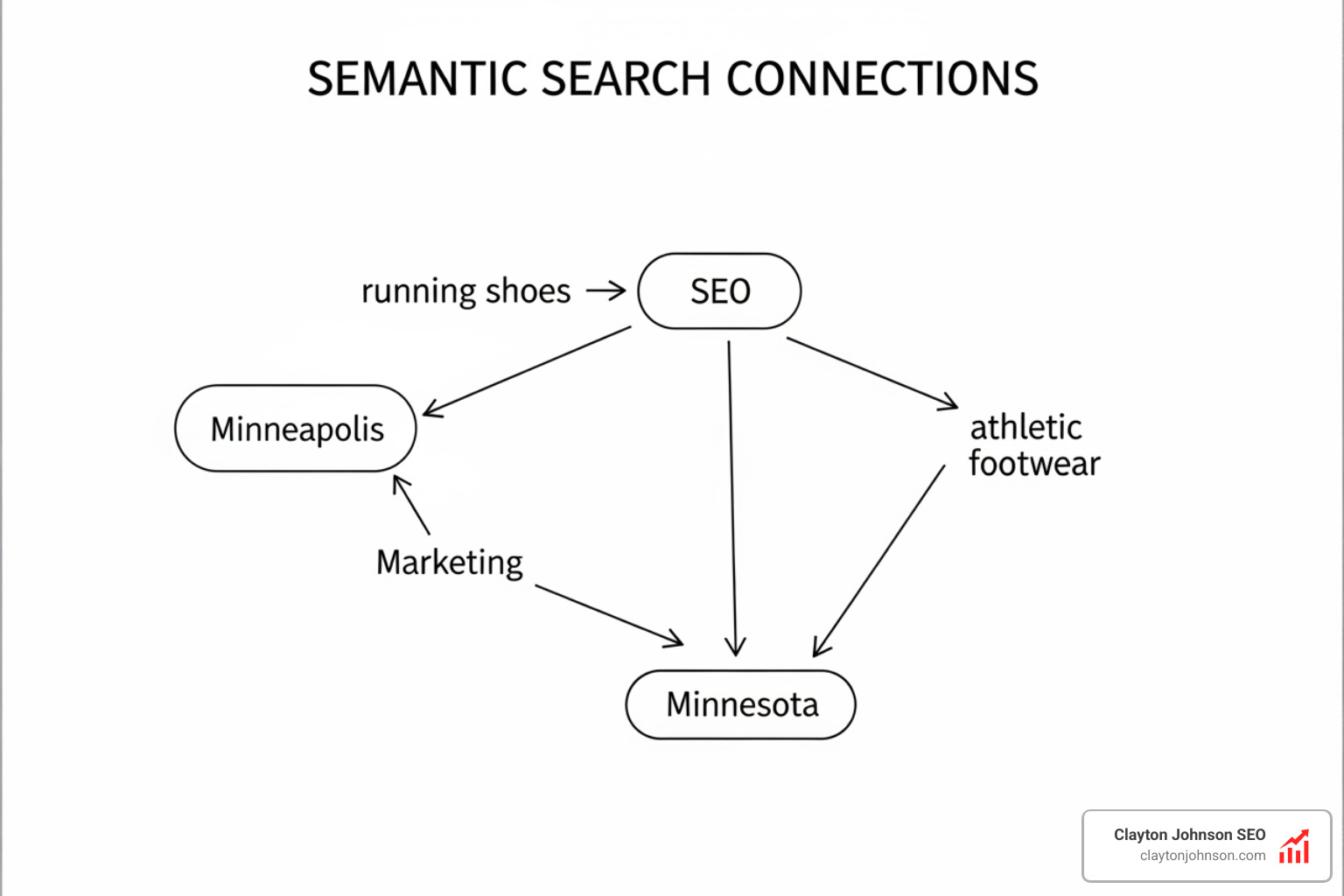
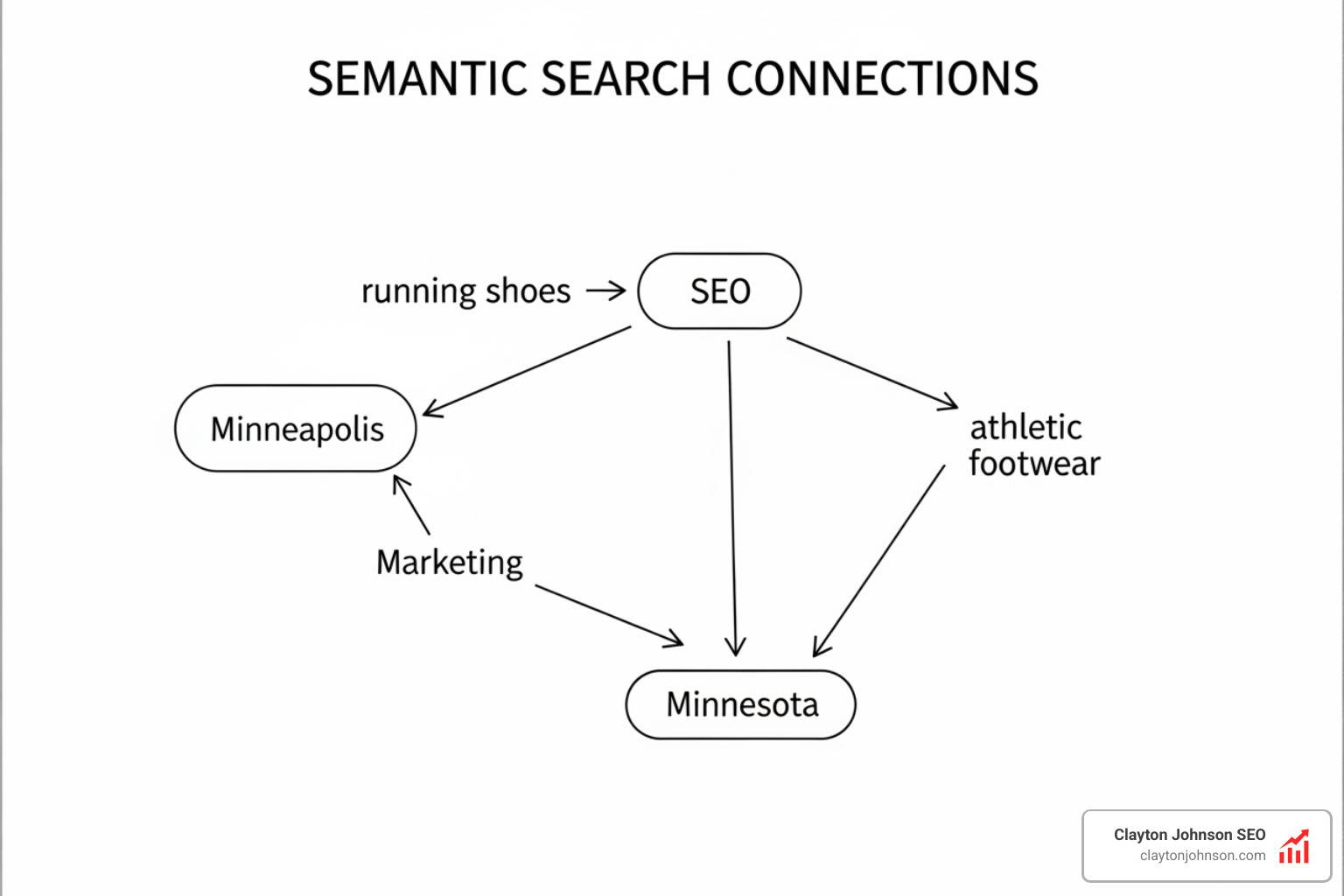
This shift began with semantic search. Instead of looking at keywords in isolation, Google now uses entities (people, places, things) and the Knowledge Graph to understand relationships. For example, if you search for “Mercury,” Google uses context to decide if you want the planet, the car brand, or the element. This contextual understanding allows the engine to serve results that match the user’s mental model rather than just their literal words.
Several major algorithm updates have cemented the importance of Intent based keyword research:
- RankBrain: Introduced machine learning to help Google process never-before-seen queries by guessing what the user meant based on similar patterns.
- BERT: Helped the engine understand the nuance of prepositions and conversational language, moving away from keyword-stuffing toward natural language processing.
- MUM: The Multitask Unified Model, which is significantly more powerful than previous iterations and can understand information across text, images, and dozens of different languages simultaneously to solve complex user needs.
According to the Search Quality Evaluator Guidelines, Google’s human raters are specifically instructed to look for how well a page satisfies the “Needs Met” rating. This is where intent velocity comes in. Pages that perfectly match the dominant intent pattern accelerate Google’s evaluation cycle. Research shows that intent-aligned content can achieve ranking improvements 3.7x faster than traditional methods because the engine recognizes the high utility of the content immediately. If you’re looking for professional guidance on navigating these shifts, you can find more info about SEO consultancy here.
Decoding the Four Pillars of Search Intent
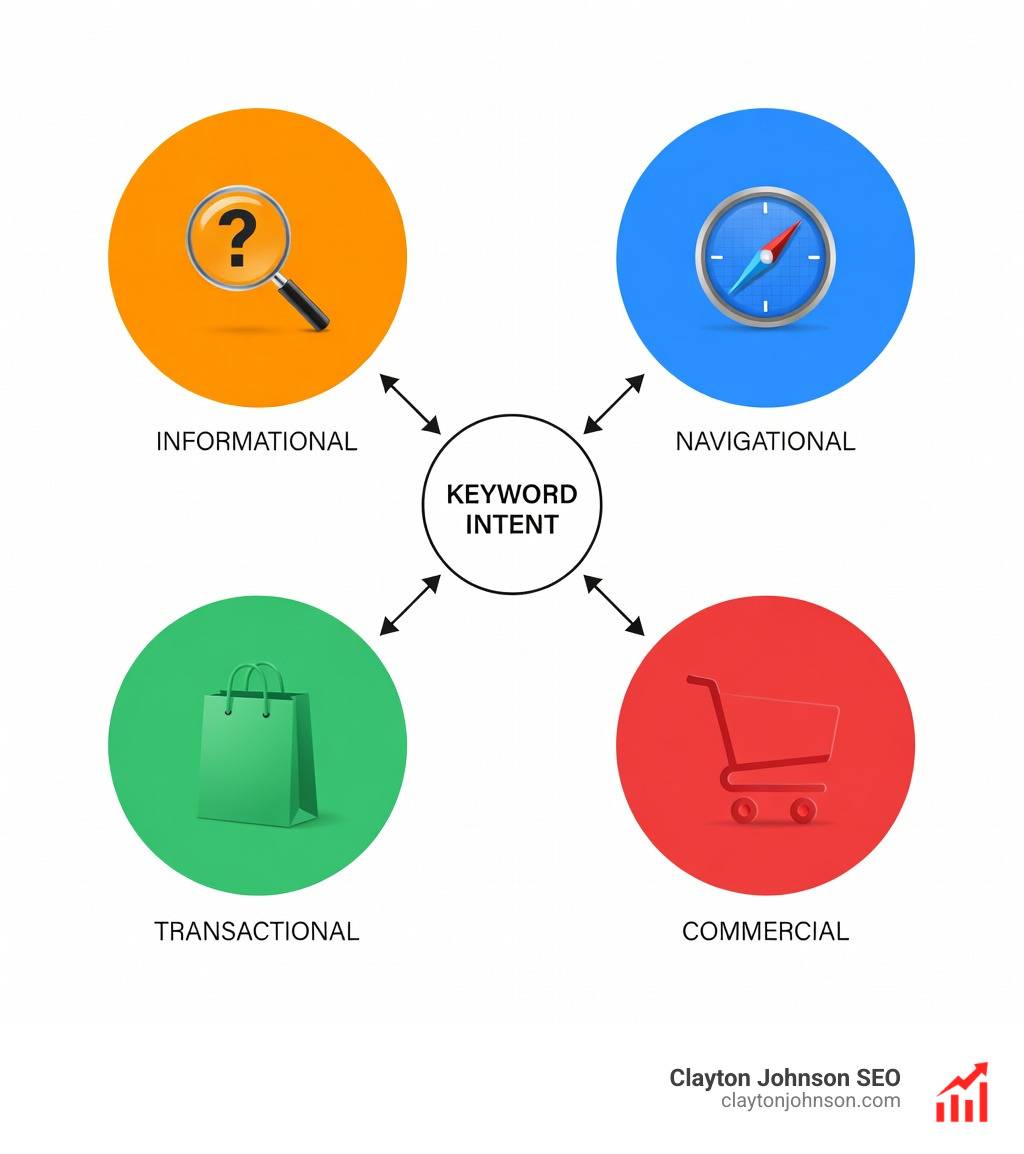
To win at Intent based keyword research, we must categorize the messy world of human curiosity into four distinct buckets. These pillars dictate the format of the content we build and the specific metrics we use to measure success. Without this categorization, you risk creating high-quality content that never ranks because it doesn’t match the user’s current stage in the buyer journey.
| Intent Type | User Goal | Common SERP Features | Content Format |
|---|---|---|---|
| Informational | “I want to know” | Featured Snippets, PAA, Knowledge Panel | Guides, Blog Posts, Videos |
| Navigational | “I want to go” | Site Links, Brand Knowledge Panel | Login pages, Homepage, Contact |
| Commercial | “I want to compare” | Reviews, Comparison Tables, Ads | Listicles, “Best of” lists, Reviews |
| Transactional | “I want to buy” | Product Carousels, Shopping Ads | Product pages, Pricing, Checkouts |
Google further refines these in their internal documentation as “Know” (Informational), “Do” (Transactional), “Website” (Navigational), and “Visit-in-person” (Local intent). For a business in Minneapolis, “Visit-in-person” intent is critical for capturing local foot traffic. Understanding how Google ranks results is vital because the search engine results page (SERP) layout itself tells you what the intent is. If the SERP is full of “People Also Ask” boxes, it’s an informational query. If it’s covered in “Shopping” results, it’s transactional.
By mapping your keyword list to these pillars, you ensure that your content strategy is balanced. You don’t want a site that only focuses on “Buy” terms while ignoring the “Know” terms that build authority and trust early in the funnel. For those looking to scale their reach, our SEO content marketing services focus on mapping these pillars to your specific buyer journey to create a compounding growth engine.
A Practical Framework for Intent Based Keyword Research
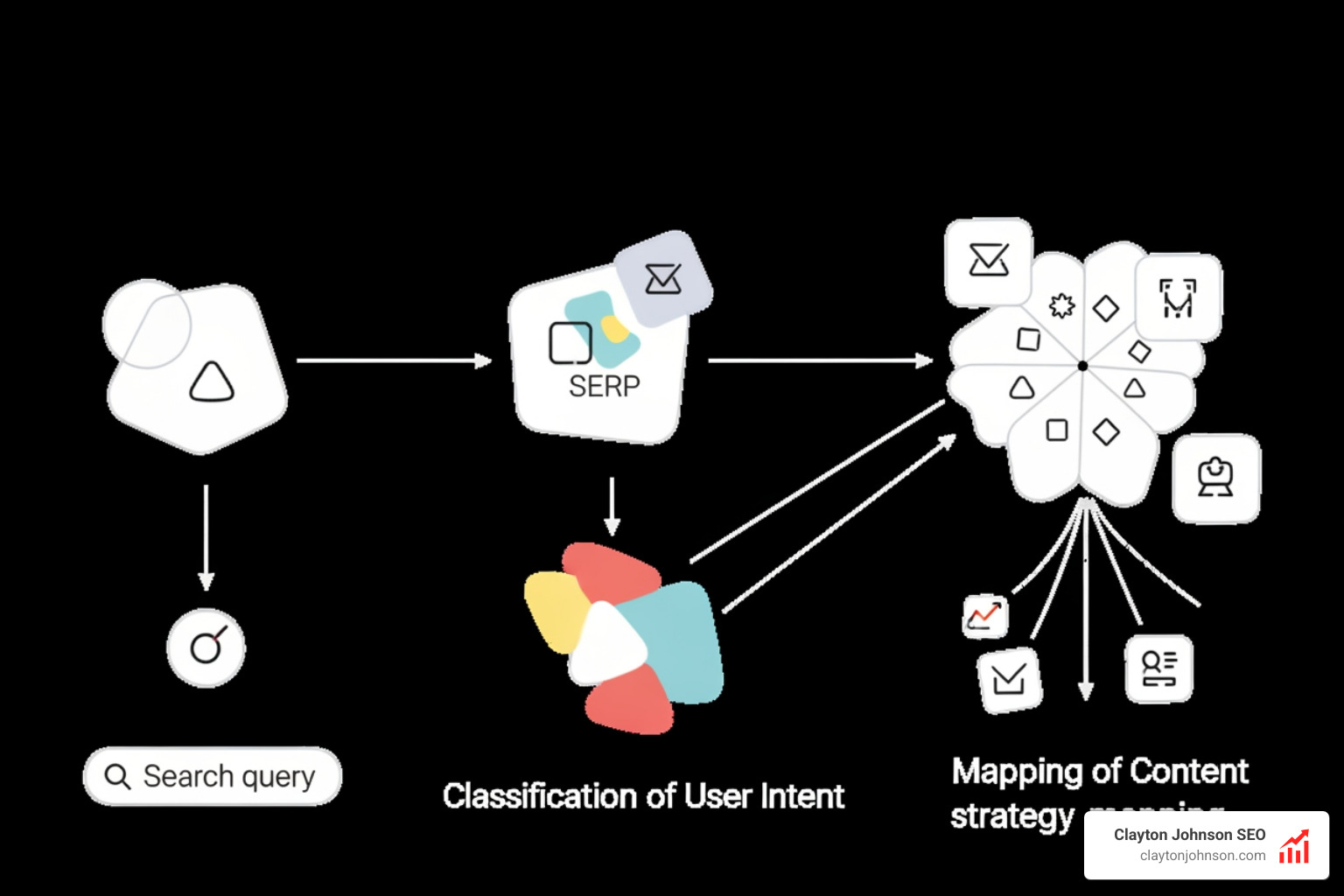
We don’t just “guess” intent; we build a structured architecture for it. At Demandflow.ai, we believe in a “Taxonomy-driven” approach. This means organizing your site into topic clusters where a central pillar page (broad intent) links to several cluster pages (specific, long-tail intents). This structure signals to search engines that you have deep expertise across an entire subject area, not just a single keyword.
Identifying Intent Through SERP Analysis
The SERP is your best friend and the most accurate real-time data source for intent. Before writing a single word, search for your target keyword in an incognito window. Look for:
- Featured Snippets: Signals “Know-Simple” intent where users want a quick, direct answer.
- People Also Ask (PAA): Reveals the “layered” intent and sub-topics users care about, helping you structure your H2s and H3s.
- Content Formats: Are the top results listicles, videos, or product pages? Don’t try to rank a product page for a keyword where Google only shows “how-to” guides; you will be fighting the algorithm’s own data on user preference.
Building Your Intent Based Keyword Research List
Start by gathering your core keywords—the basic terms for your products or services. Then, apply intent modifiers. These are “trigger words” that reveal the user’s stage in the funnel:
- Informational Modifiers: “How to,” “What is,” “Guide,” “Tips,” “History of,” “Examples,” “Tutorial,” “Benefits of.”
- Commercial Modifiers: “Best,” “Review,” “Vs,” “Top,” “Comparison,” “Alternative to,” “Pros and cons.”
- Transactional Modifiers: “Buy,” “Price,” “Coupon,” “Shipping,” “Order,” “Discount,” “For sale,” “Affordable.”
Don’t forget language localization and geographic nuances. A user in Minneapolis searching for a “pram” might get different results than one searching for a “stroller.” Using tools for analytics and data helps us audit these lists to ensure we are balancing search volume with actual business value. We look for the “sweet spot” where high intent meets manageable competition, creating a clear path for growth.
Optimizing for AI Overviews and Prompt Intent
The rise of AI search (Google’s AI Overviews) has introduced a new concept: Prompt Intent. Users are no longer just typing keywords; they are entering multi-step queries like, “What is the best SEO strategy for a Minneapolis startup that needs leads in a specific timeframe?” These queries are conversational, complex, and require the engine to synthesize information from multiple sources.
To win here, you need semantic depth. This means your content must demonstrate a complete understanding of a topic’s entities and relationships. We use an Answer-First structure to ensure both users and AI models can find the core value immediately:
- Direct Answer: Provide a concise definition or answer in the first paragraph (approx. 40-60 words).
- Semantic Expansion: Use H3s to cover related concepts, technical components, and common follow-up questions.
- Schema Markup: Use FAQPage, HowTo, and Product schema to help LLMs (Large Language Models) cite your content as a primary source.
This creates an “Authority Feedback Loop.” When an AI cites your content for a complex, long-tail prompt, it builds your E-E-A-T (Experience, Expertise, Authoritativeness, Trustworthiness), which eventually helps you rank for shorter, high-volume terms. This is the essence of modern growth architecture—building a foundation that serves both current search algorithms and future generative engines. For more on turning that traffic into revenue, check our conversion optimization strategies.
Measuring Success with Intent-Driven KPIs
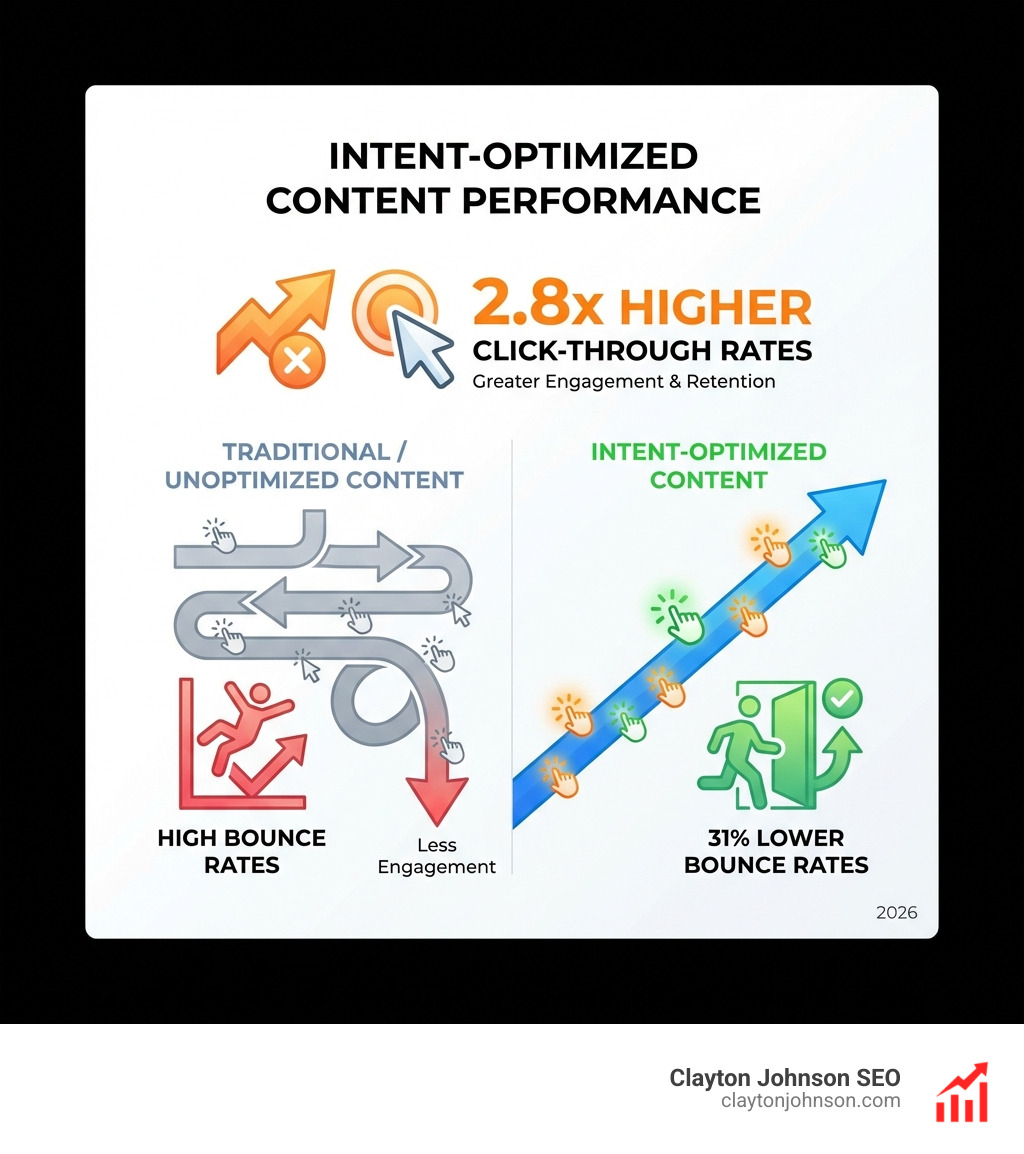
Traditional metrics like “keyword position” are becoming less relevant in an era of personalized and AI-driven search. If you rank #1 but have a 90% bounce rate, you’ve failed the intent test. The user didn’t find what they were looking for, and Google will eventually demote you. Instead, we monitor metrics that reflect true user satisfaction:
- Average Engagement Time: Does the user stay long enough to consume the content? High engagement suggests the intent was met.
- SERP Feature Ownership: Are you winning the Featured Snippet or the AI Overview citation? These are the new “Position Zero.”
- Branded Search Volume: Does your intent-driven content lead to more people searching for your brand name later? This is a sign of growing authority.
- Conversion Paths: Are users moving from an informational blog post to a commercial comparison page? This shows your content is successfully guiding them through the funnel.
While SEO is our primary engine, these insights often inform our paid advertising campaigns. By knowing which keywords have the highest transactional intent, we can bid more aggressively on those terms while using organic search to capture the top of the funnel at a lower cost per acquisition.
Frequently Asked Questions about Intent Based Keyword Research
How does intent differ from keyword difficulty?
Keyword difficulty measures competition (how many other sites are trying to rank for that specific string). Intent measures motivation (what the user actually wants to achieve). A keyword can be “easy” to rank for but have “low” business value if the intent is purely academic and doesn’t lead to a sale. Conversely, a high-difficulty keyword with clear transactional intent is often worth the investment because of its high conversion potential.
Can a single keyword have multiple intents?
Yes, this is called Mixed Intent or fragmented intent. For example, “Google Analytics” could be navigational (someone trying to log in) or informational (someone wanting to know what it is). Google usually handles this by showing a “fragmented SERP” with different types of results. In these cases, we recommend layering your content to address the dominant intent while providing clear paths for secondary goals, such as a “Login” button for navigational users and a “What is GA?” section for informational users.
How do I optimize for transactional intent?
Transactional pages should be built for direct action and minimal friction.
- Place your primary CTA (Call to Action) above the fold so it’s visible without scrolling.
- Use “trust signals” like customer reviews, security badges, and clear return policies.
- Reduce friction by ensuring fast load times and minimal form fields in the checkout process.
- Use FAQ schema to answer last-minute objections directly on the product page.
For many businesses, supporting these transactional pages with email marketing is the best way to close the loop with users who weren’t quite ready to buy on the first visit but showed high intent by visiting the page.
Conclusion
Winning the AI search era isn’t about chasing the latest algorithm hack. It’s about building a structured growth architecture that respects the user. By mastering Intent based keyword research, you stop guessing and start building content that functions as a strategic asset.
At Demandflow.ai, we help founders and marketing leaders move from tactical chaos to compounding growth. We don’t just write articles; we build taxonomy-driven SEO systems and AI-augmented workflows that turn search intent into measurable revenue.
If you’re ready to stop chasing clicks and start building authority, work with me to implement a growth system that outlasts every algorithm update.