How to Scale Your AI Pilot to Production Without Stalling


Most AI Pilots Never Scale — Here’s How to Fix That
Moving an AI pilot to scale means transitioning a working proof-of-concept into a production-ready system deployed across your organization — and most companies never get there.
Here is the fast answer for those who need it:
How to move your AI pilot to scale:
- Align AI to a specific business outcome — not just a technical experiment
- Fix your data foundation — clean, governed, accessible data is non-negotiable
- Design for scale from day one — modular, API-first architecture and MLOps pipelines
- Run a phased rollout — pilot → infrastructure → department rollout → enterprise-wide
- Drive adoption top-down and bottom-up simultaneously — leadership mandate plus frontline buy-in
- Measure relentlessly — track EBIT impact, time saved, and model accuracy continuously
If you are doing all six, you are ahead of most organizations. If not, keep reading.
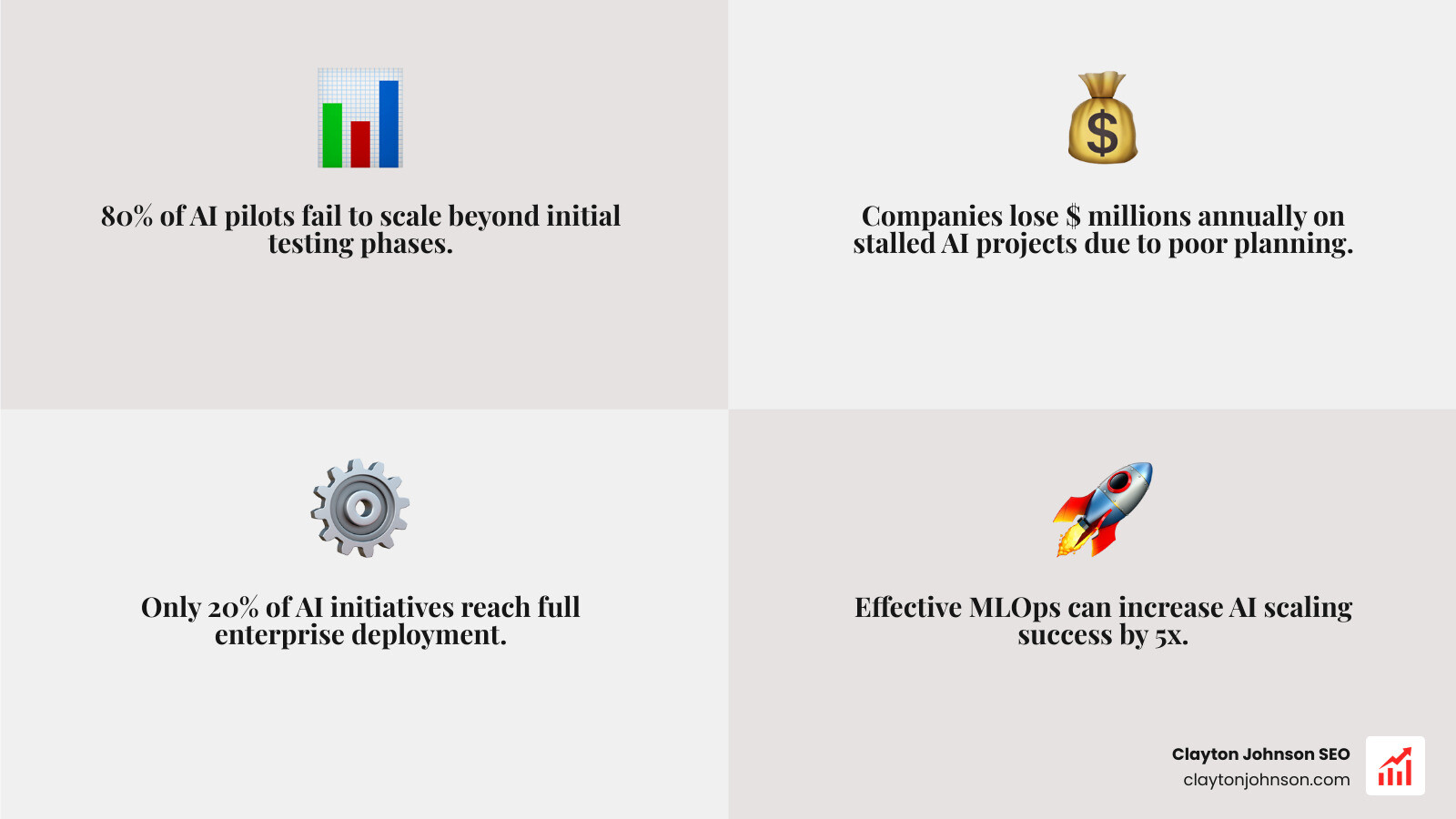
The numbers tell a sobering story. A large share of AI projects are expected to be discarded before they ever deliver meaningful ROI. Many organizations are still stuck in the experimentation phase. And only a small fraction have deployed AI at full enterprise scale, according to Capgemini research. That gap between a promising pilot and real production deployment has a name: AI pilot purgatory — and it is where most AI investments quietly die.
The frustrating part? It is rarely the AI itself that fails. The models work. The technology is ready. What breaks down is everything around it — misaligned goals, fragmented data, cultural resistance, and infrastructure that was never built to scale.
I’m Clayton Johnson, an SEO and growth strategist who has spent years building scalable systems at the intersection of AI, content architecture, and marketing operations — and helping founders and growth teams understand how to move AI pilot to scale without burning budget on dead-end experiments. In the sections ahead, I’ll walk you through a practical blueprint that addresses every layer of the problem, from technical foundations to cultural transformation.

Ai pilot to scale word guide:
Understanding AI Pilot Purgatory and Why Projects Fail

“Pilot Purgatory” isn’t just a catchy phrase; it’s a structural trap where promising AI experiments go to die. We see it all the time: a team builds a cool chatbot or a predictive model that works perfectly in a sandbox, but the moment they try to roll it out to 5,000 employees, the wheels fall off.
According to Gartner research on AI project cancellation, over 40% of agentic AI projects will be canceled due to escalating costs, unclear business value, or inadequate risk controls. When projects stay in the “experiment” phase for too long, stakeholder confidence erodes. If leadership doesn’t see a clear path to ROI, they pull the plug. To avoid this, you need to understand the root causes of failure for AI projects, which often stem from treating AI as a “cool tech project” rather than a core business capability.
Common Roadblocks to Production
Why is the jump from pilot to production so steep? It usually comes down to five main friction points:
- Data Silos and Quality: AI is only as good as the data it consumes. If your data is trapped in legacy systems or lacks a “single source of truth,” the AI will hallucinate or provide irrelevant insights.
- Skills Gaps: Scaling requires more than just data scientists. You need MLOps engineers, software developers, and change management experts.
- Cultural Resistance: If employees feel that AI is a threat to their jobs rather than a tool for empowerment, they won’t use it.
- Legacy Systems: Trying to plug cutting-edge AI into 20-year-old infrastructure is like trying to put a jet engine on a horse-drawn carriage.
- Alert Fatigue: In industrial settings, poorly tuned AI can flood workers with “false positive” notifications, leading them to ignore the system entirely.
McKinsey insights on generative AI earnings show that while 88% of companies use AI in at least one function, only one-third have actually begun scaling. Most are seeing less than a 5% impact on their EBIT because they haven’t cleared these hurdles.
The Strategic Blueprint to Move Your AI Pilot to Scale

To move an ai pilot to scale, we have to stop thinking about “projects” and start thinking about “architecture.” At Demandflow, we believe in a structured growth operating system. You wouldn’t build a skyscraper without a blueprint; you shouldn’t build enterprise AI without one either.
This starts with a comprehensive guide to AI governance. Governance isn’t about saying “no”; it’s about creating the guardrails that allow you to say “yes” faster. As Ethan Mollick on AI maturity and leadership points out, AI is not “plug and play.” It requires maturity in people, processes, and data before it can truly deliver value.
Aligning KPIs for an AI Pilot to Scale
We often see companies measuring the wrong things. “Model accuracy” is a technical metric, not a business one. To secure long-term funding, you need to align your AI initiatives with measurable outcomes. Are you trying to:
- Increase Revenue? (e.g., AI-driven churn prediction)
- Reduce Costs? (e.g., automating 80% of routine customer queries)
- Improve Efficiency? (e.g., reducing the time to process a loan from days to minutes)
By focusing on EBIT impact and growth objectives, you turn AI from a cost center into a value driver. For a deeper dive into setting these goals, learn more about enterprise AI strategy 101.
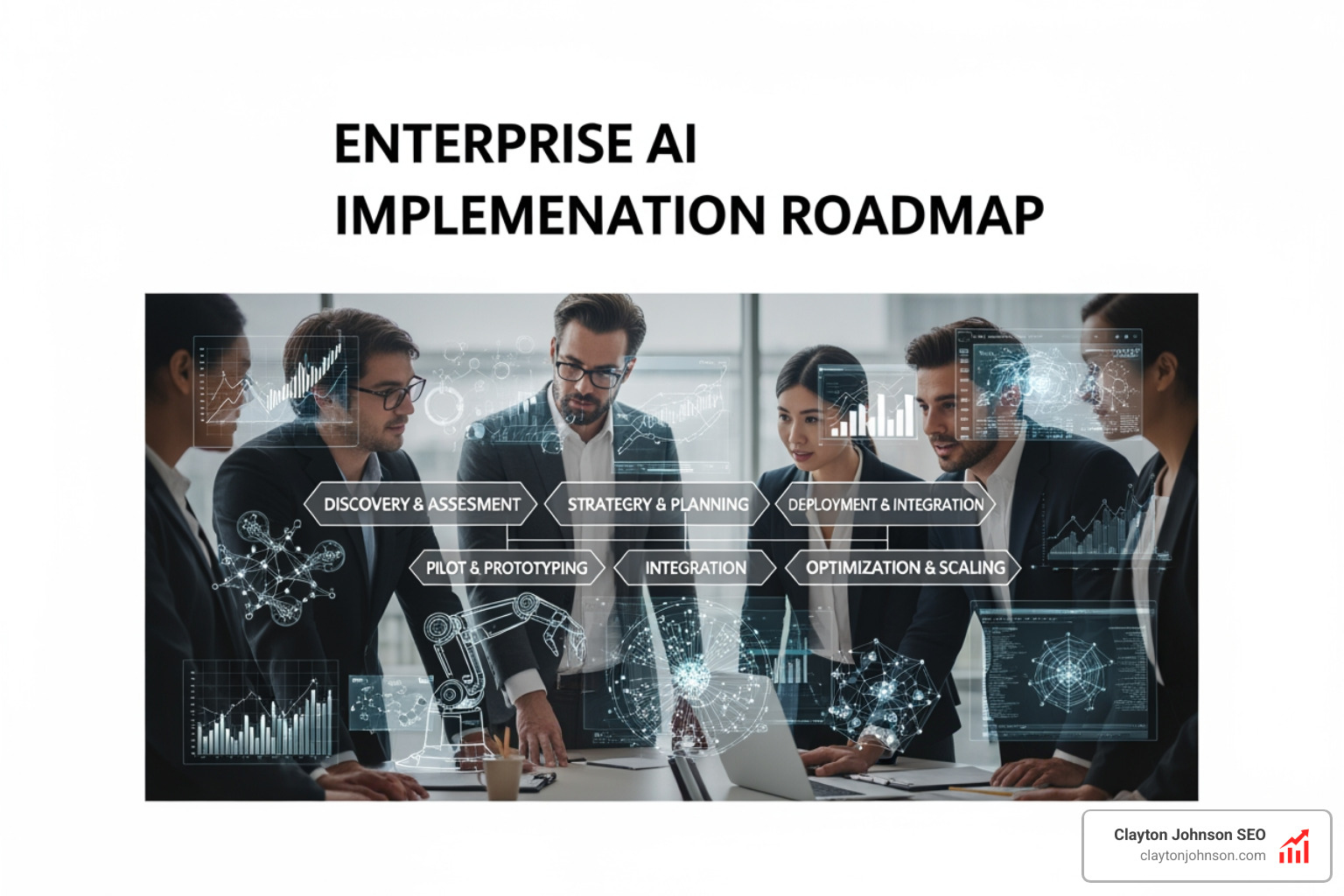
Building a Phased Roadmap for Your AI Pilot to Scale
Don’t try to boil the ocean on day one. A successful ai pilot to scale follows a logical progression:
- Pilot Testing (Weeks 1-4): Validate the core logic and user experience in a controlled environment.
- Infrastructure Build (Weeks 5-12): Set up the MLOps pipelines, security protocols, and data integrations.
- Department Rollout (Weeks 13-24): Deploy to a single high-impact business unit to gather real-world feedback.
- Enterprise Rollout (Ongoing): Scale across the entire organization with continuous optimization.
This strategic framework for scaling AI ensures that you are building on a solid foundation at every step.
Technical Foundations: Infrastructure and MLOps for Enterprise Growth
The difference between a pilot and a production system is the difference between a prototype car and a fleet of thousands. You need a robust technical foundation to handle the load.
| Feature | Pilot Stage | Production-Ready Scale |
|---|---|---|
| Data Source | Manual CSV uploads / Static sets | Live API streams / Data Lakehouse |
| Deployment | Local machine or small VM | Containerized (Kubernetes) / Cloud-native |
| Monitoring | Manual checks | Automated MLOps dashboards |
| Architecture | Monolithic / Hard-coded | Modular / API-first / MOSA |
| Security | Basic credentials | Enterprise SSO / Role-based access |
We recommend an API-first, modular architecture. This allows you to swap out models as technology evolves without rebuilding your entire system. For more technical specifics, check out our AI infrastructure best practices.
Overcoming Technical Debt and Legacy Constraints
Many organizations in Minneapolis and beyond struggle with legacy systems. The solution isn’t always to “rip and replace.” Instead, consider:
- Edge Processing: Process data locally to reduce latency and cloud costs.
- Unified Namespace: Create a common language for your data so different systems can actually talk to each other.
- Data Interoperability: As Bill Conner on digital transformation and competitive advantage notes, developing organizational and technology-based capabilities is what allows a company to sustain a competitive advantage over time.
Cultural Transformation and the Simultaneous Strategy

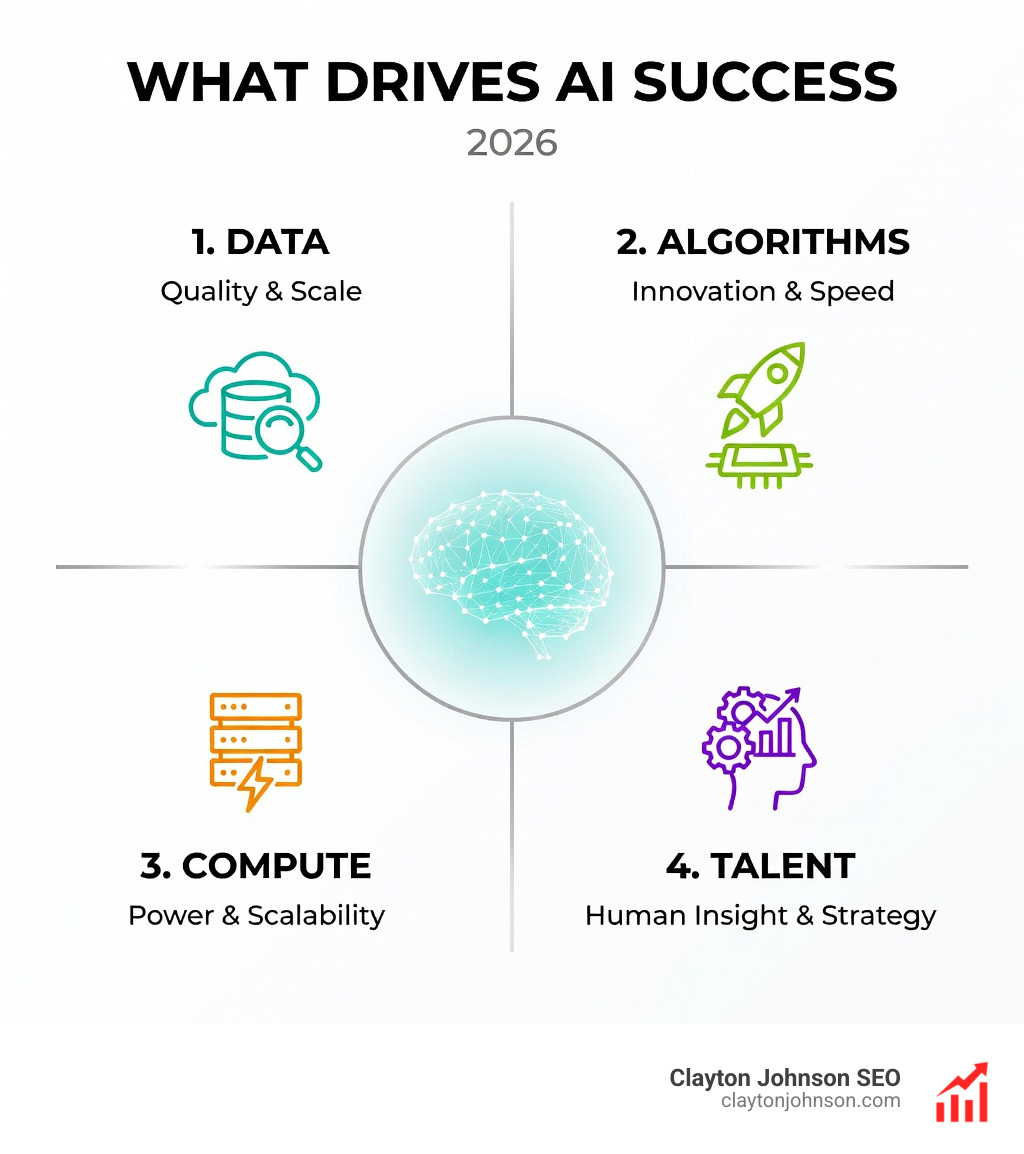
Scaling AI is 20% technology and 80% people. If you ignore the cultural aspect, your technical brilliance won’t matter. We advocate for a “simultaneous top-down and bottom-up” strategy.
- Top-Down: Leadership provides the vision, the budget, and the “permission” to innovate. Without a mandate from the CEO or CFO, AI projects often get sidelined by middle management.
- Bottom-Up: Frontline employees identify the actual pain points and use cases. They are the ones who will use the tool every day, so they need to feel a sense of ownership.
One-directional approaches fail because top-down mandates feel like “forced change,” while bottom-up experiments lack the resources to scale. You need both forces working in tandem. This is why you need to rollout AI right now with a balanced approach.
Addressing the People Risk and Skills Shortage
The Slack Workforce Index on AI productivity shows that 64% of workers report being more productive with AI, yet many fear “competence threats” or “change fatigue.”
To mitigate these risks:
- Build Cross-Functional Teams: Mix data scientists with subject matter experts from marketing, sales, and operations.
- Upskill, Don’t Just Hire: Train your current staff to use AI tools. It builds trust and preserves institutional knowledge.
- Create an AI Taskforce: A dedicated group responsible for governance, ethics, and internal evangelism.
Real-World Success: Industry Examples of Scaled AI
Seeing how others have moved an ai pilot to scale can provide the roadmap you need.
- Banking: Institutions are moving beyond simple fraud alerts to full-scale predictive analytics. For instance, some banks have scaled AI to automate legal document reviews, reducing manual labor from hours to seconds.
- Retail: Large retailers use AI to predict demand and adjust inventory in real-time across thousands of stores, significantly reducing waste.
- Healthcare: Deep learning models are being integrated directly into electronic health records to provide real-time diagnostic support for clinicians.
- Manufacturing: Industrial leaders use AI sensors for predictive maintenance. By catching a bearing failure weeks in advance, they avoid millions in unplanned downtime.
A great example of revenue-focused AI is the SK Shieldus case study on AI churn scoring. They used a consolidated data view to identify at-risk customers, extending customer lifetime value and directly impacting the bottom line. If you’re worried about the price tag, read our guide on how to assess LLM scalability without breaking the bank.
Lessons from Global Enterprise Rollouts
Large-scale rollouts like PwC’s deployment of Microsoft Copilot to over 230,000 users show that success requires a “hub-and-spoke” model. They used a decentralized rollout that allowed different regions to adapt the tool to local needs while maintaining global governance.
Similarly, BBVA scaled ChatGPT Enterprise from a small group of 3,000 to over 120,000 employees. Their secret? They trained senior leaders (including the CEO) hands-on and created a secure platform for experimentation to prevent “shadow AI.” This is the gold standard for mastering enterprise AI governance.
Frequently Asked Questions about Scaling AI
Why do most AI pilots fail to reach production?
Most fail due to a lack of business alignment, poor data foundations, and cultural resistance. If the AI doesn’t solve a problem that the CFO cares about, or if the data is too messy to be reliable, the project will stay stuck in the lab.
What is the “simultaneous top-down and bottom-up” strategy?
It is an organizational approach where leadership provides the resources and guardrails (top-down), while employees provide the use cases and feedback (bottom-up). This ensures the AI is both strategically relevant and practically useful.
How do you measure the ROI of a scaled AI deployment?
Measure both “hard” ROI (EBIT impact, cost savings, revenue growth) and “soft” ROI (time saved, employee satisfaction, improved accuracy). Tracking these through a centralized dashboard ensures stakeholders see the value in real-time.
Conclusion
Scaling AI isn’t a “one and done” event; it’s a journey of continuous learning and structural improvement. At Clayton Johnson, we focus on building Demandflow.ai — a structured strategy and growth operating system designed for founders and marketing leaders who are tired of random tactics and want a scalable architecture.
Most companies don’t lack the “tech” for AI; they lack the structured growth architecture to support it. By following this blueprint — aligning goals, fixing data foundations, and managing the human side of change — you can move your ai pilot to scale and join the 2% of organizations seeing true enterprise-wide impact.
Clarity leads to structure. Structure leads to leverage. Leverage leads to compounding growth.