Mastering the Art of Search with Neil Patel

Why Proven SEO Strategies Still Drive Organic Growth
Many marketers have studied well-known SEO frameworks because they are widely discussed and have been applied across a range of industries. The underlying mechanics are what matter most: improving content quality, tightening site architecture, strengthening authority signals, and continuously optimizing for how people actually use search.
In this guide, we break those ideas down into an evergreen system you can implement to build lasting organic growth.
Here is a quick summary of the core strategies that drive results:
- Prune and crop low-value pages so strong pages rank better
- Merge duplicate pages targeting the same keyword to eliminate search engine confusion
- A/B test meta tags (title tags and meta descriptions) to improve click-through rates
- Update old content regularly – Google favors maintained pages over stale ones
- Build links through free tools – helpful tools can attract backlinks naturally
- Optimize user experience using behavior analytics and heatmaps
- Research keywords strategically – including emerging and long-tail queries
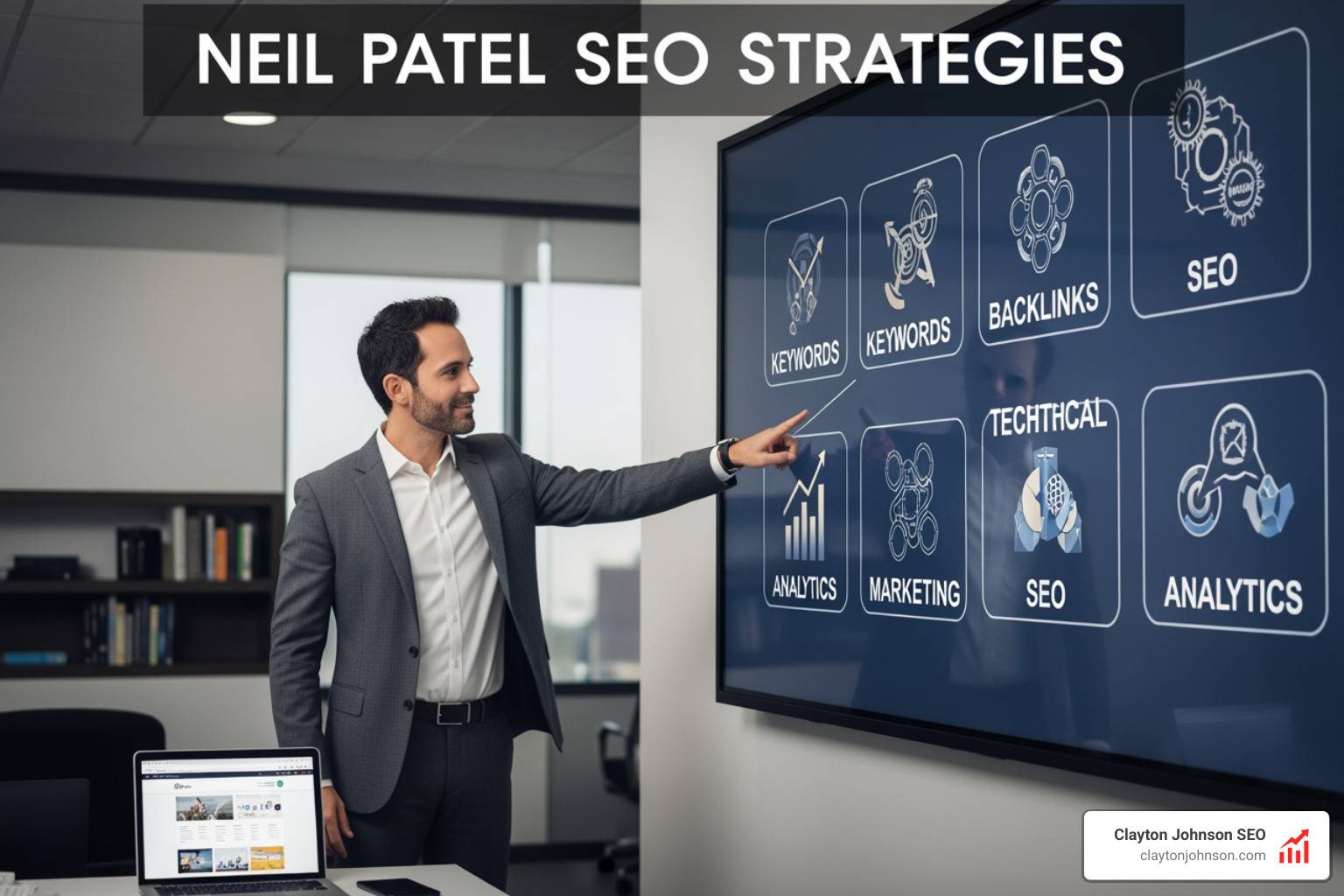
These strategies span three core pillars: on-page SEO, off-page SEO, and technical SEO. Together, they form a compounding system – not a one-time fix.
I’m Clayton Johnson, an SEO strategist focused on building scalable traffic systems and structured growth frameworks. At Demandflow.ai, we translate proven SEO principles into structured growth infrastructure: clarity, taxonomy, diagnostics, and repeatable execution.
If you are a founder or marketing leader tired of reactive SEO and fragmented content efforts, this guide is built for you.
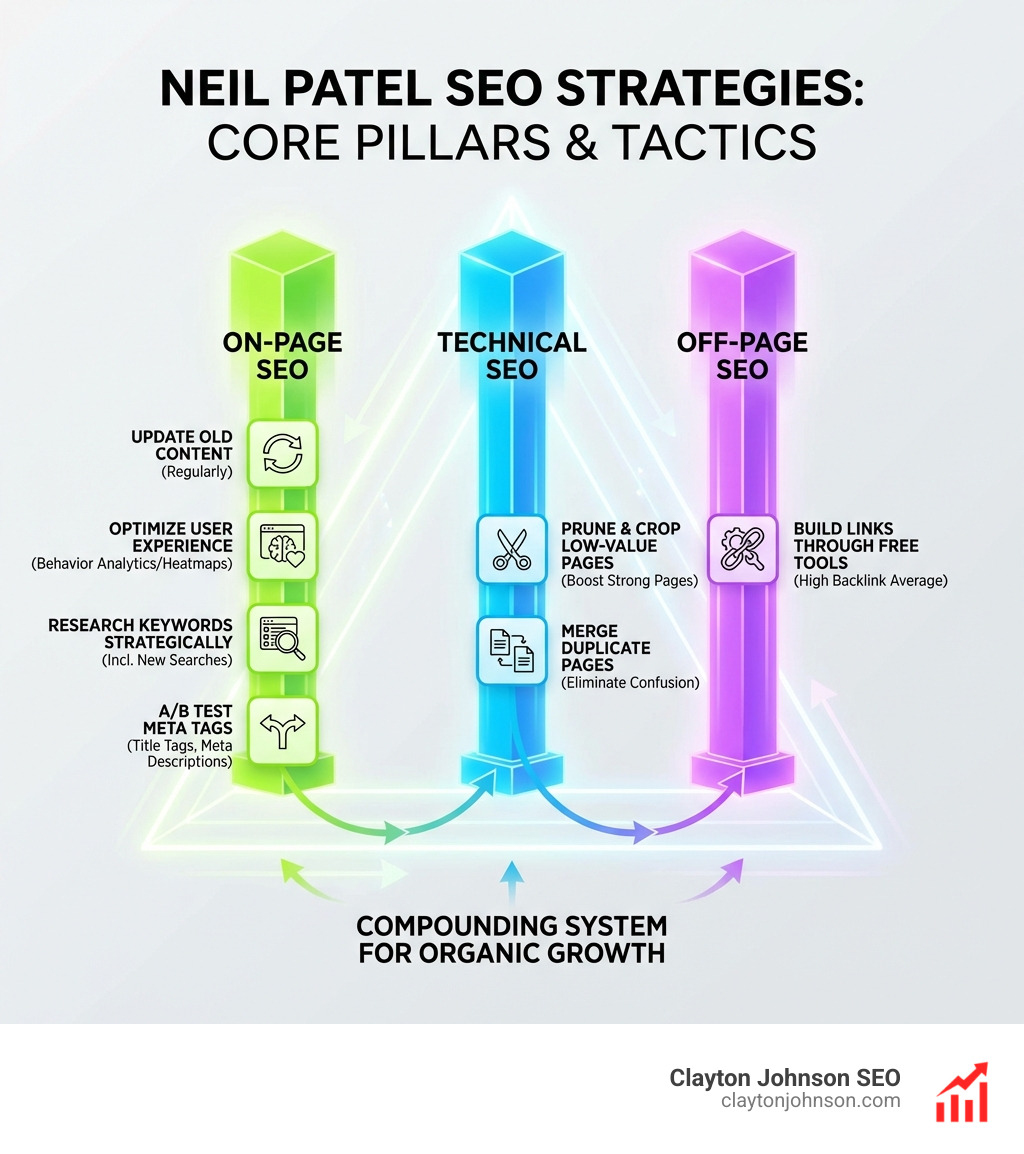
The Core Pillars of Proven SEO Strategies
To understand why these strategies work, we have to look at the three main pillars: on-page SEO, off-page SEO, and technical SEO. As many leading SEO practitioners emphasize, SEO is like a puzzle. If you are missing one piece, the picture is incomplete, and your rankings will suffer.
We often see businesses focusing solely on blog posts while ignoring their site’s crawlability. Or they build links but have a slow-loading site that frustrates users. To truly master SEO 101, you must balance all three.
- On-page SEO: This is everything you do on your actual website to help search engines understand your content. It includes keyword placement, internal linking, and content quality.
- Off-page SEO: This involves building your site’s reputation through backlinks, brand mentions, and social signals. It tells search engines that other people find your content valuable.
- Technical SEO: This is the foundation. If search engines can’t crawl or index your site, your content won’t rank, no matter how good it is.
By following Google’s approach to search, we know that the goal is to deliver the most relevant and reliable information. A well-rounded SEO framework pushes you to optimize each touchpoint of the searcher’s journey, not just publish more pages.
Mastering Search Intent
One of the biggest mistakes we see is targeting keywords based on volume alone. Effective SEO strategies prioritize search intent above all else. Google handles an enormous volume of searches every day, but if your content doesn’t answer the specific question the user is asking, you won’t stay on page one for long.
We use specialized research tools and platforms to find out exactly what customers are searching for. These tools reveal the “why” behind the search. Are they looking for information, trying to buy something, or just trying to find a specific website?
When we focus on winning the AI search era with intent-based keyword research, we look for question-based queries. Many searches are phrased as questions. By answering these directly, you position yourself as the authority.
Competitive Reverse Engineering
Why spend months experimenting when your competitors have already done the hard work for you? A core part of our approach involves learning from the strategies that are already working for your rivals.
We look at:
- Backlink Analysis: Who is linking to them? If a high-authority site links to a competitor, they might link to you too if you provide better value.
- Keyword Hijacking: We identify the keywords driving the most traffic to their sites. If they are ranking for a high-value term with a mediocre article, that’s an opportunity for us to publish a substantially better piece of content.
- Content Gaps: Even strong sites miss meaningful keyword opportunities. We find those gaps and fill them.
Using structured SEO services, we can replicate high-performing backlink patterns and content structures to shorten the learning curve while staying aligned with your brand and positioning.
Advanced Content Optimization and Pruning Techniques
Most people think more content equals more traffic. In reality, having too many low-quality or irrelevant pages can actually hurt your rankings. This is where “pruning and cropping” comes in.
| Strategy | What It Is | Why It Works |
|---|---|---|
| Pruning | Removing old, irrelevant, or low-traffic pages. | Improves crawl budget and site authority. |
| Merging | Combining multiple pages targeting the same keyword. | Eliminates keyword cannibalization and confusion. |
| Refreshing | Updating old content with new data and insights. | Signals ongoing maintenance to Google’s algorithm. |
By cutting the “dead wood” from your site, you allow your high-performing pages to shine. This is a vital part of the ultimate guide to keyword strategy. If you have three mediocre posts about “SEO tips,” merge them into one comprehensive guide that covers everything.
Implementing Content Refreshing for Long-Term Rankings
Google rewards content that stays accurate and useful over time. Wikipedia is a common example of this; it ranks for many queries because its pages are constantly being updated. We recommend maintaining a recurring schedule for updating your most important pages.
When refreshing, we look at Google’s documentation on relevance to ensure our updates align with what the algorithm values. This includes adding new statistics, original images, and answering new questions that have surfaced since the post was first published.
Mining People Also Ask
Google’s “People Also Ask” (PAA) boxes are a goldmine for content ideas. These are questions that Google’s algorithm has already identified as being highly relevant to your primary keyword.
We use the Also Asked tool to map out these clusters. By incorporating these questions as H2 or H3 headers in your articles, you increase your chances of appearing in multiple SERP features and capturing long-tail traffic. This is especially important because a meaningful portion of searches are new or newly popular queries that did not exist in the same form before.
Technical Foundations and User Experience
You can have the best content in the world, but if your site takes ten seconds to load, no one will ever read it. Leading SEO practitioners emphasize that user experience (UX) is now a critical ranking factor.
We focus on Core Web Vitals, which are specific metrics Google uses to measure a page’s loading speed, interactivity, and visual stability. If your site doesn’t meet these benchmarks, you are essentially invisible to a large portion of your audience.
We use the PageSpeed Insights tool to identify bottlenecks. Common issues include oversized images, unoptimized JavaScript, and poor server response times. It’s essential to diagnose site health regularly to catch these technical glitches before they tank your rankings.
Optimizing for Mobile and Speed
Mobile traffic now accounts for more than half of all web traffic. In fact, 88% of users have a mobile shopping app or use their browsers to shop on the go. If your site isn’t mobile-friendly, you are losing money.
Best practices for mobile optimization include:
- Image Compression: Use tools like WP Smush or ImageOptim to shrink file sizes without losing quality.
- Responsive Design: Ensure your site layout adapts perfectly to any screen size.
- Minimalist Elements: Avoid heavy pop-ups or complex scripts that slow down mobile load times.
Local SEO and Brand Visibility
For businesses in Minneapolis, Minnesota, local SEO is the lifeblood of customer acquisition. The key ranking factor here is your Google Business Profile.
We ensure that your NAP (Name, Address, Phone number) is consistent across every directory on the web. This builds trust with Google. We also recommend submitting your site to online business directories and encouraging happy customers to leave reviews. Mastering these basics is part of an absolute beginners guide to mastering core SEO.
Link Building and Authority in the AI Era
Link building is still one of the top three ranking factors. However, the way we build links has changed. Gone are the days of spammy directory links. Today, it’s about earning authority through high-quality content and useful tools.
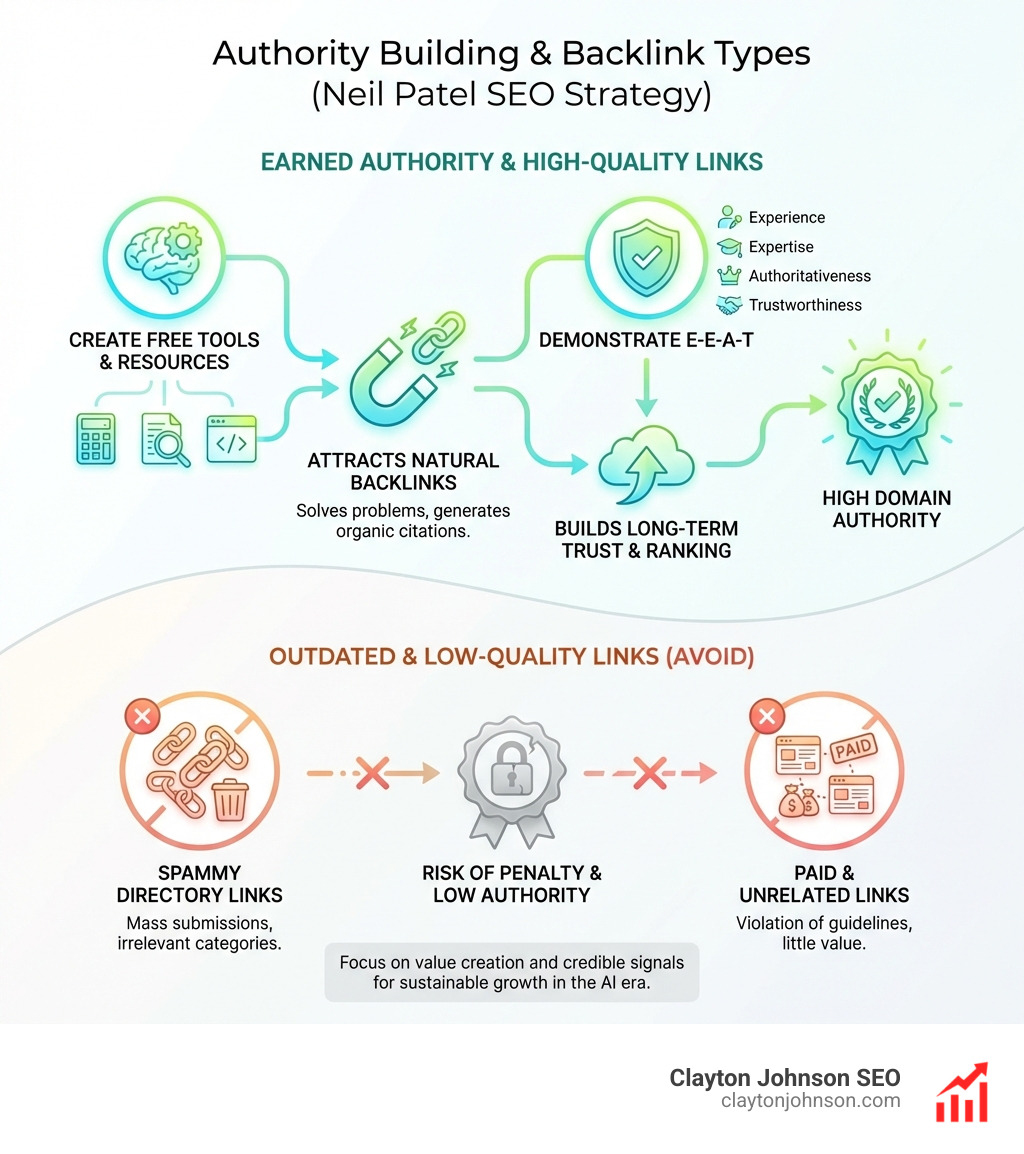
One of the most effective SEO strategies for link building is creating free tools. Whether it’s a calculator, a template, or a mini-app created with ChatGPT, tools generate an average of 319 backlinks. People love to link to resources that solve a problem for them.
We also focus on E-E-A-T (Experience, Expertise, Authoritativeness, and Trustworthiness). Google wants to see that content is written by someone who actually knows what they are talking about. This is why having clear author bios and citing reputable sources is more important than ever.
Scaling Authority with Proven Link Building Tactics
Another “quick win” for link building is scouting for unlinked brand mentions. We use alerts to find websites that mention our brand but haven’t linked back to us. A simple, friendly email asking for a link is often all it takes to turn a mention into a powerful backlink.
Digital PR is another avenue we explore. By getting mentioned on high-authority news sites, you not only get a backlink but also a massive boost in brand awareness. For more on how AI is changing this landscape, check out the no-nonsense guide to AI SEO.
User Experience as a Ranking Factor
Google tracks how users interact with your site. If users click your link and immediately hit the “back” button, Google assumes your page wasn’t helpful. This is known as “pogo-sticking,” and it can kill your rankings.
We use tools like Crazy Egg to analyze user behavior through heatmaps and scroll maps. This tells us where people are getting stuck. We also recommend A/B testing meta tags like your title and description. A small change in your title tag can lead to a significant boost in click-through rate (CTR), which signals to Google that your content is highly relevant.
Frequently Asked Questions about These SEO Strategies
How long does it take to see results from these SEO strategies?
SEO is a long-term game. While you might see some quick wins from technical fixes or pruning, significant ranking improvements often take weeks to months depending on your site’s authority, competition, and how much change is being implemented.
Why is pruning old content better than having more pages?
More pages do not equal more traffic. If your site is cluttered with short blog posts that no one reads, search engines have to waste their crawl resources on low-value content. By removing or merging these pages, you focus authority on your best content, making it much easier for Google to see you as a trusted resource.
How has AI impacted traditional SEO rankings?
AI-driven SERP features have changed how results are presented, but they have not eliminated SEO. Click behavior may shift as Google adds new layouts and summaries, yet the fundamentals remain consistent: publish genuinely helpful content, demonstrate expertise, earn authority signals, and deliver a strong on-page experience. If you optimize for users, you are naturally optimizing for AI systems that aim to surface the best answers.
Conclusion
Mastering proven SEO strategies isn’t about chasing the latest algorithm update; it’s about building a solid, structured foundation for growth. By focusing on the core pillars of technical health, intent-based content, and ethical link building, you can create a site that ranks well and stays there.
At Demandflow.ai, we believe that clarity leads to structure, and structure leads to compounding growth. We don’t just provide tactics; we provide the growth infrastructure businesses need to scale. If you want to see how these principles apply to the Greatest Marketers of All Time, we invite you to explore our framework library.
Whether you’re growing a small site or scaling a global brand, the path to search dominance starts with a single, well-optimized step. Let’s build something that lasts.