Stop Chasing Clicks and Start Generating SEO Traffic

Why Most Websites Struggle to Generate Consistent SEO Traffic
An SEO traffic generator is a tool that simulates or drives visitor behavior to your website — increasing pageviews, session duration, and click-through rates — to send stronger engagement signals to search engines like Google and Bing.
Here’s what you need to know quickly:
- What it does: Sends automated or human-like traffic to your site to influence behavioral SEO signals
- Key signals targeted: CTR (click-through rate), bounce rate, dwell time, and session depth
- Types of traffic: Organic, social, referral, and direct — often geo-targeted across 150+ countries
- Primary use cases: Boosting rankings, supporting new page indexing, local SEO, and stress testing
- Risk level: Varies — residential, human-like traffic carries far less risk than low-quality bot traffic
- What it won’t do: Generate real conversions or replace a solid content and technical SEO foundation
Most founders and marketing leaders know the problem well. You publish content. You optimize pages. You wait. And still, organic traffic stays flat or grows too slowly to matter.
The gap is usually not the content itself. It’s the engagement signals around it. Search engines interpret behavioral data — how long people stay, whether they click, how deep they browse — as proof that your content deserves to rank. Without those signals, even well-optimized pages stall.
That’s exactly the gap an SEO traffic generator is designed to address. But not all tools approach it the same way, and the difference between a tool that helps and one that creates penalties is significant.
I’m Clayton Johnson, an SEO strategist who builds scalable traffic systems and structured growth frameworks — and evaluating SEO traffic generator tools is a core part of the diagnostic work I do for founders and marketing leaders who need measurable, compounding results.
Understanding the Role of an SEO Traffic Generator
At its core, an SEO traffic generator aims to bridge the gap between “good content” and “ranked content.” In the eyes of modern search engine algorithms, a page that receives zero interaction is a page that provides zero value. By simulating user behavior, these tools help search engines see that your site is active, relevant, and engaging.
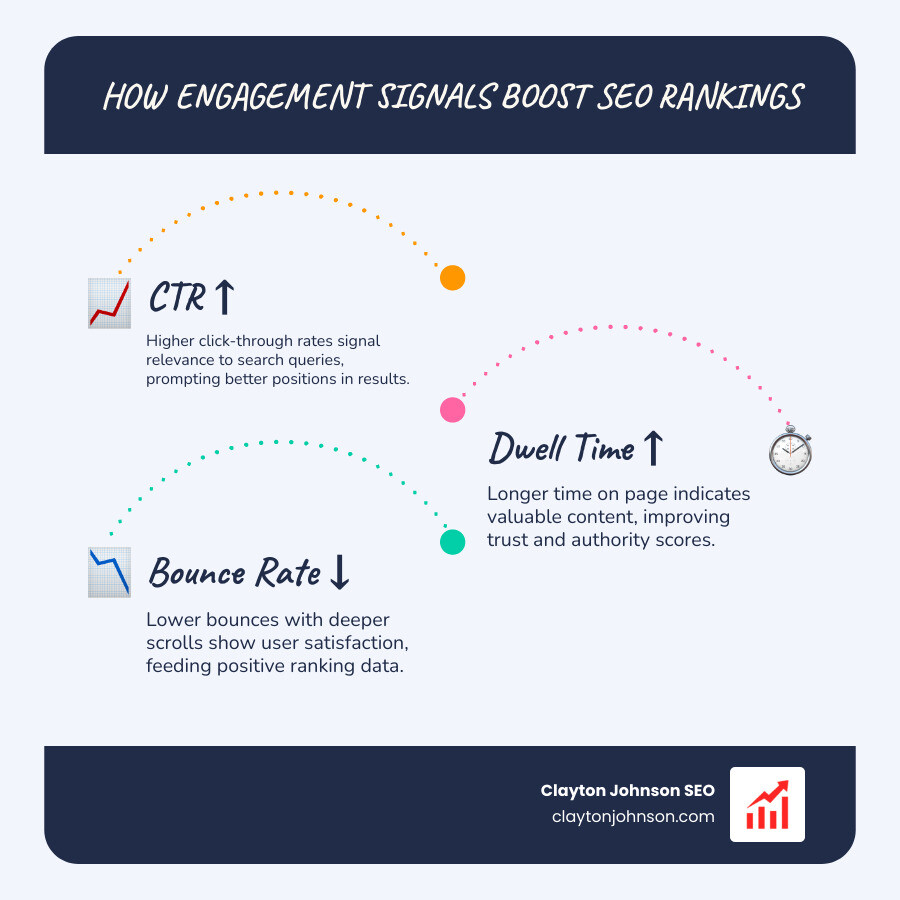
The primary goal isn’t just to inflate numbers in a spreadsheet; it is to influence the behavioral metrics that search engines use to determine quality. These include:
- Click-Through Rate (CTR) Manipulation: When users search for a keyword and click your link instead of a competitor’s, it signals to Google that your result is the most relevant.
- Dwell Time and Session Duration: Longer visits suggest that the content is fulfilling the user’s search intent.
- Bounce Rate Management: High-quality generators can adjust the bounce rate (often between 30% and 70%) to match the natural patterns of your specific niche.
- Navigation Depth: Simulating “human-like” behavior involves more than just landing on a page; it involves scrolling, clicking internal links, and browsing multiple subpages.
To achieve this without being flagged as “spam,” sophisticated tools use residential networks rather than data centers. This ensures the traffic appears to come from real devices used by real people, making the simulation nearly indistinguishable from genuine organic visits.
How Automated Traffic Influences Search Rankings
The “why” behind using an SEO traffic generator is simple: search engines prioritize websites that show signs of life. If two pages are technically equal, the one with steady, healthy traffic and high engagement will almost always win the top spot.
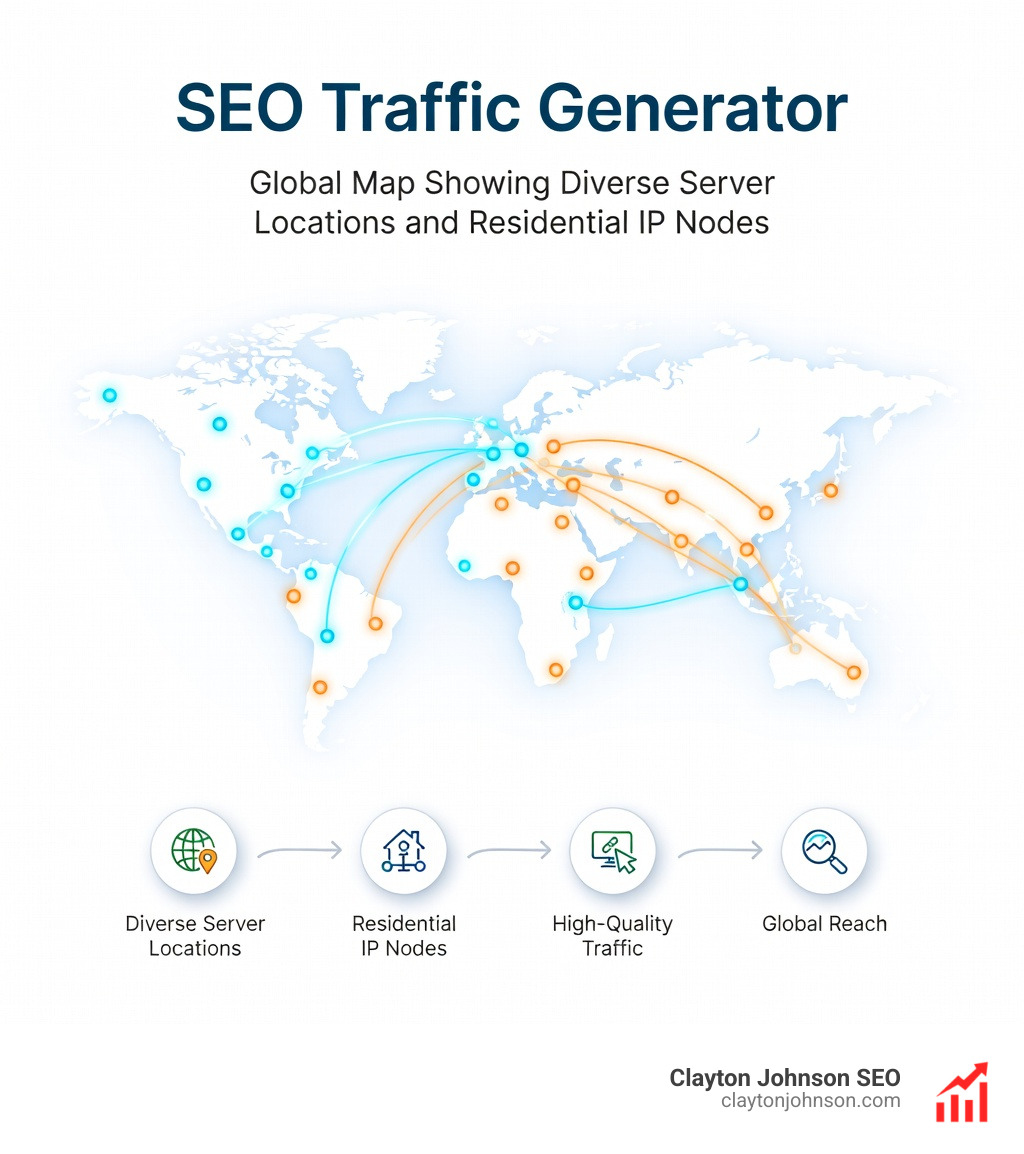
Modern generators utilize a massive network of residential IPs to ensure the traffic is authentic. For example, some top-tier networks supply over 254,000 websites with more than 100 million visitors daily. This level of scale allows for incredible diversity in how traffic is delivered.
Key factors that build search engine trust include:
- Geo-Targeting: With access to 248 geo-targetings across 150+ countries, you can ensure your traffic matches your target market—whether that’s local traffic in Minneapolis, Minnesota, or a global audience.
- Device Diversity: Clicks are sent from a mix of mobile, desktop, and tablet devices, reflecting a natural user base.
- Authentic Click Patterns: Instead of a sudden spike, traffic is scaled naturally over time to avoid triggering “unnatural growth” alerts.
Customizing Your SEO Traffic Generator for Maximum Impact
A “one-size-fits-all” approach to traffic usually fails because it doesn’t look natural. To get the most out of an SEO traffic generator, customization is mandatory. Professional-grade tools offer granular controls:
- Keyword Targeting: You can specify which keywords the “users” should search for before clicking your site, directly boosting your CTR for those specific terms.
- Session Duration and Scroll Depth: You can set visits to last anywhere from 30 seconds to 5 minutes, with simulated scrolling to prove engagement.
- Journey Mapping: Sophisticated tools allow you to define a path (e.g., Homepage > About Us > Blog Post > Contact), which increases pageviews per session.
- Referral Sources: You can mix traffic types, combining organic search clicks with social media referrals or direct visits to create a balanced profile.
Technical Features of a Modern SEO Traffic Generator
The technology under the hood determines whether a tool is a “rank booster” or a “site killer.” Modern systems use advanced browser fingerprinting and proxy rotation to stay under the radar.
- WebRTC Protection: This prevents search engines from seeing the real IP behind the proxy, ensuring total anonymity.
- GA4 and Shopify Compatibility: The visits are designed to be “100% human-like” so they show up accurately in Google Analytics 4 and ecommerce dashboards.
- Automated Crawling: Some tools can scrape 100 pages in 2 minutes to identify internal links and simulate a deep crawl of your site.
- Unique Identities: Each request is assigned a unique identity, ensuring that every visit counts as a unique pageview rather than a repeat bot.
Safety, Analytics, and Avoiding Search Engine Penalties
Safety is the number one concern for any marketing leader. Using a low-quality SEO traffic generator that relies on data center bots is a recipe for a manual penalty. Data center traffic is easily identified because the IPs are tied to servers, not homes.
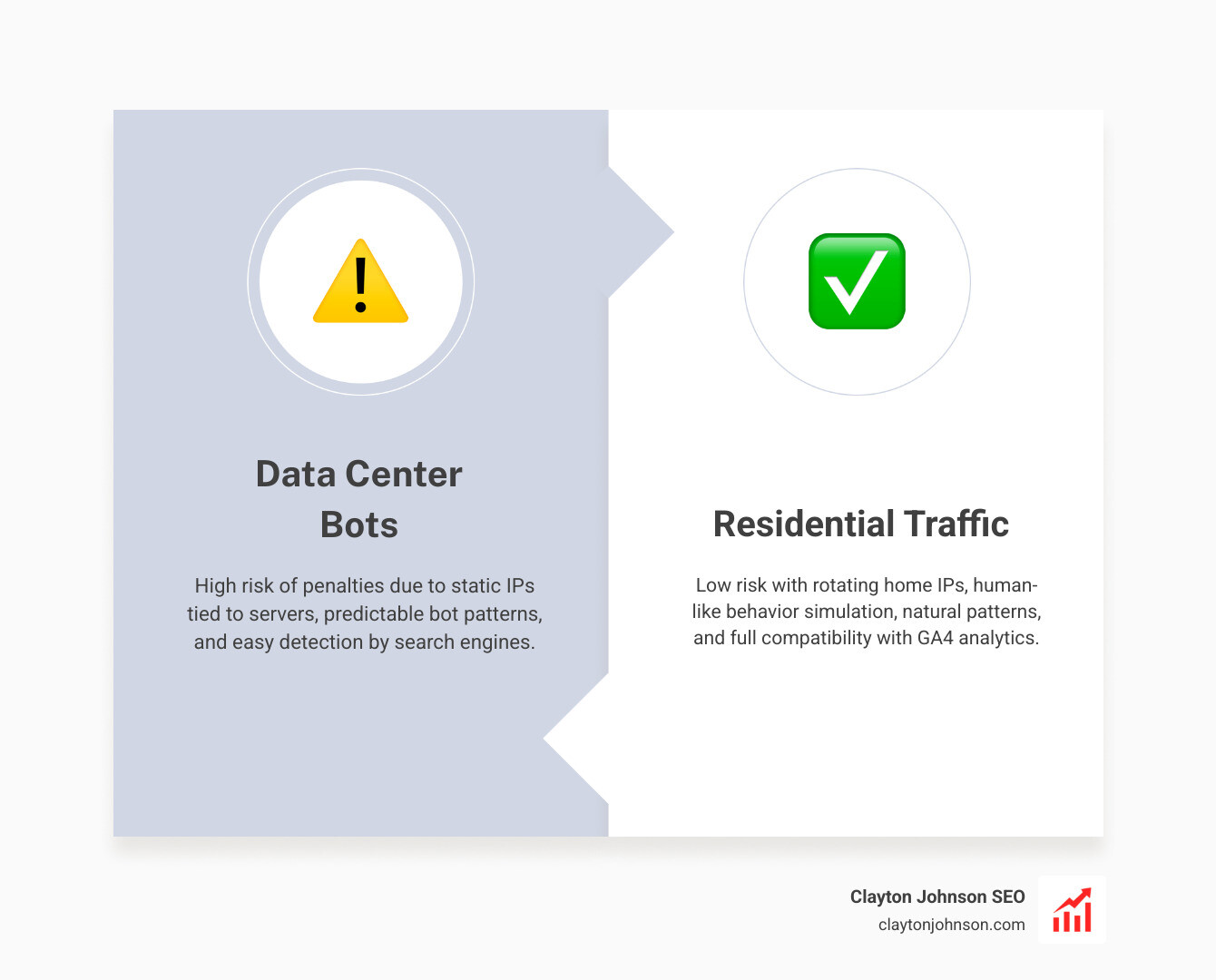
To ensure safety, especially with platforms like Google AdSense, high-quality generators take specific measures:
- AdSense Safety: They avoid clicking on ads entirely. In many cases, they won’t even load the ad scripts, preventing any “invalid click” flags.
- Footprint Reduction: By varying device types, browser versions, and screen resolutions, the tool leaves no detectable pattern.
- Live Campaign Stats: Real-time dashboards allow you to monitor the flow and pause campaigns instantly if you see anything unexpected.
- Search Console Integration: Clicks that appear in Google Search Console are the “gold standard” for ranking influence.
While these tools are powerful, they should always be used as a supplement to—not a replacement for—ethical SEO practices like high-quality content creation and technical site health.
Beyond Rankings: Stress Testing and Social Signals
While the primary goal is often SEO, a robust SEO traffic generator has applications that extend far beyond the search results page.

- Stress Testing: Developers use these tools to see how a website handles 25,000,000 page visits per month. This is crucial before a major product launch or a viral marketing campaign.
- Social and Video Signals: These tools can increase YouTube video views, Etsy shop visits, or Behance profile views by simulating referral traffic from those platforms.
- Link Shortener Support: Many tools are compatible with bit.ly or cutt.ly, allowing you to track the “viral” spread of a link across simulated social media campaigns.
- Index Boosting: By sending traffic to a new, unindexed page, you signal to search engine crawlers that the page is active and needs to be crawled immediately.
Integrating an SEO Traffic Generator into a Growth Architecture
At Clayton Johnson SEO, we believe that tactics without structure are just noise. Using an SEO traffic generator is a tactic; building a structured growth architecture is the strategy.
Through our platform, Demandflow.ai, we help founders and marketing leaders move away from “chasing clicks” and toward a system where growth is predictable and compounding. We don’t just send traffic; we build authority-building ecosystems.
Our approach combines:
- Taxonomy-Driven SEO: Ensuring your site structure makes sense to both users and bots.
- Competitive Positioning: Using tools like Ahrefs SEO Toolbar to analyze competitor authority (DR/UR) and reverse-engineer their success.
- AI-Augmented Workflows: Using the Free Keyword Generator to find high-potential, low-competition terms that our traffic systems can then support.
The goal is Strategic Leverage. When you combine a high-quality SEO traffic generator with a clear growth framework, you stop guessing and start scaling.
Frequently Asked Questions about SEO Traffic Generation
Is using an SEO traffic generator safe for Google AdSense?
Yes, provided you use a high-quality service that uses residential IPs and does not interact with ads. Professional tools are designed to be “AdSense safe” by either not loading ads at all or ensuring that simulated users never perform an accidental click that could be flagged as fraud.
How do I track the impact of generated traffic in GA4?
You can track the impact directly in your Google Analytics 4 (GA4) dashboard. Look for improvements in “Engagement Rate,” “Average Engagement Time,” and “Events per Session.” Additionally, monitor your Google Search Console to see if the increased CTR is leading to higher average positions for your target keywords. You can also use tools like SE Ranking’s Website Traffic Checker to compare your progress against competitors.
Can these tools help with local SEO and GMB rankings?
Absolutely. By selecting specific geo-locations (like Minneapolis, Minnesota) and directing traffic through Google Maps or GMB (Google My Business) search results, you can significantly boost your local visibility. This signals to Google that local users are finding your business relevant, which is a key factor in the “Local Pack” rankings.
Conclusion
Generating consistent organic traffic isn’t a matter of luck; it’s a matter of architecture. While an SEO traffic generator is a powerful lever for influencing behavioral signals and search engine trust, it works best when integrated into a broader, structured growth system.
Don’t just chase the next click. Build a system that generates traffic, builds authority, and creates compounding growth for your brand.
Start building your traffic generation system today and move from tactical guesswork to strategic clarity.