The Art of the Ask: Mastering AI Query Refinement and Disambiguation

Why AI-Powered Query Understanding Changes Everything About Search
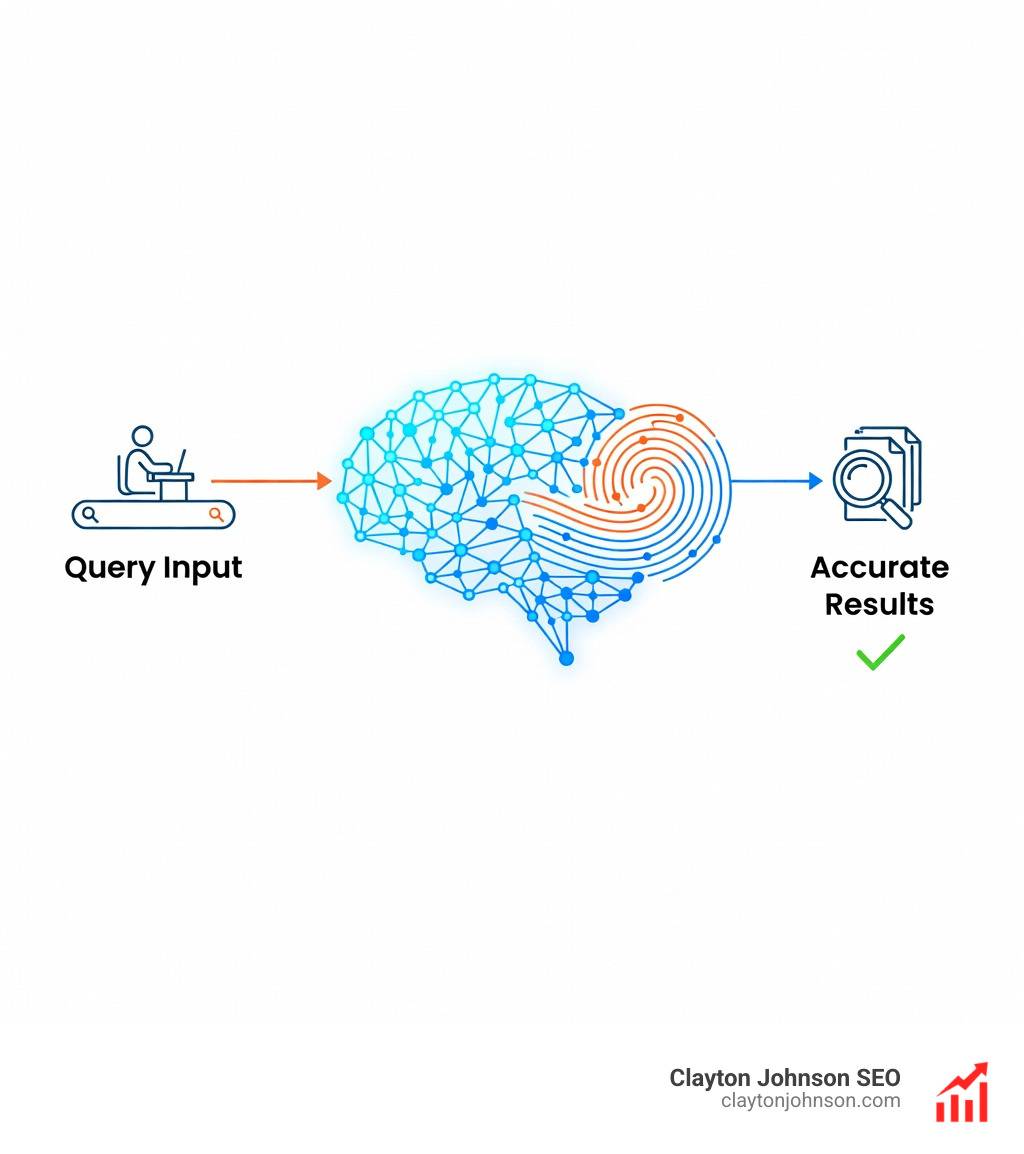
AI-powered query understanding is the process by which AI systems analyze a user’s search input to determine intent, context, and meaning — going far beyond matching keywords to deliver genuinely relevant results.
How it works at a glance:
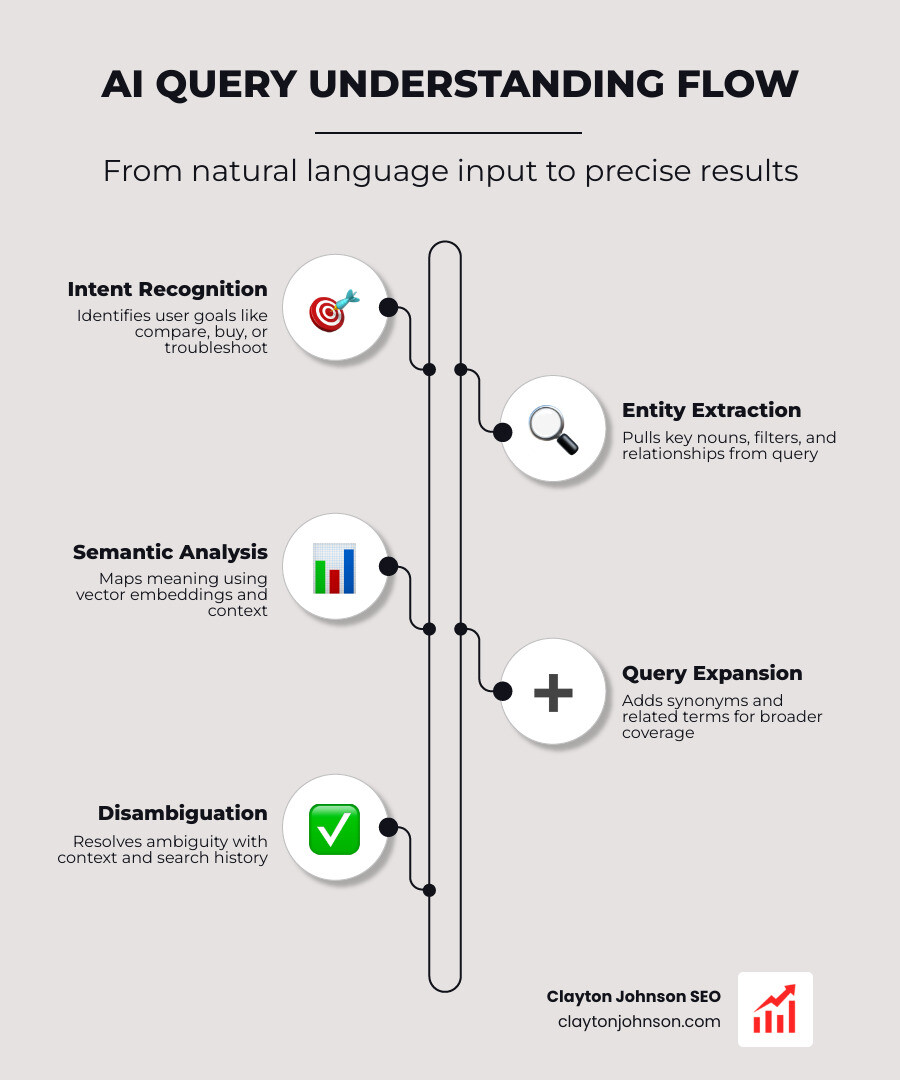
- Intent recognition — identifies what the user actually wants (compare, buy, troubleshoot)
- Entity extraction — pulls out key nouns, filters, and relationships from the query
- Semantic analysis — maps meaning using vector embeddings, not just word frequency
- Query expansion — adds synonyms and related terms to broaden relevant result coverage
- Disambiguation — resolves vague terms using context, location, or search history
- Query rewriting — reformulates the input for better search performance automatically
Most search systems still rely on exact keyword matches. If your words don’t align with indexed content, you get nothing useful. AI changes that by understanding what you meant, not just what you typed.
Take a simple search like “cheap flights to Europe next month.” A traditional system looks for those exact words. An AI-powered system recognizes low-cost intent, flexible date ranges, and geographic scope — then surfaces results using terms like “economy fares” or “May departures” that never appeared in the original query.
That gap — between what users say and what systems understand — is exactly what AI-powered query understanding is built to close.
I’m Clayton Johnson, an SEO strategist focused on building scalable content systems and AI-assisted marketing workflows that turn search intent into compounding growth. AI-powered query understanding sits at the core of how I help founders and marketing leaders architect search strategies that actually convert. In the sections ahead, we’ll break down the mechanics, real-world applications, and implementation strategies you need to put this to work.
The Mechanics of AI-Powered Query Understanding
To understand how AI deciphers a messy human sentence, we have to look under the hood. Traditional search engines are like librarians who only know how to find books by their exact title. If you ask for a book about “the big orange cat,” and the title is Garfield, they’re stuck. AI-powered query understanding turns that librarian into a subject matter expert who knows that “big orange cat” almost certainly refers to a specific comic strip character.
This transformation is driven by neural networks that process text not as strings of letters, but as complex mathematical relationships. According to research on automated query optimization, machine learning models can predict resource requirements and execution times much more accurately than traditional rule-based systems by analyzing historical performance patterns.
Core Techniques in AI-Powered Query Understanding
We use several sophisticated layers to ensure the system truly “gets” the user. It starts with the basics, like automated spell-checking and normalization, but quickly moves into advanced territory:
- Synonym Databases & Knowledge Graphs: The system identifies that “laptop” and “notebook computer” are the same entity.
- BERT Embeddings: Developed by Google, Bidirectional Encoder Representations from Transformers (BERT) allows the AI to understand the context of a word based on all of its surroundings—not just the word immediately before or after it.
- spaCy Pipelines: We utilize NLP libraries like spaCy to handle “part-of-speech” tagging. This tells the AI whether “fly” is a verb (action) or a noun (the insect) in a specific sentence.
Handling Ambiguity in AI-Powered Query Understanding
Ambiguity is the “final boss” of search. If a user types “Jaguar,” are they looking for a predatory cat, a luxury vehicle, or a classic guitar?
AI resolves this by looking at contextual clues. It might check the user’s previous queries (if they just searched for “wildlife preserves,” they probably want the cat) or their location. If the user is in Minneapolis, and there’s a local event involving a “Jaguar” sports team, the AI prioritizes that. This process, known as disambiguation, ensures that the most likely intent is served first, drastically reducing the “time to insight” for the user.
From Keywords to Context: Why Semantic Search Wins
The shift from keyword matching to semantic search is the difference between counting words and understanding ideas. Traditional systems often use the Jaccard index, which measures how many words two sets share. It’s simple, but it fails if the user uses different vocabulary than the author.
Semantic search uses cosine similarity within a high-dimensional vector space. Every concept is turned into a list of numbers (a vector). Concepts that are “close” in meaning end up “close” in the mathematical space. This allows a search for “how to fix a car that won’t start” to find a technical manual titled “Automobile Ignition Troubleshooting,” even though they share zero keywords.
Advanced Features for Modern Search
Modern AI-powered query understanding isn’t just a one-and-done interaction. It’s becoming a conversation.
- Context-Aware Conversations: AI can maintain “state.” If you ask, “Who is the CEO of Apple?” and then follow up with, “Where was he born?”, the AI knows “he” refers to Tim Cook.
- Multi-Language Support: Because vectors represent meanings rather than words, an AI can often understand a query in Spanish and find the best answer in an English database.
- Query Rewriting: The system often silently reformulates your “human” question into a “machine-optimized” version to get faster, more accurate results.
Overcoming Data Quality and Performance Barriers
Even the smartest AI can be slowed down by messy data. We often see “data silos” where information is trapped in different formats. Furthermore, AI models require significant computational power.
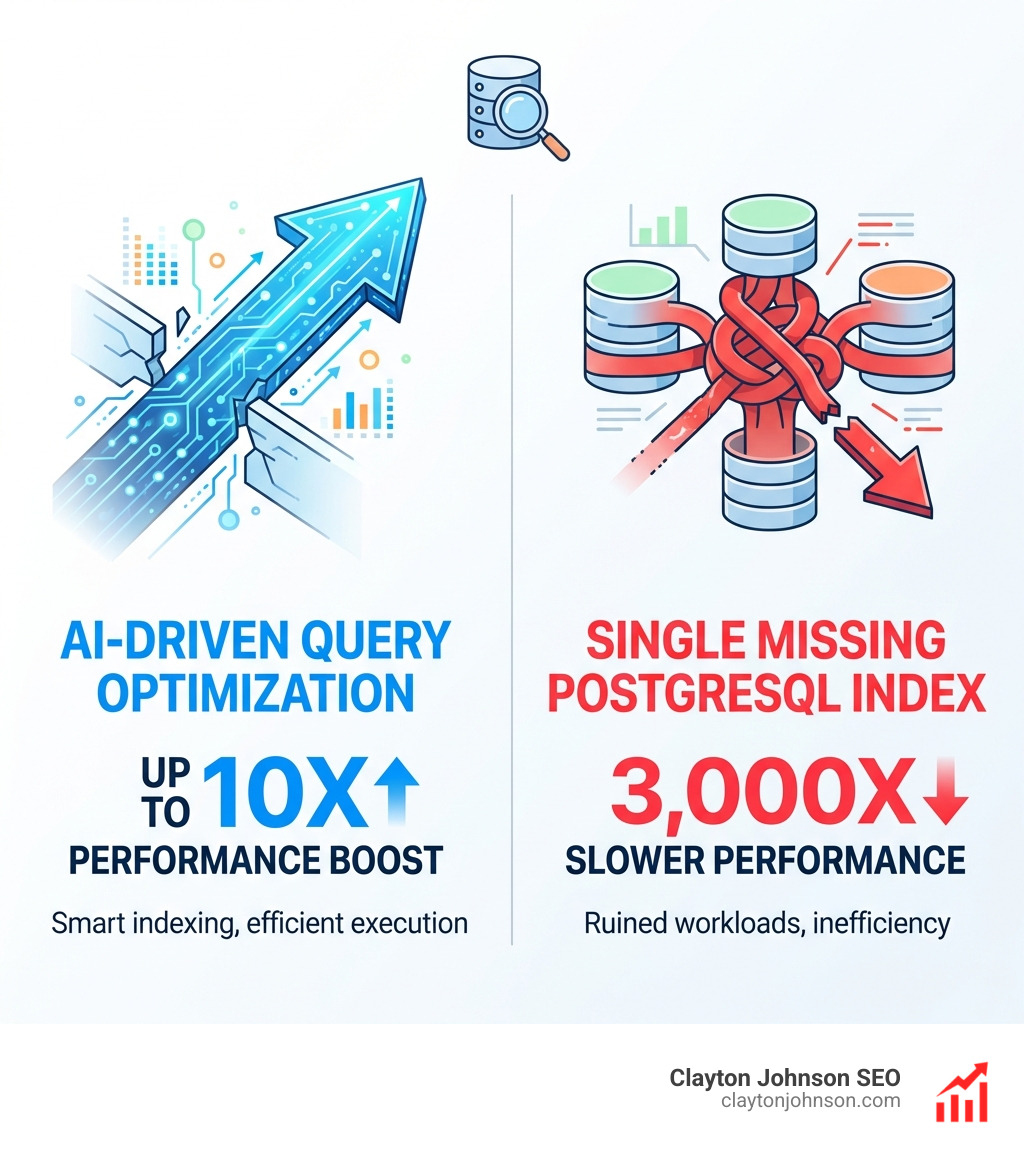
However, the performance gains are undeniable. Research on PostgreSQL index optimization shows that adding a single missing index can improve workloads by up to 3,000 times. AI-driven tools can now handle these tasks automatically, identifying inefficiencies like problematic joins or missing filters that a human might overlook.
Bridging the Gap: Text-to-SQL and Database Accessibility
One of the most exciting frontiers in AI-powered query understanding is “Text-to-SQL.” For decades, if you wanted to know your “top-performing products last quarter,” you had to ask a Database Administrator (DBA) to write a complex SQL query.
Now, Large Language Models (LLMs) act as a bridge. They map the “Natural Language” of the user to the “Schema” (the structure) of the database. This democratizes data access—suddenly, a marketing manager in Minneapolis can ask their database questions directly in plain English without knowing a single line of code.
Agentic Retrieval for Complex Database Queries
Sometimes, a single query isn’t enough. If you ask, “Find me a hotel near the beach with airport transportation that’s near a vegetarian restaurant,” the AI uses agentic retrieval.
- Subquery Decomposition: It breaks the request into three parts (beach hotels, transport options, vegetarian food).
- Parallel Execution: It searches for all three simultaneously.
- Semantic Reranking: It merges the results, ranking the hotels that meet all criteria at the top.
- Grounding Data: It ensures the final answer is backed by actual database records, not “hallucinated” AI guesses.
Real-World Applications in Enterprise Tools
We see these technologies coming to life in several key platforms:
- Amazon Q: An enterprise assistant that indexes database content and responds to user questions with citations.
- AskYourDatabase: A tool that allows users to chat with their data, creating visualizations and reports on the fly.
- OpenAI Retrieval API: This allows developers to build semantic search into their own apps, using “vector stores” to index files like PDFs, PPTs, and XLSX sheets.
- Amazon QuickSight: Integrates generative AI to allow executives to ask for revenue trends and see them visualized instantly.
Strategic Implementation: Security, ROI, and Integration
Moving to an AI-powered system isn’t just about the tech; it’s about the architecture. We recommend building “governance layers” before rolling out these tools. This includes role-based access, ensuring that a junior employee can’t “ask” the database for the CEO’s salary.
| Feature | Traditional Search | AI-Powered Search |
|---|---|---|
| Logic | Keyword matching (Literal) | Semantic understanding (Intent) |
| Speed | Fast for simple tasks | Up to 10x faster for complex analysis |
| Accuracy | High for exact titles | High for conceptual meaning |
| User Barrier | High (Requires SQL/Technical knowledge) | Low (Natural Language) |
| Scaling | Manual index management | Automated, self-optimizing |
Measuring Success and ROI in AI Adoption
How do we know it’s working? We look at several Key Performance Indicators (KPIs):
- Automation Hours: Large enterprises can save over 140,000 hours annually through AI automation.
- Infrastructure Costs: By eliminating “expensive” table scans and optimizing indexes, companies—like an e-commerce platform using AWS Aurora MySQL—have saved thousands of dollars per month on server costs.
- User Adoption: Are non-technical staff actually using the data to make decisions?
The Future of AI-Powered Query Understanding
The future is “self-managing.” We are moving toward databases that don’t just answer questions but predict them. Predictive analytics will allow systems to prepare reports before you even ask for them. Voice interfaces will make “talking to your data” as natural as talking to a colleague. By the middle of this decade, AI models are expected to reach 80% accuracy in converting complex natural language into perfect SQL code.
Frequently Asked Questions about AI Query Understanding
What is AI-powered query understanding?
It is the use of machine learning and natural language processing to interpret the intent and context behind a search query, rather than just looking for matching words.
How does AI query understanding improve SEO?
It allows your content to be found by people who are looking for the solutions you provide, even if they don’t use your specific “branded” keywords. It aligns your content with the way humans actually think and speak.
Can AI query understanding handle unstructured data?
Yes. Through “vectorization,” AI can “understand” the content of images, videos, and long-form documents, making them just as searchable as a structured Excel spreadsheet.
Conclusion
The “Art of the Ask” is no longer about learning a programming language; it’s about having the right structured growth architecture to support intelligent tools. At Demandflow, we believe that clarity leads to structure, and structure leads to leverage.
By implementing ai powered query understanding, you aren’t just “fixing search.” You are building a system where data is accessible, insights are instant, and growth is compounding. If you’re ready to move beyond tactics and start building real infrastructure, we’re here to help you architect that future.