Why Most SaaS Companies Are Leaving Growth on the Table
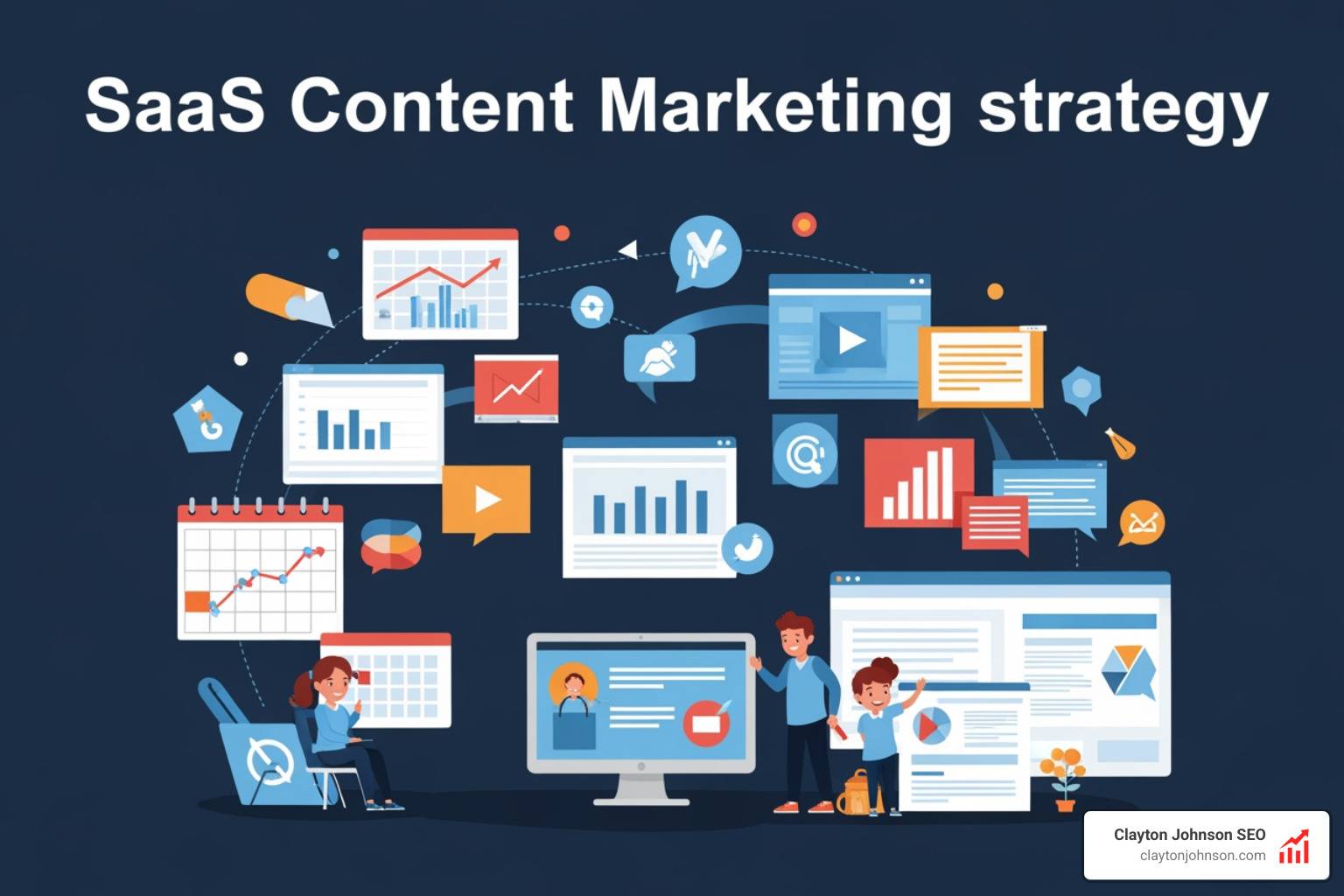
A SaaS content marketing strategy is a system for attracting, converting, and retaining software customers through targeted content — without relying solely on paid ads.
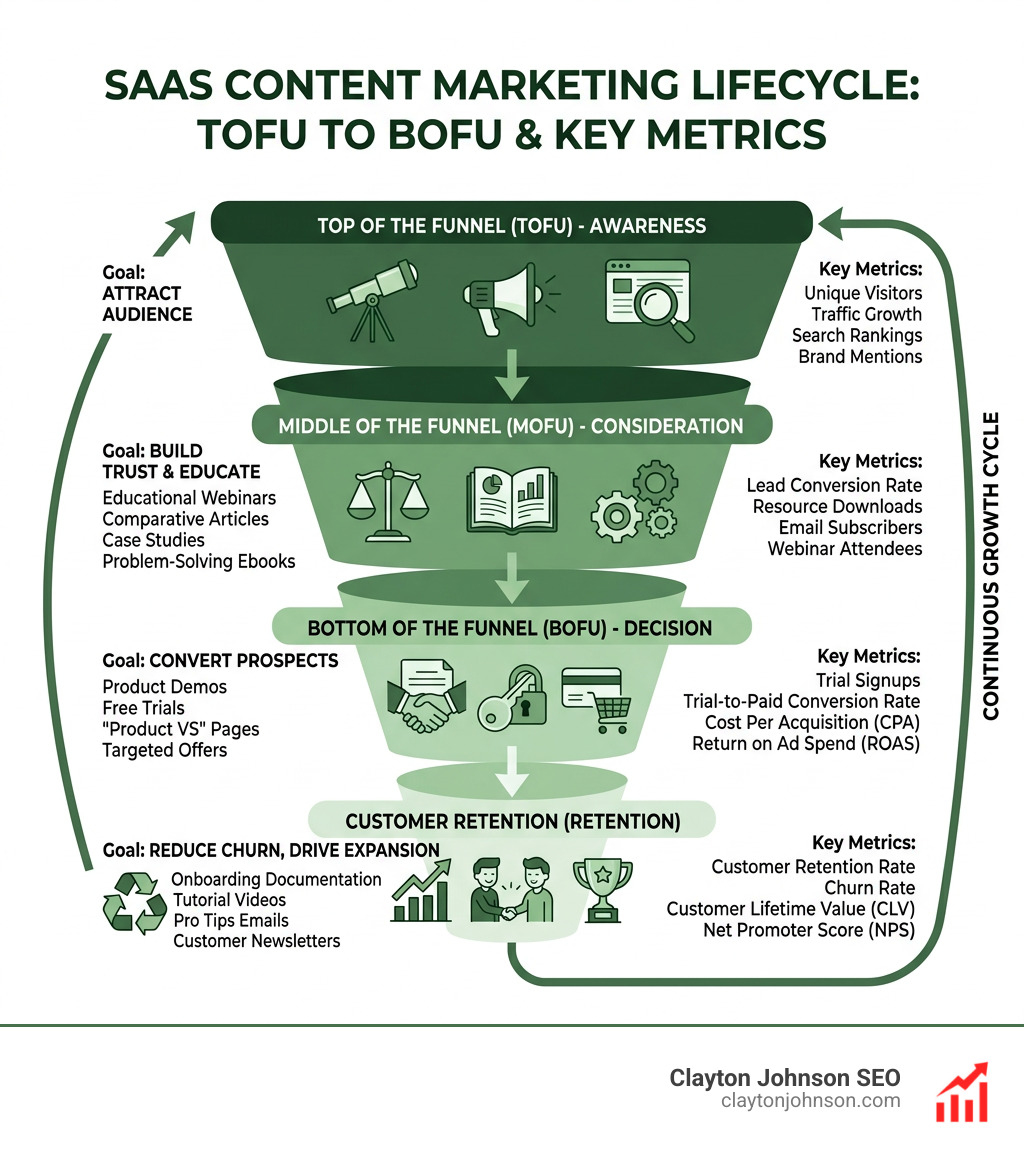
Here’s what an effective SaaS content marketing strategy looks like at a glance:
| Stage | Goal | Content Type |
|---|---|---|
| Awareness (TOFU) | Attract the right audience | Blog posts, guides, SEO content |
| Consideration (MOFU) | Build trust and educate | Comparisons, case studies, webinars |
| Decision (BOFU) | Convert prospects | VS pages, demos, free trials |
| Retention | Reduce churn, drive expansion | Onboarding docs, tutorials, emails |
Most SaaS companies are publishing content. Very few are building a strategy.
There’s a big difference.
Publishing is putting out blog posts and hoping something ranks. Strategy is building a system that compounds — where every piece of content works together to drive traffic, generate leads, and turn visitors into paying customers.
The numbers make the case clearly. Content marketing generates 3x more leads than outbound marketing while costing 62% less. Over a multi-year horizon, SEO delivers an estimated 748% ROI for B2B companies. And B2B SaaS buyers are already 57–70% through their research before they ever talk to your sales team.
That means if you’re not showing up in search during that research phase, you’re invisible when it matters most.
Yet many SaaS blogs get traffic and generate almost nothing in return. The problem isn’t the content itself — it’s the absence of a strategy connecting that content to real business outcomes.
I’m Clayton Johnson, an SEO strategist with nearly two decades of experience helping companies build scalable, revenue-driven SaaS content marketing strategies that turn organic search into a predictable growth engine. In this guide, I’ll walk you through exactly how to build one from the ground up.
Building a High-Conversion SaaS Content Marketing Strategy
To build a saas content marketing strategy that actually moves the needle, we have to stop thinking like publishers and start thinking like growth engineers. A “pretty good” blog post that nobody reads—or that the wrong people read—is just a line item on your balance sheet. We want an asset.
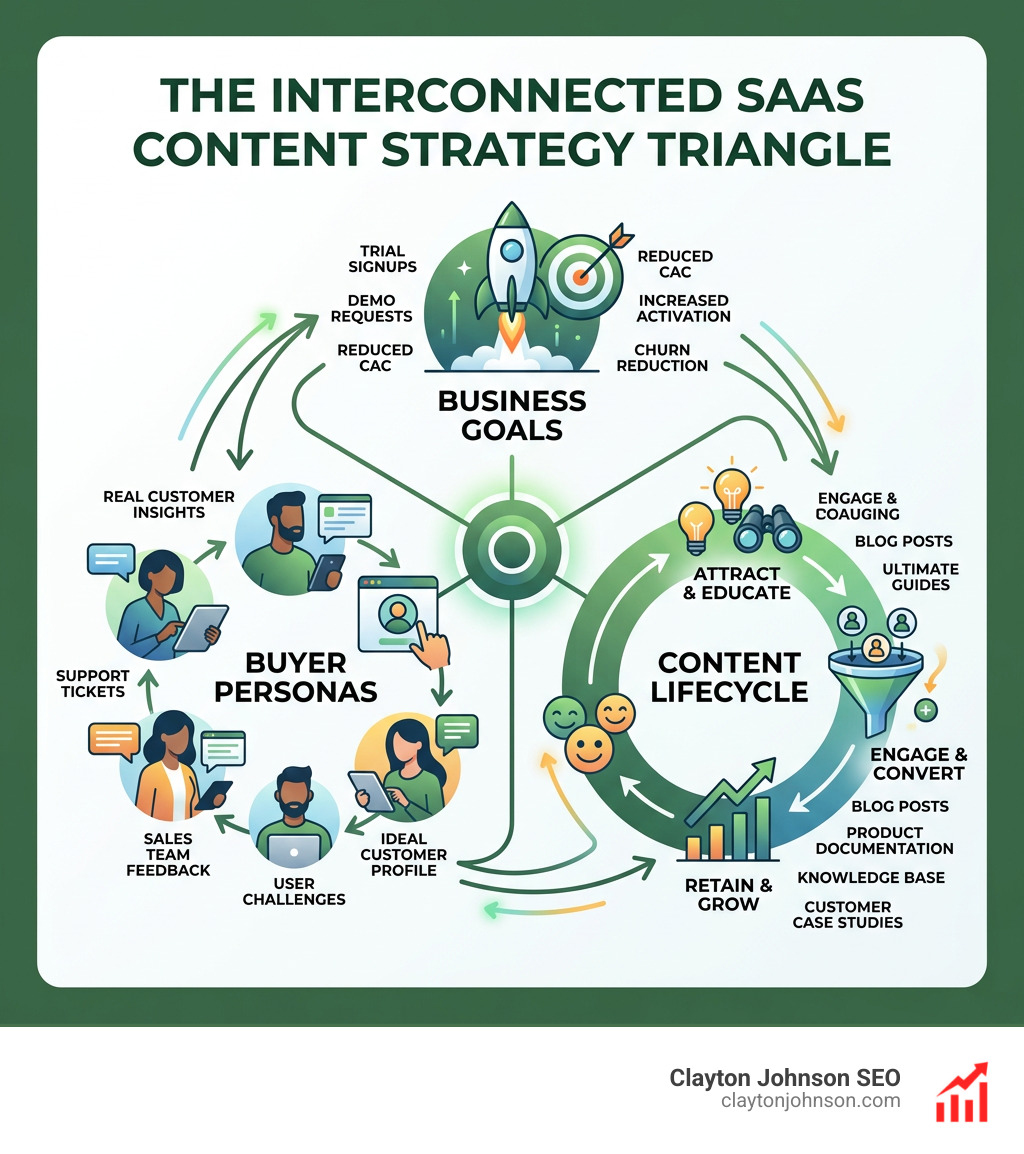
The foundation of this asset rests on three pillars: clear business goals, deep buyer personas, and a mapped customer lifecycle.
Defining Business Goals and Buyer Personas
Before we type a single word, we need to know who we are talking to and what we want them to do. In the SaaS world, we often fall into the trap of creating “SaaS Sally” personas—fictional characters that don’t actually help us write better content. Instead, we should focus on real people. We look at our existing customers’ LTV (Lifetime Value), dive into support tickets to see what they struggle with, and interview our sales team to hear the exact language prospects use.
Our goals shouldn’t just be “more traffic.” We want to track metrics that impact the bottom line:
- Trial signups or demo requests
- Customer Acquisition Cost (CAC) reduction
- Activation rates (getting users to that “Aha!” moment)
- Churn reduction through educational content
The B2B Buying Journey
According to Gartner research, B2B buyers spend a staggering 70% of their journey researching independently before they ever contact a sales team. This means your content is your silent salesperson. If your saas content marketing strategy only focuses on the top of the funnel (awareness), you are essentially introducing people to a problem and then letting them find your competitors to solve it.
We need to map content to the full lifecycle. This isn’t just about getting someone to sign up; it’s about keeping them. It is five times cheaper to retain an existing customer than to attract a new one. Content like product documentation and self-serve knowledge bases are critical for this. For a deeper dive into how we structure these systems, check out our more info about keyword strategy.
Mapping the SaaS Content Marketing Strategy Funnel
A common reason SaaS blogs fail to generate leads is that they are “top-heavy.” They have thousands of visitors reading “What is [Industry]?” articles, but none of those people are ready to buy software. To fix this, we build a balanced funnel.
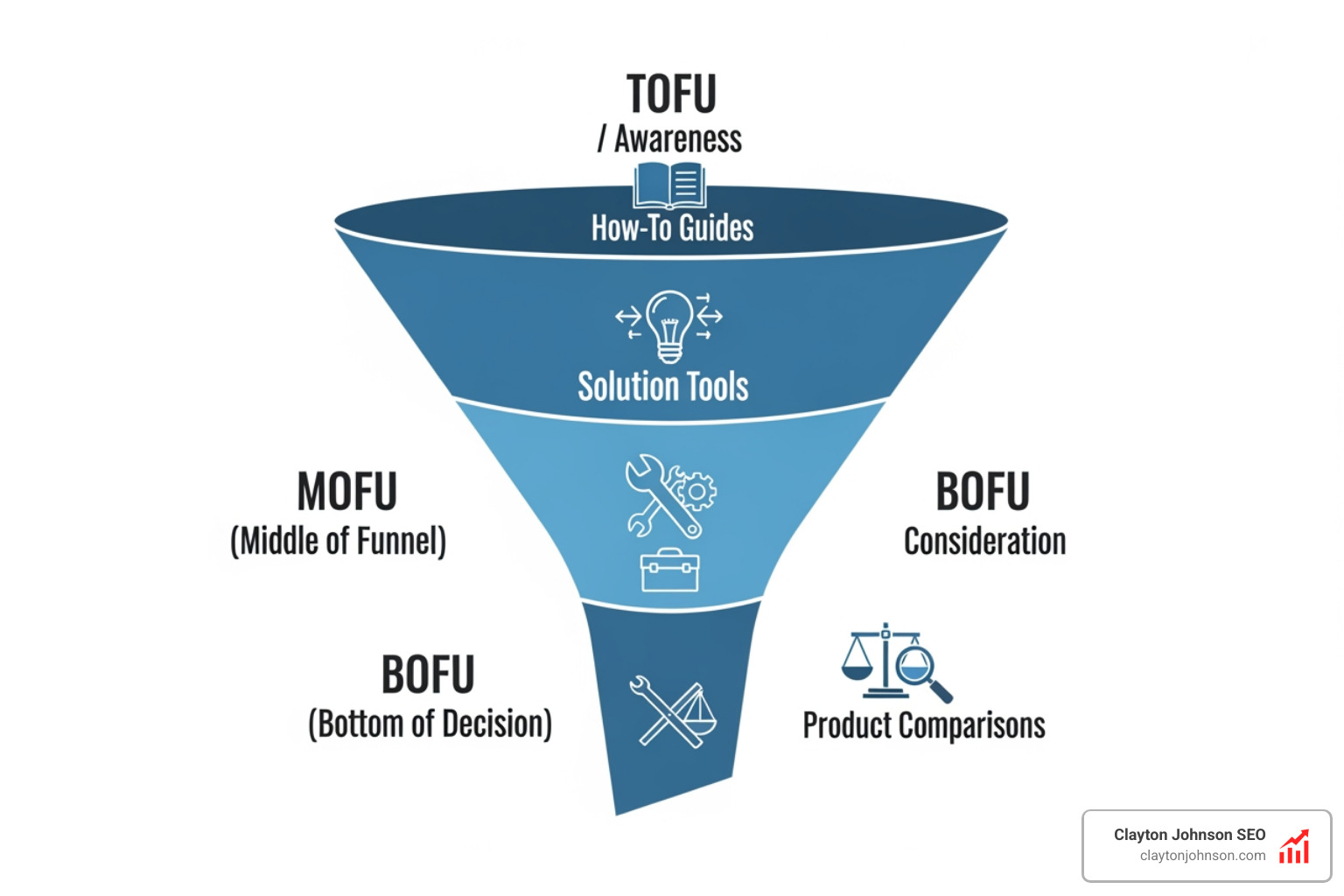
TOFU: Awareness (The “How-To” Stage)
At the Top of the Funnel (TOFU), we are helping people solve a problem. For example, a payroll SaaS might write a guide on “how to calculate payroll taxes.” These readers might not be ready for a demo today, but they now know the brand. The goal here is high-volume, educational content that builds authority.
MOFU: Consideration (The “Solution” Stage)
In the Middle of the Funnel (MOFU), the prospect knows they have a problem and is looking for the best way to solve it. They are looking for templates, whitepapers, or product tours. A great example is a “payroll tax calculator” tool. It’s interactive, helpful, and naturally leads the user toward the software solution. This is where we start integrating more info about conversion rate optimization to ensure those visitors don’t just leave.
BOFU: Decision (The “Why Us” Stage)
The Bottom of the Funnel (BOFU) is where the money is made. This content is for people who are ready to buy and are just deciding between you and a competitor. This includes:
- Use Case Pages: Showing exactly how your tool solves a specific problem for a specific industry (e.g., “CRM for Recruitment”).
- VS Pages: Honest comparisons like “Our Product vs. Competitor X.”
- Product-Led Content: Articles that show exactly how to solve a problem using your product features.
Finding High-Intent Keywords for Your SaaS Content Marketing Strategy
Most SaaS companies focus on search volume. We focus on search intent. A keyword with 10,000 monthly searches that is purely informational is often less valuable than a keyword with 100 searches that signals a “ready to buy” mindset.
The Keyword Research Process
We start by identifying “modifiers” that signal different stages of the funnel:
- Informational: “how to,” “guide,” “tips,” “what is.”
- Commercial/Transactional: “best,” “software,” “tools,” “vs,” “alternative,” “pricing.”
We use tools like Ahrefs or Semrush to find long-tail keywords—specific phrases that are easier to rank for and have higher conversion rates. For a new SaaS blog, targeting “CRM software” is a suicide mission. Targeting “cloud-based CRM for small veterinary clinics” is a winnable battle.
Realistic Expectations and the Google Sandbox
It’s important to understand that SEO is not an overnight game. New domains often sit in the “Google Sandbox,” a period where Google observes a site’s consistency and quality before letting it rank for competitive terms. Ahrefs analyzed 2 million keywords and found that only 5.7% of pages rank in the top 10 within one year of publication.
Realistically, you should expect:
- Months 1-3: Technical setup and initial indexing.
- Months 3-6: Seeing “green shoots” of traffic for low-competition terms.
- Months 6-12: Compounding growth and reliable lead generation.
Dominating Search with Content Clusters and Comparison Pages
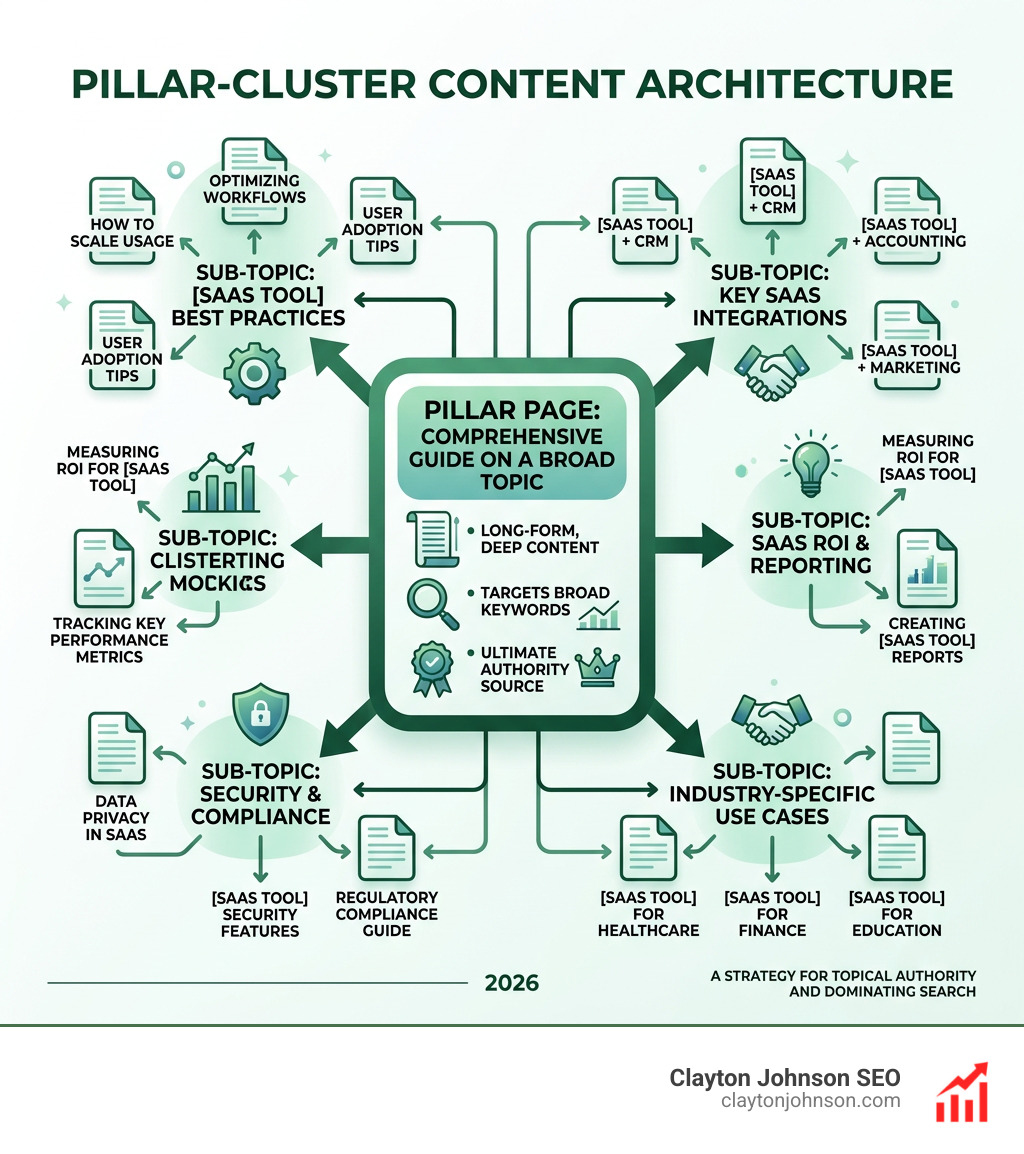
To rank for competitive terms in SaaS, you can’t just write one-off articles. You need topical authority. This is achieved through the Pillar-Cluster model.
The Pillar-Cluster Model
A pillar page is a comprehensive, long-form guide on a broad topic (e.g., “The Ultimate Guide to Remote Team Management”). Linked to this pillar are several “cluster” articles that dive deep into specific sub-topics (e.g., “Best tools for remote meetings,” “How to track remote employee hours”).
By interlinking these pages, you tell Google: “We are experts on this entire subject.” This internal linking structure is the “secret sauce” of a successful saas content marketing strategy. It distributes “link juice” and keeps users on your site longer. You can learn more about how we build these in our more info about strategic frameworks.
Why Comparison Pages are the Highest-ROI Tool
“X vs Y” pages (like “Asana vs Trello”) are often the highest-converting pages for any SaaS. Why? Because the person searching for them is at the very end of the buying cycle. They have narrowed it down to two choices.
Many companies are afraid to mention competitors, but that’s a mistake. If you don’t write the comparison page, a third-party review site will—and they’ll take the lead. By writing it yourself, you control the narrative. Be honest, acknowledge where the competitor might be a better fit (e.g., for enterprise vs. small business), and clearly state your unique value proposition.
Scaling Your Content Engine and Measuring ROI
Once you have the strategy, you need the engine to run it. One of the biggest questions SaaS founders ask is: “Should I hire a content writer or a content strategist?”
The answer is almost always both, but in a specific order.
A content writer produces the words. A content strategist builds the system, maps the keywords, and ensures every piece of content has a goal. Hiring a writer without a strategist is like hiring a bricklayer without an architect—you’ll get a lot of bricks, but you might not get a house. For help finding the right team structure, see our thoughts on more info about growth marketing firms.
Measuring True ROI
Vanity metrics like page views and social shares can be deceiving. You can have a million visitors and zero dollars in new revenue. We prefer to track metrics that correlate with growth.
| Vanity Metrics | Revenue Metrics |
|---|---|
| Total Page Views | Organic Trial Signups / Demos |
| Social Media Likes | MQL to SQL Conversion Rate |
| Keyword Rankings (Informational) | Content-Assisted Pipeline Value |
| Average Time on Page | Customer Acquisition Cost (CAC) |
Measuring ROI is a major challenge—56% of B2B marketers say it’s their biggest struggle. We use tools like Google Analytics, Mixpanel, and Amplitude to track the “multi-touch” journey, acknowledging that a customer might read five blog posts before finally clicking “Sign Up.”
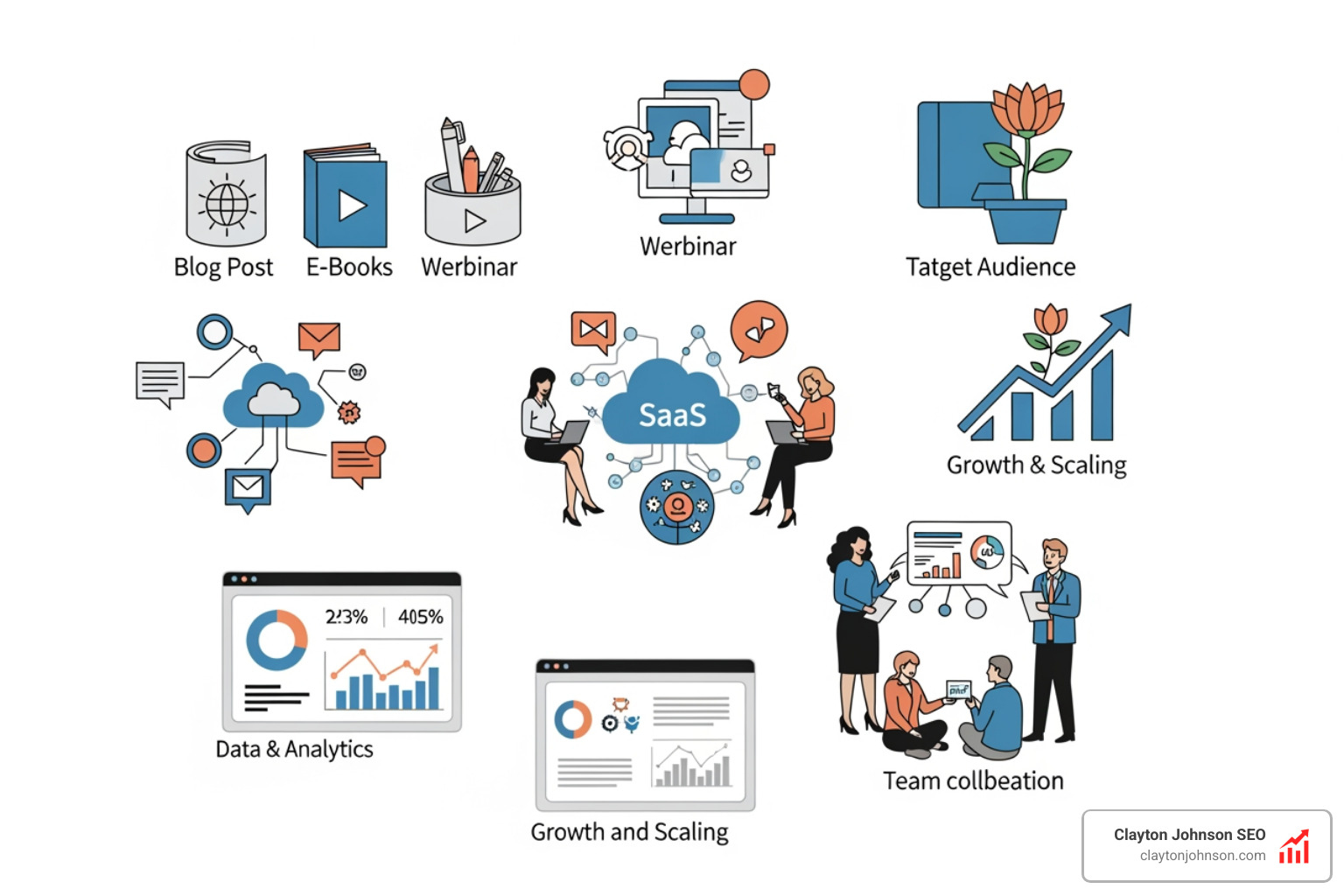
Technical Setup and Conversion Paths for SaaS
Your content can be world-class, but if your website architecture is a mess, neither Google nor your users will find it.
Website Architecture and the 3-Click Rule
A good rule of thumb: any piece of content should be accessible within three clicks from the homepage. This means having a clear navigation bar and a robust footer that links to your use case pages, VS pages, and resource center.
We also recommend a clean URL structure. Instead of website.com/p=123, use website.com/blog/saas-content-marketing-strategy. This helps search engines understand the hierarchy and context of your pages.
Turning Traffic into Revenue
Every piece of content must have a clear “next step.” This is the conversion path.
- TOFU: Offer a newsletter signup or a free ebook.
- MOFU: Offer a template, a webinar, or an interactive tool.
- BOFU: A clear, “Start Free Trial” or “Book a Demo” button.
We also love using “zero-party data”—asking readers questions through tools like Typeform or Intercom to understand their needs better and segment them into the right email nurturing flows.
Distribution and Scaling the Content Team
“If you build it, they will come” does not apply to SaaS content. You need a distribution plan. SEO is the foundation, but it’s not the only channel.
Multi-Channel Distribution
- Social Media: Don’t just post links. Create “zero-click” content—summarize the key points of your article in a LinkedIn carousel or a Twitter thread.
- Email Marketing: Your list is your most valuable asset. Send regular updates with your best content to stay top-of-mind.
- Communities: Engage in Slack groups, Reddit, and platforms like Hacker News or Product Hunt. Don’t spam; provide value first.
Scaling the Team
Scaling a content team requires systems, not “heroics” from a single person. As you grow, you might move from a single freelance writer to an in-house content manager who oversees a network of specialized freelancers.
The biggest hiring pitfall? Hiring for “writing ability” alone. In SaaS, you need writers who can handle technical depth. Your audience is smart; if the content is surface-level or generic, they will leave. For more on how to build these specialized teams, check out more info about content marketing studios.
Conclusion: Turning Content into a Durable Growth System
A successful saas content marketing strategy isn’t about the latest “hack” or a viral post. It’s about systems thinking. It’s about building a library of assets that work 24/7 to educate your market and bring in qualified leads.
At Clayton Johnson SEO, we focus on the intersection of technical depth and strategic positioning. We don’t just want you to rank; we want you to dominate your niche by providing the most valuable, structured, and accessible information available.
By focusing on clarity, structure, and leverage, you can turn a fragmented blog into a compounding growth engine. If you’re ready to stop “publishing” and start building a system for more info about traffic generation, we are here to help you bridge that gap.
The strategy your SaaS is missing isn’t a secret—it’s a system. Now, go build it.