What Competitive Positioning Really Means (And Why It Matters)
Competitive positioning is the strategy a business uses to define how it stands apart from competitors in the minds of buyers.
It answers three core questions:
- How will you approach your target market?
- What alternatives can buyers choose instead of you?
- In what ways are you meaningfully different?
Note: Competitive positioning is not messaging or copywriting. Those are downstream tactics. Positioning is the strategic foundation they’re built on.
Think of it this way: every prospect who finds you is also looking at your competitors. Whether you shape that comparison or not, it will happen. competitive positioning means you take control of that narrative.
The stakes are real. Around 50% of businesses fail by their fifth year — and a lack of clear competitive positioning is a major contributing factor. When buyers can’t quickly understand why you’re the better choice, they default to whoever does make it clear.
Eight weeks. That’s all the time that separated Apple’s iPhone launch from Motorola’s next-generation Razr release. Motorola’s executives scrambled to answer urgent questions: Had the iPhone changed the competitive landscape entirely? Had it created a new niche, or was it coming for the Razr directly? That pressure — to define your position fast and get it right — is something every business faces, just usually with less fanfare.
This guide walks you through everything: frameworks, real-world examples, how to find your unique value, and how to measure whether your positioning is actually working.
The Strategic Framework of Competitive Positioning
To move beyond “gut feelings,” we need structured models. These frameworks transform market noise into actionable intelligence. Without them, you are essentially navigating a maze blindfolded.
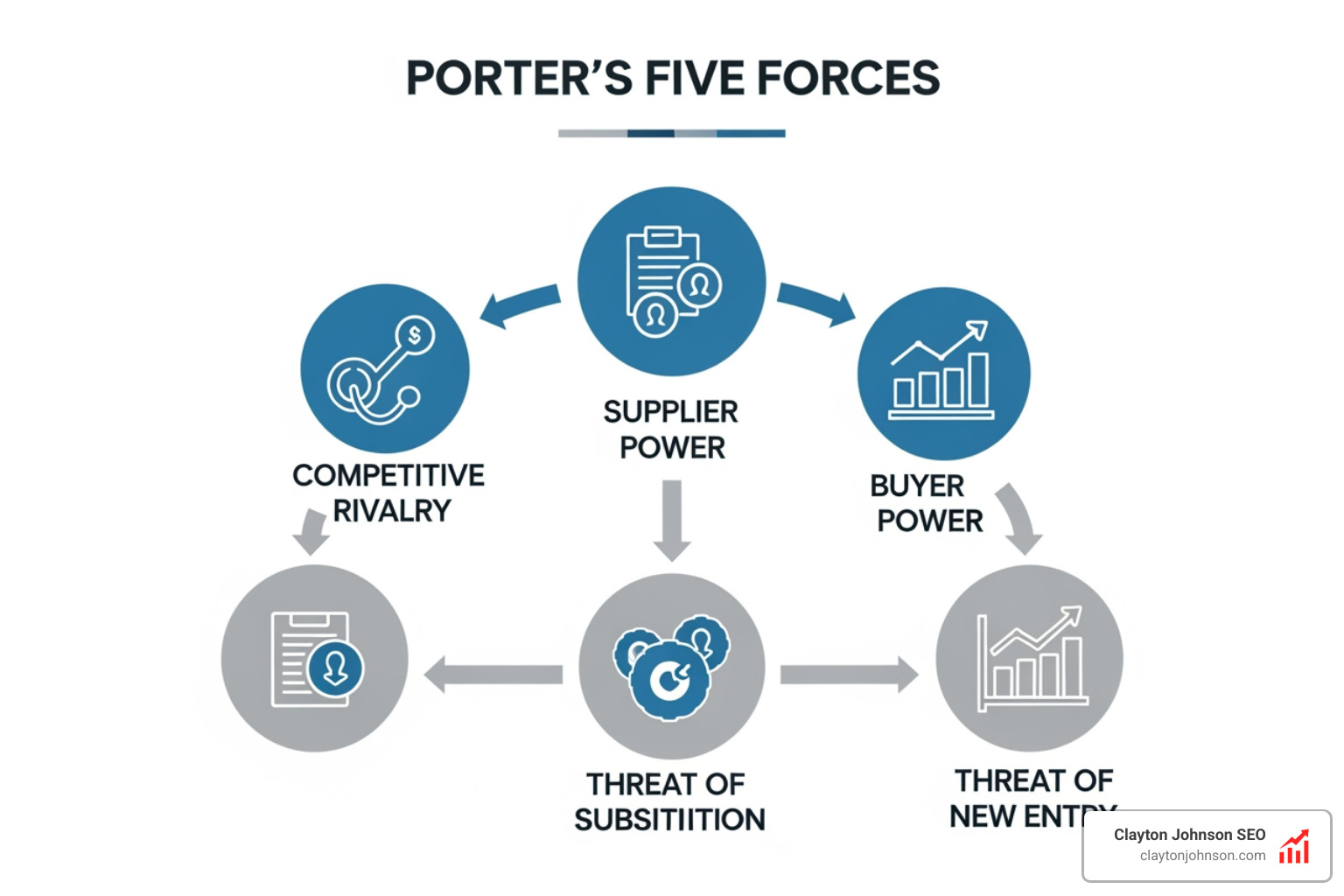
One of the most enduring models was championed by Michael Porter of Harvard Business School. His “Five Forces” framework helps us understand the industry structure and the level of competition. It forces us to look beyond just our direct rivals and consider the “threat of substitutes”—like how Netflix didn’t just compete with Blockbuster, but with the entire concept of leaving the house for entertainment.
Other essential models include:
- SWOT Analysis: Used by over 70% of companies, though many treat it as a box-checking exercise. To make it work for competitive positioning, we must focus on where our strengths overlap with competitor weaknesses.
- BCG Matrix: This helps businesses with multiple products decide where to invest. Research shows that properly integrating the Boston Consulting Group matrix can improve capital allocation efficiency by an average of 15%.
- Perceptual Mapping: This has a 35-40% adoption rate. It allows us to plot competitors on a graph based on two attributes important to customers (e.g., Price vs. Quality), often revealing “white space” where no one is currently playing. Learn more about Perceptual Mapping to visualize your market gaps.
| Framework | Best Used For… | Key Focus |
|---|---|---|
| SWOT | Internal/External Audit | Strengths, Weaknesses, Opportunities, Threats |
| BCG Matrix | Portfolio Management | Market growth vs. Market share |
| Porter’s 5 Forces | Industry Attractiveness | Macro-competitive environment |
| Perceptual Map | Customer Perception | Visualizing brand “white space” |
For a deeper dive into choosing the right model, check out our market-positioning-strategy-complete-guide and the-ultimate-guide-to-market-positioning-models.
Identifying Your Unique Value Proposition in Competitive Positioning
Your Unique Value Proposition (UVP) is the “why” behind the buy. It isn’t just a list of features; it’s a promise of value delivered. To find it, we must align our core capabilities with customer pain points.
We like to think in terms of “Value Zones”:
- The High-Value Zone: This is the sweet spot. It’s the intersection of what your customers desperately want, what you do exceptionally well, and where your competitors are weak.
- The Mid-Value Zone: These are the “swing states” of business. You and your competitors are both “okay” here. Winning here often requires better execution or slightly better pricing.
- The Low/No-Value Zone: This is where features go to die. Either customers don’t care about them, or your competitors do them so much better that you shouldn’t even try to compete on those grounds.
Mastering the-art-of-being-different-and-better is about doubling down on the High-Value Zone. If you want to stop-blending-in-and-start-positioning-like-april-dunford, you have to be willing to ignore the features that don’t drive true differentiation.
How Market Maturity Influences Competitive Positioning
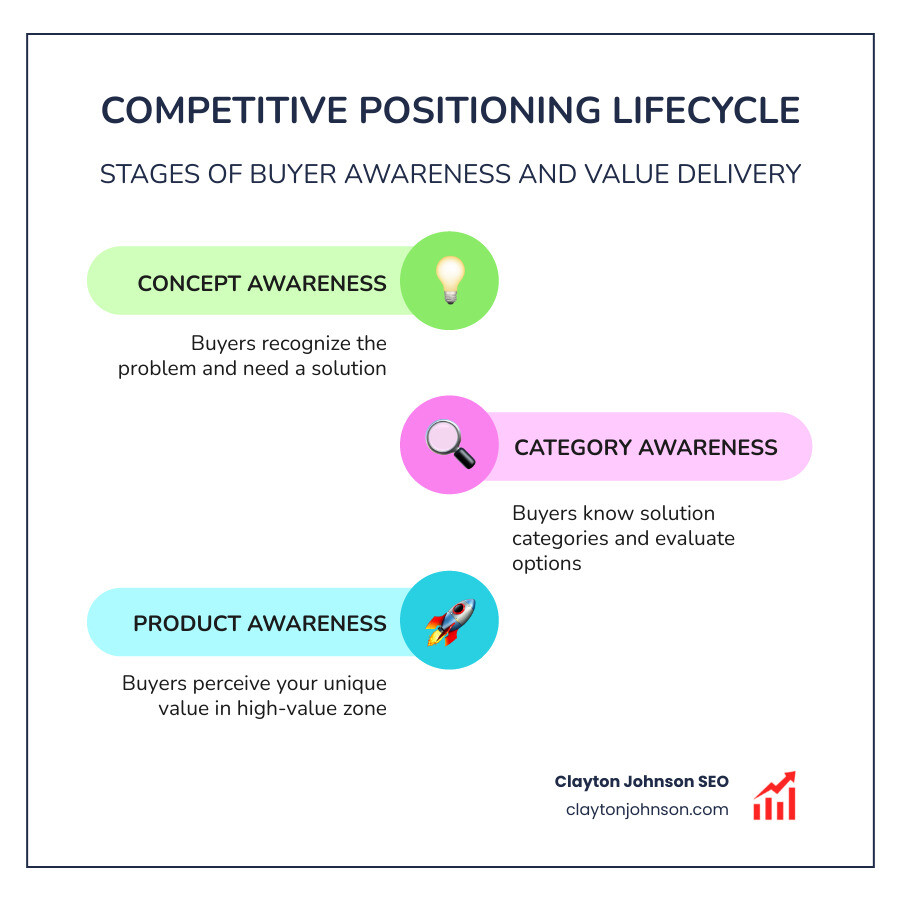
Your competitive positioning shouldn’t stay static. It must evolve as the market grows up. We categorize this into three stages:
- Stage 1: Concept Awareness: Buyers don’t even know they have a problem yet. Your job is to educate. Think of the early days of ice baths; brands had to sell the benefit of cold exposure before they could sell a specific tub.
- Stage 2: Category Awareness: Buyers know the category exists (e.g., “I need an ice bath”) but aren’t sure which type is best. Here, you position your method as superior to others (e.g., “Our tub stays colder than a DIY chest freezer”).
- Stage 3: Product Awareness: The market is crowded. Most B2B products live here. You must directly compare features, price, and quality. This is where you use “value wedges” to show exactly why you are the better choice.
Understanding The Definitive Guide to Brand Awareness is crucial here. You can’t use Stage 3 tactics in a Stage 1 market without looking like a jerk, and you can’t use Stage 1 tactics in a Stage 3 market without looking out of touch. See our competitive-positioning-map-demystified for more on visualizing these shifts.
Leveraging Competitive Intelligence and AI Tools
You can’t position yourself against a ghost. You need data. While traditional research involves SEC filings and manual reviews, about 33% of marketers are now using AI to speed up the process.
Tools like Perplexity can synthesize massive amounts of competitor news, reviews, and G2 data in seconds. However, the most valuable data often comes from “win-loss” interviews—asking former prospects exactly why they chose a rival over you.
The goal is to move from reactive tracking to a proactive growth system. We recommend you stop-guessing-and-start-positioning-with-competitive-intelligence by building a repeatable “game tape” for your sales and product teams. Just remember: use these tools for speed, but don’t lose the human touch. Here is how-to-use-ai-for-positioning-without-looking-like-a-robot.
Executing and Defending Your Market Stance
Once you’ve found your spot, you have to defend it. Competitors will try to copy your features, undercut your price, or steal your messaging.
A “Strategy Canvas” is a great way to visualize your competitive edge. It plots your performance across various industry factors compared to your rivals. If your line looks exactly like everyone else’s, you aren’t positioned—you’re just participating.
To truly win, you need to how-to-position-your-brand-so-competitors-cry. This involves creating barriers to entry, such as:
- Product Leadership: Constant innovation that keeps you two steps ahead.
- Operational Excellence: Being so efficient that no one can match your price or speed.
- Customer Intimacy: Knowing your niche so well that a generic competitor feels like a stranger to them.
Ready to stop being a “me-too” brand? Build your growth system today to turn your competitive landscape into a strategic advantage.
Real-World Examples of Successful Differentiation
Let’s look at some “hall of fame” examples of competitive positioning:
- iPhone vs. Razr: In 2007, Motorola had the “coolest” phone. Apple didn’t just build a better phone; they repositioned the entire category as a “pocket computer.” Motorola was left trying to figure out if they should emphasize their patented noise-filtering tech while Apple was busy deleting the physical keyboard.
- Netflix vs. Blockbuster: Netflix didn’t win on movie selection; they won on convenience and the elimination of late fees. They positioned themselves as the “anti-hassle” choice. Read more about The best category-creating product here.
- VRBO vs. Airbnb: While Airbnb focused on “living like a local” (often in shared spaces), VRBO positioned itself for families by emphasizing “a place to yourself.” They didn’t try to be Airbnb; they chose a specific segment and owned it.
To see how these strategies translate to the digital world, check out How to sharpen your homepage positioning.
Measuring Effectiveness with Key Performance Indicators
How do you know if your competitive positioning is actually working? You can’t just rely on “vibes.” You need to track specific KPIs:
- Market Share: Are you taking a bigger slice of the pie over time?
- Win/Loss Rates: When you go head-to-head with a specific rival, how often do you win?
- Brand Awareness: Do people associate your brand with your intended differentiator?
- Customer Acquisition Cost (CAC): Strong positioning should make selling easier, which should theoretically lower your CAC.
We also recommend polling your current customers regularly. Ask them: “If we didn’t exist, what would you use instead?” Their answers will tell you who your real competitors are, not just who you think they are. For a deeper dive, see HBR: Mapping Your Competitive Position.
Building Durable Systems for Long-Term Growth
At Clayton Johnson SEO, we believe that competitive positioning isn’t a one-time project—it’s an ongoing growth engine. Clayton Johnson is an SEO strategist and growth operator who specializes in turning fragmented marketing efforts into coherent systems driven by search intent and structured strategy.
Our approach isn’t about chasing the latest tactic or keyword. It’s about:
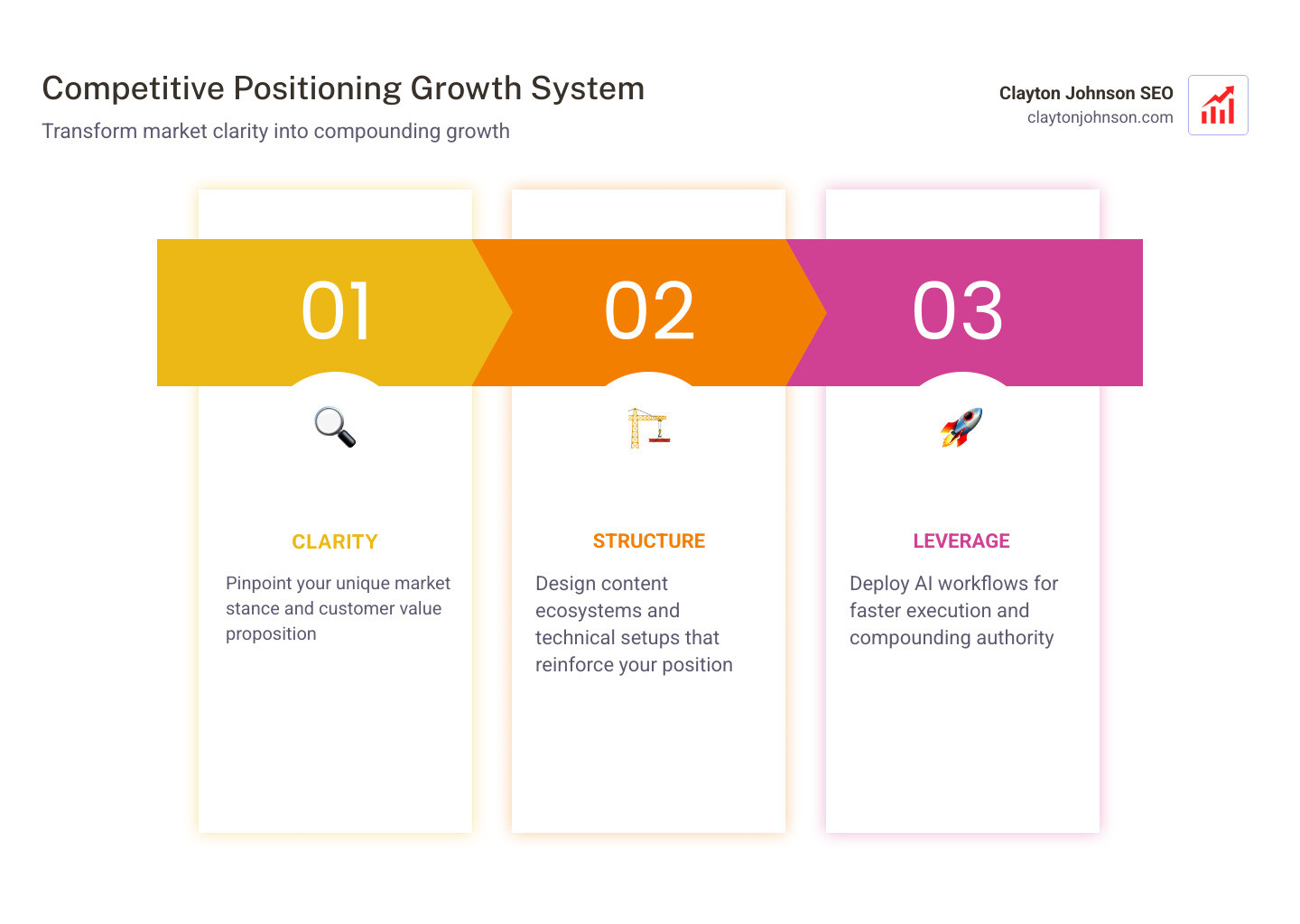
- Clarity: Understanding exactly where you sit in the market.
- Structure: Building content ecosystems and technical architectures that reflect that position.
- Leverage: Using AI-augmented workflows to execute faster than the competition.
- Compounding Growth: Creating internal linking and taxonomy structures that build authority over time.
We don’t just advise on strategy; we build the systems that operationalize it. Whether it’s through our library of 50+ strategy frameworks or our AI-enhanced marketing workflows, we help founders and operators move from “guessing” to “growing.”
Stop blending in. Start building a brand that rivals can’t ignore. Contact us to build your growth system and turn your market position into a durable competitive advantage.