Implementing AI in Business: A Guide to Boosting Your Bottom Line


Why Implementing AI in Business Is No Longer Optional
Implementing AI in business is the process of integrating artificial intelligence tools and systems into your operations to improve decisions, automate tasks, cut costs, and deliver better customer experiences.
Here is how to do it, step by step:
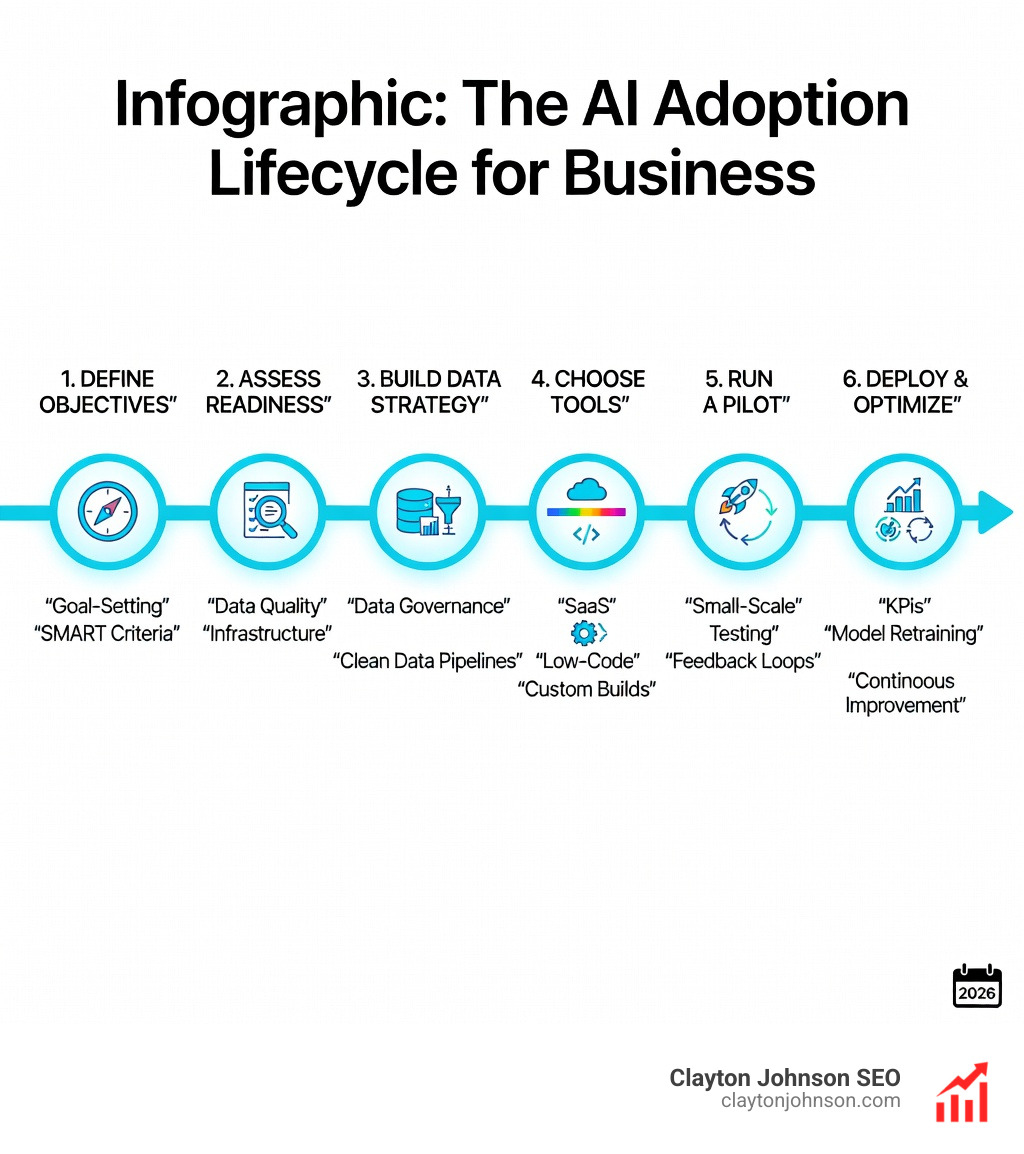
- Define clear objectives — identify specific business problems AI can solve
- Assess your readiness — evaluate your data quality, infrastructure, and team skills
- Build a data strategy — clean, structured data is the foundation of any AI system
- Choose the right tools — match AI solutions to your needs (SaaS, low-code, or custom)
- Start with a pilot — test on a small, non-critical process before scaling
- Deploy and optimize — monitor performance, gather feedback, and improve continuously
The numbers are hard to ignore. Companies that treat AI as a strategic priority are pulling ahead — fast. Klarna’s AI assistant now handles two-thirds of all customer service chats, cutting resolution times from 11 minutes to 2 minutes and projecting $40 million in profit improvement. Morgan Stanley deployed AI so effectively that 98% of its advisors use it daily, and document access jumped from 20% to 80%. These are not pilot experiments anymore. They are competitive advantages built on structured, deliberate implementation.
Most businesses, though, are stuck. They run a few AI experiments, get mixed results, and stall. The problem is rarely the technology. It is the absence of a clear strategy behind it.
This guide breaks down exactly how to move from scattered AI experiments to a system that compounds value over time — without requiring a computer science degree or an enterprise budget.
I’m Clayton Johnson, an SEO strategist and growth operator who has spent years building AI-augmented marketing systems and helping founders turn fragmented efforts into scalable growth engines — including the systems side of implementing AI in business across content, SEO, and operations. In the sections ahead, I will walk you through every stage of a successful AI implementation, from defining your first use case to measuring ROI and scaling what works.
Basic Implementing AI in business vocab:
Why Implementing AI in Business is a Strategic Necessity
In today’s rapidly evolving business landscape, implementing AI in business is no longer just a forward-thinking idea—it’s a strategic necessity. For organizations in Minneapolis and beyond, the shift toward AI isn’t just about keeping up with the “cool kids” in Silicon Valley; it’s about survival and leverage.
The benefits of AI go far beyond just automation. While many think of AI as a way to replace human effort, the most successful organizations use it to amplify human potential. When we integrate AI correctly, we unlock:
- Improved Decision-Making: AI can parse through millions of data points to find patterns we’d miss. For example, Morgan Stanley advisors now access critical documents in seconds rather than minutes, allowing them to spend more time on strategy and less on searching.
- Massive Efficiency Gains: Look at Indeed’s job matching. By using GPT-powered explanations, they saw a 20% increase in applications and a 13% uplift in actual hires. That is efficiency that hits the bottom line.
- Cost Savings: Klarna’s AI assistant is doing the work of hundreds of agents, but it’s not just about cutting heads—it’s about cutting the time it takes to solve a problem.
- Personalized Customer Experiences: We see this in retail every day. Lowe’s fine-tuned their AI to improve product tagging accuracy by 20%, ensuring customers find exactly what they need, exactly when they need it.
- Scalability: AI allows you to grow your output without linearly growing your overhead. BBVA employees created over 2,900 custom GPTs in just five months, slashing project timelines from weeks to mere hours.
For us, the math is simple: Organizations achieve an average ROI of 3.7x for every $1 invested in generative AI. If you aren’t moving toward this, your competitors certainly are.
Overcoming the Primary Challenges of AI Adoption
If it were easy, everyone would be doing it perfectly. The reality is that scientific research on AI-powered success shows that without a solid plan, even the most advanced tools fail to deliver.
We often see businesses stumble over these key hurdles:
- Data Quality and Silos: Data is the backbone of any AI system. If your data is messy, inconsistent, or locked in separate “silos” (like marketing data not talking to sales data), your AI will be useless. Garbage in, garbage out.
- Security and Trust: Hallucinations—where AI confidently makes things up—are a real risk. This is why a “human-in-the-loop” approach is vital, especially in regulated industries like finance here in Minnesota.
- The Talent Gap: There is a massive shortage of people who understand both business strategy and AI implementation. You don’t just need coders; you need “translators.”
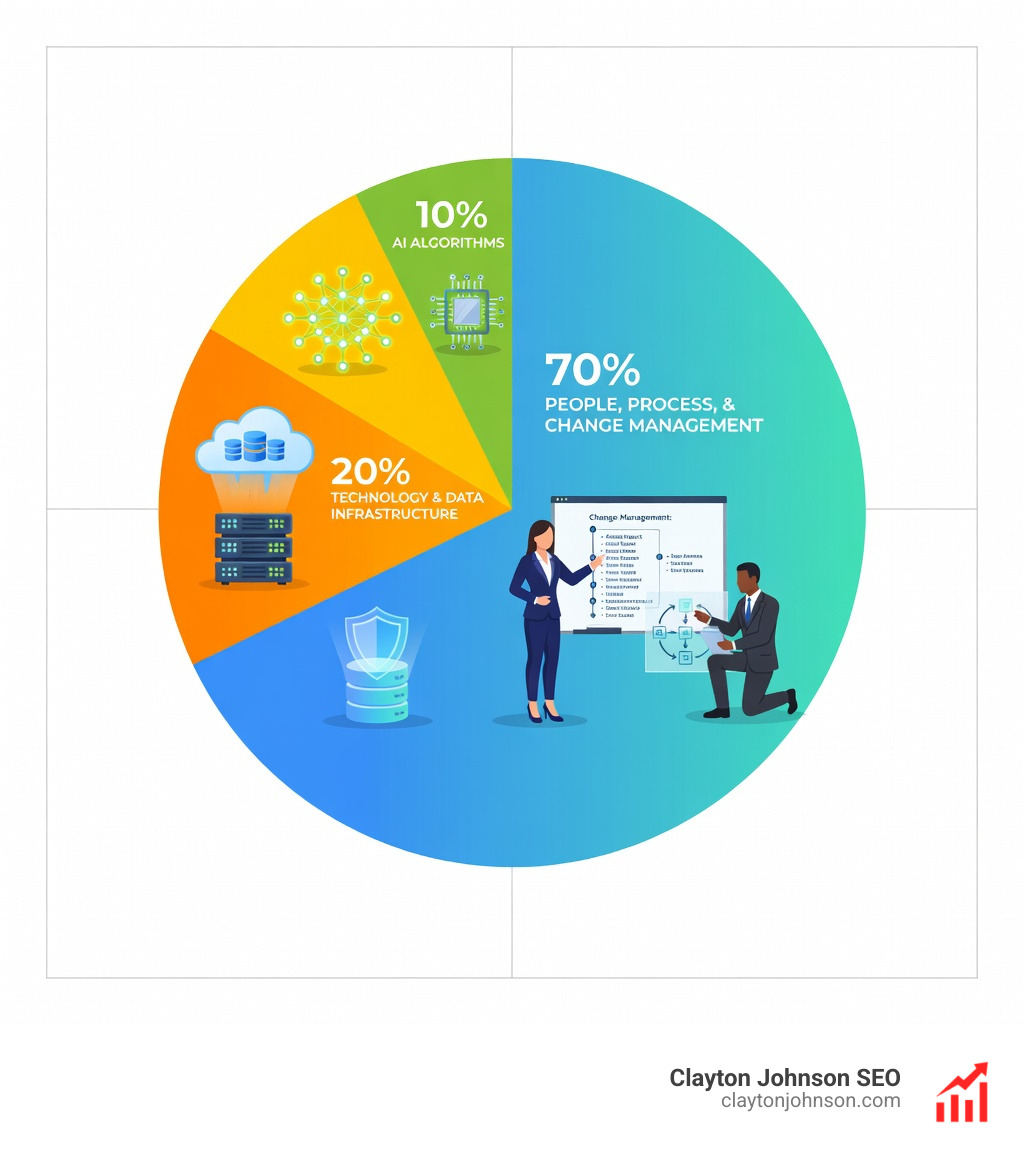
- Change Management: This is the big one. Nearly 70% of AI challenges are people-related, not technical. Employees often fear job replacement, which leads to resistance.
- Infrastructure and Cost: While the cloud makes things easier, the initial setup and ongoing “knowledge infrastructure” costs can be daunting for small to mid-sized firms.
To win, we have to treat AI as a long-term organizational transformation, not a quick software fix.

A Step-by-Step Strategy for Successful AI Integration
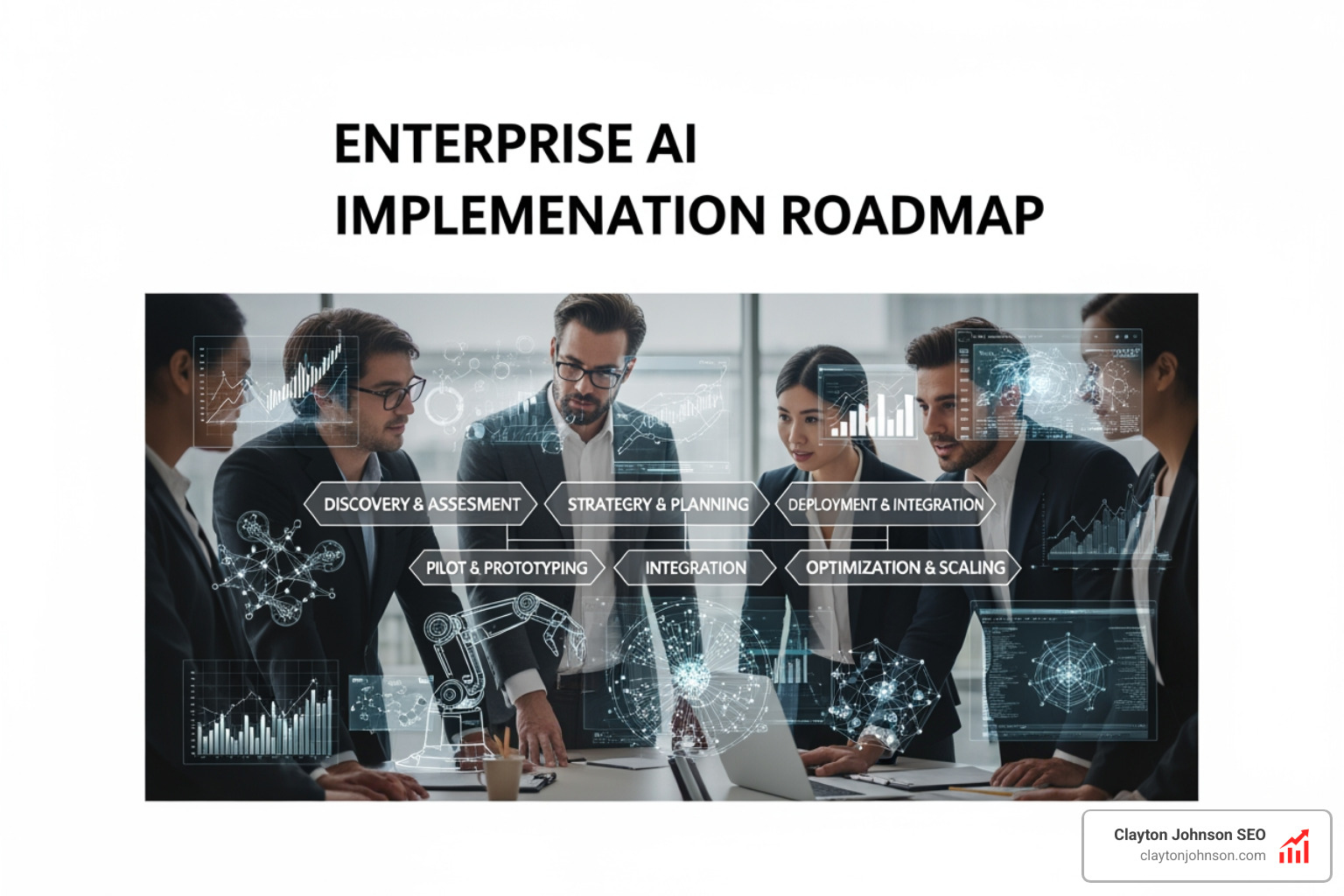
Successful implementing AI in business follows a structured growth architecture. We don’t just “turn on” AI; we build a system.
- Define SMART Objectives: Don’t just say “we want AI.” Say, “We want to reduce customer response time by 50% using an AI chatbot.”
- Assess Readiness: Do you have the GPUs, the cloud storage, and the clean data to support your goals?
- Build a Data Strategy: This involves identifying your data sources, ensuring accessibility, and setting up governance so everyone knows who owns what.
- Choose the Right Tools: You need to decide on your “consumption pattern.”
| Model | Description | Best For |
|---|---|---|
| SaaS (Software as a Service) | Ready-to-use tools like Microsoft 365 Copilot. | Quick wins, daily productivity. |
| PaaS (Platform as a Service) | Using platforms like Azure AI to build custom apps. | Specific business workflows. |
| IaaS (Infrastructure as a Service) | Fully managed infrastructure for training your own models. | Highly regulated or unique needs. |
- Pilot Testing: Run a “micro-battle” on a non-critical process.
- Continuous Optimization: AI models need retraining. As your business changes, your AI should too.
Get the AI Strategy Roadmap to visualize how these pieces fit together.
Best Practices for Starting Small when Implementing AI in Business
You don’t need to reinvent your entire company on day one. In fact, HBR IdeaCast on digital transformation suggests that you should take it one discovery at a time.
- Focus on Low-Hanging Fruit: Start with internal productivity. Can you use AI to summarize meetings or draft emails?
- Use No-Code/Low-Code Platforms: Tools like Zapier AI or Microsoft Power Platform allow non-technical business owners to build automations without writing a single line of code.
- Run Phased Pilots: Pick one department—maybe HR or Customer Service—and test a specific tool. Gather feedback, fix the bugs, and then roll it out to the rest of the company.
Measuring ROI and Scalability when Implementing AI in Business
Getting AI to scale is where most companies fail. They get a win in a small pilot but can’t replicate it across the enterprise. To ensure scalability, we focus on:
- Modular Architecture: Build your AI systems in pieces so you can swap out models or data sources as technology evolves.
- Cloud Services: Use on-demand resources so you aren’t paying for massive computing power when you don’t need it.
- Feedback Loops: The best AI systems learn from their users. If the AI gives a bad answer, there should be a simple way for a human to correct it and “teach” the model.
- Clear KPIs: Measure things that matter—revenue uplift, hours saved, or customer satisfaction scores (NPS).
Building Your AI Dream Team: Hiring vs. Upskilling
One of the most common questions we get is: “Do I need to hire a $300k-a-year developer?” The answer is usually no—at least not at first.
- Contractors for Concept: Start with contractors or agencies to prove your concepts. They bring the technical expertise without the long-term overhead.
- Upskilling Existing Staff: Your current employees already have the “domain expertise.” They know your business. Use an online learning success guide to help them learn how to use AI tools within their current roles.
- The Technical PM: If you hire anyone full-time, make it a Technical Project Manager. You need someone who can speak both “business” and “code” to manage your contractors and internal teams.
Essential AI Skills for In-House Teams:
- Prompt Engineering: Learning how to talk to AI to get the best results.
- Data Literacy: Understanding how to read and interpret AI-generated insights.
- AI Ethics and Oversight: Knowing when to trust the machine and when to step in.
Ethical AI, Data Governance, and Regulatory Compliance
We cannot talk about AI without talking about responsibility. In Minneapolis, businesses must be particularly aware of data privacy and sector-specific regulations, especially in the financial and healthcare sectors.
The Microsoft Responsible AI Standard provides a great framework for this. We focus on:
- Transparency: Can you explain why the AI made a certain decision?
- Fairness: Are you regularly auditing your models for bias? AI can inadvertently learn human prejudices if the training data is skewed.
- Security: Protecting client data is paramount. Many firms prefer “local” or private AI models to ensure sensitive information never leaves their secure environment.
- Accountability: There must always be a human responsible for the AI’s output.
Following the NIST AI Risk Management Framework is a best practice for ensuring your AI implementation doesn’t become a legal liability.

Frequently Asked Questions about AI in Business
How long does it take to see ROI from AI?
Small businesses often see a break-even point in as little as 3 to 4 months for simple automations. For larger enterprise transformations, you should expect to see significant returns within 12 to 18 months as the systems scale and the “compounding value” kicks in.
Should I build custom AI or buy existing software?
The “Buy vs. Build” debate is shifting. Currently, purchased (SaaS) solutions have a 67% success rate compared to just 33% for internal builds. Our advice? Buy the “table stakes” (like email or document drafting) and build the “strategic bets” that are unique to your business.
How do I handle employee fear of job replacement?
Transparency is key. We recommend framing AI as a “co-pilot,” not an autopilot. Show them how AI handles the rote, boring tasks (the “drudgery”) so they can focus on high-value strategy. Create an AI learning culture where upskilling is rewarded, not feared.
Conclusion
Implementing AI in business is not a one-time event; it is a continuous journey of reinvention. It requires strategic preparation, cultural buy-in, and a structured growth architecture.
At Demandflow.ai, we believe that most companies don’t lack tactics—they lack the structure to make those tactics scale. Whether you are looking for More info about AI tools or a complete growth diagnostic, we are here to help you build the infrastructure for compounding growth.
The future belongs to the “Frontier Firms”—those who combine human creativity with AI leverage to move faster and smarter than the competition. It’s time to get started.