10 SEO Automation AI Examples to Steal Today

Why Knowing How AI Automates SEO Gives You a Compounding Advantage
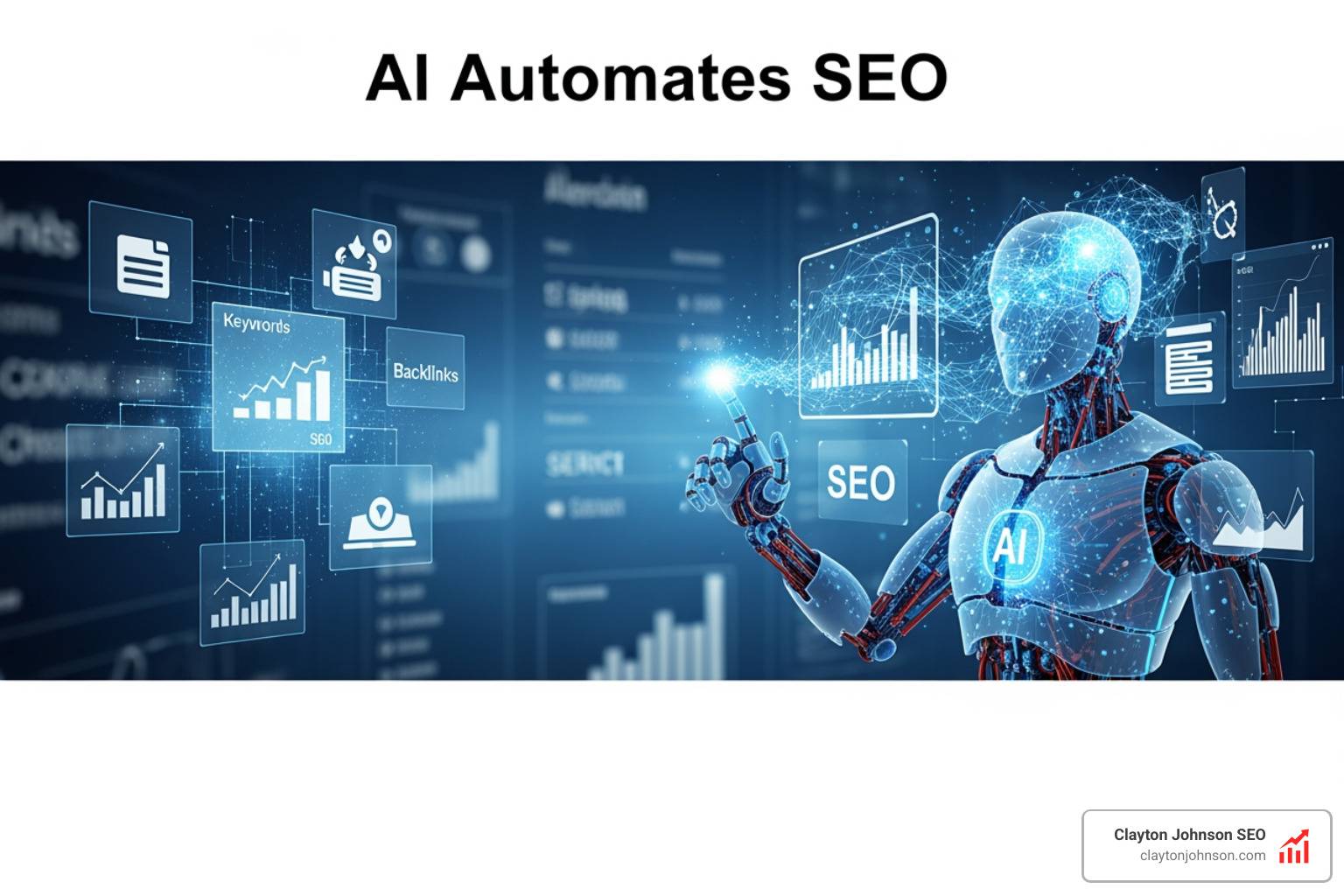
How AI automates SEO comes down to one core shift: replacing slow, repetitive manual work with systems that run at scale, around the clock.
Here’s the quick answer:
AI automates SEO by:
- Clustering keywords by topic and intent automatically
- Generating content briefs from competitor and SERP data
- Auditing technical health and flagging issues in real time
- Creating schema markup for structured data and rich results
- Managing internal links with contextual anchor text logic
- Detecting competitor gaps and content decay signals
- Automating reporting dashboards and KPI visualization
- Optimizing local SEO citations and GMB signals
- Personalizing link outreach at scale with AI prospecting
- Structuring content for AI Overviews and answer engines
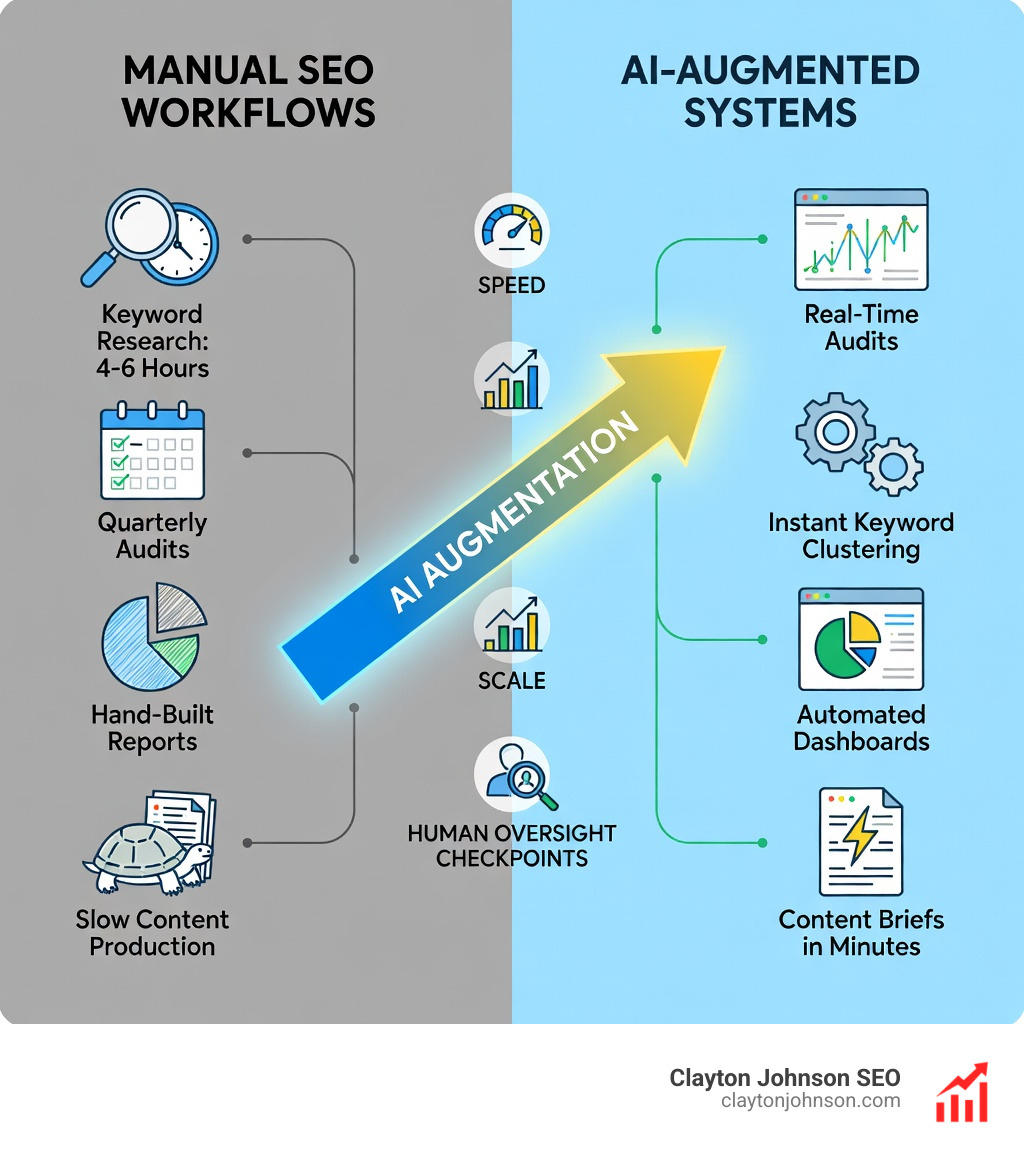
Most SEO teams are still running on manual workflows. Keyword research done by hand. Briefs built from scratch. Technical audits run once a quarter. Reporting copy-pasted into spreadsheets.
That approach doesn’t scale. And in a search environment where AI Overviews now appear in over 13% of Google queries, speed and structure matter more than ever.
The good news? AI doesn’t replace SEO strategy. It removes the execution drag that slows it down.
One experiment with five domains and hundreds of AI-generated articles found that fully autonomous AI SEO produced mediocre “C-level” content — it ranked, but barely converted. The lesson wasn’t that AI fails. It’s that AI without human strategy is just fast mediocrity.
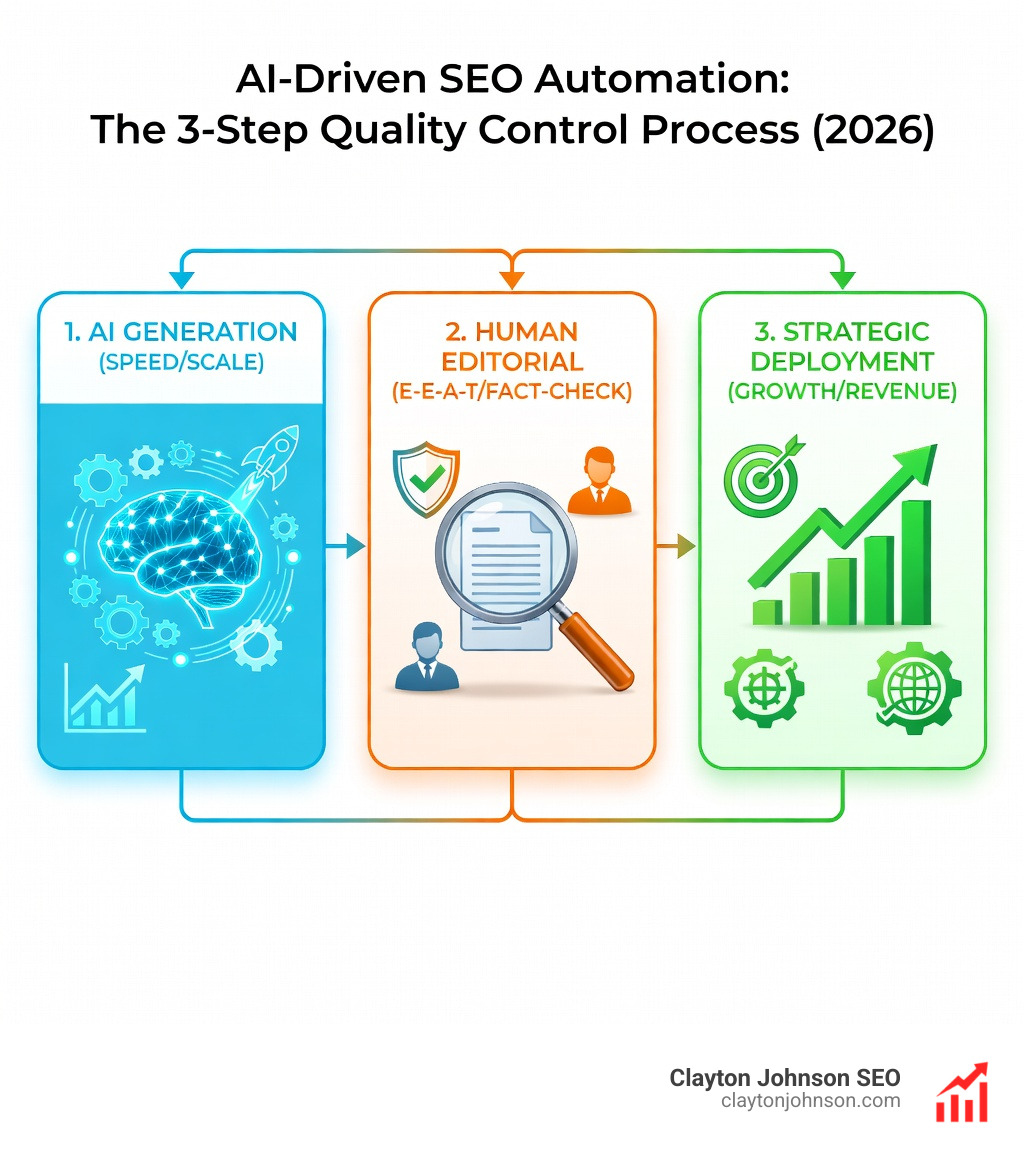
The teams winning right now use AI to handle volume while humans control direction.
Production time per article has dropped from 8 hours to under 3 hours for teams using AI-assisted workflows. One case study reported 4,162% traffic growth after combining AI SEO programs with human editorial review. And 74% of link builders report better outcomes when AI handles prospecting and pitch personalization.
This isn’t about replacing your SEO team. It’s about giving them leverage.
I’m Clayton Johnson — SEO strategist and growth architect focused on building AI-augmented SEO systems that compound over time, and understanding how AI automates SEO is central to everything I build for founders and marketing leaders. My frameworks have been applied across 50+ business models to turn fragmented execution into structured, scalable demand engines — and in this guide, I’ll show you exactly which workflows to hand off to AI first.
Related content about how ai automates seo:
- what is ai seo
- what is seo automation
- SEO AI workflow automation
Understanding How AI Automates SEO Workflows
To understand how AI automates SEO, we have to look past the “magic button” myth. AI isn’t a replacement for a brain; it’s a high-speed pattern recognition engine. It excels at processing massive datasets that would take a human weeks to parse. For example, McKinsey research on generative AI impact shows that organizations adopting these tools in marketing and sales report a 10–20% revenue uplift.
In my work as an SEO consultant, I see AI shifting SEO from a one-off, project-based effort into an always-on operating system. AI enables:
- Semantic Search Understanding: Moving beyond matching words to understanding the intent behind a query.
- Algorithmic Adaptation: Quickly identifying when Google shifts ranking factors and suggesting real-time pivots.
- Intent Mapping: Automatically categorizing thousands of keywords into “informational,” “transactional,” or “navigational” buckets.
By automating the “grunt work” of data collection and initial analysis, we free up our creative energy for high-level growth architecture.
10 Practical Examples of SEO Automation
Workflow efficiency is the ultimate competitive advantage. If your competitor takes 15 hours to plan a content cluster and you take 15 minutes, you win on volume and speed every time.
| SEO Task | Manual Duration | AI-Automated Duration | Efficiency Gain |
|---|---|---|---|
| Keyword Clustering (500 terms) | 4-6 Hours | 2 Minutes | 99% |
| Content Brief Creation | 90 Minutes | 5 Minutes | 94% |
| Technical Site Audit | 3-5 Hours | Real-time / 10 Mins | 95%+ |
| Schema Markup Generation | 30 Minutes | 30 Seconds | 98% |
| Internal Link Mapping | 2 Hours | 5 Minutes | 96% |
1. Automated Keyword Clustering and Intent Mapping
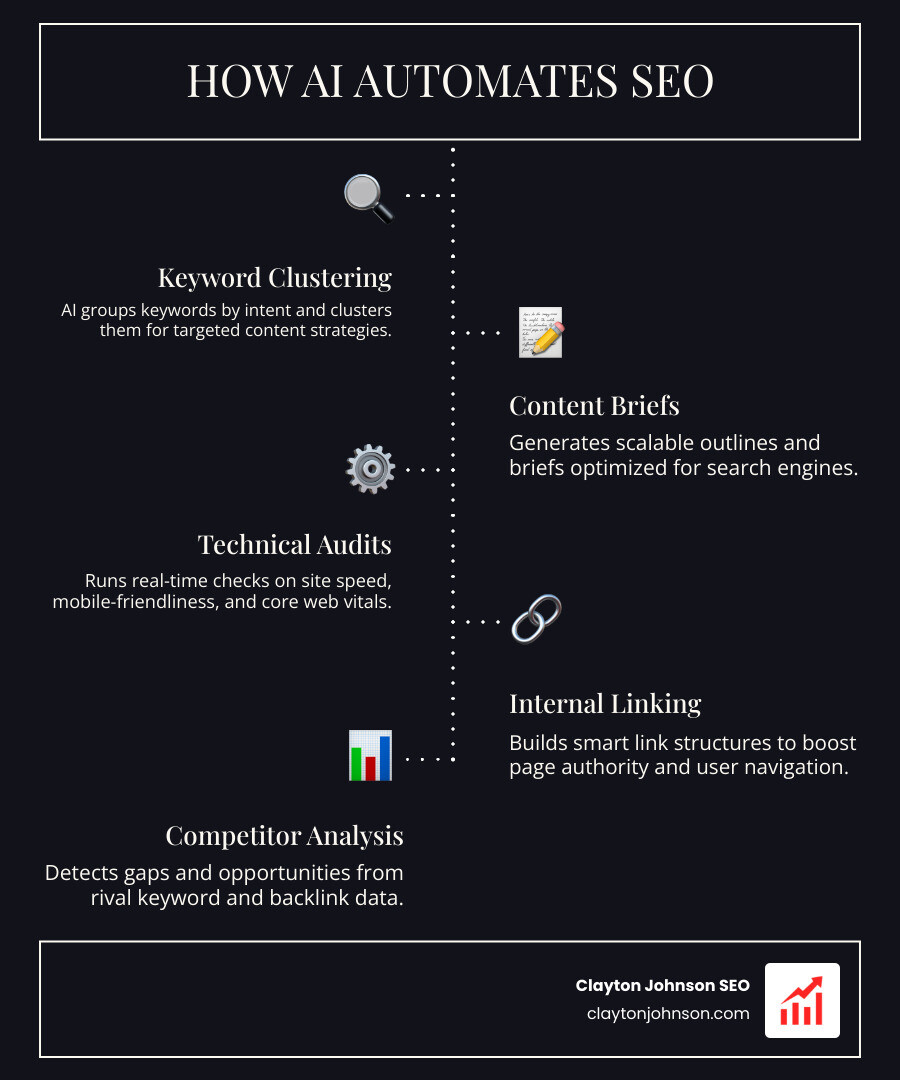
Gone are the days of staring at a spreadsheet of 5,000 keywords and trying to group them manually. Tools like LowFruits and SEO Stack use AI to analyze SERP similarity. If two keywords show the same search results, the AI clusters them into one topic.
This helps us discover long-tail opportunities we might have missed. Instead of one page per keyword, we build “topic clusters” that establish semantic relevance and authority. Shifting to this model has helped some brands rank for 68% more long-tail keywords year over year.
2. Scaling Content Briefs and Outlines
A great content brief is the difference between an article that ranks and one that disappears. AI-driven tools like Clearscope and Surfer AI analyze the top 20 results for your target keyword.
They identify:
- Common subheadings and questions.
- The optimal word count and reading level.
- Missing “entities” (related topics) that Google expects to see.
By automating the outline process, we ensure our writers have a data-backed roadmap before they type a single word.
3. Real-Time Technical SEO Audits
Technical SEO is often treated as a “once-a-year” spring cleaning. That’s a mistake. A single broken redirect or a drop in Core Web Vitals can tank your rankings in days.
Automation tools like Screaming Frog and Alli AI can be set to crawl your site on a schedule. They flag issues like duplicate content, missing alt tags, or slow-loading pages immediately. This allows us to maintain site health proactively rather than reacting to a traffic drop.
4. Dynamic Schema Markup Generation
Schema markup is the “language” search engines use to understand your content. It tells Google, “This is a recipe,” or “This is a product price.” While it’s technically complex, Google recommends including all relevant properties to increase your eligibility for rich results.
AI can scan your page and automatically generate the JSON-LD code required for FAQ schema, Review schema, and Organization schema. This ensures entity clarity without requiring a developer for every small update.
5. AI-Powered Internal Linking Systems
Internal links distribute “link juice” (authority) throughout your site. Most sites have a few “power pages” and hundreds of “orphaned pages” with no links.
Using tools like Page Optimizer Pro, we can automate the discovery of contextual relationship opportunities. The AI identifies which existing pages have the most relevant content to link to a new post, optimizing your anchor text and site architecture in minutes.
6. Competitor Intelligence and Gap Detection
If your competitor publishes a new guide that starts stealing your featured snippets, you need to know now, not next month. AI agents in platforms like SE Ranking and AirOps monitor competitor movements 24/7.
They can alert us to:
- Keywords the competitor just started ranking for.
- Content gaps where they have an article and we don’t.
- “Content decay” signals where our rankings are slipping relative to their updates.
7. Automated Reporting and Data Visualization
Reporting is usually the most hated task in an SEO agency. It’s tedious and often ignores the “why” behind the numbers. By using Looker Studio, we can build custom SEO dashboards that pull live data from Google Search Console and GA4.
AI layers on top of these dashboards can even write the executive summary, highlighting which KPIs moved and what the likely cause was. This turns a static report into an actionable strategic document.
8. Local SEO and Citation Management
For businesses in Minneapolis or other specific regions, Local SEO is a different beast. AI helps maintain NAP (Name, Address, Phone) consistency across hundreds of directories.
Platforms now offer local SEO suggestions by analyzing regional search patterns. AI can even help draft responses to Google Business Profile reviews, ensuring you stay active and engaged with your local audience without spending hours on administrative work.
9. Link Building Prospecting and Personalization
Link building is the hardest part of SEO to automate because it requires a human touch. However, 74% of link builders report better outcomes with AI when it’s used for the heavy lifting.
AI can:
- Scrape thousands of sites to find relevant prospects.
- Filter out “low-quality” or “spammy” sites automatically.
- Draft a personalized pitch based on the specific content on the prospect’s blog.
We still review every pitch, but AI gets us to the “send” button 10x faster.
10. Optimizing for AI Overviews and Answer Engines
The future of search is “zero-click.” Google’s AI Overviews and tools like ChatGPT summarize the web so users don’t have to click. To stay visible, we use GEO (Generative Engine Optimization).
This involves creating an extractable content structure — using clear headings, concise definitions, and authoritative tables that AI models can easily “cite” as a source. If you aren’t optimized for the answer engine, you’re invisible.
Best Practices for Implementation
Knowing how AI automates SEO is one thing; implementing it without getting penalized is another. We must always follow Google’s helpful content guidelines, which prioritize content created for people, not just for search engines.
Maintaining Quality Control in How AI Automates SEO
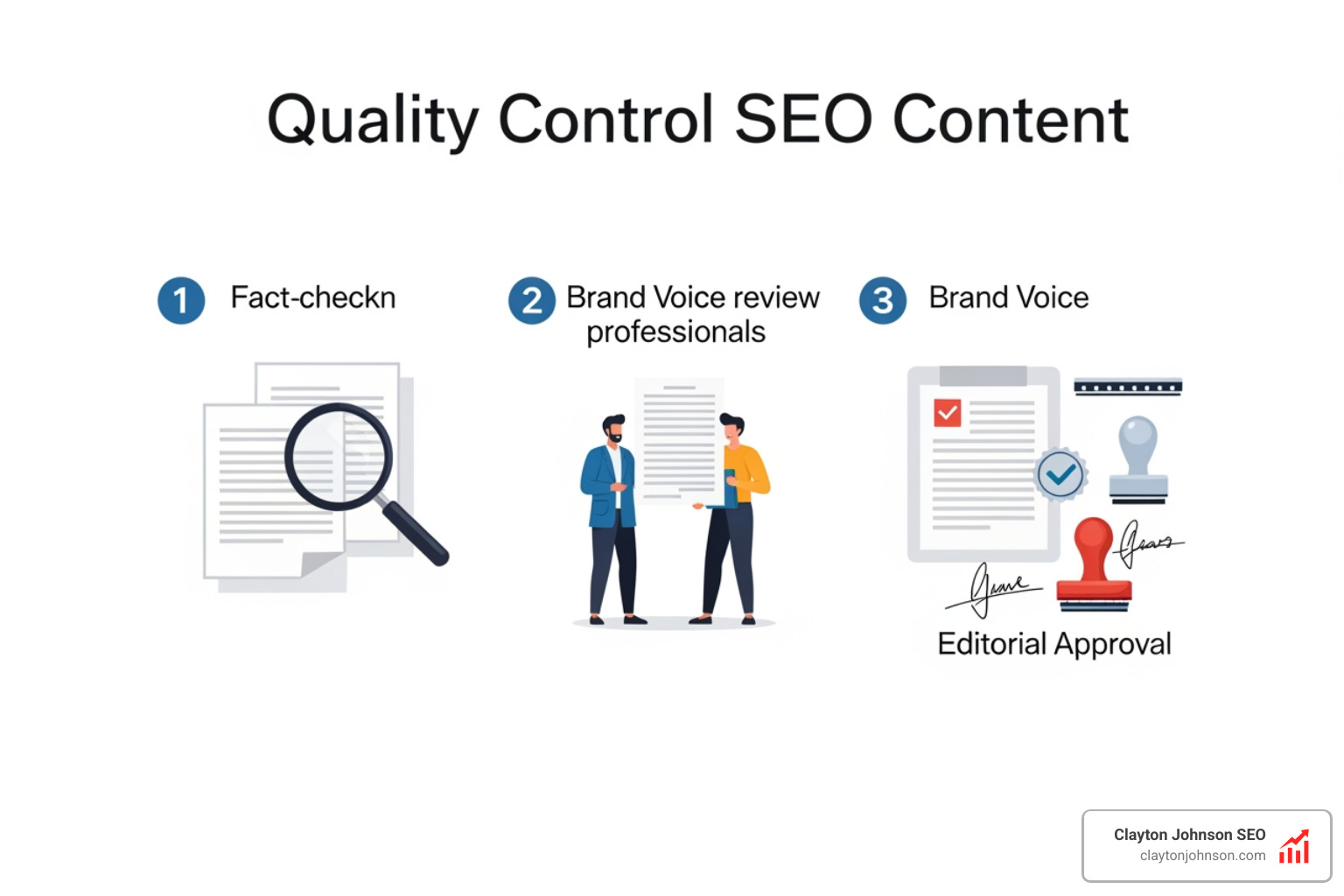
AI is an “eager apprentice,” not a master strategist. It can hallucinate facts or produce “thin” content that lacks first-person experience (E-E-A-T). Every piece of AI-assisted content must go through a rigorous human editorial gate to ensure:
- Factual Accuracy: AI is notoriously bad at math and recent news.
- Brand Voice: AI tends to use the same generic “marketing speak” unless coached otherwise.
- Unique Value: If your AI content is just a summary of the top 10 results, why should Google rank it? You must add proprietary data or unique insights.
Strategic Oversight for How AI Automates SEO
Automation is only as good as the architecture it sits on. Harvard Business Review on automation driving growth notes that companies cutting manual tasks by 30% see the most success when they reinvest that time into creative strategy.
At Clayton Johnson SEO, we focus on Revenue-Aligned KPIs. We don’t just want more traffic; we want the right traffic that converts into customers. AI handles the volume; we handle the value.
Frequently Asked Questions about SEO Automation
Does AI-generated content rank well in search engines?
Yes, but with a caveat. Google has stated they do not penalize AI content simply for being AI-generated. They penalize bad content. If your AI content provides genuine value, uses structured data, and demonstrates expertise, it can rank at the top. If it’s just “spammy” or repetitive, it will eventually be filtered out.
Are SEO automation tools worth the investment compared to manual staff?
Absolutely. A mid-tier automation stack might cost $500–$1,000 a month, which is a fraction of the cost of a junior SEO specialist or virtual assistant. More importantly, AI doesn’t get tired, doesn’t make typos in data entry, and can process keywords 24/7. However, you still need a strategist to steer the ship.
How does AI handle complex technical SEO aspects like schema?
AI is actually better at technical tasks than creative ones. Because code (like JSON-LD) follows strict rules, AI can generate valid, error-free schema markup much faster than a human. It can also identify complex technical patterns, like “crawl budget” leaks, by analyzing server log files in seconds.
Conclusion
The era of manual SEO is ending. Whether you’re a founder in Minneapolis or a marketing leader at a global brand, understanding how AI automates SEO is the key to building a sustainable growth engine.
At Clayton Johnson SEO, we build more than just content; we build structured growth infrastructure through Demandflow.ai. By combining actionable strategic frameworks with AI-augmented workflows, we help you stop chasing tactics and start building a compounding asset.
Ready to scale your visibility across traditional and AI search?
Explore our AI SEO services here and let’s build your growth architecture together.