Why Every Business Owner Needs a Growth Marketer’s Playbook
A growth marketer’s playbook is a structured system of frameworks, tactics, and experiments that guides you from scattered marketing activity to predictable, compounding growth. Here’s what it covers at a glance:
The Growth Marketer’s Playbook — Quick Overview:
| Stage | What It Means | Key Focus |
|---|---|---|
| Acquisition | Get the right people in the door | SEO, paid ads, content, referrals |
| Activation | Turn visitors into engaged users | Onboarding, UX, quick wins |
| Retention | Keep customers coming back | Lifecycle emails, behavioral triggers |
| Revenue | Maximize what each customer is worth | Upsells, pricing, expansion |
| Referral | Let customers grow the business for you | Viral loops, advocacy programs |
Most businesses don’t struggle because they lack effort. They struggle because they’re using the wrong tactics, in the wrong order, without a system connecting them.
The stats back this up. Acquiring a new customer costs 5 to 25 times more than keeping an existing one. Yet most marketing budgets are still front-loaded on acquisition, with almost nothing invested downstream. Meanwhile, 94% of consumers have cut ties with a brand simply because the messaging felt irrelevant.
Growth marketing fixes this by treating the entire customer lifecycle as the playing field — not just the top of the funnel.
It replaces gut-feel campaigns with hypothesis-driven experiments. It replaces vanity metrics with KPIs tied directly to revenue. And it replaces one-off tactics with a repeatable system that compounds over time.
I’m Clayton Johnson, an SEO strategist and demand generation expert who has spent nearly two decades building scalable growth frameworks for businesses that want more than just traffic — they want revenue. My experience building data-driven systems directly informs every section of this growth marketer’s playbook, so you’ll leave with strategies you can actually implement.
The Core Framework of a Growth Marketer’s Playbook
When we talk about a growth marketer’s playbook, we aren’t talking about a list of “hacks” we found on a late-night Reddit thread. We are talking about a fundamental shift in how a business operates. Traditional marketing often focuses on brand awareness and the top of the funnel—getting your name out there and hoping someone bites. Growth marketing, however, is obsessed with measurable outcomes at every single stage of the customer journey.
While a traditional brand might spend millions on a Super Bowl ad to “build awareness,” a growth team would rather spend that budget on a series of A/B tests to find the exact referral loop that lowers their Customer Acquisition Cost (CAC). As a McKinsey report on modern marketing suggests, senior marketers recognize the need for modernization, but they often lack the focus on specific capabilities required to bridge the gap. That’s where a structured framework comes in.
The AARRR Model: Your North Star
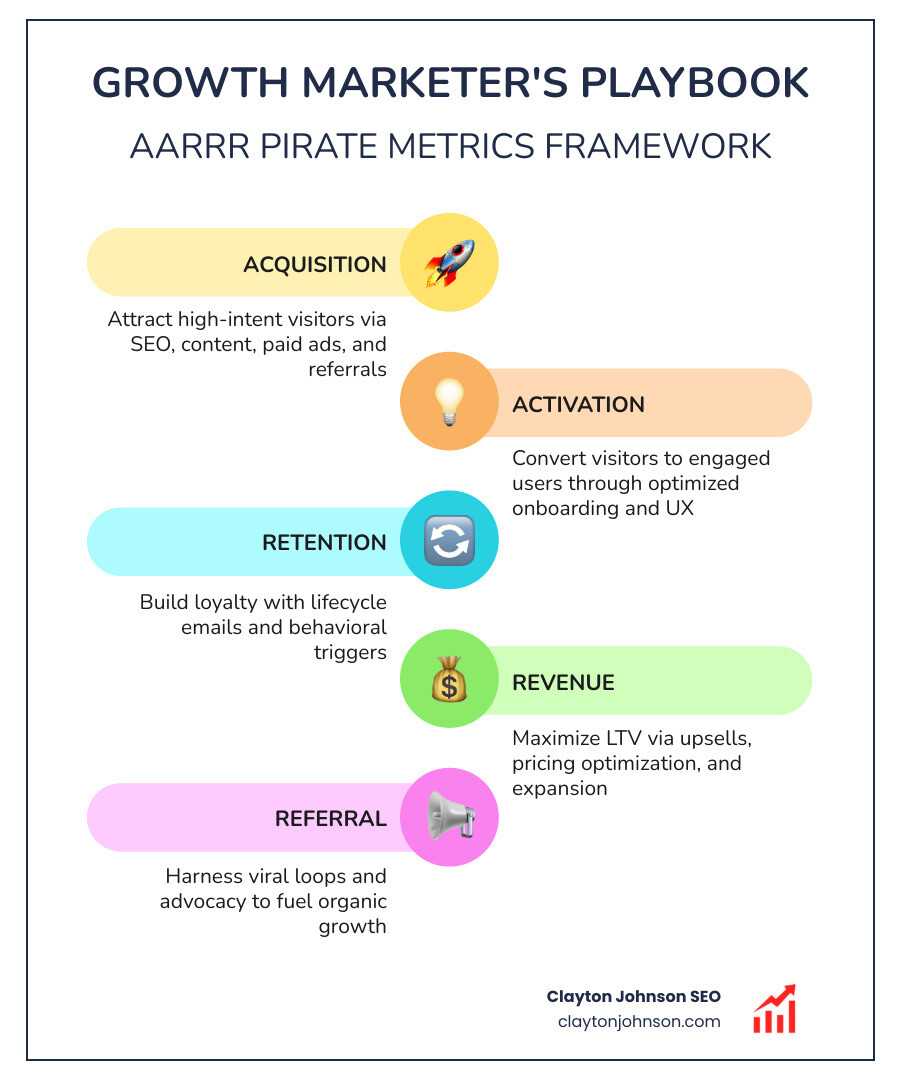
The backbone of any successful growth marketer’s playbook is the AARRR model, often called “Pirate Metrics.” If you want to stop sinking and start sailing with the pirate metrics growth framework, you need to understand these five levers:
- Acquisition: How do people find you? This isn’t just about traffic; it’s about high-intent traffic that actually has a problem your product solves.
- Activation: Do they have an “Aha!” moment? This is the first time a user realizes the value of your product. If they sign up but never use the key feature, you’ve failed at activation.
- Retention: Do they come back? This is the most important metric for long-term survival. If you have a “leaky bucket,” no amount of acquisition will save you.
- Revenue: How do you make money? This involves optimizing pricing, upsells, and the total lifetime value (LTV) of the customer.
- Referral: Do they tell their friends? This is where exponential growth happens through viral loops and advocacy.
Foundational Steps for Scalable Growth
Before we start running experiments, we must ensure our foundation is solid. You cannot scale a product that nobody wants. This is why growth-systems/product-market-fit is the absolute prerequisite for everything else in this playbook.
We also need to align our team. Growth isn’t just a “marketing thing”—it’s a company-wide mindset. We need to identify growth roadblocks, establish a clear buyer’s journey, and ensure we have the growth-systems in place to measure what matters. Without these, we are just throwing spaghetti at the wall.
Optimizing Activation and Retention in the Growth Marketer’s Playbook
If acquisition is the engine, then activation and retention are the fuel and the maintenance that keep the car on the road. Many businesses make the mistake of focusing 90% of their energy on getting new customers while ignoring the ones they already have. This is a recipe for burning cash.
Activation is all about that first success. We track the activation rate—the percentage of users who take a specific, value-driven action within a certain timeframe. For a SaaS company, this might be completing an onboarding checklist. For an e-commerce brand, it might be making their first purchase using a personalized discount code.
Retention, however, is where the real wealth is built. According to research, it costs 5 to 25 times more to acquire a new customer than to retain an existing one. We use the executive guide to compounding growth architecture to build systems that keep users engaged over the long haul.
Comparing Activation and Retention Tactics:
| Strategy | Activation Tactics | Retention Tactics |
|---|---|---|
| Primary Goal | Deliver the “Aha!” moment quickly | Increase Customer Lifetime Value (LTV) |
| Key Tactics | Interactive walkthroughs, personalized welcome emails, “quick win” features | Behavioral triggers, loyalty programs, community building, win-back campaigns |
| Key Metric | Time-to-first-success | Churn rate / NRR (Net Revenue Retention) |
| Communication | In-app notifications, SMS alerts | Educational newsletters, usage reports, anniversary rewards |
To prevent churn, we use predictive analytics to identify “at-risk” users. If a user hasn’t logged in for ten days, that’s a behavioral trigger that should prompt an automated, helpful reach-out. We also focus on Customer Lifetime Value (LTV) vs. Customer Acquisition Cost (CAC). A healthy business typically aims for an LTV:CAC ratio of 3:1 or higher. If yours is lower, your growth marketer’s playbook needs to shift its focus toward retention and expansion revenue.
Scaling Acquisition Channels with a Growth Marketer’s Playbook
Once the bucket is no longer leaking, it’s time to pour in the water. Acquisition in a growth marketer’s playbook is about finding the most efficient, repeatable, and scalable ways to reach your Ideal Customer Profile (ICP).
We don’t try to be everywhere at once. Instead, we master 2-3 channels where our buyers already hang out. This might involve:
- SEO and Content Marketing: We build growth systems for traffic generation by focusing on search intent. We don’t just write “blog posts”; we build content architecture that answers the specific questions our customers are asking.
- Technical Marketing: For those in complex industries, The Ultimate Growth-Hacking Playbook for Technical Marketers emphasizes the importance of data-crunching and platform integration.
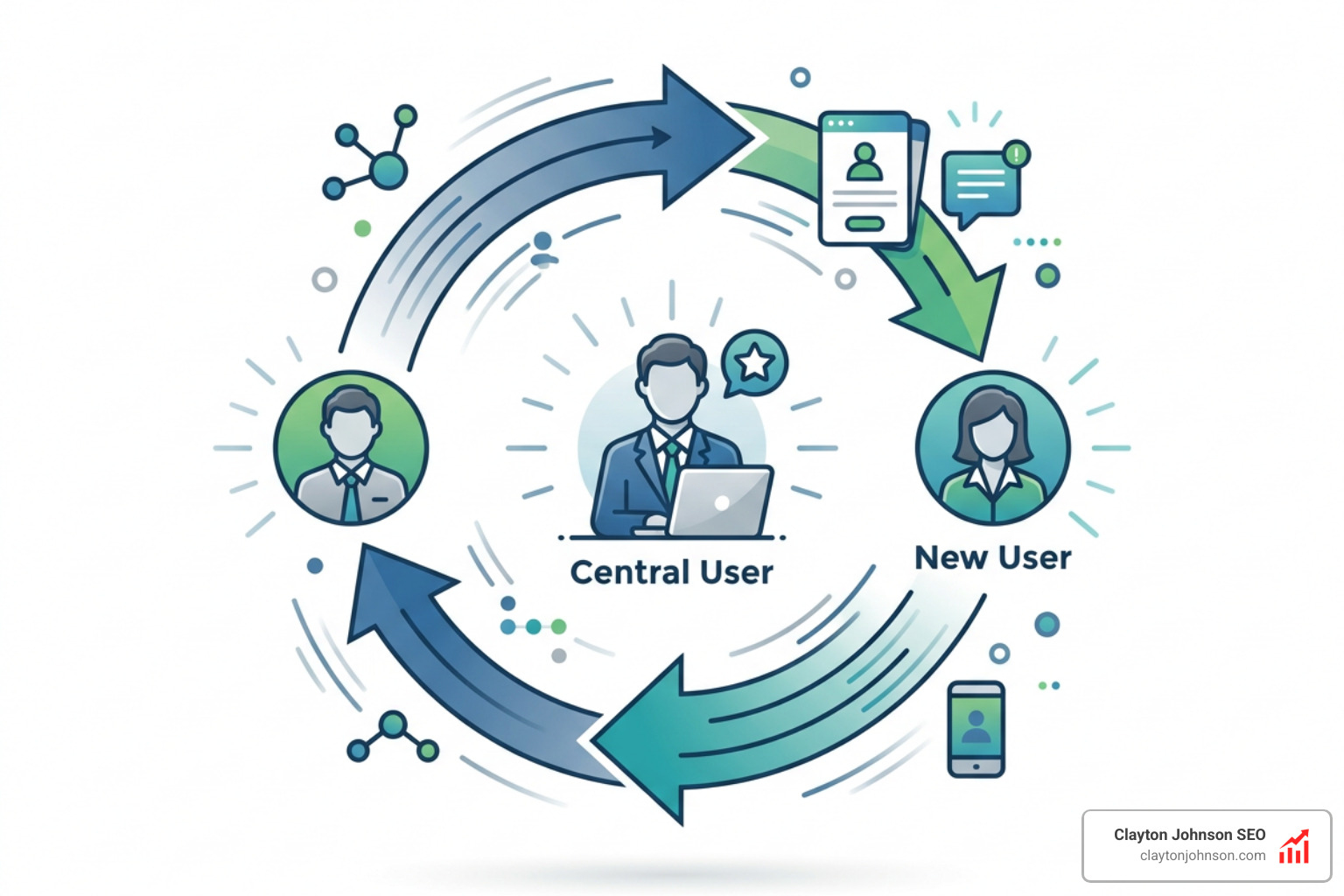
- Viral Loops and Referrals: These are self-reinforcing systems where one user brings in another. Think of Dropbox giving away free storage for referrals. A successful viral loop requires low friction and a clear incentive for both the referrer and the referee.
- Paid Acquisition: We use Google Ads and Paid Social not just for “clicks,” but to test hypotheses quickly. Paid media is the fastest way to validate a new message or landing page before we invest months into organic SEO.
A critical component of modern acquisition is omni-channel relevance. 80% of consumers report a fragmented experience when engaging with brands across different platforms. Our playbook ensures that whether a customer sees a LinkedIn ad, receives an email, or visits our website, the message is consistent and personalized. Statistics show that 90% of text messages are read within three minutes, and 72% of consumers prefer email as their primary messaging channel. We use these channels in tandem to create a seamless journey.
Leveraging AI and Data for Growth Experimentation
The “magic” in growth marketing isn’t magic at all—it’s math. Specifically, it’s the math of experimentation. To run a high-growth engine, we need to move away from “I think this will work” to “The data suggests we should test this.”
AI is transforming this process. By using the architect’s guide to AI growth, we can automate the boring stuff and focus on high-level strategy. AI-powered growth hacking allows for:
- Predictive Lead Scoring: Using machine learning to identify which leads are most likely to convert based on historical data.
- Dynamic Pricing and Upsells: Adjusting offers in real-time based on user behavior and demand.
- Predictive Churn Intervention: Identifying the exact moment a customer is about to leave and hitting them with the right incentive to stay.
- Automated Experimentation: Running 10x more experiments per quarter by using AI to generate hypotheses and analyze results.
How to Prioritize Growth Experiments: We don’t just run every idea we have. We use frameworks like ICE or RICE to build our experimentation roadmap:
- Impact: How much will this project move the needle?
- Confidence: How sure are we that it will work?
- Ease (or Effort): How hard is it to implement?
By scoring every idea, we ensure we are always working on the highest-leverage tasks. We also need to overcome data silos. Technical marketers often struggle because their data is stuck in different tools. A modern growth stack—including tools like Google Analytics, Mixpanel, and CRM platforms—must be integrated so we have a 360-degree view of the customer.

Building Your Durable Growth System
At Clayton Johnson SEO, we believe that growth isn’t a one-time event; it’s a durable system. We see too many founders chasing the latest “hack” only to find themselves back at square one three months later. Our philosophy is different: Clarity → Structure → Leverage → Compounding Growth.
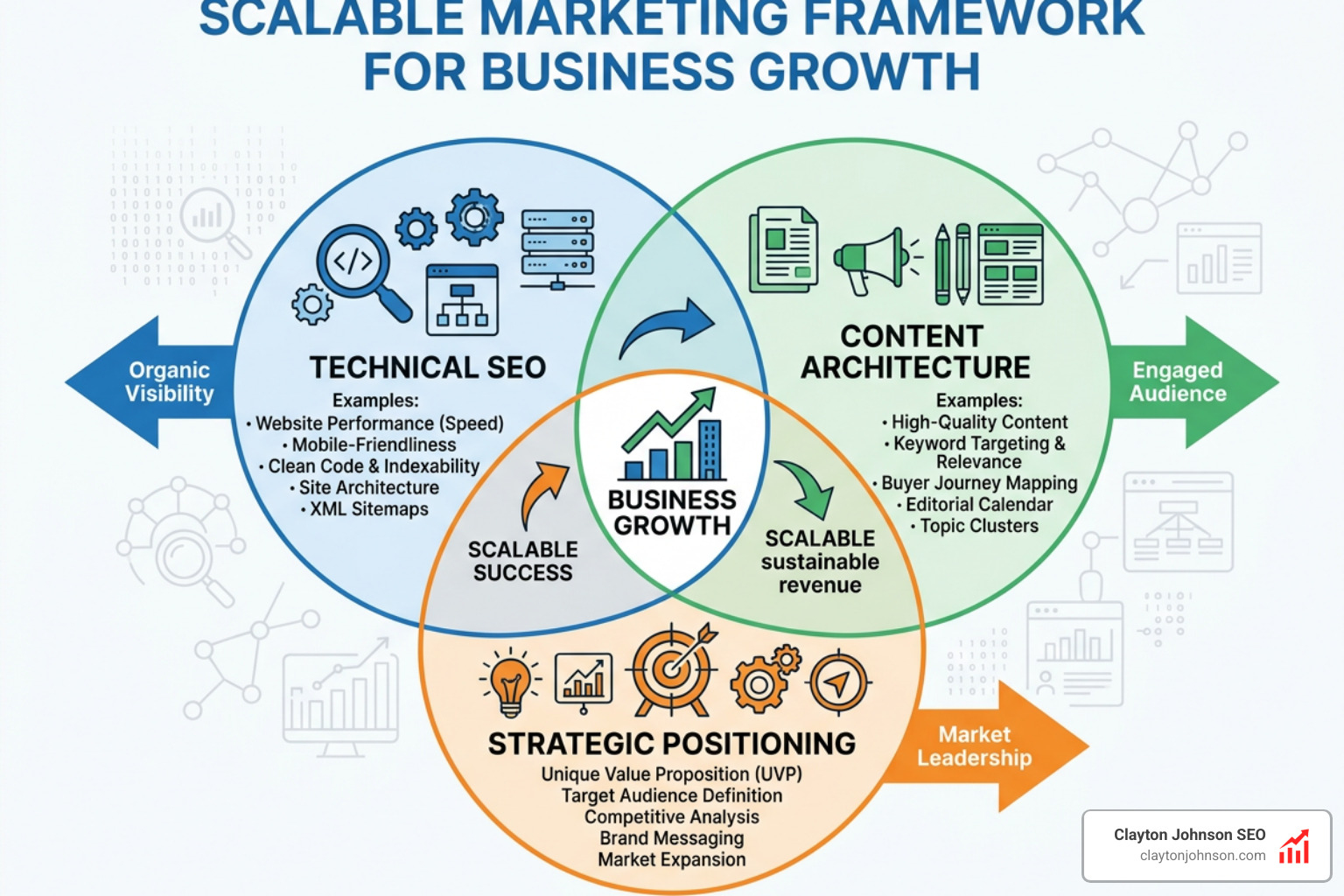
We help businesses build the ultimate blueprint for scalable marketing frameworks and AI brand strategies. This isn’t just about getting more traffic; it’s about building an ecosystem where every piece of content, every internal link, and every automated email works together to drive revenue.
Why Your Business Needs a System
If you are relying on fragmented tactics, you are essentially “sinking” while trying to bail water out with a spoon. You need to understand why your business needs a growth system to survive. A system provides:
- Scalable Traffic: Moving away from unpredictable spikes to a steady, growing stream of high-intent visitors through technical SEO and content architecture.
- Strategic Positioning: Ensuring you aren’t just “another vendor” in a crowded market. We use competitive analysis to find the gaps your competitors are missing.
- Measurable Impact: Focusing on the metrics that actually improve your bottom line—not vanity metrics like “likes” or “impressions.”
The Clayton Johnson Approach
We don’t just advise on strategy; we operationalize it. Whether it’s building a structured strategy framework library spanning 50+ business models or integrating AI-enhanced workflows into your marketing execution, our goal is to give you leverage.
Leverage means doing more with less. It means using a taxonomy-driven content ecosystem so that one great piece of content ranks for hundreds of related keywords. It means setting up tool-backed decision processes so your team knows exactly what to do next without a three-hour meeting.
When you follow a proper growth marketer’s playbook, growth stops being a mystery and starts being a choice. It requires discipline, data, and a willingness to fail fast so you can learn even faster.
If you’re tired of the fluff and ready to build a growth engine that actually compounds, it’s time to stop reacting and start building. Focus on the systems, respect the data, and remember: if you aren’t growing, you’re dying. Let’s get to work.