Why Your Google Search Campaign Strategy Determines Your ROI
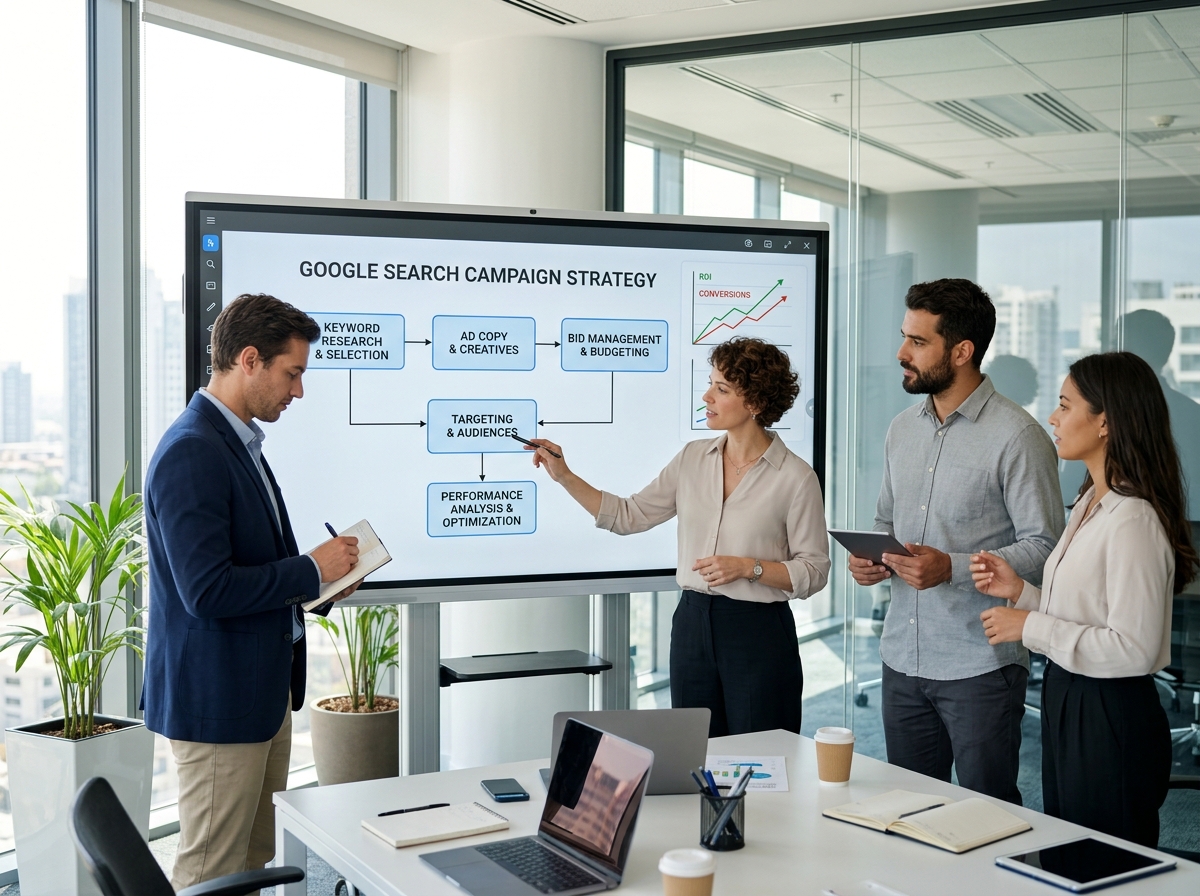
A strong google search campaign strategy is the difference between ads that drain your budget and ads that consistently bring in qualified leads and sales.
Here is a quick overview of what an effective Google Search campaign strategy involves:
- Define clear goals – Choose between sales, leads, or website traffic before you build anything
- Research keywords by intent – Target transactional searches like “buy” or “hire” over generic informational ones
- Structure your account logically – Organize campaigns and ad groups around tight themes
- Write relevant ads – Match your headlines and descriptions to what the searcher actually wants
- Choose the right bidding strategy – Align your bid approach with your campaign objective
- Track conversions accurately – Know exactly which clicks turn into customers
- Optimize continuously – Review search terms, Quality Scores, and budget pacing on a regular schedule
The numbers back this up. Web visitors from Google Ads are 50% more likely to purchase than organic visitors. The average conversion rate on Google Search sits at 4.4% across all industries. And businesses see an average 8:1 return on their Google Ads investment when campaigns are run correctly.
But here is the reality most advertisers face: the platform is powerful, but it punishes guesswork. Poor structure, weak keywords, and misaligned ads burn through budgets fast — with little to show for it.
I’m Clayton Johnson, founder of Clayton Johnson SEO and a demand generation strategist with nearly two decades of experience building and scaling paid search systems. Developing a winning google search campaign strategy is core to the work I do for businesses that want measurable, scalable growth. In this guide, I’ll walk you through every layer of that process — from account structure and keyword intent to bidding, ad copy, and optimization.
Explore more about google search campaign strategy:
- dental seo strategies
- seo marketing strategy
- technical seo site migration
Building a High-Performance Google Search Campaign Strategy
To win at paid search, we first need to understand the playground. The Google Search Network is a massive ecosystem where ads appear next to search results when people look for products or services. It isn’t just about the main Google search bar; it also includes Google Play, Google Maps, and Google Search Partners (a variety of other websites and apps that show Google ads).
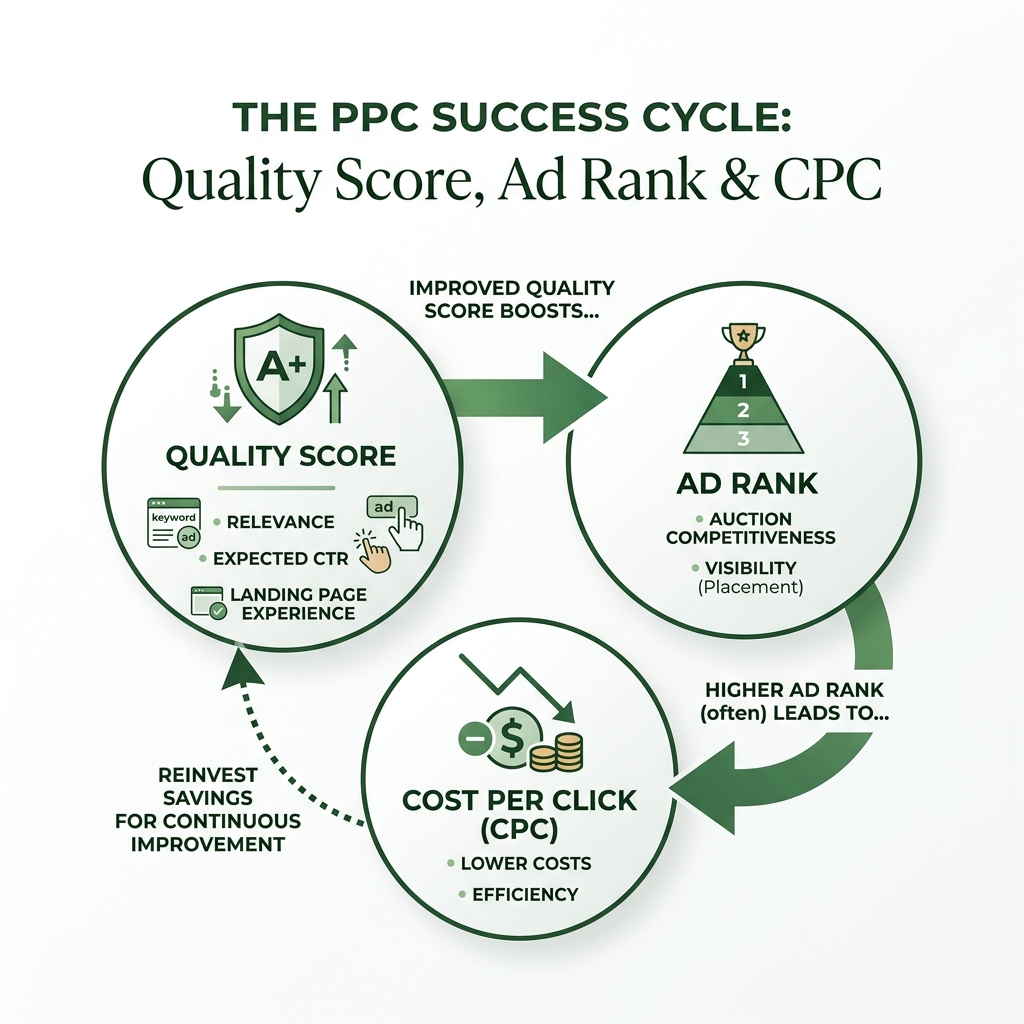
The system operates on an auction. Every time a user types a query, Google runs a lightning-fast auction to decide which ads appear and in what order. This order is determined by your Ad Rank, which is a combination of your bid amount, your budget, and your Quality Score.
Quality Score is Google’s way of ensuring users see relevant stuff. It looks at your expected click-through rate (CTR), ad relevance, and the experience people have on your landing page. High Quality Scores mean you can actually pay less than your competitors while ranking higher. In fact, research shows that a 4.4% average conversion rate on Search is the benchmark to beat. If your google search campaign strategy is tight, you aren’t just buying clicks; you’re engineering a path to profit.
Defining Goals and KPIs for Search Success
We never start a campaign by picking keywords. We start by defining what “winning” looks like. Without clear objectives, your account will eventually look like a junk drawer of random settings.
We use SMART objectives (Specific, Measurable, Attainable, Relevant, and Time-bound). In the Google Ads interface, you’ll be asked to choose a campaign goal:
- Sales: Drive online sales, in-app purchases, or phone calls.
- Leads: Encourage people to share their contact info.
- Website Traffic: Get the right people to visit your site.
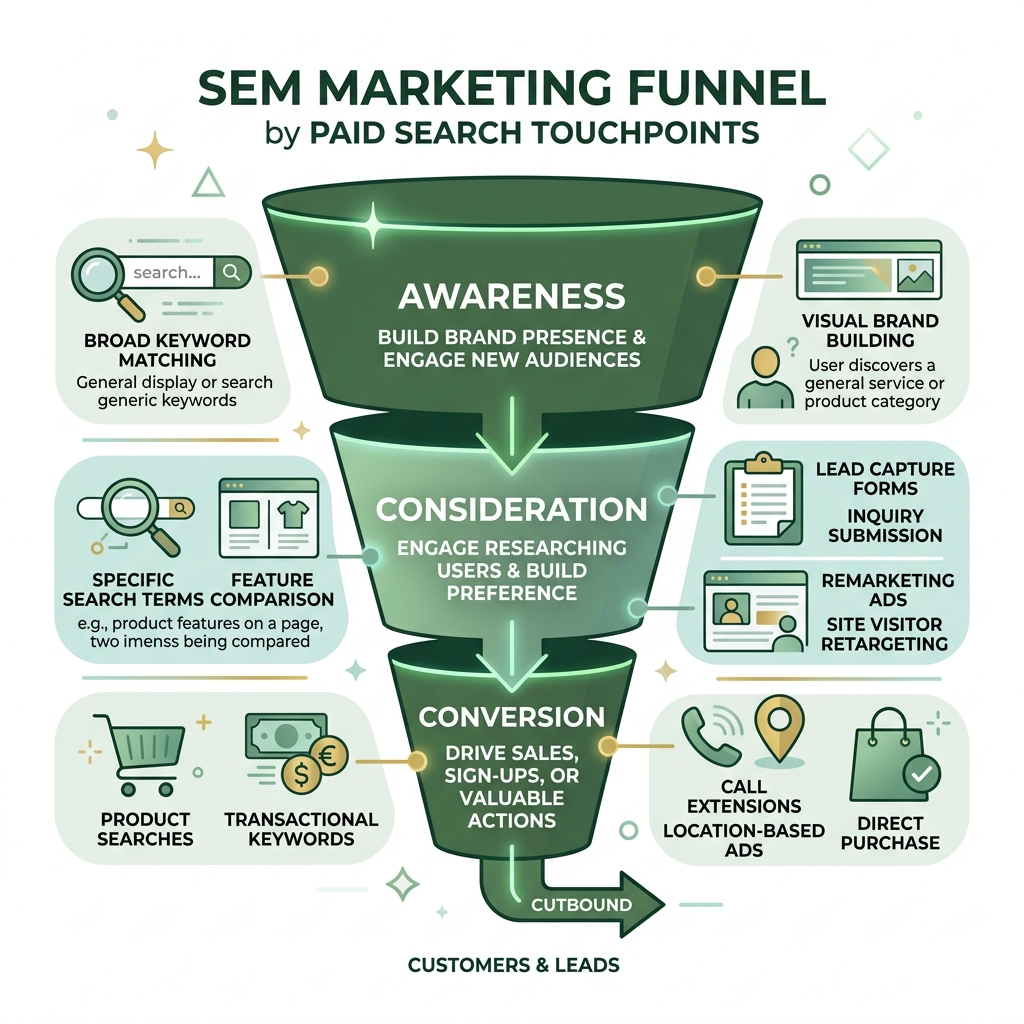
Once the goal is set, we monitor Key Performance Indicators (KPIs). Click-Through Rate (CTR) tells us if our ads are enticing. Cost Per Acquisition (CPA) tells us if those leads are affordable. Return on Ad Spend (ROAS) tells us if the whole machine is profitable. For a deeper dive into the basics, check out this Digital Marketing Explained in 5 Minutes resource.
Structuring Your Account for a Google Search Campaign Strategy
Think of your Google Ads account like a well-organized library. If all the books are thrown in a pile, nobody can find anything. A messy account structure makes it impossible for Google’s AI to learn what works.
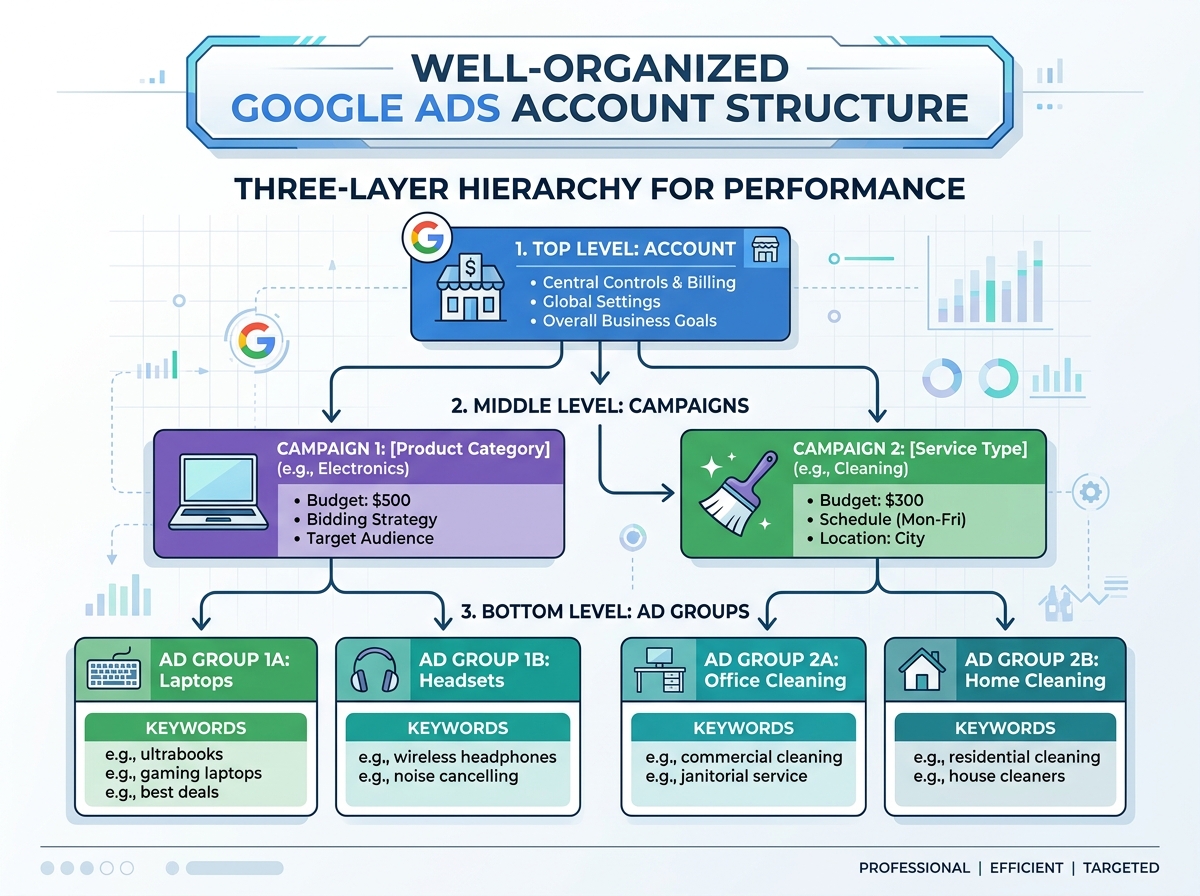
We follow a three-layer hierarchy:
- Account: Your unique ID with billing and high-level preferences.
- Campaigns: This is where you set your budget and targeting (like location and language). We often separate campaigns by product categories or geographic regions.
- Ad Groups: These live inside campaigns. Each ad group should focus on one very specific theme. For example, if you sell furniture, don’t put “couches” and “dining tables” in the same ad group. Give them their own space so the ads can be 100% relevant to the keywords.
This theme-based segmentation is the “secret sauce” of The perfect Google Ads campaign structure. It ensures that when someone searches for “leather sofa,” they see an ad for a leather sofa, not a generic “Furniture Store” ad. For a step-by-step walkthrough, our step-by-step-guide-to-paid-advertising-strategy covers the technical setup in detail.
Keyword Research and Intent Mapping
Keywords are the bridge between a user’s problem and your solution. But not all keywords are created equal. We categorize them by search intent.
- Informational: “What is a standing desk?” (The user is just learning).
- Transactional: “Buy standing desk online” (The user is ready to pull out their credit card).
We focus our google search campaign strategy on transactional and local intent keywords because they have the highest ROI. To find these, we use the Google Keyword Planner. It shows us search volume, competition levels, and estimated costs.
You also need to master Match Types. If you use broad match for everything, you’ll end up paying for searches that have nothing to do with you.
| Match Type | Syntax | What it does | Example |
|---|---|---|---|
| Broad Match | keyword | Reaches the widest audience; includes misspellings and related topics. | red shoes -> crimson footwear |
| Phrase Match | “keyword” | Shows ads on searches that include the meaning of your keyword. | “red shoes” -> best red shoes for sale |
| Exact Match | [keyword] | Most control; shows ads only for the exact meaning or intent. | [red shoes] -> red shoes |
Using a mix of these — while heavily leaning on exact and phrase match for new campaigns — is the-blueprint-for-a-winning-pay-per-click-advertising-strategy.
Crafting High-Converting Ads and Assets
Now that we have the structure and the keywords, we need to write the ads. In the modern Google Ads landscape, we use Responsive Search Ads (RSAs).
With RSAs, you provide up to 15 headlines and 4 descriptions. Google’s machine learning then tests different combinations to see which one performs best for each individual user. It’s like having a tiny, automated copywriter working for you 24/7.
But the ad itself is just the beginning. To really dominate the page, you must use Ad Assets (formerly called extensions). These add extra information and links to your ad, making it physically larger and more helpful.
- Sitelinks: Links to specific pages like “Contact Us” or “Sale Items.”
- Callouts: Short snippets like “Free Shipping” or “24/7 Support.”
- Lead Forms: Allow users to submit their info directly from the ad.
According to Google, Responsive Search Ads (RSAs) that are fully optimized with assets can significantly improve your click-through rate.
Bidding Strategies and Budget Management
How much should you pay for a click? It depends on your goals. Google Ads offers several Smart Bidding strategies that use AI to optimize for conversions in every single auction.
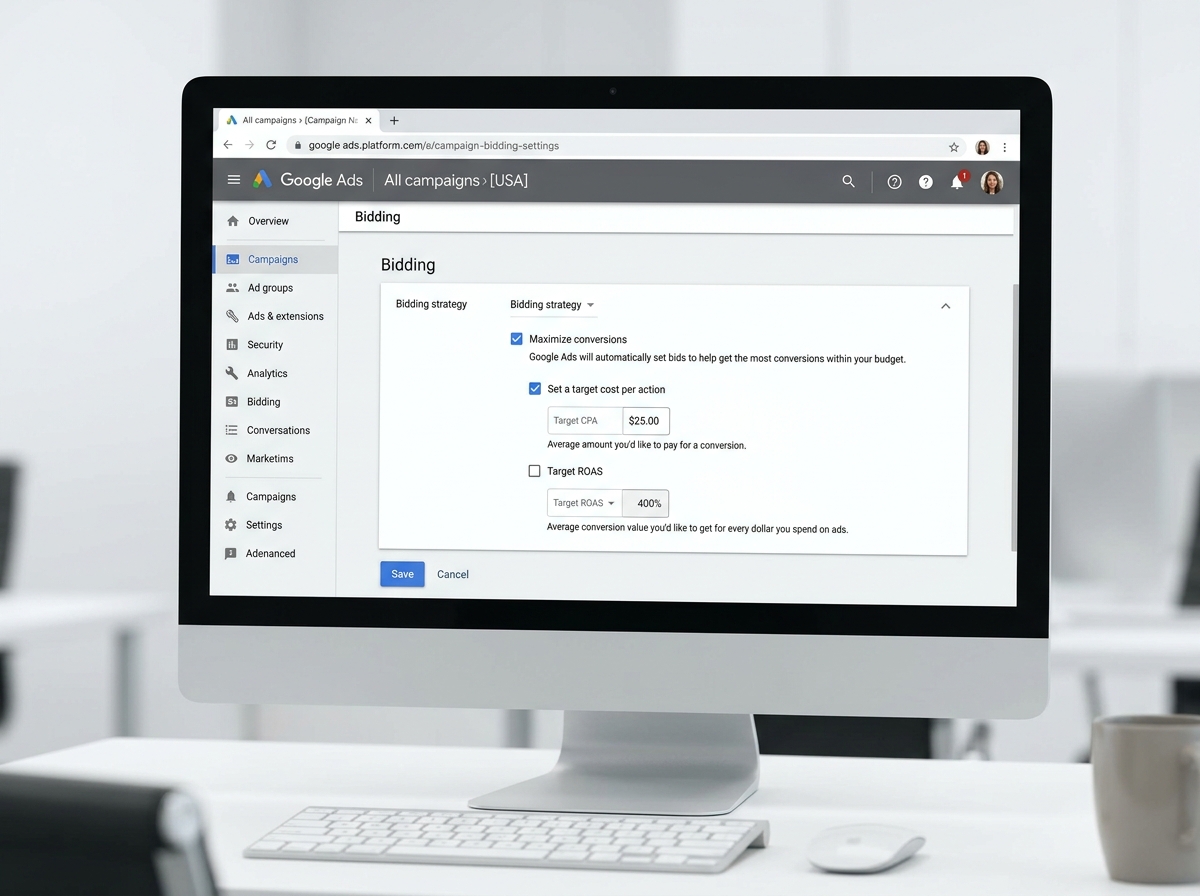
- Maximize Conversions: Best if you want to get as many leads as possible within a fixed budget.
- Target CPA (Cost Per Acquisition): You tell Google exactly how much you’re willing to pay for one lead.
- Target ROAS (Return on Ad Spend): Ideal for e-commerce; you tell Google you want $5 back for every $1 spent.
A common mistake we see is “setting and forgetting” the budget. Google may spend up to twice your daily budget on high-traffic days, but it will never exceed your monthly charging limit. Efficient budget management is a core part of mastering-the-art-of-pay-per-click-advertising-campaigns.
Measuring ROI with a Google Search Campaign Strategy
If you can’t measure it, you can’t improve it. We always ensure Conversion Tracking is set up through Google Tag Manager before a single ad goes live. This allows us to see exactly which keyword and which ad led to a sale.
We also highly recommend linking your Google Search Console to your Google Ads account. This gives you a “Paid & Organic” report, showing where you are already ranking naturally and where you need to use ads to fill the gaps.
One of the most important metrics to watch is your Quality Score. Improving your score by just one point can lower your cost-per-click by 16%. It’s the closest thing to “free money” in digital marketing. For those struggling to see results, it’s time to stop-guessing-and-start-clicking-with-paid-search-advertising by focusing on these data-driven optimizations.
Advanced Optimization and Scaling for Paid Search
Once your campaign is running and the data is rolling in, the real work begins. Optimization isn’t a one-time event; it’s a weekly and monthly discipline.
1. Negative Keyword Mining This is the most underrated part of any google search campaign strategy. We regularly check the “Search Terms” report to see what people actually typed to trigger our ads. If we see irrelevant terms (like someone searching for “free” when we sell a premium service), we add those as negative keywords. This prevents wasted spend and instantly boosts ROI.
2. A/B Testing We never assume we know which headline will work best. We test. We test different offers (“10% Off” vs. “Save $50”), different calls to action (“Book Now” vs. “Get a Quote”), and different landing pages.
3. Scaling Responsibly When a campaign is performing well, don’t just double the budget overnight. This can shock the algorithm and send your campaign back into a “learning phase.” We recommend increasing budgets by 10-20% every two weeks while monitoring the CPA.
Common Google Ads Mistakes to Avoid:
- Neglecting Mobile: Over 60% of clicks happen on mobile. If your landing page is slow or hard to use on a phone, you’re burning cash.
- Over-reliance on Broad Match: Without a massive list of negative keywords, broad match can be a budget killer for beginners.
- Sending Traffic to the Homepage: Always send users to a dedicated landing page that matches the specific ad they clicked.
- Ignoring Search Partners: Sometimes these partners provide cheap leads; other times, they provide junk. Check the “Segment” report to see if they are worth your money.
At Clayton Johnson SEO, we specialize in building these types of scalable traffic systems. We don’t just chase clicks; we build frameworks that align search intent with business outcomes. If you’re ready to turn your fragmented marketing efforts into a coherent growth engine, explore our services/paid-advertising.
Building a successful google search campaign strategy takes patience and a commitment to data. But when you get the structure, the intent, and the bidding right, you create a compounding growth machine that delivers results year after year. Let’s get to work!