Achieving Problem-Solution Fit Before You Build

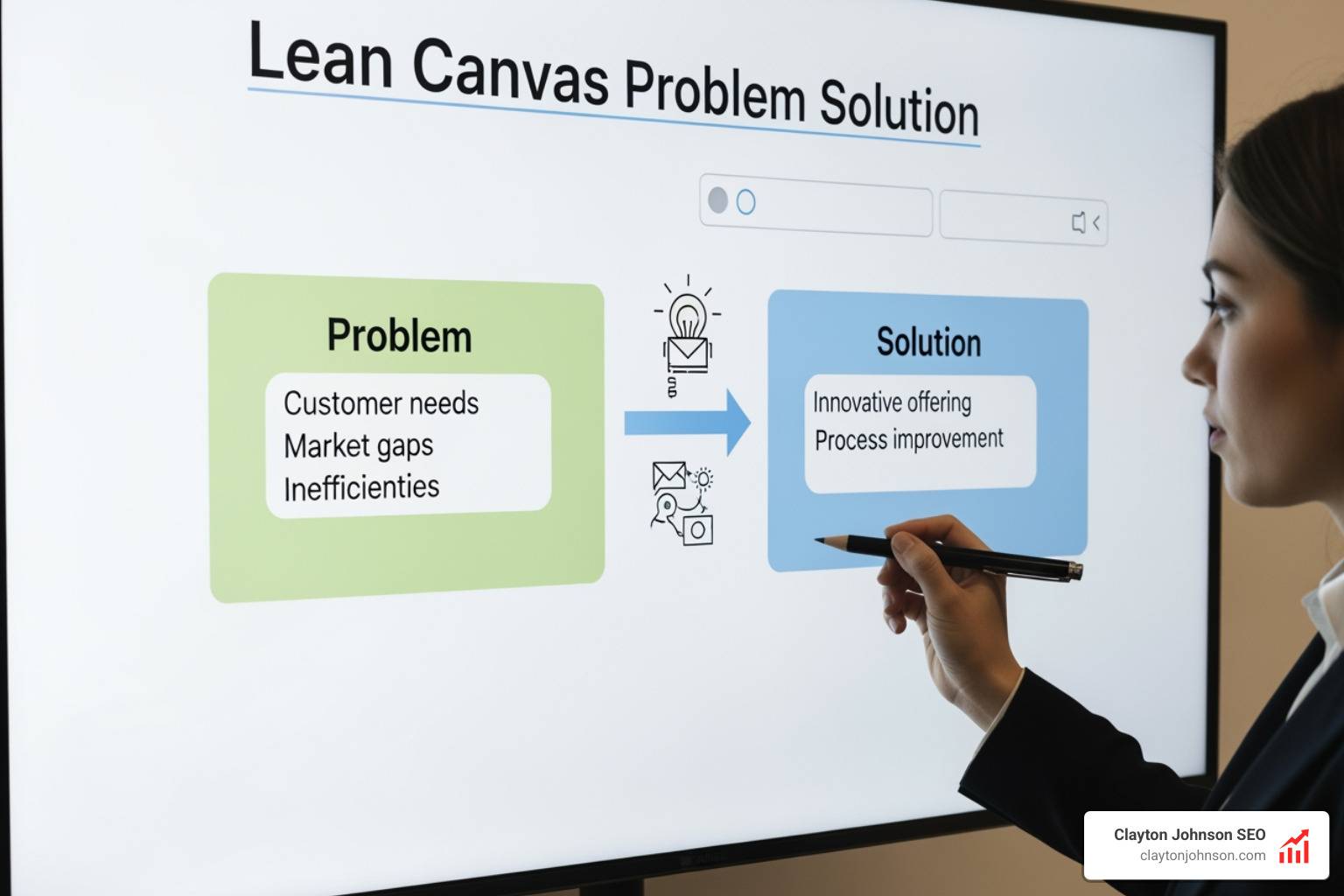
Why the Lean Canvas Problem Solution Approach Is the Foundation of Startup Success
The Lean Canvas problem solution approach is the critical first step in validating whether your business idea solves a real customer pain point before you invest time and resources in building. Most startups fail not because they can’t build their product, but because they build something nobody wants—42% of startups fail due to “no market need.”
Here’s what the Lean Canvas problem solution approach involves:
Core Components:
- Problems Block – Identify the top 1-3 specific pain points your target customers face
- Solution Block – Outline how your product addresses each validated problem
- Validation Process – Test problem and solution hypotheses through customer interviews before building
- Iterative Refinement – Continuously update both blocks based on customer feedback and market changes
The Critical Sequence:
- Start with the Problem and Customer Segments blocks (most uncertain, most important)
- Validate problems exist through interviews and existing data
- Only then develop solutions aligned to validated problems
- Test problem-solution fit before investing in full product development
Most startup founders begin with passion and hope—they spend months building, then discover customers don’t want what they built. As one founder story illustrates: “Google’s story began with two guys spending hours in a garage trying to build the right thing. Another couple of friends—the future Airbnb founders—were short on cash and looking for a way to earn some.”
The difference between these success stories and the 73% of founders who build the wrong thing? They started with validated customer problems, not assumed solutions.
The Lean Canvas transforms the traditional business plan into a dynamic, one-page strategic tool. Created by Ash Maurya and adapted from Alex Osterwalder’s Business Model Canvas, it forces you to confront your riskiest assumptions first. The Problems block sits at the heart of this framework—it’s not just another box to fill, but the anchor for every strategic decision you’ll make.
I’m Clayton Johnson, and I’ve spent years helping founders and marketing leaders build growth systems grounded in validated customer problems rather than hopeful assumptions. Through my work with the Lean Canvas problem solution framework, I’ve seen how starting with evidence-based problem discovery dramatically increases the odds of achieving product-market fit and sustainable growth.
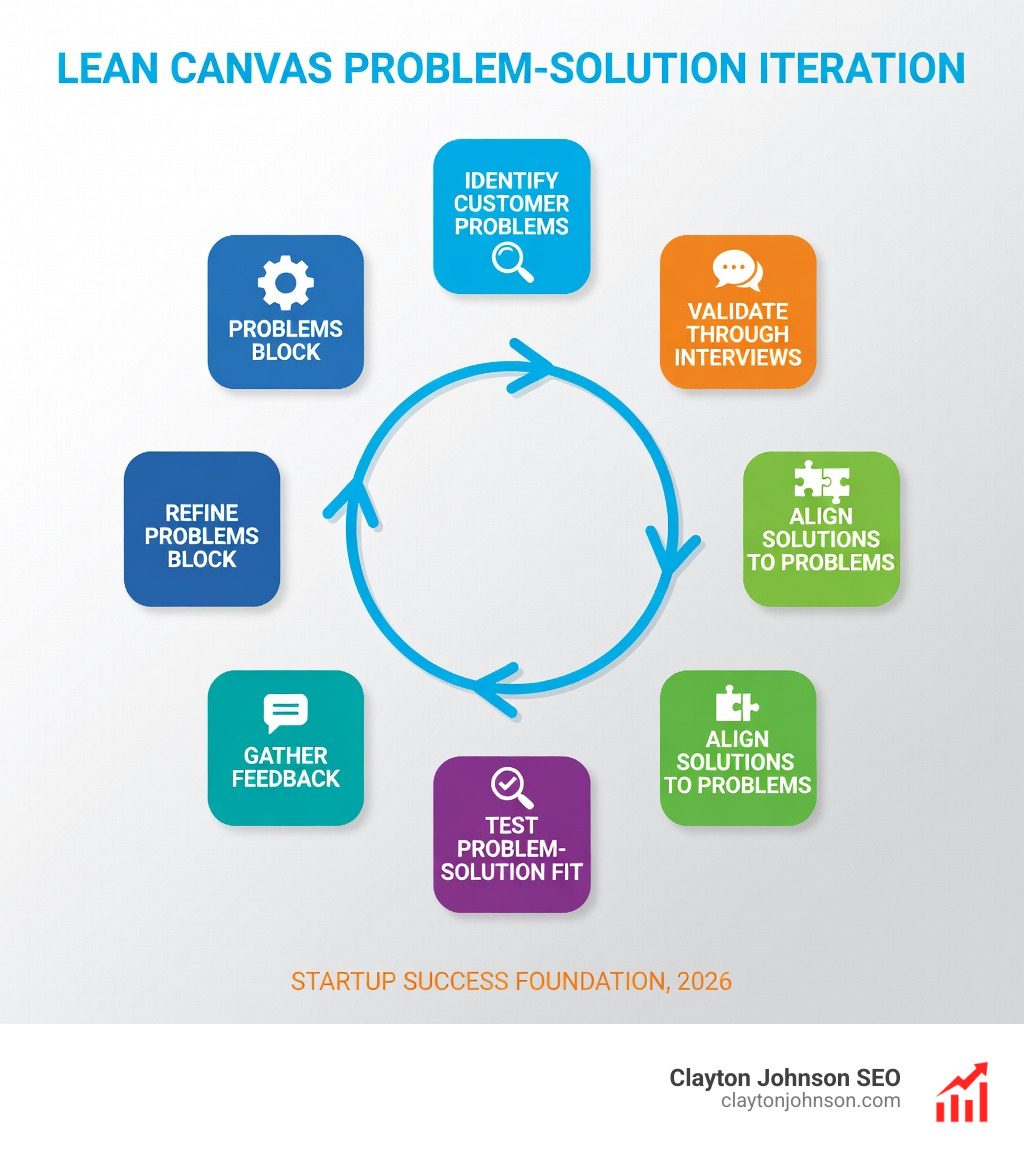
Lean Canvas problem solution terms explained:
The Problems Block: The Foundation of the Lean Canvas
When we look at a Lean Canvas, the ‘Problems’ block is the linchpin. While the original Business Model Canvas focused heavily on infrastructure and partners, Ash Maurya’s adaptation prioritizes the customer’s world. This block is the foundation because every other element—from your revenue streams to your channels—is a derivative of the problem you are solving.
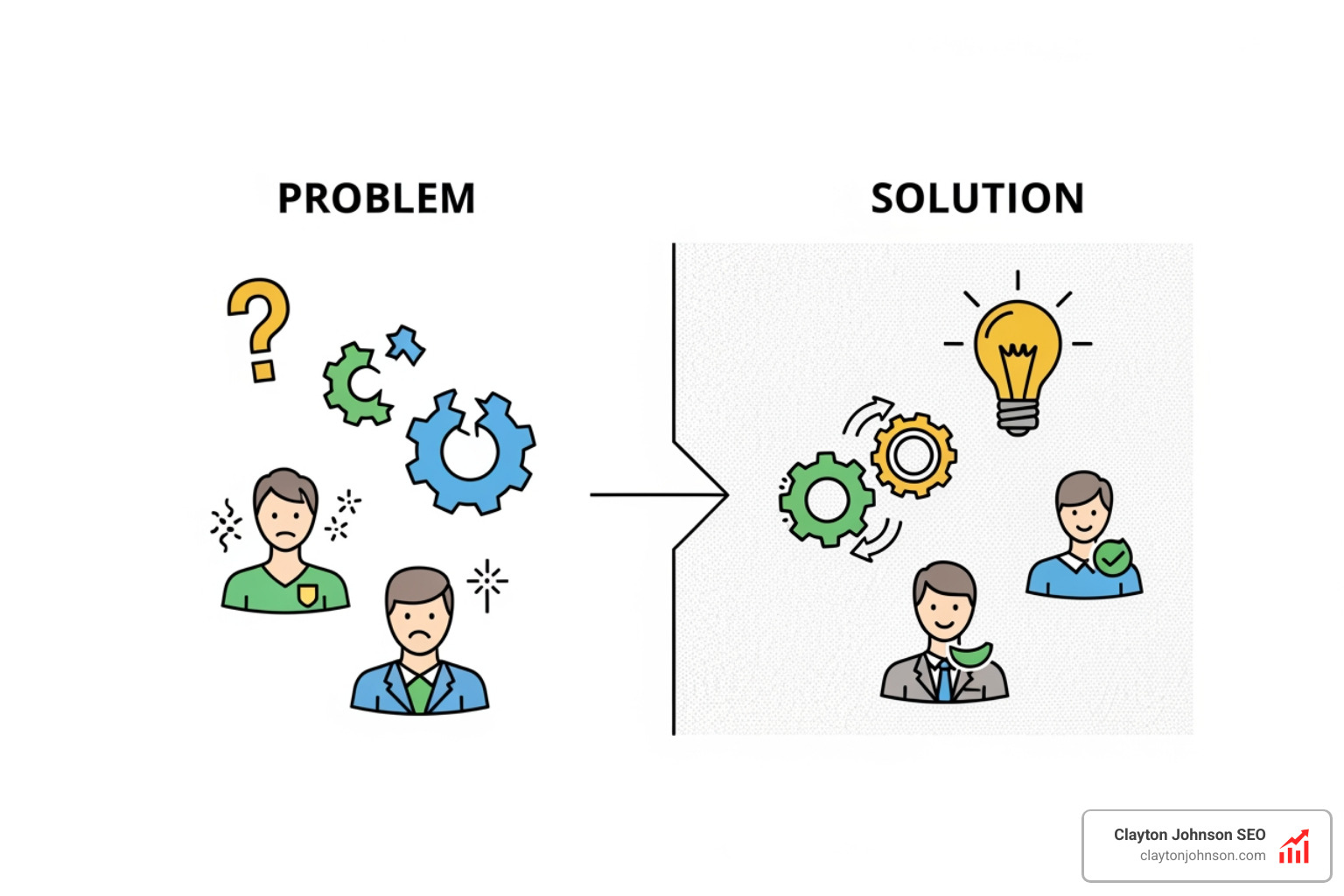
Think of the Problems block as your strategic guide. It’s not a “set it and forget it” field. Instead, the Lean Canvas iterative approach advocates for continuous refinement. Your initial guess at a customer’s pain point is just a hypothesis. To build a successful business, we must dig into the root causes. If a customer says they want a faster car, the root cause might actually be that they are bored during their commute or stressed about being late to work. Identifying the true root cause allows for a much more potent solution.
Shifting from Product-Focused to Customer-Centric
The biggest hurdle we see founders face is “Innovator’s Bias.” This is the “build-first” strategy where you fall in love with your solution before you understand the problem. When you’ve decided to build a hammer, every customer problem looks like a nail.
Shifting to a customer-centric approach means prioritizing market demand and unmet needs over cool features. By focusing on customer pain points first, we ensure we aren’t part of the 73% of founders building the wrong thing. For a deeper dive into this mindset shift, check out our guide on mastering the lean startup model canvas for new ventures.
The Art and Science of Lean Canvas Problem Solution Identification
Identifying a problem isn’t just about asking “what’s wrong?” It’s about understanding the forces that drive human behavior. We categorize problems into three distinct types:
- Functional Problems: The “task” the customer can’t complete (e.g., “I can’t track my freelance invoices”).
- Emotional Problems: How the customer feels (e.g., “I feel stressed about unpredictable expenses”).
- Social Problems: How the customer is perceived (e.g., “I want to look professional to my clients”).
We often use the Customer Forces Canvas to visualize these dynamics. It helps us distinguish between “Needs” (must-haves for survival or business operation) and “Desires” (nice-to-haves that might not drive a purchase). You can download the Customer Forces Canvas to start mapping these out for your own audience.
Conducting Effective Problem Interviews
The goal of a problem interview isn’t to pitch your product; it’s to get the customer’s worldview. We focus on four key areas:
- Triggers: What event caused the customer to start looking for a solution?
- Desired Outcomes: What does “better” look like to them?
- Existing Alternatives: How are they solving it today? (Even if it’s just using a messy spreadsheet).
- Inertia and Friction: What makes it hard for them to switch to something new?
As discussed in The Bootstart Manifesto on Problem Interviews, we avoid future-oriented questions like “Would you use this?” because people are notoriously bad at predicting their own behavior. Instead, we look for past actions. To understand the psychology behind this, read about the science of how customers buy anything.
Validating Your Lean Canvas Problem Solution Hypotheses
Once you have your top 1-3 problems listed, you need to build evidence. This is about risk reduction. We want to move a belief from a “leap of faith” to a “fact.”
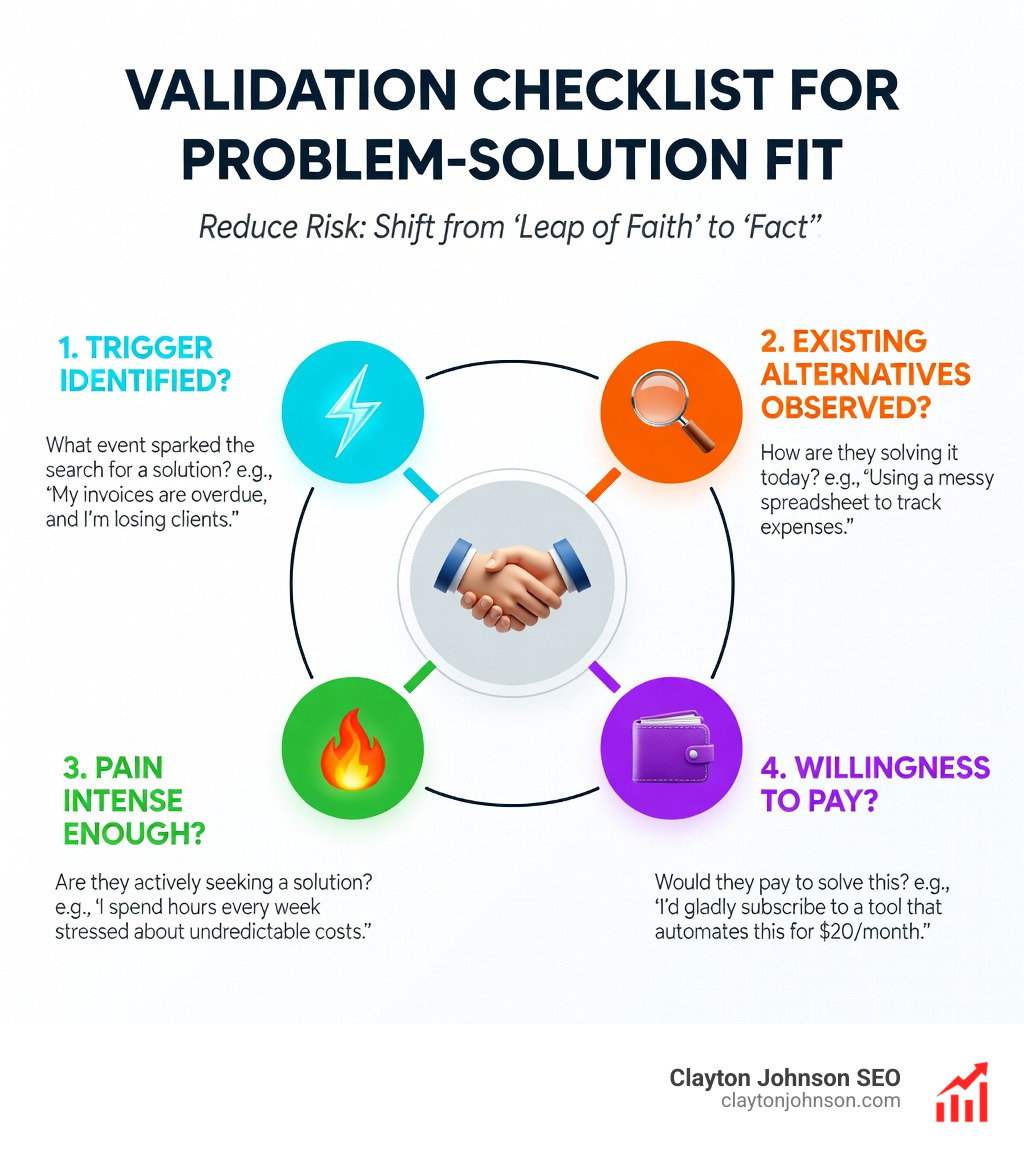
A strong validation checklist includes:
- Can you identify a specific trigger?
- Have you observed customers using existing alternatives?
- Is the pain intense enough that they are actively seeking a solution?
- Would they pay to make this problem go away?
For more on how to measure these insights, explore the metrics that make or break your lean canvas.
How Problem-Solution Fit Influences Your Entire Business Model
Achieving problem-solution fit is the moment you realize that the solution you’ve designed actually addresses a problem that customers care about. This alignment influences every other box on your canvas.
| Feature | Problem-Centric Development | Solution-Centric Development |
|---|---|---|
| Focus | Customer Pain & Triggers | Product Features & Tech |
| Marketing | “Stop stressing over invoices” | “Cloud-based accounting software” |
| Roadmap | Driven by validated feedback | Driven by “cool” ideas |
| UVP | Based on the value of the “cure” | Based on technical specs |
When you understand the problem deeply, your Unique Value Proposition (UVP) becomes a clear, compelling message that resonates. Your Customer Segments become more refined—you aren’t just targeting “small business owners,” you’re targeting “freelance designers who spend 5+ hours a week on manual billing.” To see how this fits into the broader picture, read how to blend lean startup and BMC for success.
Aligning the Solution and UVP to Validated Problems
Your solution should be a direct mirror of your validated problems. If the problem is “I miss bill payments,” the solution isn’t just “a budgeting app,” it’s “automated bill reminders and one-click payments.” This level of alignment ensures that your marketing messaging hits home and your team stays focused on building features that actually matter.
Real-World Lean Canvas Problem Solution Case Studies
Looking back at tech giants helps us see the Lean Canvas problem solution framework in action, even if they didn’t call it that at the time.
- Google: They didn’t just build a search engine; they solved the problem of “irrelevant search results” in a rapidly growing web.
- Airbnb: The founders were short on cash and realized others were too. They solved the problem of “unaffordable lodging during high-demand conferences.”
- Amazon: Jeff Bezos didn’t start with “the everything store.” He solved the problem of “limited book selection and accessibility” by leveraging the internet’s cataloging power.
- YouTube: Originally a dating site idea, they pivoted to solve the problem of “no easy way to share and host videos online” after the creators couldn’t find clips of a famous Super Bowl incident.
Lessons from Billion-Dollar Startups
Whether they were “invention-driven” (like Google) or “money-driven” (like Amazon), these companies succeeded because they eventually found a problem worth solving. They all started with bootstrapping origins and were willing to pivot when their initial hypotheses were proven wrong. You can see more retrospective Lean Canvas analysis to understand how these giants evolved.
Overcoming Roadblocks in the Problem-Solving Process
The road to validation is paved with pitfalls. The most common roadblocks we see include:
- Assumption Reliance: Treating your “gut feeling” as a fact without talking to a single human.
- Over-complexity: Trying to solve ten problems at once instead of the top three.
- Feedback Neglect: Ignoring customers who say “I don’t actually care about that” because it hurts your ego.
To mitigate these, we foster a continuous problem-solving culture. This means empowering your team to proactively address challenges and revisit the canvas regularly. For more on these strategies, check out Addressing the Problems Block in Lean Business Canvas.
When to Revisit and Iterate on the Problems Block
The Problems block is a living document. You should revisit it when:
- Market Changes: A global event or economic shift changes customer priorities.
- New Competitors: A new player solves the problem better or cheaper.
- Technological Advancements: New tech makes your old solution (or the problem itself) obsolete.
- Shifting Priorities: Your early adopters’ feedback highlights a different, more pressing pain point.
Frequently Asked Questions about Lean Canvas Problem Solution
What is the recommended fill order for a Lean Canvas?
While there is no “perfect” order, the universal starting point for most successful products is Customer Segments and Problems. We recommend taking a 20-minute snapshot of your idea first. Then, study your “chain of beliefs.” If your biggest risk is whether customers actually want the product (Desirability), start there. As Ash Maurya notes in the right fill order for a Lean Canvas, deconstructing your idea helps you uncover the “leaps of faith” you are making.
How do I distinguish between a customer’s “need” and a “desire”?
A “need” is often tied to a functional or social requirement that the customer is already spending money or significant time to solve. A “desire” is something they say they want but aren’t willing to pay for or change their habits to get. Look at their willingness to pay and the intensity of the pain point. If they aren’t using an existing alternative (even a bad one), it might just be a desire, not a problem worth solving.
What are the ideal outcomes of a strong Problems block?
A well-executed Problems block results in:
- Validated Pain Points: Evidence that people actually have these struggles.
- Clear Customer Segments: Knowing exactly who has these problems.
- Foundation for MVP: A clear list of features that must be in the first version to solve the problem.
- Strategic Alignment: Your whole team knows exactly “why” they are building what they are building.
Conclusion
Mastering the Lean Canvas problem solution approach isn’t just about filling out a template; it’s about adopting a mindset of continuous discovery. By focusing on the problem before the solution, you reduce risk, save resources, and build products that truly resonate with the market.
At Clayton Johnson SEO, we specialize in providing the actionable frameworks and growth strategies you need to diagnose problems and execute with measurable results. Whether you’re a founder in Minneapolis or a marketing leader looking for a better way to scale, our goal is to help you build a culture of evidence-based growth.
Ready to take the next step in your startup journey? Explore more info about SEO consultant services and let’s build something people actually want.