Why Business Strategy Frameworks PDFs Are the Shortcut Every Growth-Focused Leader Needs
The best business strategy frameworks pdf resources give you ready-to-use tools for diagnosing your market position, allocating resources, and building a competitive edge — all in one downloadable format.
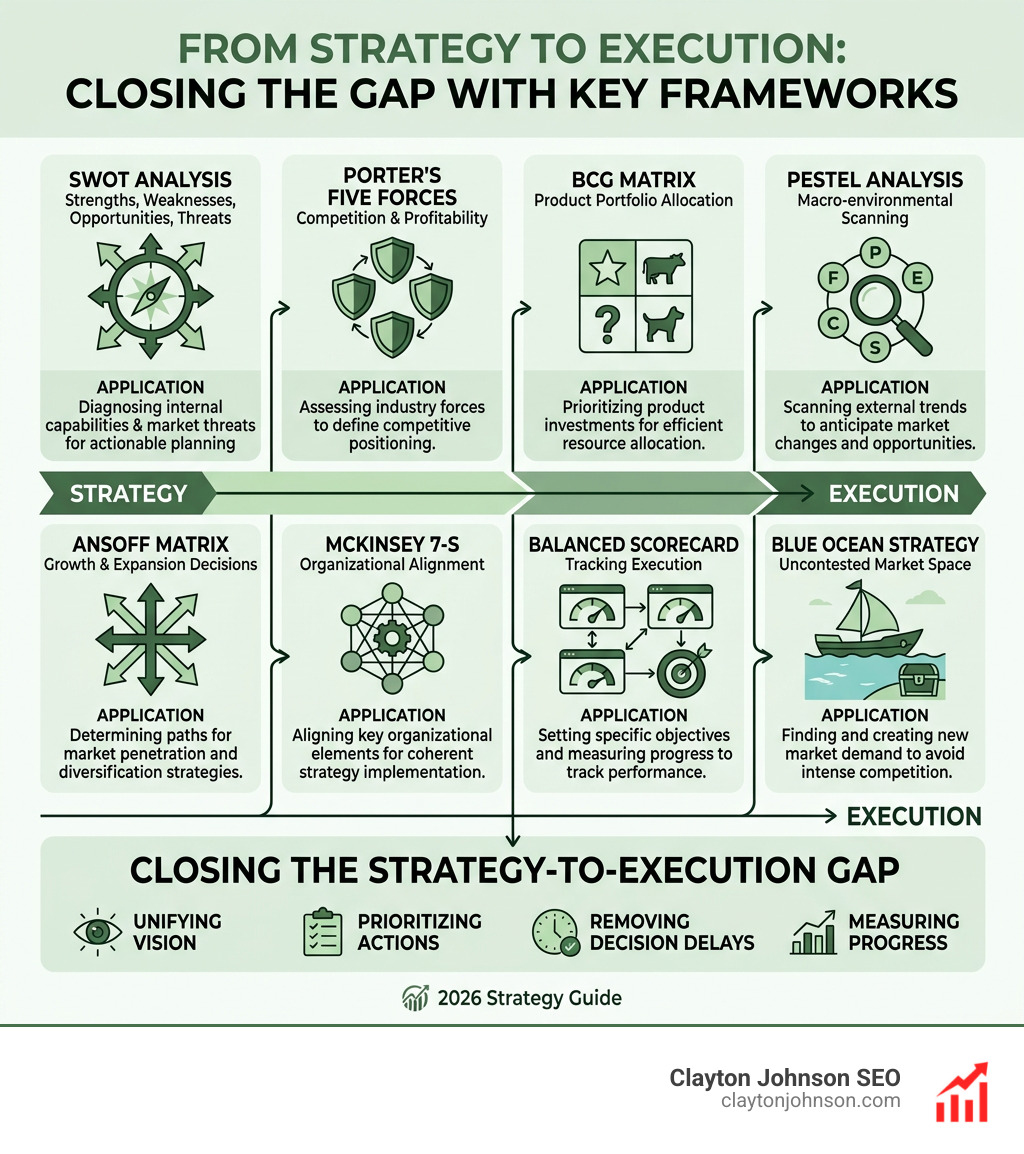
Here are the most essential frameworks you’ll find in top-rated strategy PDFs:
| Framework | Best For |
|---|---|
| SWOT Analysis | Internal strengths vs. external threats |
| Porter’s Five Forces | Industry competition and profitability |
| BCG Matrix | Product portfolio resource allocation |
| PESTEL Analysis | Macro-environmental scanning |
| Ansoff Matrix | Growth and market expansion decisions |
| McKinsey 7-S | Organizational alignment |
| Balanced Scorecard | Tracking strategy execution |
| Blue Ocean Strategy | Finding uncontested market space |
These tools aren’t just for large corporations. Any business owner trying to sharpen focus, navigate market shifts, or align their team around clear goals can put them to work immediately.
Here’s what makes them matter: the average company loses $62 million every year to decision delays caused by unclear roles and criteria. A solid framework cuts through that fog.
I’m Clayton Johnson, an SEO strategist and demand generation expert who has spent nearly two decades helping businesses build scalable growth systems — including using business strategy frameworks pdf resources to structure content authority and competitive positioning online. This guide walks you through the most valuable frameworks available, where to download them, and how to put them into action.
Essential Business Strategy Frameworks PDF: A Comprehensive Toolkit
When we talk about a business strategy framework, we are referring to a structured method used to analyze business challenges and formulate a plan for sustainable success. Think of it as a mental map. Without one, you’re just wandering through the market hoping for the best. With one, you have a set of coordinates to follow.
Research shows that data-driven firms are 23 times more likely to win customers and 19 times more profitable when they combine intelligence with clarity systems. This is why resources like the Tim Vipond’s Top 30 Strategy Frameworks have become viral sensations; they offer a “strategic toolkit” in a single download.
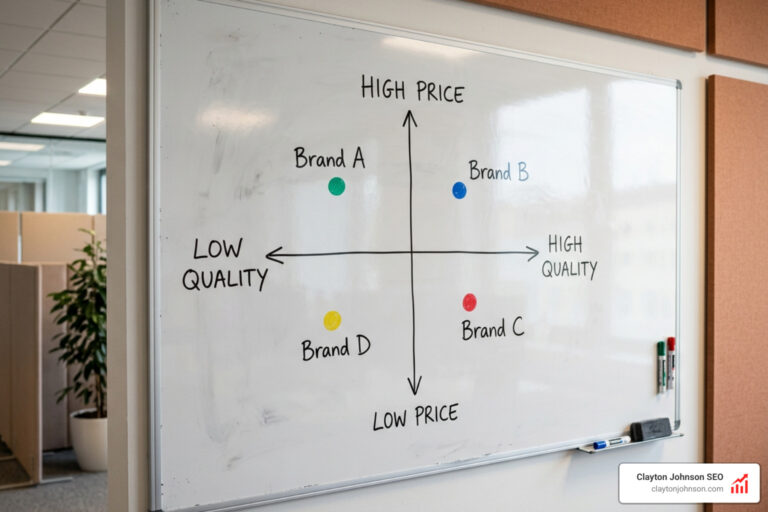
To achieve organizational success, we must move beyond “competing to be the best” and focus on “competing to be unique.” As Michael Porter often suggests, the worst error in strategy is competing with rivals on the same dimensions. Instead, we use frameworks to find our unique value proposition.
| Strategic Element | Purpose | Key Framework |
|---|---|---|
| Positioning | Where do we play? | Porter’s Five Forces |
| Capabilities | What are we good at? | VRIO Framework |
| Portfolio | Which products get investment? | BCG Matrix |
| Execution | How do we align the team? | McKinsey 7-S |
Core Diagnostic Tools in the Business Strategy Frameworks PDF
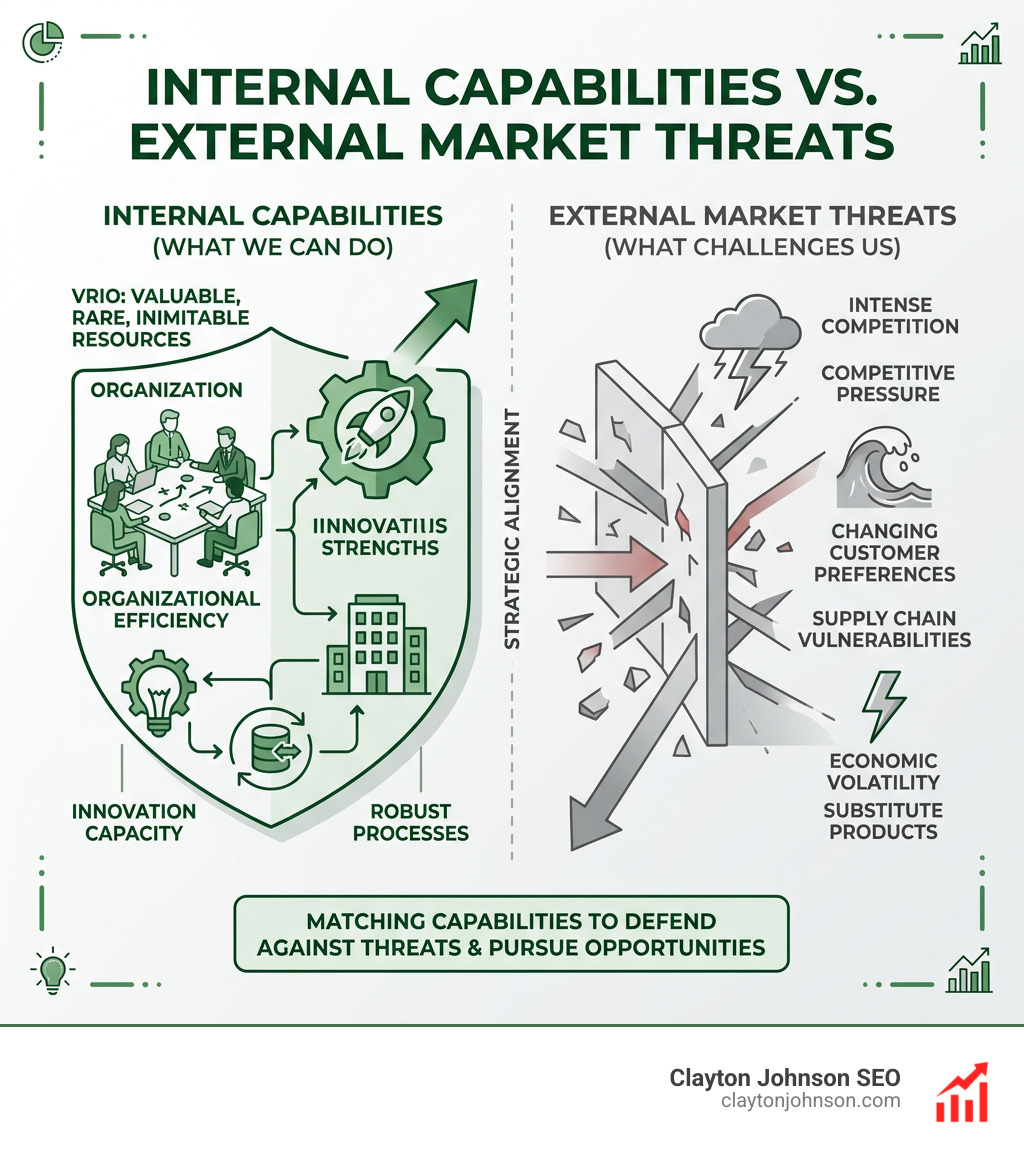
Before we can grow, we must diagnose. The core diagnostic tools found in a high-quality business strategy frameworks pdf help us look both inward and outward.
- SWOT Analysis: This classic tool helps us identify Strengths, Weaknesses, Opportunities, and Threats. While it’s often the first framework taught in business school, its power lies in its simplicity. It forces us to reconcile our internal capabilities with external market dynamics.
- PESTEL Factors: To understand the macro-environment, we look at Political, Economic, Social, Technological, Environmental, and Legal factors. This is critical for scanning for “megatrends” that could disrupt our industry.
- VRIO Framework: This helps us evaluate if our resources provide a sustained competitive advantage. Is the resource Valuable, Rare, Inimitable (hard to copy), and is the Organization set up to capture that value?
For those looking to dive deeper into how these tools fit into a broader marketing plan, check out more info about competitive analysis to see how we apply these to digital landscapes.
Advanced Growth Models and Business Strategy Frameworks PDF Downloads
Once the diagnosis is complete, we move into growth and alignment. This is where advanced models from the Corporate Finance Institute (CFI) Frameworks collection become invaluable.
- Ansoff Matrix: This is the go-to for deciding whether to focus on market penetration, product development, market development, or diversification.
- Blue Ocean Strategy: Instead of fighting over a shrinking profit pool in a “red ocean” full of sharks (competitors), we use this to find “blue oceans” — uncontested market spaces where the competition is irrelevant.
- McKinsey 7-S: This framework ensures that seven internal aspects of an organization — Strategy, Structure, Systems, Shared Values, Style, Staff, and Skills — are aligned. If one is out of sync, the whole engine sputters.
- Scenario Planning: In an unpredictable world, we don’t just plan for one future. We create multiple “what-if” scenarios to ensure we stay agile regardless of market shifts.
The Delta Model and Resource-Based View (RBV)
While Porter focused heavily on industry rivalry, the Delta Model and the Resource-Based View (RBV) offer a more modern, integrative approach.
The Resource-Based View suggests that the key to superior performance is not just the industry you’re in, but the specific, rare resources you control. If you have a “10x force” — like a proprietary algorithm or a deeply integrated supply chain — you can change the rules of the game.
The Delta Model, developed by Dean Wilde and Arnoldo Hax, moves the focus from the product to the customer. It suggests three strategic options:
- Best Product: Competing on low cost or differentiation (The traditional view).
- Total Customer Solutions: Reducing the customer’s costs or increasing their productivity by integrating with their infrastructure.
- System Lock-In: Creating a “lock-in” for customers and a “lock-out” for competitors by involving “complementors” (think of how many apps only work on an iPhone).
You can find more info about innovation models to see how these adaptive processes drive long-term value.
Implementing Strategy Across Corporate and Functional Levels
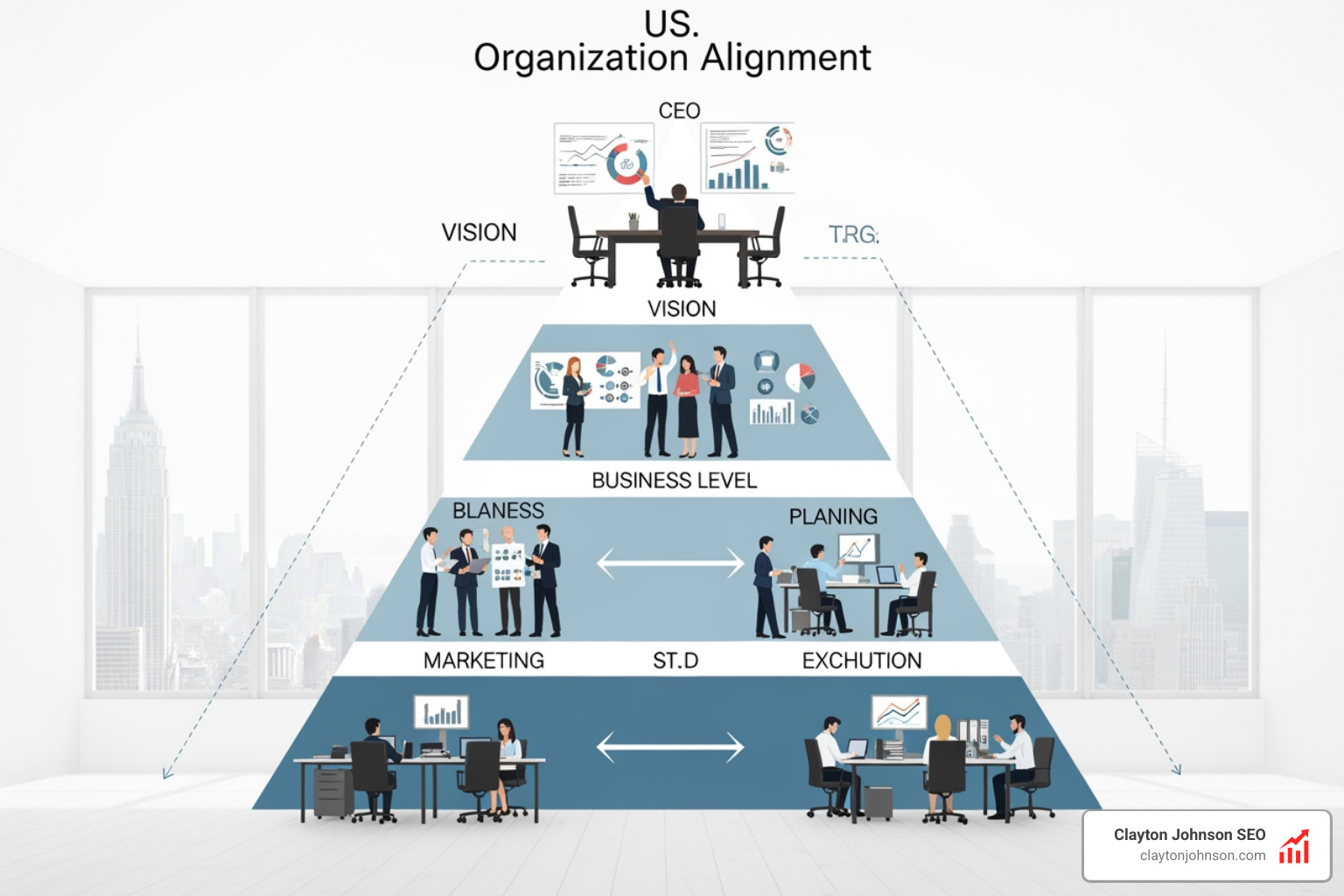
A strategy is only as good as its execution. We often see a massive gap between the “vision” in the boardroom and the “action” on the shop floor. To fix this, we must understand the three levels of strategy:
- Corporate Level: What businesses should we be in? (e.g., Disney deciding to own both theme parks and a streaming service).
- Business Level: How do we compete in this specific market? (e.g., a specific brand aiming for cost leadership).
- Functional Level: How do the departments (marketing, R&D, finance) support the business strategy?
For a deep dive into the foundational logic of these levels, Michael Porter’s Competitive Strategy Guide remains the gold standard for understanding industry structure.
Real-World Case Examples: From IKEA to Microsoft
Let’s look at how these frameworks look in the real world. These aren’t just academic exercises; they are the blueprints for billion-dollar empires.
- IKEA’s Value Chain: IKEA doesn’t just sell furniture; they’ve redesigned the entire value chain. By using modular designs, having customers do their own assembly, and building massive warehouses that double as showrooms, they created a cost leadership position that is almost impossible to imitate.
- PACCAR’s Customization: In the heavy truck industry, PACCAR (the maker of Peterbilt and Kenworth) doesn’t try to be the cheapest. Instead, they focus on owner-operators who want luxurious cabins and fuel efficiency. They command a 10% price premium because they’ve chosen a unique “niche” strategy.
- Disney’s Synergy: Disney is the master of corporate strategy. A single character (like Elsa from Frozen) starts in a movie, moves to a theme park ride, becomes a toy in a retail store, and eventually a Broadway show. This is “synergy” — the whole is worth much more than the sum of its parts.
- Microsoft’s System Lock-In: By making their operating system the standard for business software, Microsoft created a system lock-in. Once a company’s entire workflow is built on Excel and Outlook, the cost of switching to a competitor is too high.
If you’re looking for guidance on how to apply these examples to your own firm, more info about business coaches can help you find an expert to bridge the gap between theory and practice.
Overcoming Implementation Challenges and Measuring Success
Why do strategies fail? Usually, it’s one of three things: environmental uncertainty, resource constraints, or a lack of organizational alignment.
To overcome these, we recommend using Economic Profit (EP) as your yardstick. EP isn’t just accounting profit; it’s NOPLAT (Net Operating Profit Less Adjusted Taxes) minus the cost of capital. McKinsey’s research shows that the top 20% of companies generate 70 times more economic profit than the middle 60%.
How to measure success:
- Pass the 10 Tests: Does your strategy tap a true source of advantage? Is it granular about where to compete? Does it put you ahead of trends?
- Experimentation: Don’t bet the whole company on one unproven idea. Use “no-regrets moves” and “real options” to test your strategy in the market.
- Metrics: Use a Balanced Scorecard to track not just financial results, but customer satisfaction, internal process efficiency, and organizational learning.
For more resources on staying aligned, see more info about strategic frameworks.
Building Scalable Systems with Clayton Johnson SEO
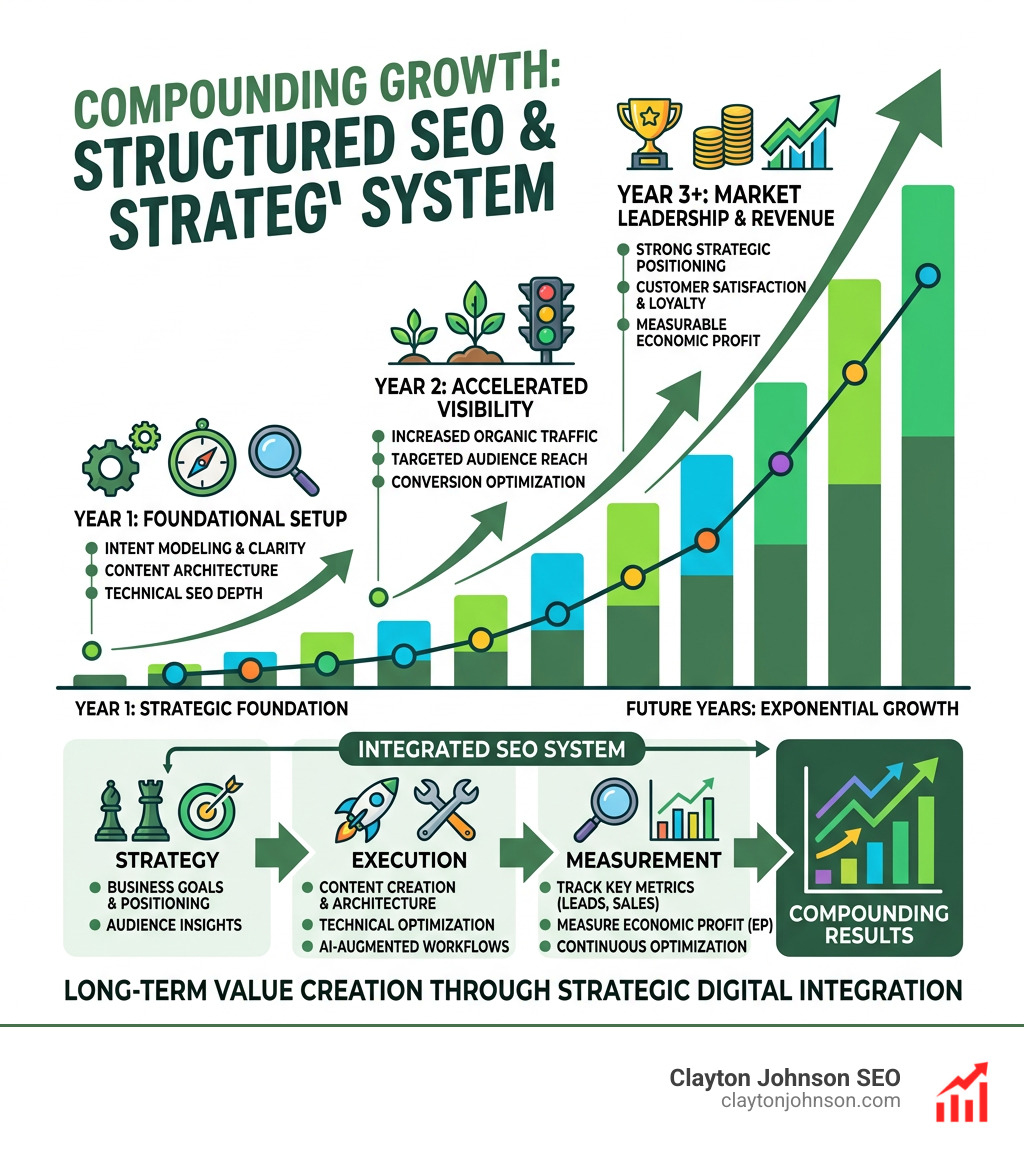
At Clayton Johnson SEO, we don’t just talk about strategy; we build the systems that operationalize it. We believe that clarity leads to structure, which leads to leverage, and ultimately, compounding growth.
We take these high-level business strategy frameworks pdf concepts and apply them to the digital world. For example, instead of just “doing SEO,” we use intent modeling to understand exactly what your customers are looking for. We build content architecture that mirrors your business’s strategic positioning, ensuring that every blog post and landing page reinforces your unique value proposition.
Our approach combines:
- Technical SEO Depth: Building the “systems” that search engines love.
- Strategic Positioning: Ensuring you aren’t just getting traffic, but the right traffic that leads to economic profit.
- AI-Augmented Workflows: Using cutting-edge tools to execute strategy faster and more accurately than the competition.
If you’re ready to turn your fragmented marketing efforts into a coherent growth engine, explore more info about SEO strategy to see how we can help you build a durable system for the future.
Key Takeaways for Leaders
Integrating multiple frameworks into a cohesive strategic planning process is the hallmark of a great leader. Don’t just pick one tool; build a toolkit.
- Diagnose first: Use SWOT and PESTEL to understand your starting point.
- Choose your path: Decide if you are competing on cost, differentiation, or a total customer solution.
- Align your activities: Ensure your value chain and organizational structure (McKinsey 7-S) support your choice.
- Measure and Adapt: Use Economic Profit and continuous experimentation to refine your approach.
Strategy is not a one-time exercise. It’s an ongoing way to make better decisions. When you download practical frameworks and put them to work, you give your team a clearer structure for handling uncertainty, focusing resources, and shaping growth with intention.