How to run organic social media campaigns that work

Is Organic Social Growth Really Dead? Here’s What Actually Works
Organic social media campaigns are non-paid strategies that grow your brand through authentic content, community engagement, and algorithm-friendly posting — no ad spend required.
Here’s a quick breakdown of what makes them work:
- Create high-value content your audience genuinely wants to share
- Choose the right platforms where your audience already spends time
- Engage consistently — reply to comments, ask questions, join conversations
- Use trends and formats like Reels, UGC, and employee advocacy to extend reach
- Track engagement signals to refine what’s working and cut what isn’t
Headlines love to declare organic social dead. But the data tells a different story.
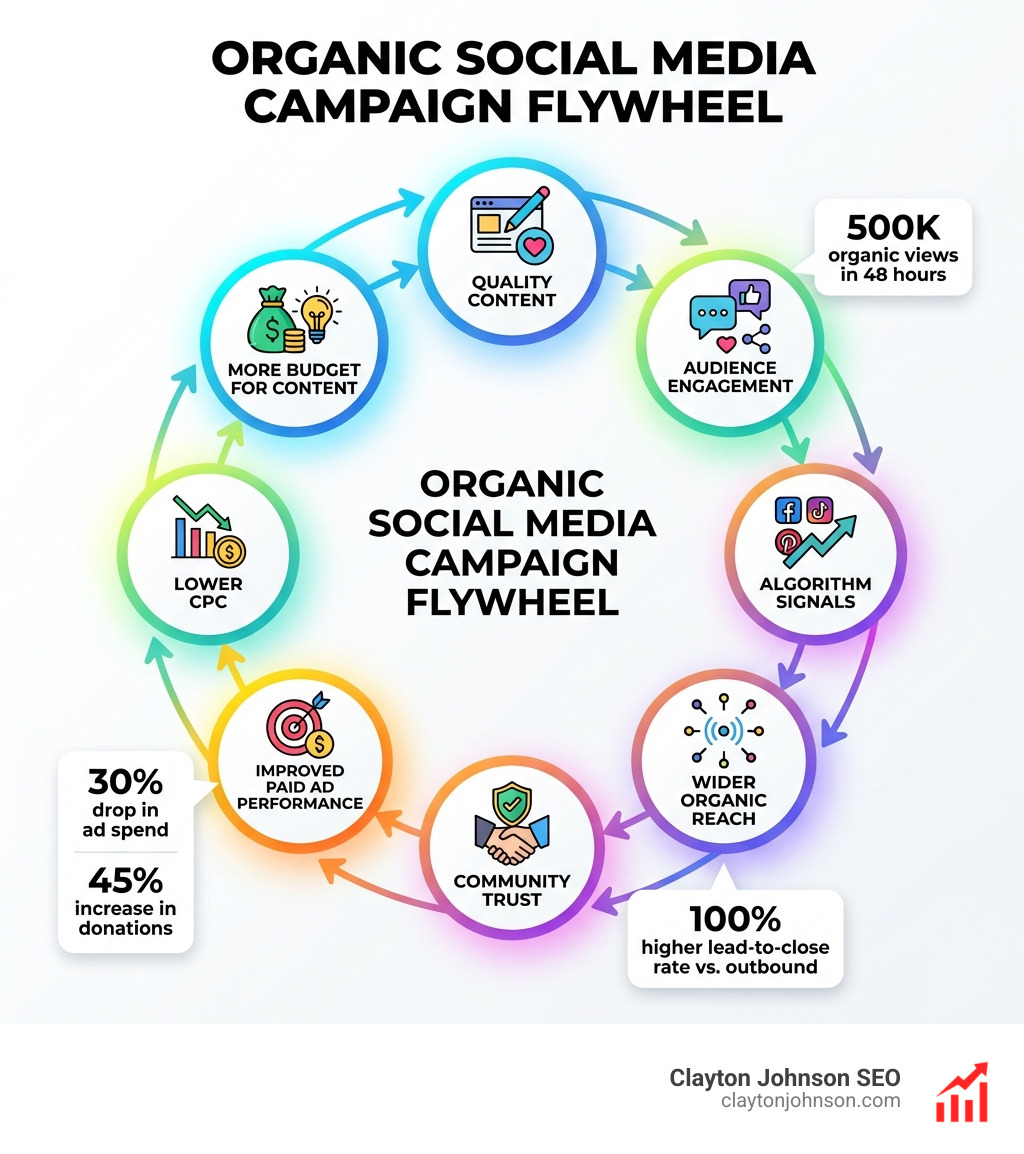
Social media still delivers a 100% higher lead-to-close rate than outbound marketing. One Instagram Reel from a human rights nonprofit hit 500,000 organic views in 48 hours — against an average of 8,000. A single viral organic post caused ad spend to drop 30% while donations climbed 45%.
That’s not a dead channel. That’s a misunderstood one.
The real problem isn’t organic reach. It’s strategy. Most brands either treat organic like a bulletin board — posting announcements and moving on — or they abandon it entirely in favor of paid ads. Both approaches leave serious growth on the table.
Organic social isn’t just “free marketing.” Done right, it builds trust, trains algorithms, and creates the kind of audience loyalty that paid ads simply can’t buy.
I’m Clayton Johnson, an SEO and growth strategist who has built content systems and organic social frameworks across dozens of business models — including structuring organic social media campaigns that compound authority over time rather than spike and fade. In this guide, I’ll show you exactly how to build campaigns that work.
Key terms for organic social media campaigns:
Defining Organic Social Media Campaigns vs. Paid Strategies
To succeed today, we have to understand the fundamental shift in how people consume content. Organic social media campaigns are built on authenticity and relationship-driven interactions. They are the “long game.” While paid social is about immediate reach and results, organic is about building a sustainable brand presence and earning “emotional residue”—that feeling of trust a customer has when they see your brand consistently showing up on their terms without a hard sell.
The biggest differentiator? Control. With paid ads, you pay for a guaranteed audience. With organic, you earn it. However, organic content acts as a “coach” for the algorithm. When your unpaid posts get high engagement, it signals to the platform that your content is valuable. This “coaching” actually makes your paid advertising services more efficient by lowering your CPC and improving targeting.
Despite the reality of pay-to-play social platforms, where reach has dropped significantly, organic remains the foundation of brand validity. If a user clicks a paid ad and lands on a “ghost town” profile with no recent posts or engagement, they lose trust.
| Feature | Organic Social Media | Paid Social Media |
|---|---|---|
| Primary Goal | Relationship building & Trust | Reach, Clicks & Conversions |
| Cost | Free (Time/Resource investment) | Direct Ad Spend |
| Reach | Dependent on Algorithm/Engagement | Guaranteed based on Budget |
| Trust Level | High (Perceived as authentic) | Moderate (Perceived as advertising) |
| Speed | Slow, compounding growth | Instant visibility |
How to Build Effective Organic Social Media Campaigns from Scratch

Building a strategy from zero requires more than just “posting more.” We focus on structured growth architecture. You need SMART goals (Specific, Measurable, Achievable, Relevant, and Time-bound). Instead of saying “we want more followers,” aim for “growing our Instagram from 5K to 10K followers in 6 months through video-first content.”
Success starts with the importance of high-quality audience data. 82% of marketers agree that high-quality data is the key to success. We don’t guess who our audience is; we research their pain points, interests, and where they hang out. This data informs our SEO content marketing services, ensuring that what we post on social aligns with what people are actually searching for.
Selecting the Right Platforms for Organic Social Media Campaigns
Not every brand needs to be on every platform. In fact, spreading yourself too thin is a recipe for low engagement. We recommend focusing on 2-3 platforms where your audience is most active.
- LinkedIn: The powerhouse for B2B. It is responsible for 80% of B2B leads generated through social media. B2B content marketing value on LinkedIn is unmatched, with 84% of marketers saying it delivers the best value.
- Instagram: With 2 billion monthly users, it’s the preferred platform for younger audiences. It’s perfect for visual storytelling and building a “vibe.”
- TikTok: The reigning king of organic virality. If you want to grow quickly without a budget, TikTok’s algorithm rewards authenticity over polish.
- Facebook: Don’t count it out. Business decision-makers spend 74% more time on Facebook than average users.
Choosing the right home for your content is a core part of our social media marketing services.
Content Types that Drive Organic Social Media Campaigns
If content is king, context is god. You must tailor your formats to what the platform’s algorithm currently favors.
- Short-Form Video: This is non-negotiable. 93% of brands gained a new customer due to a video on social media. Why? Because the power of video information retention is massive—viewers retain up to 95% of a message via video compared to 10% via text.
- User-Generated Content (UGC): Customer engagement is 28% higher when using UGC. People trust other people more than they trust brands.
- Employee Advocacy: When your team shares company content, the reach can increase by up to 561%. It humanizes the brand.
- Micro-Narratives: Tell one small story per post. Whether it’s a “behind-the-scenes” look or a quick customer win, narratives drive “saves” and “shares,” which are high-value engagement signals.
Real-World Lessons from Viral Organic Success Stories
We can learn a lot from brands that have mastered the art of the organic “hit.”
- Adidas & Messi: During the World Cup, Adidas released a six-second, seemingly amateur video of a 3D billboard in Dubai featuring Messi. It looked like a fan shot it from a moving car. The result? 250 million organic views and 12.5 million engagements. Lesson: Authenticity and “lo-fi” production often beat high-gloss commercials. How Adidas generated 250 million organic views shows that tech like CGI can be used to create organic buzz.
- Duolingo: By turning their mascot, Duo, into a sassy, irreverent TikTok influencer, they grew to over 11 million followers. They empowered a junior talent to “test and learn,” proving that taking risks with brand personality pays off.
- Merriam-Webster: They transformed from a “stuffy dictionary” to a witty social authority by engaging in trending conversations with warmth and humor. Their thread asking non-native speakers for words without English equivalents gained 10 million views.
- UN Women Australia: To reach teenage girls, they launched the #EmpowerMoves campaign on TikTok, hiding self-defense moves within a dance trend. It reached 62.5 million people organically because it met the audience where they were, using a format they already loved.
Measuring ROI and Optimizing for Long-Term Growth

One of the biggest myths is that you can’t measure organic social ROI. While it’s true that organic is slower to scale, the metrics are there if you know where to look. We use our analytics and data services to track:
- Lead-to-Close Rate: Organic leads often convert at a 100% higher rate than outbound leads because the trust is already established.
- Sentiment Analysis: Are people talking about you positively? The Cheesecake Factory saw 97% positive sentiment during their organic pineapple upside-down cheesecake campaign.
- Engagement Signals: Shares and “Sends per Reach” are the new gold standard. They tell the algorithm your content is worth showing to more people.
- Customer Care Metrics: 73% of social users say they’ll buy from a competitor if a brand doesn’t respond. Brands that reply to comments see a 40% increase in engagement.
Post-campaign, we don’t just move on. We conduct a “wrap-up” to see which Reels or threads over-performed and why. Then, we repurpose that winning content to extend its life.
Frequently Asked Questions about Organic Social Media
Is organic social media still worth it for brands?
Absolutely. While reach has declined, organic is where you build “emotional residue” and brand validity. It’s the difference between a transactional interaction and a long-term relationship. Hootsuite’s guide to building community emphasizes that authentic interactions like replies and feedback are essential for modern NGOs and brands alike. Without organic, you have no community, only a target list.
How do organic posts improve paid ad performance?
Think of organic as the “scout” for your paid ads. When an organic post goes viral (like the human rights nonprofit Reel with 500k views), it provides a playbook for the algorithm. It tells the platform exactly who finds your content valuable. By running conversion optimization services alongside organic, we’ve seen ad spend drop by 30% because the algorithm is already “trained” on who to target.
What are the best practices for boosting organic reach?
- Consistency: Post weekly on LinkedIn for a 2x lift in engagement.
- Hashtags: 72% of marketers agree that trending hashtags impact reach.
- Active Management: Reply to every comment in the first hour.
- Native Voice: Don’t just cross-post. A TikTok should look like a TikTok, and a LinkedIn post should feel professional. Our SEO services help ensure your content is optimized for both humans and algorithms.
Conclusion
The era of “set it and forget it” social media is over. Success in organic social media campaigns requires a structured growth architecture. At Clayton Johnson, we build Demandflow.ai to provide founders and marketing leaders with the frameworks and systems needed to turn social media from a “noise-maker” into a compounding growth engine.
Whether you are in Minneapolis, Minnesota, or scaling a national brand, the goal is the same: Clarity → Structure → Leverage → Compounding Growth. Organic social is the foundation of that leverage. It builds the trust that makes every other part of your marketing—from SEO to paid ads—work harder.
If you’re ready to stop guessing and start building a structured social presence, explore our social media marketing services and let’s build something that lasts.
Scalable Authority Framework
If you want to dominate your market, your social authority must match your search authority. Our Scalable Authority Retainers ensure your brand remains visible across both organic and AI ecosystems:
- Foundation Authority ($1,997/mo): Baseline ranking and structured topical expansion.
- Growth Authority ($2,997/mo): Increased velocity and expanded cluster depth.
- Competitive Authority ($3,997/mo): Stronger backlink concentration and multi-cluster expansion.
- Expansion Authority ($4,997/mo): Ecosystem development and higher AI inclusion probability.
- Scale Authority ($6,997/mo): Faster SERP capture and expanded generative search visibility.
- Market Leader Authority ($9,997/mo): Competitive displacement and durable market dominance.