Why Traditional SEO Audits Are Falling Behind
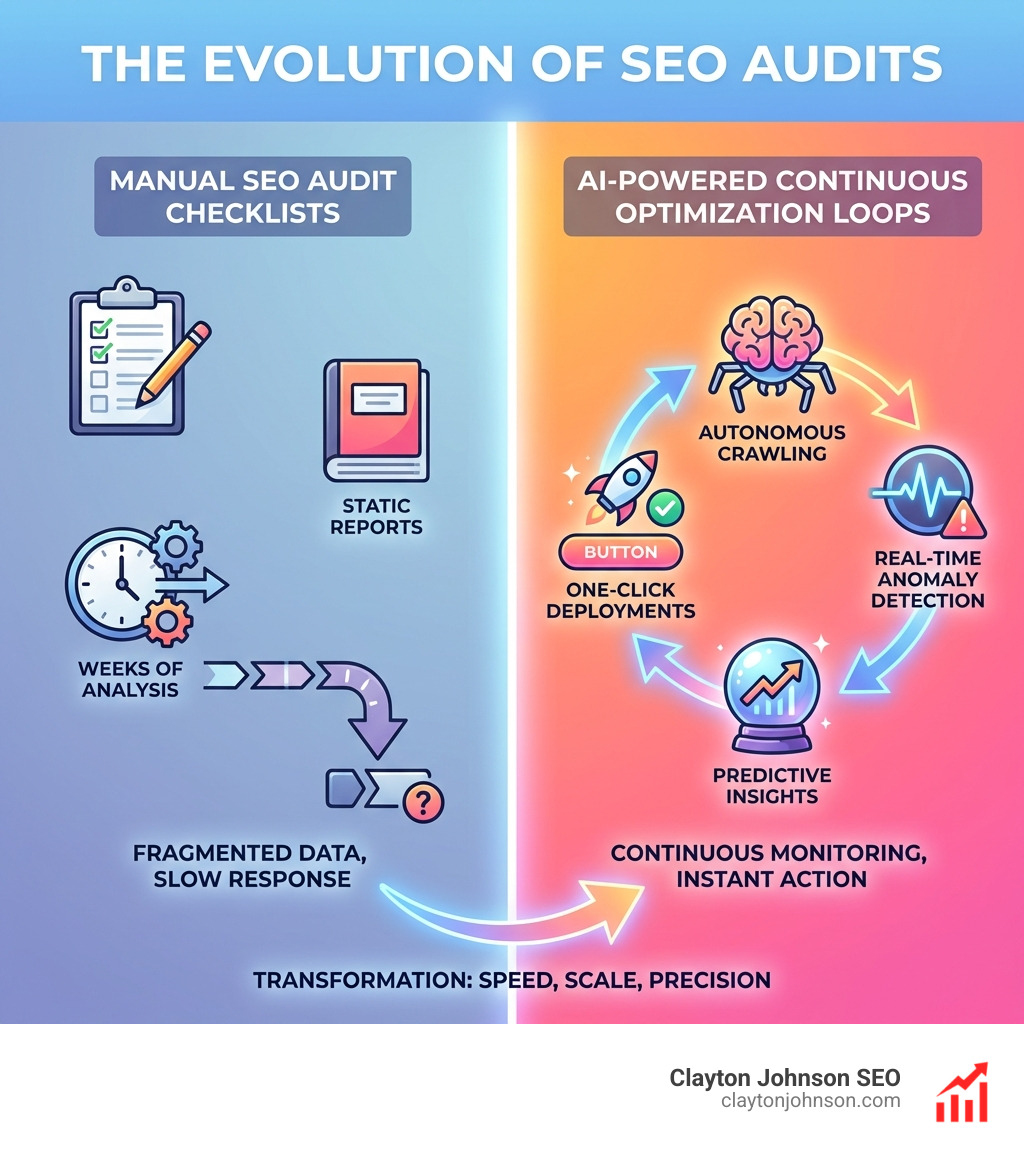
AI driven SEO audits use machine learning, natural language processing, and automation to analyze website health, detect technical issues, prioritize fixes, and even deploy optimizations—often in minutes instead of weeks. Here’s what they deliver:
- Autonomous crawling and analysis that learns site-specific patterns and schedules checks dynamically
- Real-time anomaly detection flagging issues like redirect loops or deindexed pages before traffic drops
- NLP-powered content gap analysis revealing missing topics and semantic opportunities
- Predictive optimization forecasting Core Web Vitals degradation and ranking shifts
- One-click deployment of fixes for titles, meta tags, structured data, and more
- Continuous monitoring replacing static snapshots with living systems that adapt to algorithm changes
Traditional manual audits hit a wall when sites scale past thousands of pages or when Google’s algorithm updates arrive faster than your quarterly review cycle. Enterprise teams report spending 80% of their time identifying problems instead of solving them. Meanwhile, 32.6% of SEO professionals say audits and fixes consume most of their time, and Google’s AI Overviews now capture 25-30% of search demand share—making speed and precision non-negotiable.
AI changes the equation. Instead of manually cross-referencing crawl data, server logs, and Search Console exports in spreadsheets, AI correlates these signals automatically, scores issues by impact and effort, and generates developer-ready instructions. Some platforms even push fixes directly to production or export optimized tags to WordPress with a single click. The result: 10x faster issue detection, 90% more issues fixed on the first pass, and 15-25% organic performance improvements for early adopters.
But AI isn’t magic. It amplifies human expertise—not replaces it. You still need strategic judgment to set priorities, interpret nuance, and align technical fixes with business goals. The best workflows combine AI’s speed and scale with human oversight on indexing directives, content strategy, and governance.
I’m Clayton Johnson, and I’ve spent years building scalable SEO systems that merge technical rigor with strategic clarity—now increasingly powered by AI driven SEO audits that turn fragmented data into coherent growth engines. This guide will show you how to implement AI auditing workflows without losing your mind to complexity, from choosing the right tools to operationalizing continuous optimization.
Why AI Driven SEO Audits are Essential in the Era of AI Overviews
The search landscape is undergoing its most significant change since the invention of the crawler. We are moving away from a world of simple blue links toward a paradigm dominated by AI-mediated discovery.
Google’s AI Overviews (formerly SGE) now account for roughly 25% to 30% of all search demand share. This means that for a significant portion of queries, users never even scroll down to the first organic result. If your site isn’t technically perfect and semantically relevant, it won’t just drop in Google Rankings; it will become invisible to the AI agents that synthesize information for users.
Algorithm volatility has also reached a fever pitch. In the past, you might have performed a quarterly audit, spent six weeks implementing fixes, and then enjoyed the results for a year. Today, algorithm updates hit so frequently that a static audit is often obsolete before the developer ticket is even assigned. This is why 32.6% of SEO professionals are stuck in a reactive loop, constantly chasing errors instead of building growth.
AI driven SEO audits solve this by providing real-time monitoring and competitive intelligence. Rather than waiting for a traffic drop to signal a problem, AI-powered systems detect anomalies—like a sudden spike in 404 errors or a degradation in Core Web Vitals—the moment they happen.
Preparing for AI-First Search Engines
To survive in this new era, your website must be “readable” not just by humans and traditional bots, but by Large Language Models (LLMs). This requires a shift in technical priorities:
- llms.txt: Implementing a dedicated file to guide AI crawlers on how to interpret and summarize your content.
- Bot Access Management: Ensuring that AI agents like ChatGPT, Claude, and Perplexity can access your high-value pages without being blocked by overly restrictive robots.txt files.
- Semantic HTML and Structured Data: Moving beyond simple tags to provide rich, server-rendered context. AI search engines rely heavily on Schema.org markup to understand the entities and relationships on your page.
Optimizing for these elements ensures that when an AI agent searches for an answer, your brand is the one it cites.
The Shift from Reactive to Proactive Optimization
The most critical advantage of AI is the transition from “what happened?” to “what is about to happen?” Modern SEO is no longer just about fixing broken links; it’s about predictive SEO.
Currently, 14.8% of respondents consider AI agents and automation to be the most critical SEO tools available. These agents don’t just find errors; they recognize patterns. For example, an AI audit might notice that every time you update a specific product template, your Largest Contentful Paint (LCP) score drops by 200ms. By flagging this trend early, an SEO Consultant can intervene before the cumulative impact triggers a ranking penalty.
Core Components of a Modern AI SEO Audit
When we perform AI driven SEO audits, we aren’t just looking at a checklist. We are looking at a multi-dimensional map of your site’s health.
| Feature | Traditional Manual Audit | AI-Driven SEO Audit |
|---|---|---|
| Speed | 2-4 Weeks | Minutes to Hours |
| Frequency | Quarterly or Bi-Annually | Continuous / Real-Time |
| Data Scope | Sample of 500-1,000 pages | Full site (Millions of URLs) |
| Prioritization | Subjective / Gut Feeling | Data-backed ROI & Effort Scoring |
| Fixes | Manual Documentation | One-Click Fix Generation |
Our SEO Services leverage these core components to ensure no stone is left unturned.
Technical Health and ML-Optimized Crawling
Traditional crawlers act like tourists with outdated maps—they wander aimlessly and often get stuck. ML-optimized crawling, however, acts like an intelligent guide. It prioritizes your crawl budget by focusing on pages that drive the most traffic, conversions, and update frequency.
One enterprise client saw their most important pages crawled 3x more frequently after switching to an ML-optimized schedule. This is vital for catching:
- JavaScript Rendering Issues: Detecting “hydration” errors where content is visible to users but invisible to bots.
- Orphaned Pages: AI can identify high-value product pages that are receiving traffic but have no internal links, recovering lost equity instantly.
- Redirect Loops: Catching systemic errors that could cost thousands in daily revenue if left unchecked.
Start My Free Audit to see how your technical architecture stacks up against modern AI standards.
NLP-Driven Content Gap Analysis in AI Driven SEO Audits
Technical health is the foundation, but content is the architecture. AI uses Natural Language Processing (NLP) to perform entity extraction and topical mapping.
Instead of just looking for “keywords,” AI driven SEO audits look for “topical authority.” The AI analyzes your competitors to see which entities (concepts, people, places) they are covering that you are missing. This is the core of modern SEO Content Marketing. It allows us to build keyword clusters based on semantic relevance rather than just search volume, ensuring your content satisfies the deep intent of both users and AI answer engines.
The Step-by-Step Workflow for AI Driven SEO Audits
Operationalizing AI doesn’t mean clicking a button and walking away. It requires a structured workflow to turn data into dollars.
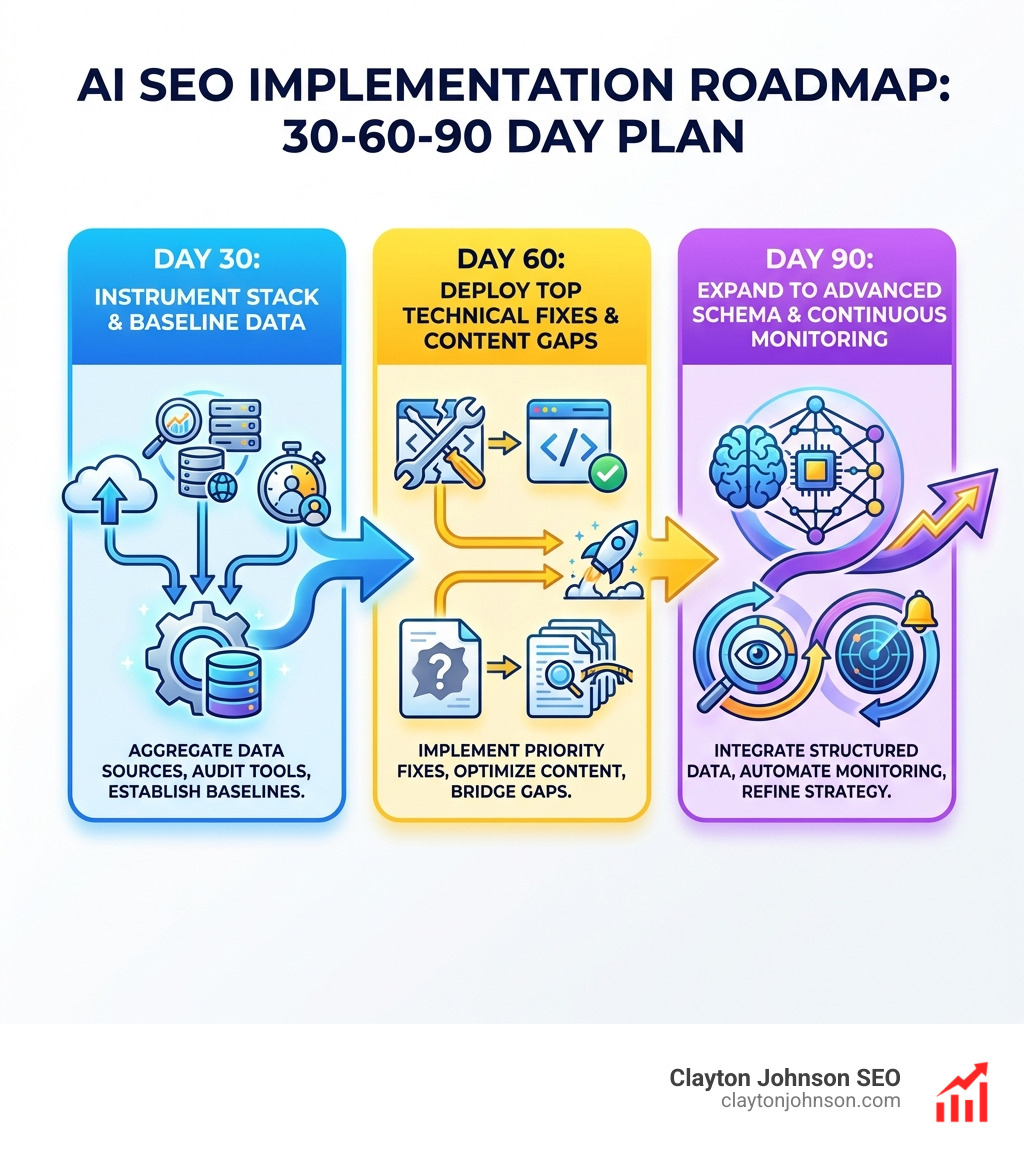
- Data Foundation: We aggregate data from every available silo—Google Search Console, server logs, real-user monitoring (RUM), and competitor SERP intelligence.
- Crawl Execution: Using JS-enabled, ML-prioritized crawlers to map the site.
- Anomaly Detection: The AI flags deviations from “normal” site behavior.
- Issue Prioritization: We use the RICE framework (Reach, Impact, Confidence, Effort) enhanced by AI metrics to decide what to fix first.
With 20.5% of businesses now investing in SEO workflow automation, companies in markets like Minneapolis SEO are finding that speed is their greatest competitive advantage.
From Detection to One-Click Deployment
The biggest bottleneck in SEO isn’t finding the problem; it’s getting the fix through the development queue. AI driven SEO audits bridge this gap by generating production-ready code.
Imagine an audit that doesn’t just tell you “Your meta descriptions are missing,” but instead presents you with 500 optimized, intent-aligned descriptions ready to be pushed to your CMS. Some tools now offer WordPress exports or direct API integrations that allow for bulk updates of titles, H-tags, and Open Graph tags. This turns weeks of “engineering handoffs” into a single afternoon of QA.
Try the AI Audit Tool for Free to experience this “one-click” reality.
Integrating AI Audits into Enterprise Workflows
For larger organizations, AI audits must act as a “central nervous system.” This means integrating the audit agent with your existing ecosystem:
- CMS Connectivity: Pushing content updates directly.
- Ticketing Systems: Automatically creating Jira or Asana tickets for technical errors.
- ROI Tracking: Correlating technical fixes with organic session growth and revenue.
According to PwC’s 2024 Pulse Survey, 49% of tech leaders have fully integrated AI into their core strategy. SEO should be no different. By making audits a continuous loop rather than a static event, you ensure your site scales without accumulating “SEO debt.”
Top Tools and Platforms for AI-Powered Auditing
While the market is flooded with “AI” tools, only a few provide the depth required for professional-grade audits. At Clayton Johnson SEO, we focus on tools that offer actionable intelligence over simple data dumps.
- Clayton Johnson SEO Proprietary Tools: Our internal systems stand out for their ability to fix 90% more issues on the first pass by providing specific recommendations rather than raw data. This saves an average of 3 hours per audit.
- Custom Agentic Workflows: We often build custom AI agents that connect your Google Search Console data with LLMs to perform deep-dive entity analysis.
- Enterprise Platforms: Tools that offer “AI Visibility Scores” to benchmark how often your brand appears in AI-generated answers compared to your competitors.
As an SEO Expert, I recommend looking for tools that offer “Source Code Guarantees” or “Bring Your Own Key” (BYOK) LLM support. This ensures you own your data and aren’t locked into a single provider’s black-box logic. You can explore our full suite of Clayton Johnson SEO Tools/Platform to see how we integrate these technologies into our client strategies.
Specialized Features for Competitive Benchmarking
One of the most powerful features of AI is “Overlap Analysis.” AI can scan the top 10 results for your target keywords and identify the exact “share of voice” you have compared to competitors. It doesn’t just look at rankings; it looks at Commercial Opportunity Targeting. It identifies keywords where your competitors are ranking but have poor content quality or technical errors, allowing you to swoop in and claim that traffic with minimal effort.
Frequently Asked Questions about AI Driven SEO Audits
Can AI audits replace human SEO expertise?
The short answer is no. While AI is 10x faster at detection, it still lacks the strategic context of a human. McKinsey research shows that only 6% of organizations are “AI high performers”—and these are the ones who keep a “human-in-the-loop.” You need a human to decide if a “technical error” is actually a deliberate choice for user experience, or if an AI-generated content brief aligns with your brand voice.
How does AI handle Core Web Vitals optimization?
AI excels at pattern recognition within Real User Monitoring (RUM) data. Instead of just giving you a Lighthouse score, AI can analyze thousands of user sessions to find exactly which JS modules are causing Layout Shifts (CLS) or Interaction to Next Paint (INP) delays across different devices and geographies. You can use the Core Web Vitals Test to get your baseline, but AI is what helps you engineer the solution at scale.
What are the limitations of AI-driven SEO tools?
AI is only as good as the data it can see. Most AI tools have a limited “crawl depth” or may struggle with highly complex, login-protected environments. Furthermore, AI can sometimes miss contextual nuances—like sarcasm or brand-specific terminology—in content audits. Always validate your structured data using the Schema Markup Validator to ensure the AI’s recommendations are technically sound.
Conclusion
The era of spending months on a manual SEO audit is over. If you want to compete in a world of AI Overviews and autonomous agents, you need a strategy that moves as fast as the algorithms do.
At Clayton Johnson SEO, we don’t just give you a report; we give you a growth engine. By combining AI driven SEO audits with our deep expertise in growth strategy and content systems, we help you build a “living” SEO presence that adapts, learns, and wins.