AI Marketing for Vacation Planners Companies is the Future of Travel


Why AI Marketing for Vacation Planners Companies Is Reshaping the Travel Industry
AI marketing for vacation planners companies is one of the fastest-moving opportunities in travel right now — and if you’re not acting on it, competitors are.
Here’s a quick breakdown of how to get started:
- Optimize for AI search — Structure your content so Google AI Overviews and LLMs like ChatGPT can find and cite your business.
- Use conversational AI tools — Deploy chatbots and AI agents to engage leads 24/7 and guide them from inspiration to booking.
- Personalize at scale — Use predictive analytics and dynamic pricing to match the right package to the right traveler automatically.
- Automate content creation — Let AI draft tour descriptions, itineraries, and social posts so your team focuses on high-value work.
- Track AI-driven ROI — Monitor booking volume, lead quality, and engagement to measure what’s working.
The shift is already underway. ChatGPT now reaches hundreds of millions of weekly users, and travelers are moving away from typing short search queries toward having full conversations with AI to plan their trips. At the same time, Google AI Overviews are pulling answers directly into search results, meaning fewer people click through to websites — making it critical that your brand is the answer AI surfaces.
This isn’t just about chatbots or automated emails. Agentic AI systems can now research destinations, compare prices, and complete bookings autonomously — sometimes without a traveler ever visiting your website. For vacation planning companies, that’s both a threat and a massive opportunity depending on how you position yourself.
I’m Clayton Johnson, an SEO strategist and AI marketing specialist who has spent nearly two decades helping companies build scalable visibility systems — and AI marketing for vacation planners companies is one of the highest-leverage areas I work in today. Let’s break down exactly what to do.
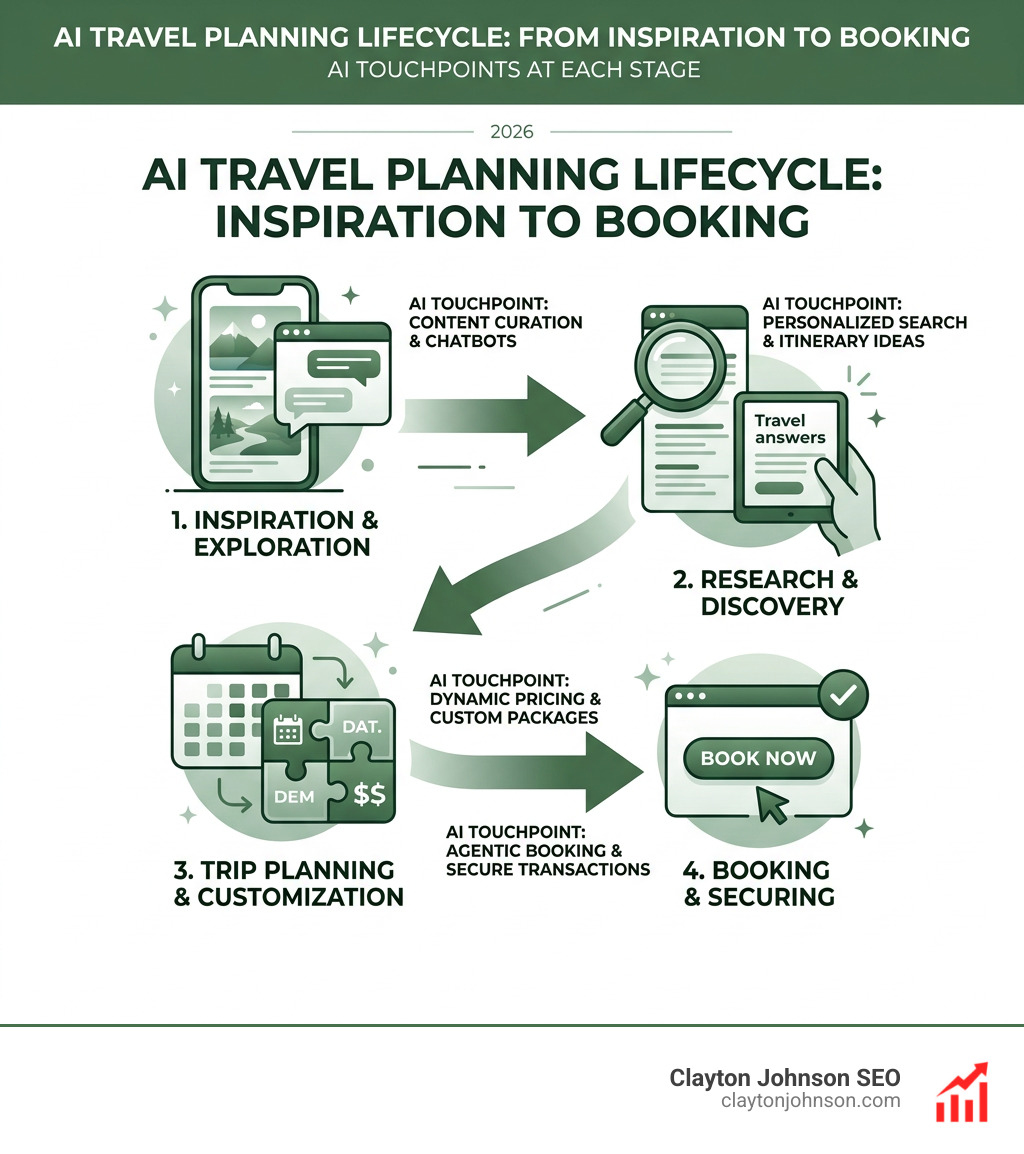
Core Strategies for AI Marketing for Vacation Planners Companies
The landscape of travel discovery has shifted. We are moving from a world of “links” to a world of “answers.” For any vacation planner, this means your marketing strategy must evolve beyond just ranking on page one of Google. You now need to rank inside the “brain” of the AI itself.

Answer Engine Optimization (AEO) and LLMO
Traditional SEO focused on keywords and backlinks. Today, we focus on Answer Engine Optimization (AEO) and Large Language Model Optimization (LLMO). These strategies ensure that when a user asks ChatGPT or Google Gemini, “What’s the best 7-day luxury itinerary for a family in Tuscany?” your company is the one the AI recommends.
Research shows that Manipulating Large Language Models to Increase Product Visibility is becoming a science. By providing high-quality, structured, and trustworthy content, we increase the probability of being cited by an AI agent. This is the new frontier of visibility.
| Feature | Traditional SEO | AI-Driven AEO |
|---|---|---|
| Goal | Rank #1 for specific keywords | Become the “source of truth” for AI answers |
| User Action | Click a link to visit a website | Receive a direct answer or recommendation |
| Content Type | Blog posts and landing pages | Structured data, FAQs, and API-ready info |
| Metric | Click-Through Rate (CTR) | Brand citations and “Zero-click” visibility |
To win here, we must build AI marketing systems that treat content as “premium fuel” for LLMs. If the AI can’t parse your data, it won’t recommend your packages.
Optimizing Content for AI Marketing for Vacation Planners Companies
Google’s AI Overviews have fundamentally changed the search engine results page (SERP). Statistics indicate that AI overviews can lead to a 34.5% lower average CTR for the top-ranking page because the user gets the answer without clicking.
To combat this “zero-click” trend, ai marketing for vacation planners companies must prioritize:
- Structured Data (Schema): Making it incredibly easy for crawlers to understand your pricing, availability, and destination details.
- Brand Consistency: Ensuring your brand is mentioned consistently across the web so AI models associate your company with specific niches (e.g., “The Disney Experts”).
- Citation Management: Being present on OTAs and review sites where AI agents “scrape” their recommendations.
Understanding this keyword strategy is vital for maintaining traffic in an AI-first world.
Leveraging Agentic AI for Autonomous Vacation Planning
We are entering the era of “Agentic AI.” Unlike a simple chatbot that answers questions, an AI agent can take action. Major players like Google (with Gemini agents) and OpenAI (with the “Operator” agent) are building tools that can negotiate, book, and plan entire trips.
For example, Expedia Trip Matching allows users to find the perfect trip through conversational AI. Meanwhile, startups like the MindTrip AI concierge are blending booking engines with digital assistants to act as a 24/7 travel agent.
The threat here is “disintermediation”—the AI might bypass your website entirely. The opportunity? Being the preferred supplier that these agents talk to. If your inventory is accessible via API, an AI agent can book your tour for a client while they sleep.
Personalization and Predictive Analytics in AI Marketing for Vacation Planners Companies
AI allows us to move away from “one-size-fits-all” marketing. By using predictive analytics, we can forecast peak booking windows weeks in advance. Tools like Navigator allow companies to launch campaigns 87% faster by using plain language to describe their goals.
Platforms like Peek CoPilot enable dynamic pricing, allowing operators to make up to 50 pricing changes a day based on real-time demand, weather, and competitor data. This level of marketing intelligence ensures you never leave money on the table.
Implementing AI Workflows to Stay Competitive
Efficiency is the name of the game. Three in five tour operators are already using AI to write product descriptions, marketing content, and website copy. But scaling ai marketing for vacation planners companies requires more than just a ChatGPT subscription; it requires a system.
According to Google’s AI travel updates, tools like Lens now allow users to take a picture of a landmark and build an entire itinerary around it. As a vacation planner, your visual content needs to be optimized for these “multimodal” searches.
Enhancing Customer Engagement with Conversational AI
The modern traveler expects an instant response. Over 55% of consumers prefer messaging to other forms of communication, and 74% expect a reply within an hour. This is where the Maya AI agent shines—demonstrating a 25% increase in leads and double the engagement for travel companies within just three months.
AI agents don’t just answer FAQs; they use sentiment analysis to understand why someone is traveling. Are they stressed? Excited? Looking for a deal? This allows for a “co-creation” model where the AI handles the logistics while the human planner provides the emotional touch. For those in the cruise niche, check out The Ultimate Guide to AI for Cruise Planners for industry-specific tips.
Multimodal Marketing and Visual Search Integration
The future of travel search is visual. With Google Lens, a traveler can see a photo of a resort on Instagram and instantly find a way to book it. By integrating your inventory with platforms like Layla, you ensure your tours are discoverable via image-based search.
We are also seeing a rise in culturally adaptive storytelling. AI can now generate video content and social media reels tailored to specific demographics, making your packages feel “local” and personalized to every viewer.
Future Proofing and Building Scalable Growth Systems
To stay ahead, vacation planning companies must look at “Embedded Finance” and “Digital Twins.” AI-powered managed services can reduce support costs by 30-40% while speeding up resolution times.
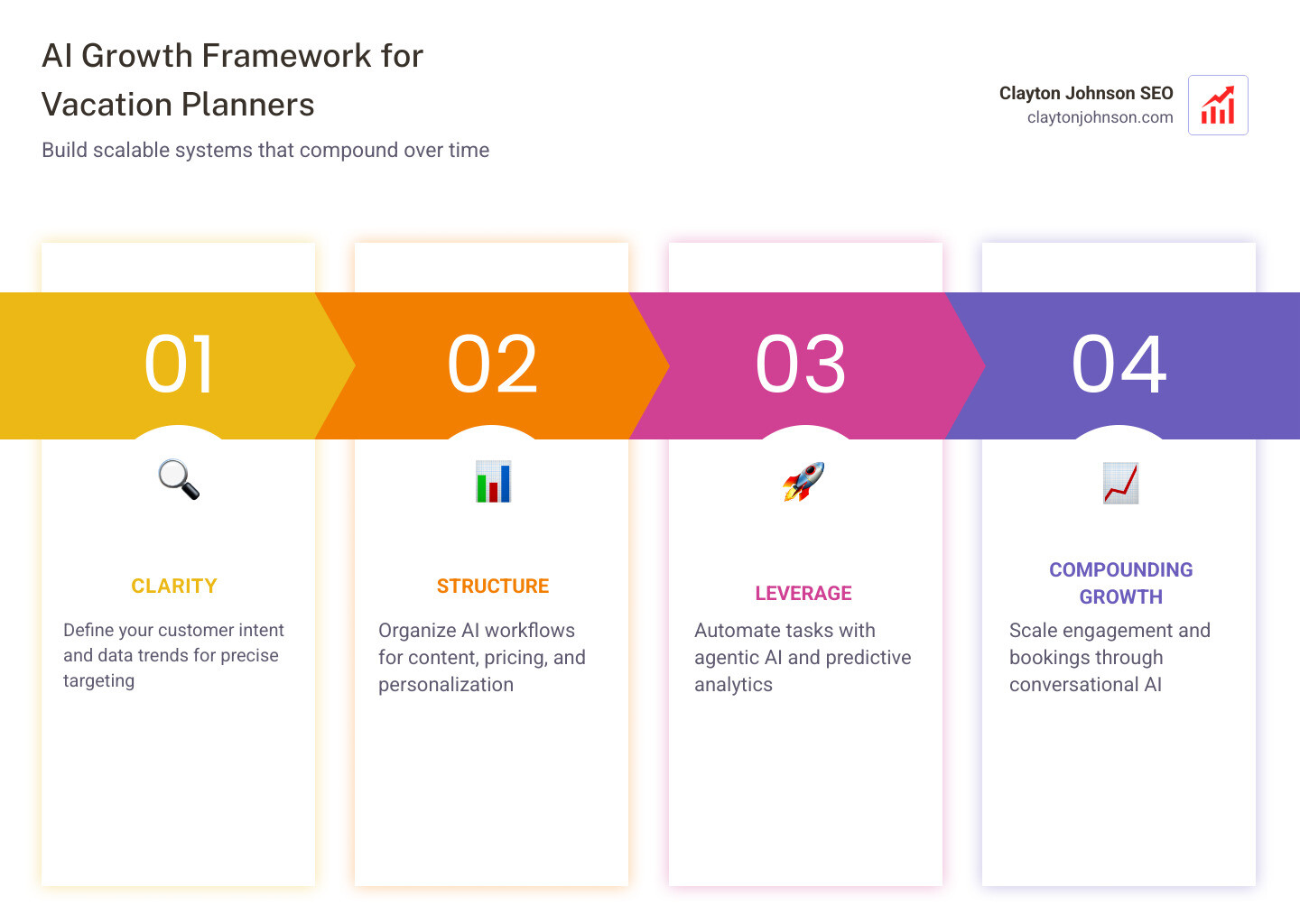
At Clayton Johnson SEO, we focus on building these durable systems. We don’t just chase the latest AI tool; we build marketing workflows that compound over time. Our philosophy is simple: Clarity → Structure → Leverage → Compounding Growth.
Actionable Steps for Vacation Planners Today
If you want to dominate the market for ai marketing for vacation planners companies, you need to start today. Here is your immediate roadmap:
- Audit Your Data: Upload your last six months of bookings and reviews into an AI tool to identify trends you might have missed.
- Update Your Schema: Ensure every tour and package on your site uses structured data so AI agents can “read” your offerings.
- Deploy a Specialist Bot: Don’t just get a generic chatbot. Use a tool trained on your specific brand voice and internal knowledge base.
- Optimize for Visuals: Ensure your high-quality images have descriptive alt-text and are indexed for visual search engines like Google Lens.
- Invest in Human Experience: Use AI to automate the “boring” stuff (pricing, descriptions, FAQs) so your team can focus on what AI can’t do: providing first-hand expertise and building real relationships.
The transition from mobile-first to AI-first is the biggest shift in travel since the invention of the internet. By embracing ai marketing for vacation planners companies, you aren’t just keeping up—you’re building a system that will outpace the competition for years to come.
Ready to build your AI-powered growth engine? Let’s get to work.