Why AI Marketing for Real Estate Coaches Companies Is a Game-Changer
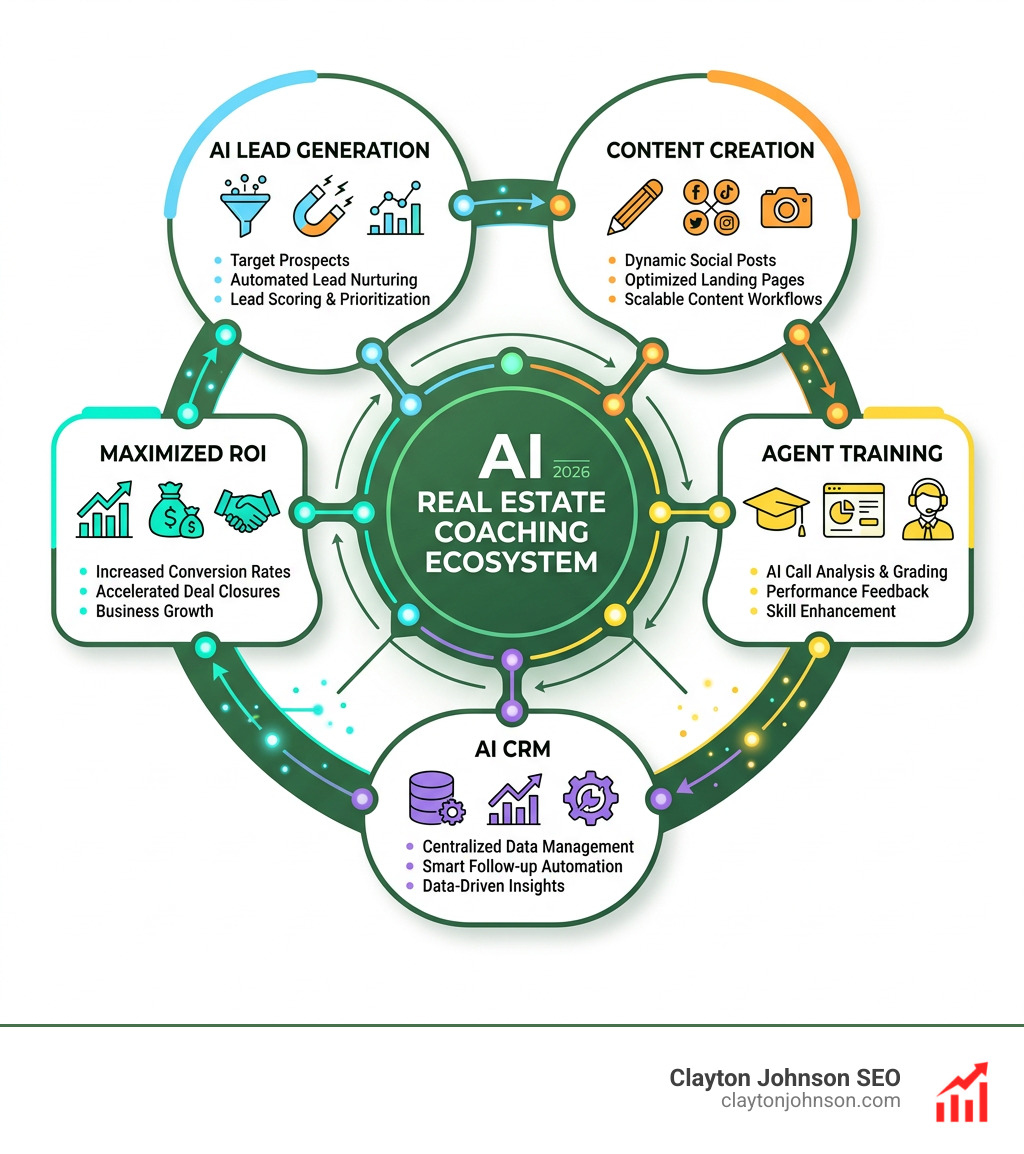
AI marketing for real estate coaches companies is the practice of using artificial intelligence tools to automate lead generation, content creation, agent training, and client follow-up — so coaching businesses can scale without burning out their teams.
Here’s a quick snapshot of what AI marketing can do for real estate coaching companies:
| Goal | AI Solution | Result |
|---|---|---|
| Generate more leads | AI-powered CRMs and lead scoring | 3.2x more leads generated |
| Save time on marketing | Automated content and campaigns | 12 hours saved weekly |
| Improve agent performance | AI call grading and coaching | 55%+ increase in appointment rates |
| Close deals faster | Smart follow-up automation | 45% faster time to close |
| Boost response rates | AI-driven outreach | 68% higher response rate |
Running a real estate coaching company means wearing a lot of hats. You’re managing agents, creating content, chasing leads, tracking performance — and somehow trying to grow at the same time. Most coaching businesses don’t have a strategy problem. They have a capacity problem.
That’s exactly where AI steps in.
AI tools can handle the repetitive, time-consuming tasks — drafting listing descriptions, scoring leads, following up with prospects, grading sales calls — so you and your team can focus on the work that actually moves the needle: relationships, coaching, and closing.
The gap between coaches who adopt AI now and those who don’t is widening fast.
I’m Clayton Johnson, an award-winning SEO strategist and AI marketing innovator who has spent nearly two decades building scalable, data-driven growth systems — including AI marketing for real estate coaches companies — that drive measurable revenue. In this guide, I’ll walk you through exactly how to put AI to work for your coaching business.
Core Strategies for AI Marketing for Real Estate Coaches Companies
The primary bottleneck in most real estate coaching businesses isn’t a lack of talent; it’s the sheer volume of “noise” that prevents high-value action. We see coaches struggling with inconsistent lead follow-up, marketing overload, and the heavy lift of recruiting and onboarding new agents. When these tasks are handled manually, they become friction points that stall growth.
By implementing ai marketing for real estate coaches companies, we shift from manual labor to system-level leverage. Instead of a marketing assistant trying to remember to post on LinkedIn, an AI-augmented workflow ensures your brand is “always on.” This allows your team to stop “stitching together” fragmented tools and start using a unified command center.
One of the most significant shifts we advocate for is moving away from the “hiring trap.” Many coaches think the answer to growth is hiring a $40,000-a-year marketing assistant. However, an investment in AI systems often yields a higher ROI by automating the same tasks with 24/7 reliability.
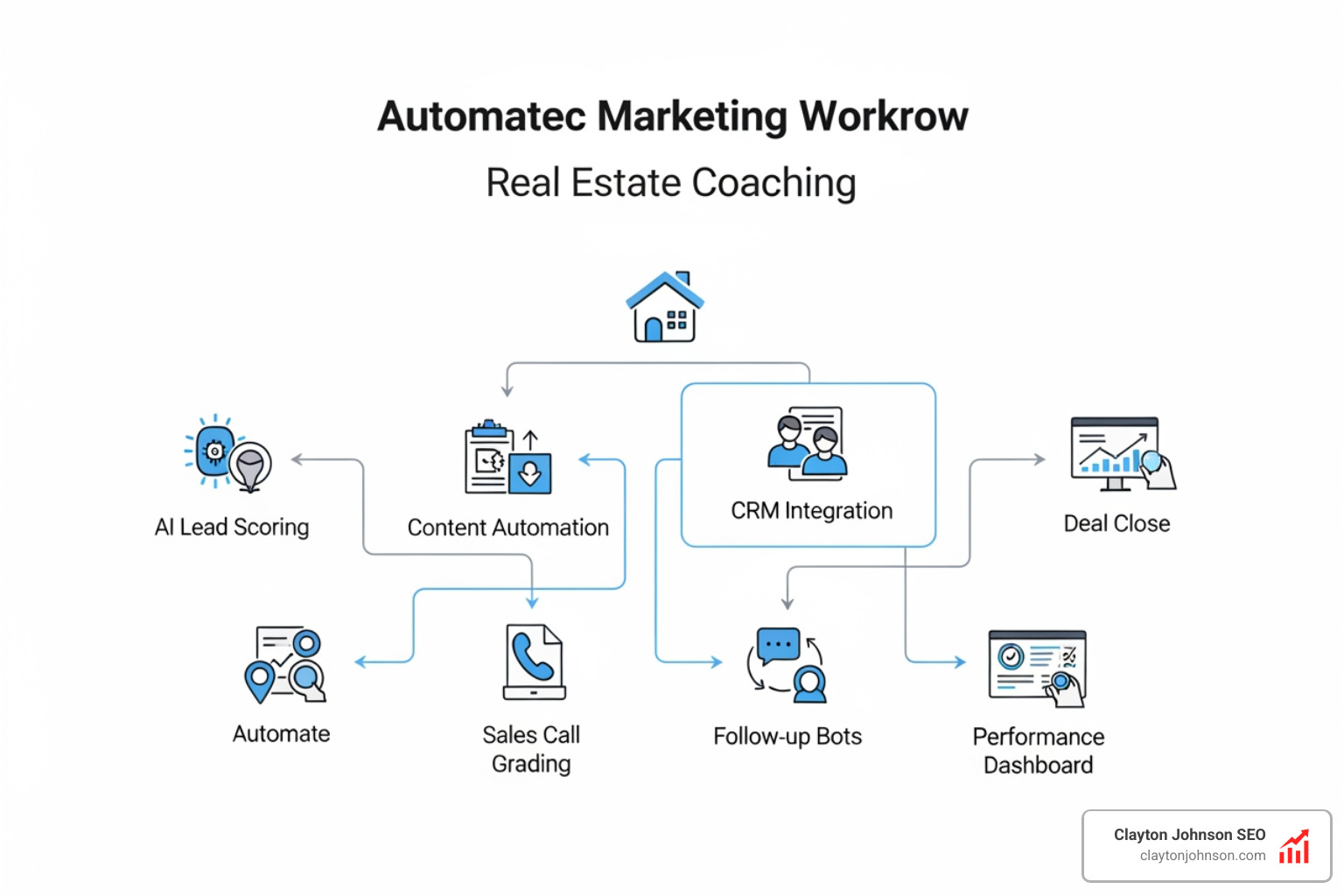
To understand the impact, let’s look at how AI stacks up against traditional methods. While a human assistant brings creativity, they also bring overhead and limited hours. AI provides the scale. For a deeper dive into how to bridge this gap, check out our guide on AI strategy and implementation for people who hate jargon.
| Feature | AI Marketing Systems | Traditional Marketing Assistant |
|---|---|---|
| Availability | 24/7/365 | 40 hours/week |
| Lead Response | Instant (under 2 minutes) | Variable (minutes to hours) |
| Cost | Fixed software/subscription fees | Salary + Benefits + Taxes |
| Scalability | Unlimited volume | Limited by human bandwidth |
| Data Processing | Millions of data points instantly | Manual spreadsheet entry |
According to NAR research on homebuyer behavior, 98% of millennials rely on the internet to find homes. For coaching companies, this means your digital presence isn’t just a business card; it’s your primary lead engine. If your agents aren’t responding to these digital leads instantly, you are losing money. AI ensures that no lead goes cold while your team is sleeping or in meetings.
Streamlining Content with ChatGPT and AI Content Generation Tools
The “blank page” is the enemy of consistency. Real estate coaches often know what they want to say, but finding the time to draft listing descriptions, email newsletters, and social media captions is a constant struggle. This is where ChatGPT and other large language models become “content accelerators.”
We don’t recommend using AI to replace your voice, but rather to amplify it. By feeding AI your previous successful newsletters or transcripts from your coaching calls, you can train it to generate “scripts that don’t suck.” You can take a 10-minute video of a coaching session and ask an AI tool to turn it into:
- Three LinkedIn posts
- An email blast to your database
- A blog post optimized for search intent
- A series of short-form video scripts
This multichannel approach ensures your brand stays top-of-mind across all platforms. For those looking to build a durable engine, we’ve developed the ultimate guide to AI content systems to help you structure this workflow.
Real estate-specific tools like Jasper or specialized GPTs can even pull in MLS data to write listing descriptions that are not only accurate but emotionally resonant. This removes the highest hurdle in marketing: ideation. When the AI provides the first draft, your team only needs to spend five minutes fine-tuning it, rather than an hour writing from scratch.
Leveraging AI Marketing for Real Estate Coaches Companies for Lead Nurturing
Lead generation is relatively easy; lead conversion is where most coaching companies fail. We call this the “middle-funnel leak.” You might be generating hundreds of leads from Zillow or social ads, but if your agents aren’t nurturing them with personalized, timely content, those leads will eventually “shop around” with a competitor.
Modern AI-powered CRMs solve this by automatically scoring leads based on engagement. If a prospect clicks on a specific neighborhood guide three times in one hour, the AI flags them as a “hot lead” and triggers a smart autoresponder. This isn’t just a generic “thanks for your interest” email. It’s a personalized message tailored to their behavior.
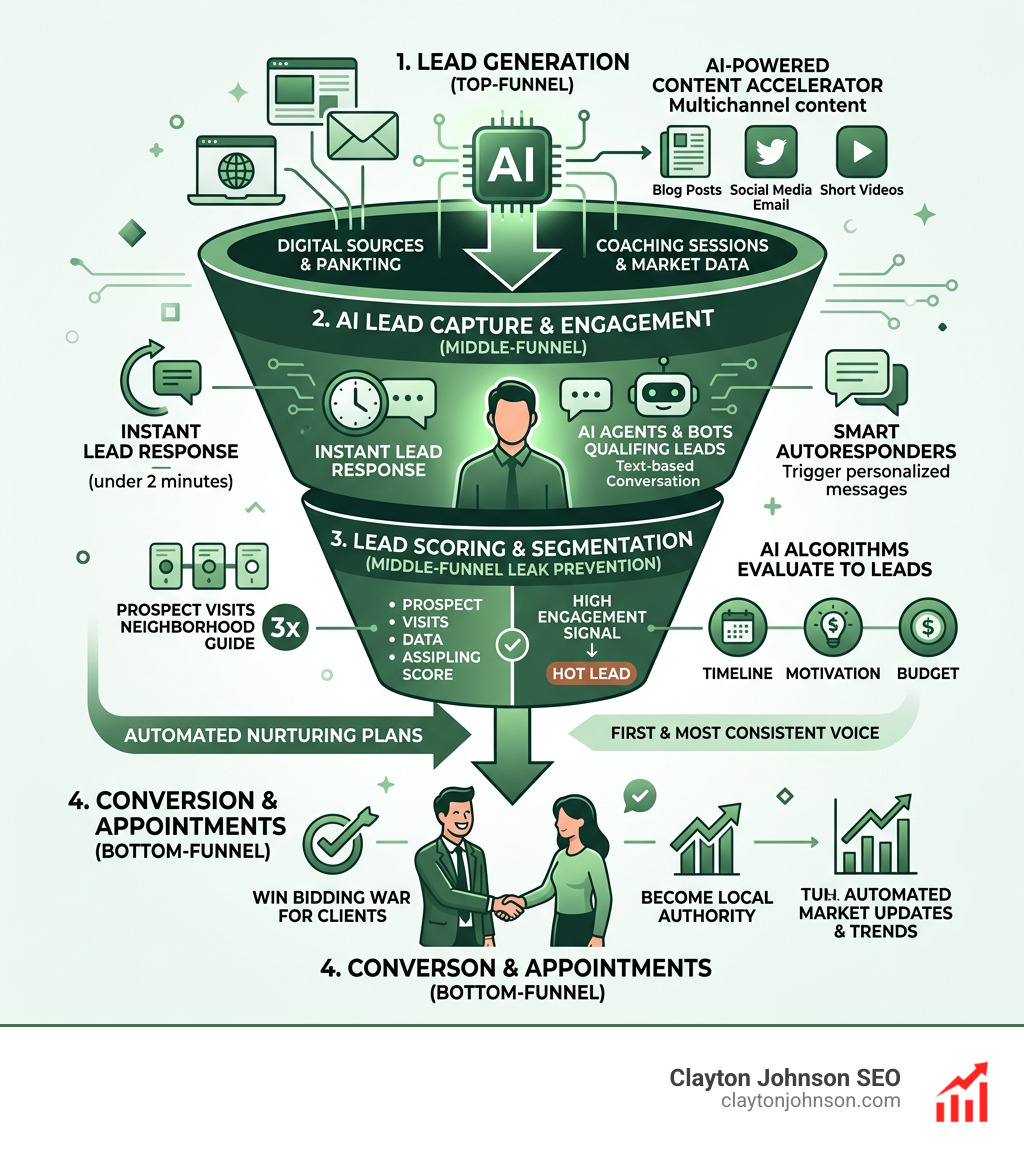
Platforms like Marketing Titan or PulseIntel PRO allow coaches to deploy “AI agents” that handle the initial “speed to lead” outreach. These bots can engage in text-based conversations to qualify a lead’s timeline and motivation before ever handing them off to a human agent. This ensures your team is only talking to people who are actually ready to buy or sell.
By automating these plans, we’ve seen teams win the bidding war for clients by simply being the first and most consistent voice in the prospect’s inbox. When you combine this with market intelligence—AI that tracks local trends and sends automated updates—you position your coaching brand as the local authority.
Data-Driven Performance Tracking and Agent Training
One of the most applications of ai marketing for real estate coaches companies is in the realm of sales training. Traditionally, a sales manager would have to listen to hours of recorded calls to find “coachable moments.” It was a needle-in-a-haystack problem.
Now, AI call grading tools can analyze every single call your agents make. They look for specific markers like:
- LPMAMA Completion: Did the agent ask about Location, Price, Motivation, Agent, Mortgage, and Appointment?
- Sentiment Analysis: Was the prospect frustrated or excited?
- Appointment Ask Rate: Did the agent actually ask for the meeting?
Using tools like Otter.ai for transcription and specialized platforms for grading, a sales manager can review a week’s worth of an agent’s performance in 30 seconds. Instead of generic “keep it up” advice, you can provide precise coaching: “You’re great at building rapport, but you missed the mortgage question on 40% of your calls last week.”
This data-driven approach is a core part of how to build AI marketing workflows that actually work. It removes the emotion from performance reviews and replaces it with objective metrics. Agents who use AI-driven role-play simulators to practice handling objections often see their appointment rates climb by 55% or more because they are practicing in a “safe” environment before talking to a live lead.
Implementing AI Systems for Long-Term Growth
The biggest hurdle to AI adoption isn’t the technology—it’s the people. Getting team buy-in is critical. We often see resistance from agents who fear that “the bots are coming for their jobs.” To overcome this, we must frame AI as a virtual assistant that handles the “grunt work,” allowing the agents to focus on high-value relationship building.
When you integrate AI into your existing CRM, it shouldn’t feel like “extra work.” It should feel like a relief. For example, using Calendly with AI integrations to automate meeting scheduling removes the back-and-forth emails that drain energy. As Sharon Love-Bates on emerging tech suggests, the goal is to use innovation to enhance the human element of real estate, not replace it.
Successful implementation starts with a “quick win.” Don’t try to automate your entire business on day one. Pick one bottleneck—like drafting listing descriptions or following up with old leads—and solve it with a specific tool. Once the team sees the time saved, the “fear factor” disappears. For a list of vetted tools, see our breakdown of AI marketing software that actually sells.
Personalizing the Coaching Brand Voice
A common complaint about AI-generated content is that it sounds “robotic” or generic. This happens when you use AI as a search engine rather than a creative partner. To maintain your unique coaching brand, you need to “train” the AI on your specific voice and values.
We recommend creating a “Brand Bible” for your AI. This includes:
- Your core coaching philosophies (e.g., “Relationships over transactions”)
- Specific vocabulary you use (and words you hate)
- Examples of your best-performing emails and social posts
- Your target audience’s pain points
By using Custom GPTs, you can build a “Marketing Assistant” that already knows your market, your goals, and your experience. This is the same level of sophistication we see in the Agent Intelligence newsletter, where the content feels personal because it’s grounded in real-world expertise.
Developing these essential AI skills is what separates the “hustlers” from the “operators.” When your AI “knows” you, it can draft a weekly newsletter that sounds exactly like you wrote it, saving you hours of work while maintaining brand consistency.
Future Trends in AI Marketing for Real Estate Coaches Companies
The next frontier of ai marketing for real estate coaches companies is “Agentic AI”—AI that doesn’t just write text, but actually performs tasks across different platforms. Imagine an AI that sees a new listing in the MLS, automatically generates a social media ad, targets it to a specific neighborhood, and starts responding to the comments—all without you lifting a finger.
We are also seeing the rise of “Computer Vision” in real estate. This technology can analyze property photos to automatically suggest renovations, provide instant home valuations, or even check for compliance with MLS rules. This level of market intelligence allows coaches to provide their agents with data that was previously only available to giant tech firms.
Predictive analytics will also play a larger role. Instead of waiting for a lead to contact you, AI will analyze public data to predict who is likely to move in the next six months based on life events (marriages, job changes, etc.). This allows for “proactive marketing” rather than “reactive chasing.” To stay ahead of these shifts, explore the ultimate guide to digital marketing AI.
Measuring ROI and Scaling with Clayton Johnson SEO
At the end of the day, AI is just a tool. Its value is measured by business impact. For real estate coaching companies, the metrics that matter are conversion rates, retention of top agents, and the ROI of your marketing spend.
We’ve seen that teams using AI integrations achieve a 91% client retention rate, compared to an industry average of just 50%. This is because AI allows for a higher level of “personal touch” at scale. Automated anniversary emails, personalized market reports, and instant lead responses create a client experience that feels premium, even if it’s powered by a system.
At Clayton Johnson SEO, we focus on building these durable systems. We don’t just give you a list of tools; we build the architecture that allows those tools to talk to each other. By applying system-level thinking to your marketing, we turn fragmented efforts into a coherent growth engine.
Whether it’s through AI marketing intelligence platforms or structured SEO frameworks, the goal is clarity. When you have clarity on your data and structure in your workflows, you gain the leverage needed for compounding growth. Don’t let the bots out-hustle you—put them to work so you can out-scale the competition.