Why AI Marketing Intelligence Platforms are the Future of Growth

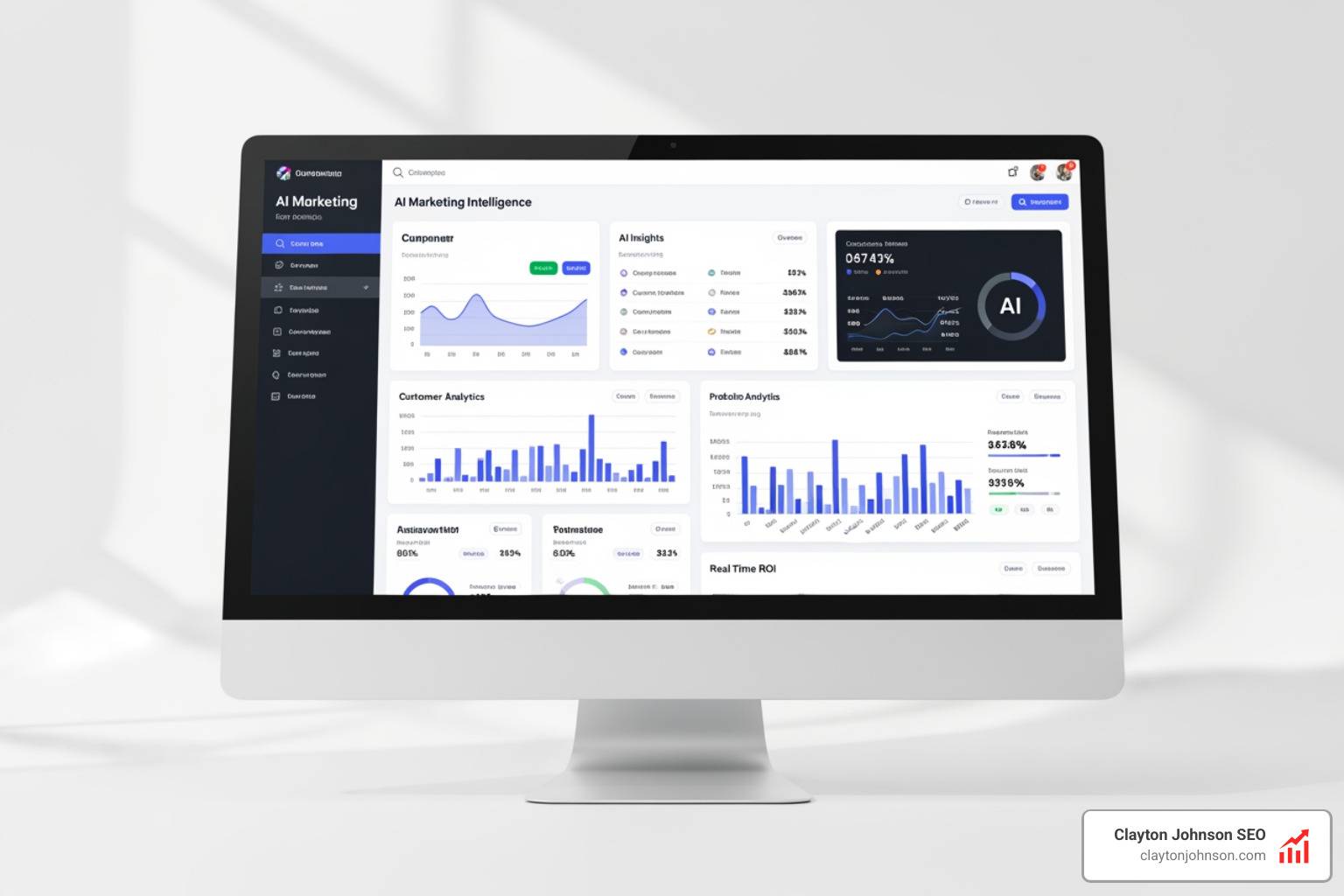
Why an AI Marketing Intelligence Platform is Reshaping How Businesses Grow
An AI marketing intelligence platform is a unified system that combines predictive analytics, generative AI, and automation to help marketing teams make smarter decisions, personalize at scale, and drive measurable revenue growth.
Here’s what these platforms do at a glance:
- Unify data from all marketing channels into a single source of truth
- Predict customer behavior using machine learning and behavioral signals
- Automate personalization across email, web, mobile, and paid channels
- Generate and optimize content at scale while maintaining brand consistency
- Measure real impact — not just clicks, but revenue, retention, and ROI
Most marketing teams are sitting on mountains of data but struggling to act on it fast enough. Campaigns go out based on gut feel. Content gets created without clear intent signals. SEO runs in a silo from paid and email. The result? Fragmented growth that stalls out.
AI marketing intelligence platforms are built to fix exactly that. They replace reactive, disconnected workflows with a system that thinks, learns, and executes — continuously.
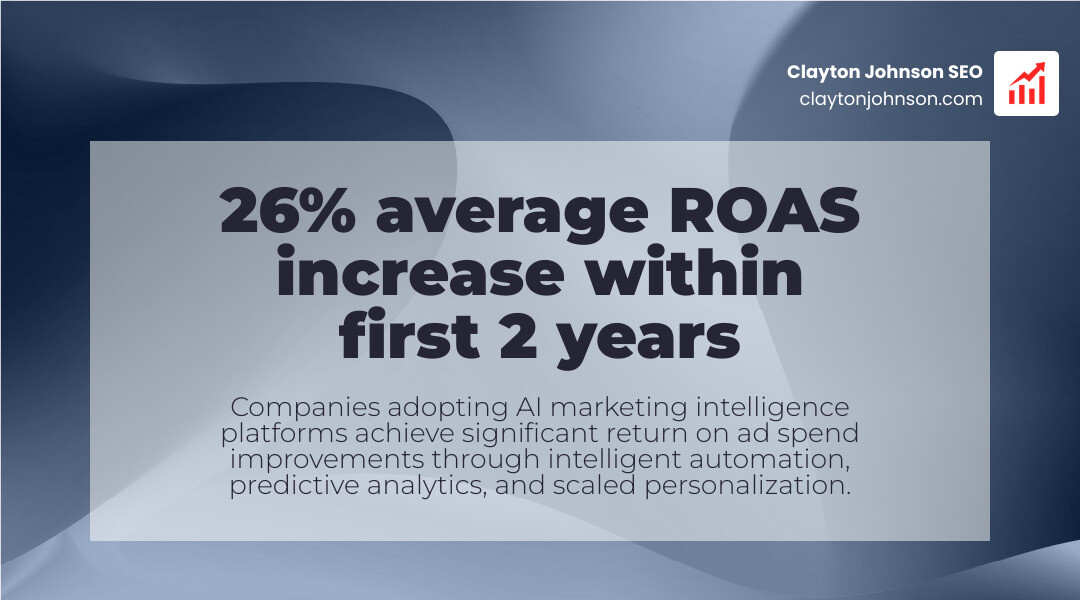
Real-world results back this up. Companies using these platforms have seen outcomes like 105% email revenue growth, 26% higher returns on ad spend, and teams saving thousands of hours annually on content production and reporting.
This isn’t a tool upgrade. It’s a structural shift in how growth gets engineered.
I’m Clayton Johnson — an SEO strategist and growth architect who works at the intersection of technical SEO, AI-assisted workflows, and scalable content systems. My work evaluating and implementing AI marketing intelligence platforms across B2B gives me a practical, systems-level view of what actually drives compounding growth versus what just looks good in a demo.
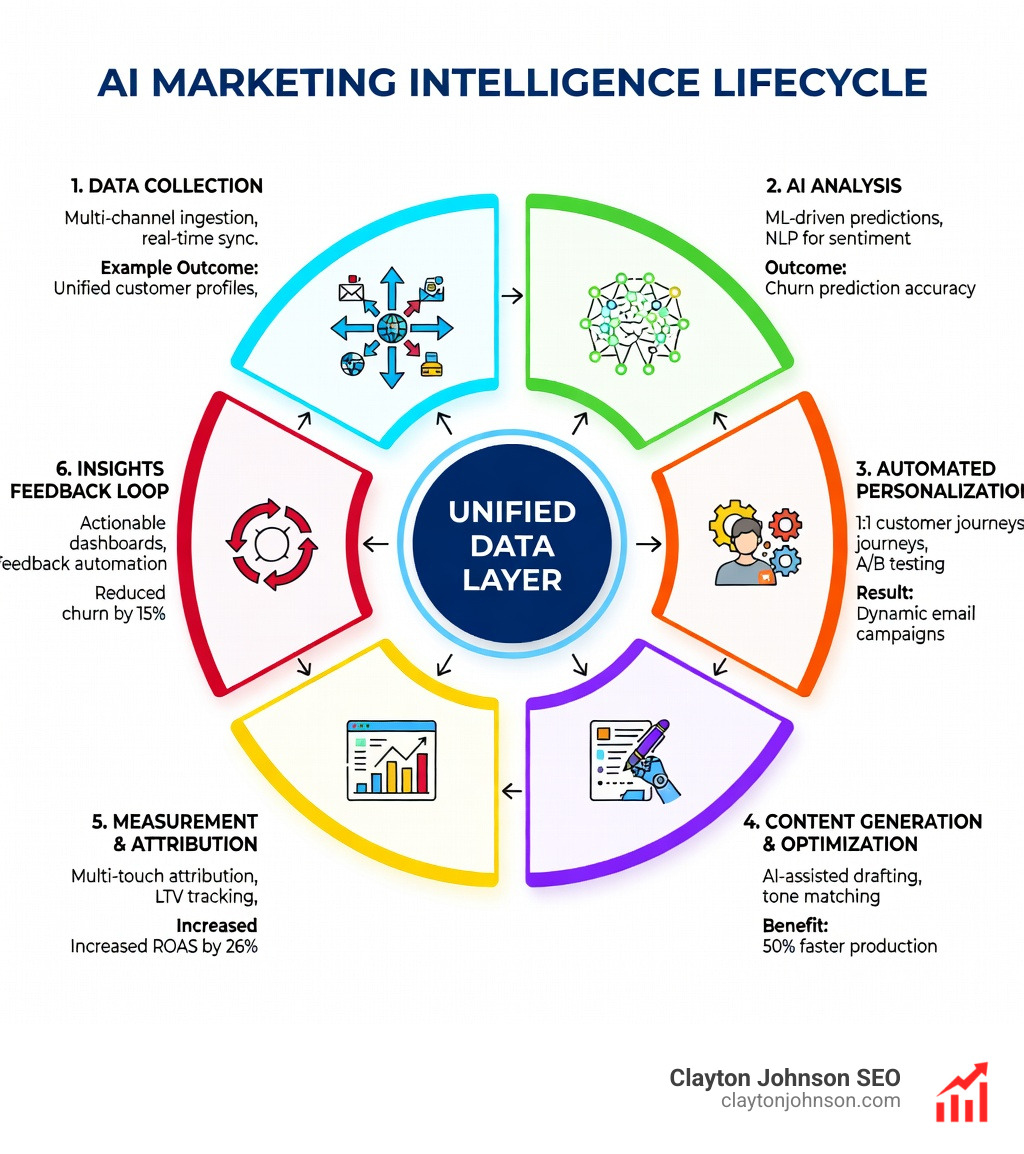
Common AI marketing intelligence platform vocab:
Defining the AI Marketing Intelligence Platform
At its core, an AI marketing intelligence platform is the “brain” of a modern marketing department. Unlike traditional tools that simply record what happened in the past, these platforms use machine learning to tell us what is likely to happen next. They move beyond simple data storage into the realm of “agentic” action—where software doesn’t just show you a chart; it executes a task.
These platforms rely on three pillars: predictive analytics (forecasting behavior), generative AI (creating assets), and automation (executing workflows). By combining these, we can finally move away from “batch and blast” marketing toward a scientific approach to growth.
How AI Marketing Intelligence Platforms Differ from Traditional Analytics
Traditional analytics are reactive. You check your dashboard on Monday to see how many people clicked a link on Friday. It’s like driving a car while only looking in the rearview mirror. You might see the pothole you just hit, but you can’t avoid the one coming up.
An AI marketing intelligence platform is proactive. It identifies patterns in real-time, allowing us to pivot before a campaign fails. Traditional tools often leave data in silos—your email stats don’t talk to your paid search data, which doesn’t talk to your CRM. AI intelligence platforms unify these identities into a single profile. This allows for more info about analytics data to be processed as a cohesive story rather than a series of disconnected chapters.
Core Capabilities of an AI Marketing Intelligence Platform
To be considered a true intelligence platform, the system must possess several core capabilities:
- Machine Learning: The ability to improve its own performance as it processes more data.
- Sentiment Analysis: Understanding the “vibe” of customer feedback or social mentions to gauge brand health.
- Competitor Intelligence: Automatically tracking rival spend, keyword movements, and market share.
- Pattern Recognition: Identifying “hidden” segments of customers who are about to churn or are ready for a high-value upsell.
Core Features of AI Marketing Intelligence Platforms
The leading platforms in this space—such as Emarsys, Jasper, and Funnel—each tackle a different piece of the growth puzzle. However, they all share a commitment to omnichannel personalization and unified data.
A top-tier AI marketing intelligence platform typically features:
- Omnichannel Personalization: Ensuring the message a customer sees on Instagram matches the email in their inbox and the landing page they visit.
- Extensive Data Connectors: The ability to pull in data from hundreds of sources (Google Ads, Facebook, Shopify, etc.) without manual effort.
- Agentic Workflows: AI “agents” that can perform specialized tasks like writing product descriptions or adjusting ad bids.
- Unified Customer Profiles: A single, 360-degree view of every individual who interacts with your brand.
Content Orchestration and Agentic Workflows in an AI Marketing Intelligence Platform
Content is the fuel for growth, but scaling it manually is impossible. Platforms like Jasper have evolved from simple “copywriting assistants” into full execution platforms. They use “Content Pipelines” to automate the entire lifecycle of an asset—from the initial data connection to the final distribution.
By using multimodal knowledge—the ability to understand text, video, audio, and images—these platforms ensure that every piece of content stays on-brand. They use a “Brand Voice” guardrail so the AI doesn’t sound like a robot; it sounds like your best marketing manager. This leads to automated SEO where the system can optimize 60% of SEO tasks or generate thousands of product descriptions in a single day.
Data Integration and Measurement
The biggest headache for any marketing leader is “messy data.” Platforms like Funnel solve this through “Zero ETL” (Extract, Transform, Load) integration. This means you don’t need a team of engineers to connect your data sources.
With over 600 connectors and 500,000 active data sources, these platforms provide “Data Clarity.” You can use conversational “Data Chat” to ask questions like, “Why did our ROAS drop in Minneapolis last week?” and get an instant, annotated answer. This eliminates the need for endless spreadsheets and allows for real-time ROAS optimization.
Driving Measurable Outcomes through Intelligent Automation
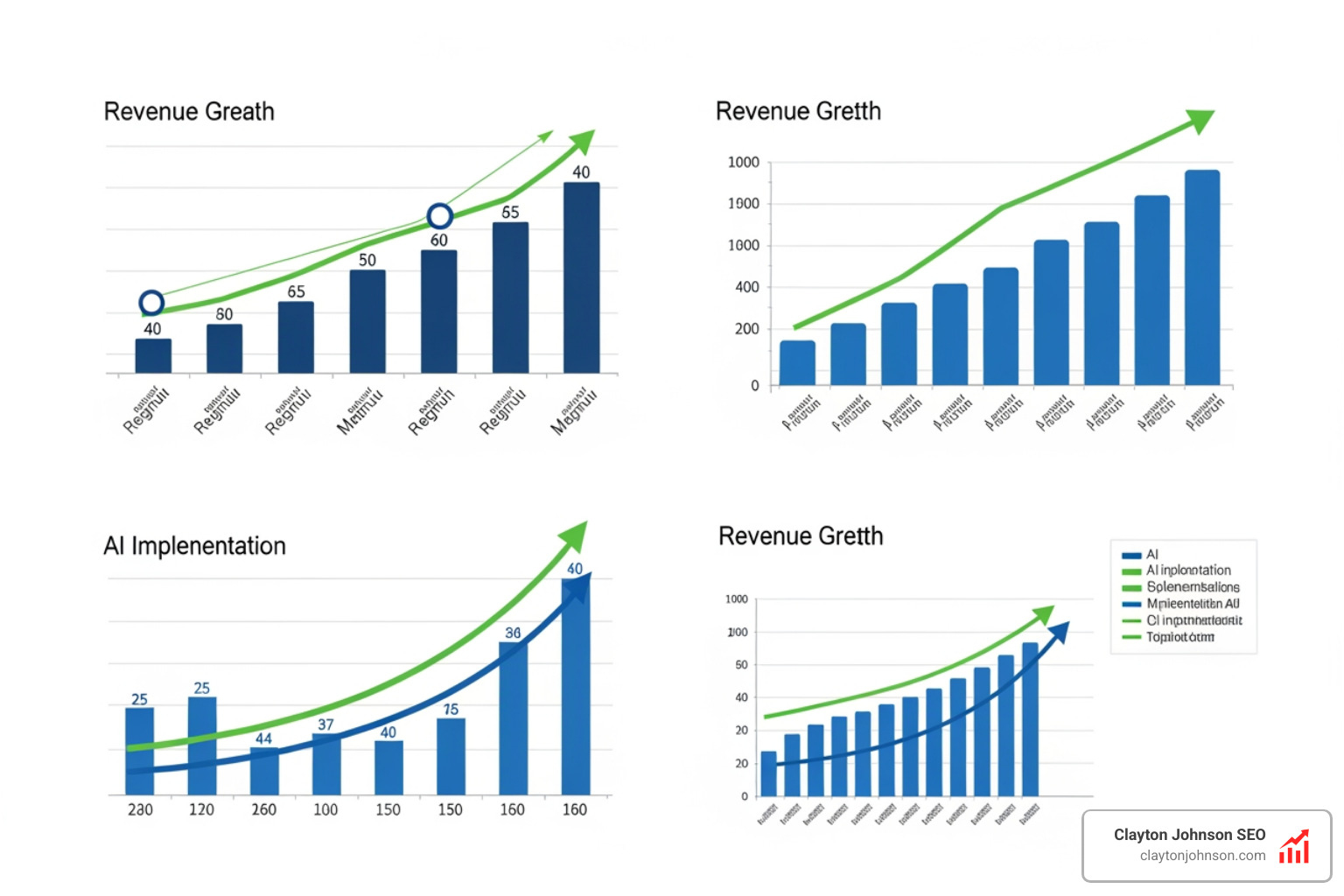
The shift to an AI marketing intelligence platform isn’t just about “cool tech”—it’s about the bottom line. When you move from manual guesswork to intelligent automation, the efficiency gains are staggering.
- Revenue Growth: By using AI-driven product recommendations, brands have seen email revenue jump by over 100%.
- Operational Efficiency: Teams are saving 100+ hours every month by automating reporting and content creation.
- Personalization at Scale: Instead of segments of thousands, we can now target segments of one, leading to a significant uplift in average order value.
Omnichannel Engagement and Customer Segmentation
One of the most powerful uses of AI is predictive segmentation. Instead of just looking at who bought something, the AI looks at who is likely to buy or who is showing signs of churn. This allows for lifecycle optimization—sending a “win-back” offer exactly when a customer starts to drift away.
Platforms like Emarsys enable real-time web personalization. If a user in Minnesota is browsing winter gear, the site adapts instantly to show the most relevant products based on their specific behavior and local context. This “moment-aware” marketing is what separates the winners from the laggards in modern commerce.
Scaling Content and SEO Performance
In SEO, volume and quality used to be at odds. You could have one or the other, but rarely both. AI content creation tools have changed that equation. We are seeing companies automate 60% of their SEO processes while actually improving their rankings.
For example, a large enterprise might save 10,000+ hours annually on localized marketing content. This isn’t just about spinning text; it’s about using advanced search intelligence to understand what “Answer Engines” are looking for and delivering high-quality, structured data that ranks.
Security, Compliance, and the Future of AI Search
As we lean more heavily on AI, data security and ethical usage become paramount. Leading platforms ensure they are GDPR and SOC 2 compliant, meaning they don’t train their models on your proprietary customer data. This “Trust Foundation” is critical for enterprise-grade security.
We are also seeing a shift in the search landscape. It’s no longer just about Google; it’s about AEO (Answer Engine Optimization) and GEO (Generative Experience Optimization).
Navigating the Shift to Answer Engine Optimization
The way people find information is changing. With the rise of AI Overviews and platforms like ChatGPT or Perplexity, brands need to track their “LLM visibility.” Are these AI models mentioning your brand? Is the sentiment positive?
Advanced SEO intelligence tools now allow us to track brand mentions and citations within these generative search results. This ensures your business remains visible even when a user never clicks through to a traditional website.
Future Trends in Agentic Marketing
The future of the AI marketing intelligence platform is “Agentic.” We are moving toward a world of autonomous agents that don’t just provide insights but actually “do” the marketing.
- Real-Time Signal Processing: Imagine your platform detecting a social media trend or a sudden weather shift and automatically launching a contextual ad campaign before the trend fades.
- Answer-Driven Marketing: Strategic collaborations between AI giants (like Zeta and OpenAI) are creating systems where a CMO can ask a complex question and the system executes the solution instantly.
Frequently Asked Questions about AI Marketing Intelligence
What are the key features to look for in an AI marketing intelligence platform?
You should look for unified data integration, predictive analytics, generative AI capabilities that respect your brand voice, and a strong security/compliance framework. The platform must be able to act on data, not just report it.
How do these platforms ensure data privacy and compliance?
Top-tier platforms use “LLM-optimized architecture” that prevents your data from being used to train public models. They adhere to global standards like GDPR, CCPA, and SOC 2 to ensure your customer information remains private and secure.
Can small businesses benefit from enterprise AI marketing tools?
Absolutely. Many of these tools offer scalable pricing or “freemium” versions. Small teams can see the biggest relative gains because AI acts as a “force multiplier,” allowing a single marketer to do the work of an entire department.
The era of fragmented, “gut-feel” marketing is over.
To compete today, businesses need a structured growth architecture. At Clayton Johnson SEO, we focus on building these systems through Demandflow.ai.
Our thesis is simple: Clarity → Structure → Leverage → Compounding Growth.