Why AI Marketing for Wellness Centers Is Changing How the Industry Grows
AI marketing for wellness centers companies is the use of artificial intelligence tools — like automated scheduling, personalized campaigns, AI chatbots, and predictive analytics — to attract more clients, reduce churn, and grow revenue without adding staff.
Here is a quick breakdown of what it covers:
| AI Marketing Area | What It Does for Wellness Centers |
|---|---|
| Automated scheduling | Fills bookings 24/7, reduces no-shows |
| Personalized campaigns | Tailors offers based on member behavior |
| AI chatbots | Converts leads around the clock |
| Predictive analytics | Flags at-risk members before they cancel |
| Sentiment analysis | Improves services using real client feedback |
The wellness industry is growing fast. The global digital wellness sector is valued at nearly $13 billion and is projected to reach over $45 billion over time. But growth alone does not guarantee success. Most wellness businesses still lose roughly half their members within six months. Classes run half-empty. Leads go cold because follow-up is too slow. Seasonal dips hit revenue hard.
Traditional marketing was not built to handle all of this at once. AI was.
The promise of AI marketing is not just efficiency — it is intelligence. The ability to detect when a member is about to quit, send the right message at the right moment, fill an empty yoga class on a Tuesday, or answer a new client’s question at midnight without a single staff member involved.
I’m Clayton Johnson, an SEO strategist and AI marketing innovator with nearly two decades of experience helping businesses grow through data-driven systems — including applying ai marketing for wellness centers companies to drive measurable client acquisition and retention results. In the sections below, I’ll walk you through exactly how to put these tools to work in your wellness business.
Solving Growth Challenges with ai marketing for wellness centers companies
Running a wellness center is a balancing act. You are trying to provide a high-touch, “zen” experience while simultaneously battling high member churn—where up to 50% of members cancel within their first six months—and inconsistent class attendance. We have seen boutique studios struggle with half-empty rooms despite having a healthy paper roster. This is where ai marketing for wellness centers companies steps in to turn “potential” revenue into actual bank deposits.
One of the most immediate wins is smart scheduling. Statistics show that 70% of consumers prefer to book online, but standard booking widgets are often passive. AI-powered scheduling interfaces are dynamic; they learn your business rhythms, predict gaps in your calendar, and automatically prompt clients to fill those spots. This isn’t just about convenience; it’s about revenue per hour. Businesses using these smart tools have seen booking rates hit 86%.

Furthermore, AI is the ultimate weapon against the “no-show.” By using predictive algorithms to send perfectly timed reminders via SMS or email, wellness centers can reduce missed appointments by 25% or more. For those running specialized clinics, these systems ensure that high-value equipment and staff time are never wasted. If you want to dive deeper into how this applies to clinical settings, check out our more info about AI for medical practices.
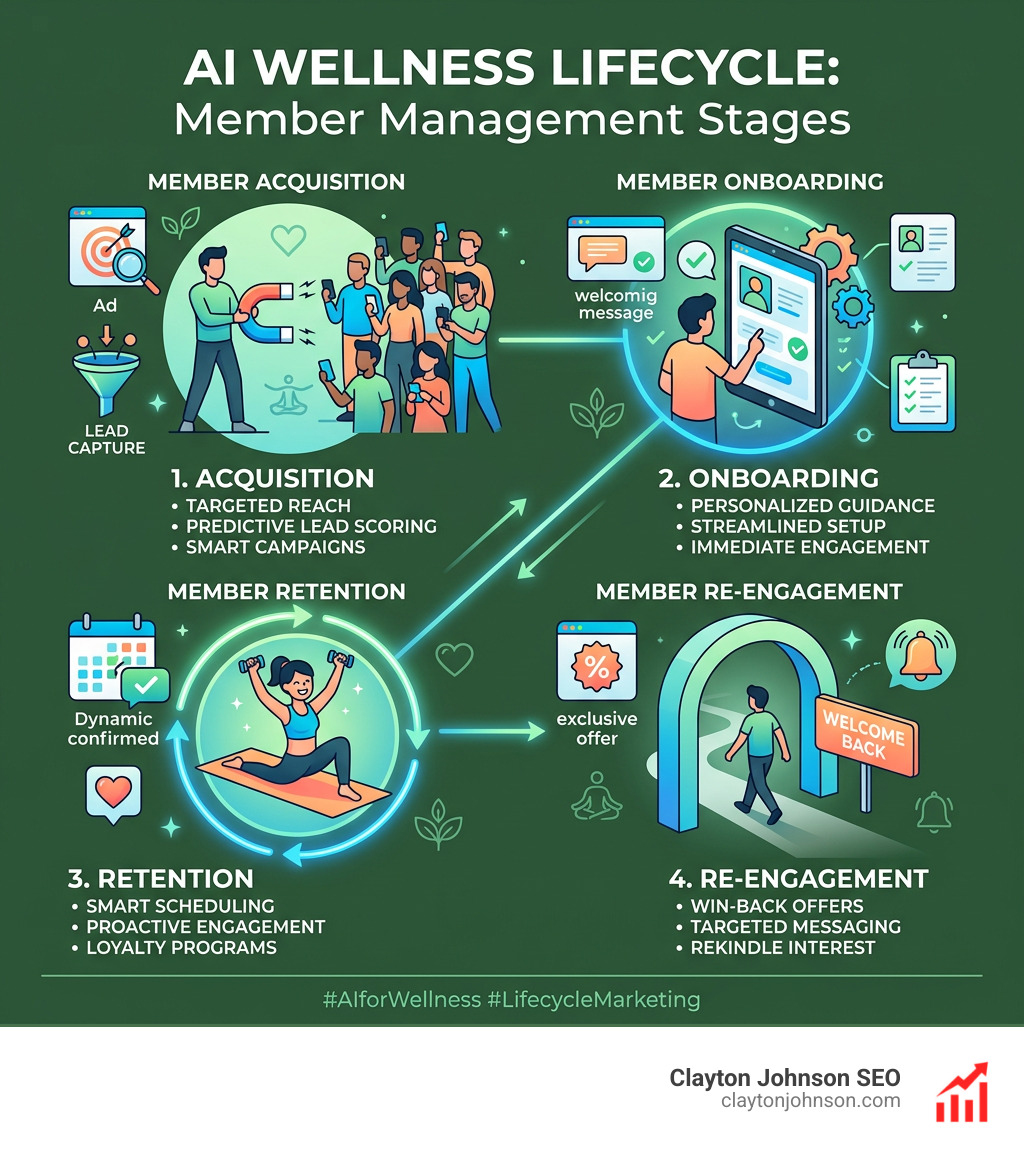
Beyond the daily calendar, AI stabilizes revenue by smoothing out seasonal fluctuations. Instead of panicking during a slow month, AI growth systems analyze historical data to launch “at-risk” interventions. If the system notices a member who usually attends three times a week hasn’t scanned in for ten days, it can automatically trigger a “We miss you” offer or a personalized workout recommendation to bring them back before they decide to cancel. This proactive approach is a core part of our more info about AI growth systems.
Hyper-Personalization and ai marketing for wellness centers companies
Consumers don’t just appreciate personalization—they demand it. Research from McKinsey & Company shows that 71% of consumers expect personalized interactions, and 76% get frustrated when they don’t get them. For a wellness center, this means moving past “Dear [First Name]” emails and into real behavioral targeting.
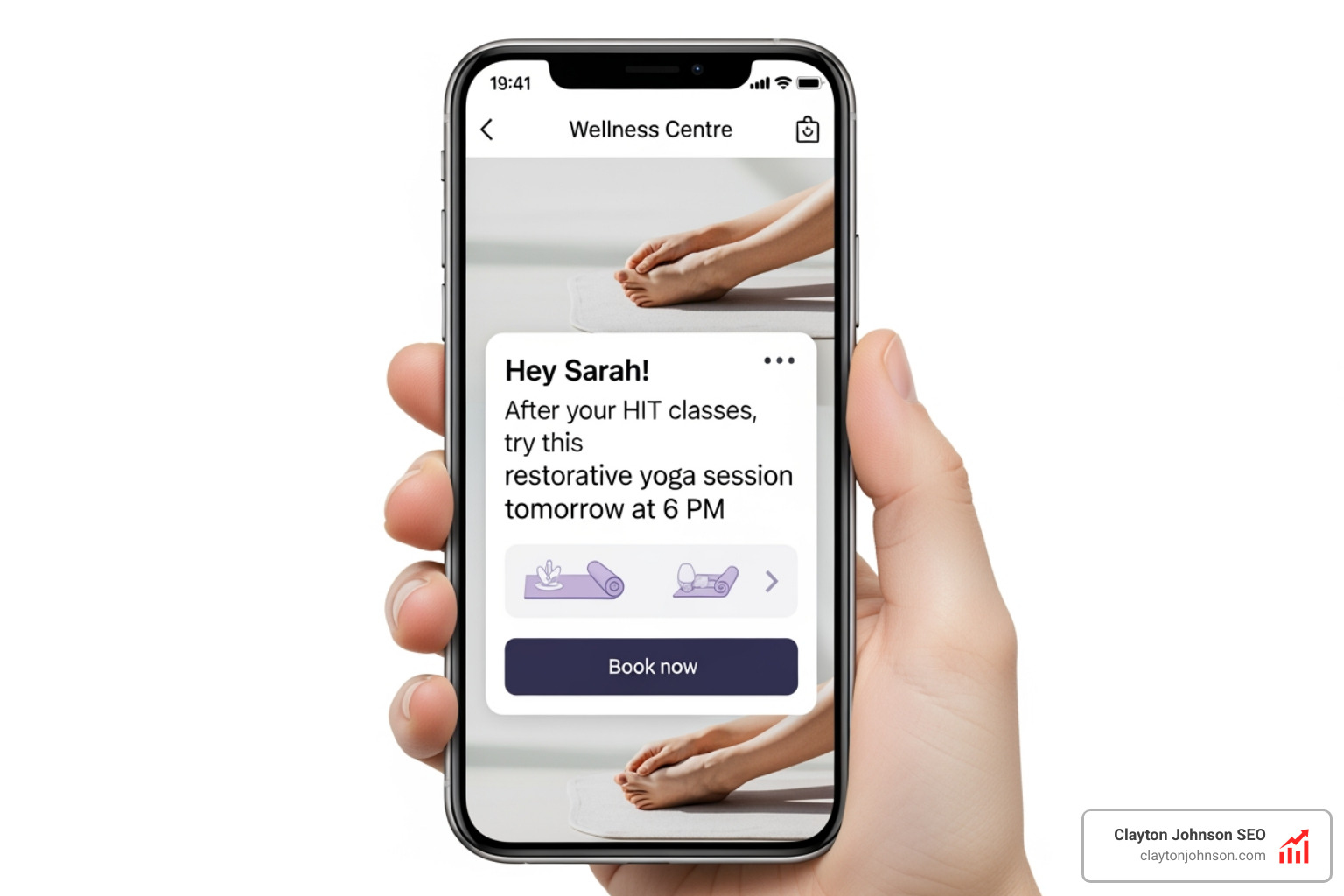
Imagine an AI system that looks at a member’s past yoga attendance and suggests a specific restorative session because they’ve been attending high-intensity HIIT classes all week. Or consider a med-spa using AI skin analysis tools, like those from Perfect Corp, which can identify 14 different skin concerns in just seven seconds. This data doesn’t just sit there; it fuels ai marketing for wellness centers companies by generating tailored product recommendations and treatment plans that feel like they were written by a personal concierge.
This level of detail requires a strong digital foundation. To ensure your personalized content actually reaches your audience, you need to align it with a more info about AI SEO strategy. By understanding search intent, we can help you create content that answers the specific questions your clients are asking.
AI also enables predictive pricing and milestone celebrations. The system can automatically reward a member on their 100th class or offer a special “anniversary” discount on a service they haven’t tried yet. By leveraging more info about AI tools, wellness brands can create a “sticky” ecosystem where members feel seen, heard, and valued.
Automating the Member Lifecycle with ai marketing for wellness centers companies
The journey from a “curious website visitor” to a “loyal platinum member” is full of leaks. Leads ghost, trial members forget to show up for their second class, and staff often lack the time to follow up manually. AI chatbots and virtual assistants solve this by providing 24/7 engagement.

These aren’t the clunky bots of the past. Modern AI sales agents can handle 69% of customer inquiries, from explaining the benefits of infrared saunas to qualifying leads based on their health goals. For alternative medicine clinics—where treatments like ketamine therapy or regenerative medicine might require extra education—AI advocates can triple appointment bookings by bridging the knowledge gap instantly. This is a prime example of ai marketing software that actually sells.
Once a lead is captured, the AI manages the entire trial-to-member conversion process. It automates onboarding sequences, sends “speed-to-lead” voice calls (contacting leads 98% faster than humans), and ensures no one falls through the cracks. This “Agentic AI” approach acts as a proactive co-pilot for your business, constantly monitoring for profit opportunities. You can find more info about AI marketing intelligence to see how these systems provide prescriptive insights that go far beyond simple automation.
Essential AI Tools for Spas, Gyms, and Clinics
To implement ai marketing for wellness centers companies effectively, you need the right stack. While there are many general tools out there, the wellness industry has specific needs regarding HIPAA compliance and service-based booking.
- Marketing Titan: Excellent for automated member journeys and retention campaigns.
- Podium: Their AI Patient Coordinator is a game-changer for clinics, handling 24/7 scheduling and lead nurturing.
- Perfect Corp: The gold standard for AI skin and hair analysis, perfect for high-end spas and med-clinics.
- Boulevard: A specialized management platform that uses AI to optimize the “revenue per hour” for salons and spas.
- HealthVerse: A HIPAA-compliant platform designed specifically for behavioral health and wellness marketing.
- Zenoti & Mindbody: Industry giants that are rapidly integrating AI for predictive analytics and smart marketing.
- Aleen Inc: A rising star in smart wellness analytics, focusing on personalized health coaching at scale.
- Wellness Advocate: Specializes in AI sales agents for small clinics, often achieving 370% ROI through lead qualification.
As you build your stack, technology is only as good as the person wielding it. Keeping up with more info about digital marketing AI and developing more info about AI skills for marketers will be essential for your team’s long-term success.
Implementing a Scalable AI Strategy for Long-Term Growth
Transitioning to an AI-driven model doesn’t happen overnight. We recommend a phased approach to ensure your team isn’t overwhelmed and your ROI is clear from day one.
- Pilot Phase: Start with one high-impact area, such as automated lead follow-up or AI-powered scheduling. Monitor the “speed to lead” and the reduction in no-shows.
- Integration Phase: Connect your AI tools to your existing CRM or EHR. Ensure all systems are talking to each other to create a single source of truth for member data.
- Optimization Phase: Use the data gathered to refine your campaigns. This is where predictive analytics come in—identifying which classes are likely to underperform and automatically launching promotions to fill them.
Throughout this process, data security is paramount. In the wellness space, HIPAA compliance isn’t optional. When we help clients with how to win at implementing AI marketing systems, we prioritize secure platforms and encrypted communication protocols.
Looking toward the future, we expect to see even deeper integrations with wearable technology. Imagine your wellness center’s AI analyzing a member’s sleep data from their Oura ring and automatically suggesting a yoga nidra class to help them recover. This isn’t science fiction—it’s the logical next step for ai marketing for wellness centers companies.
Overcoming Adoption Barriers and Maximizing ROI
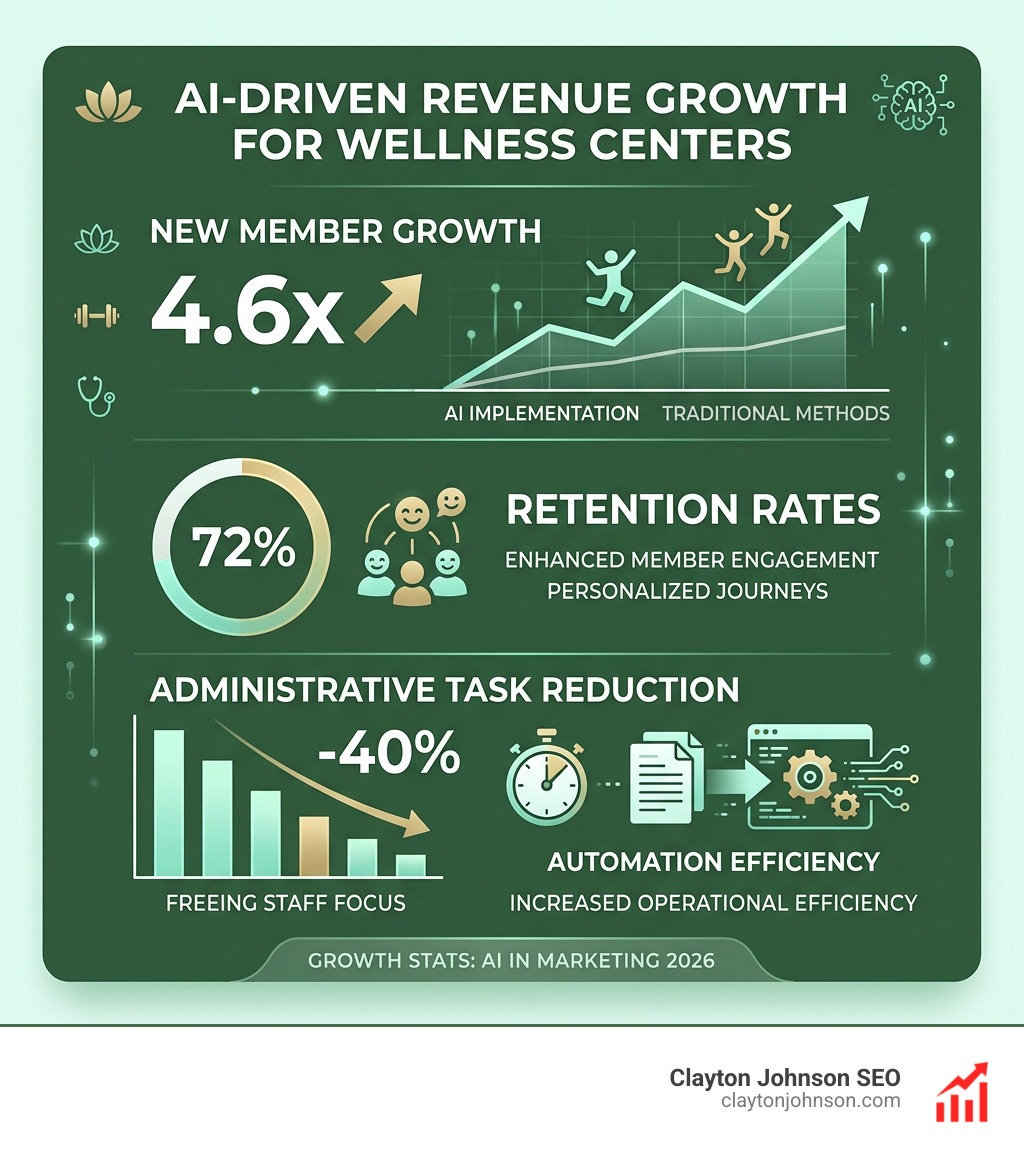
The biggest fear we hear from wellness owners is: “Will AI replace the human touch?” The answer is a resounding no. In fact, AI enhances the human element. By reducing administrative tasks by up to 40%, your staff is freed from spreadsheets and phone tag, allowing them to focus on what they do best—providing exceptional care and connection.
Another concern is cost. However, when you look at the stats—4.6x new member growth and 72% retention rates—the ROI becomes undeniable. To help you plan your budget, we have compiled more info about wellness coach SEO pricing, which provides a framework for understanding the costs associated with high-level digital growth.
| Workflow Task | Manual Method | AI-Augmented Method |
|---|---|---|
| Lead Follow-up | 2-24 hours (if at all) | < 2 minutes (24/7) |
| Appointment Booking | Phone tag / Manual entry | Instant 24/7 self-service |
| Member Retention | Reactive (wait for cancel) | Proactive (predictive alerts) |
| Content Creation | Hours of writing/designing | Minutes using Gen-AI prompts |
| Sentiment Analysis | Reading reviews manually | Real-time dashboard of trends |
To maximize your results, maintain transparency with your clients. Let them know how AI is being used to improve their experience—whether it’s through more accurate skin analysis or more convenient booking. When clients see that technology is making their wellness journey smoother and more personalized, they don’t just accept it—they embrace it.
At Clayton Johnson SEO, we don’t just chase the latest AI tactics. We build durable systems that operationalize these technologies into a coherent growth engine. If you’re ready to turn your wellness center into a high-performance, AI-powered sanctuary, let’s start building your system today.