Choose the Right AI Programming App for Faster, Smarter Builds
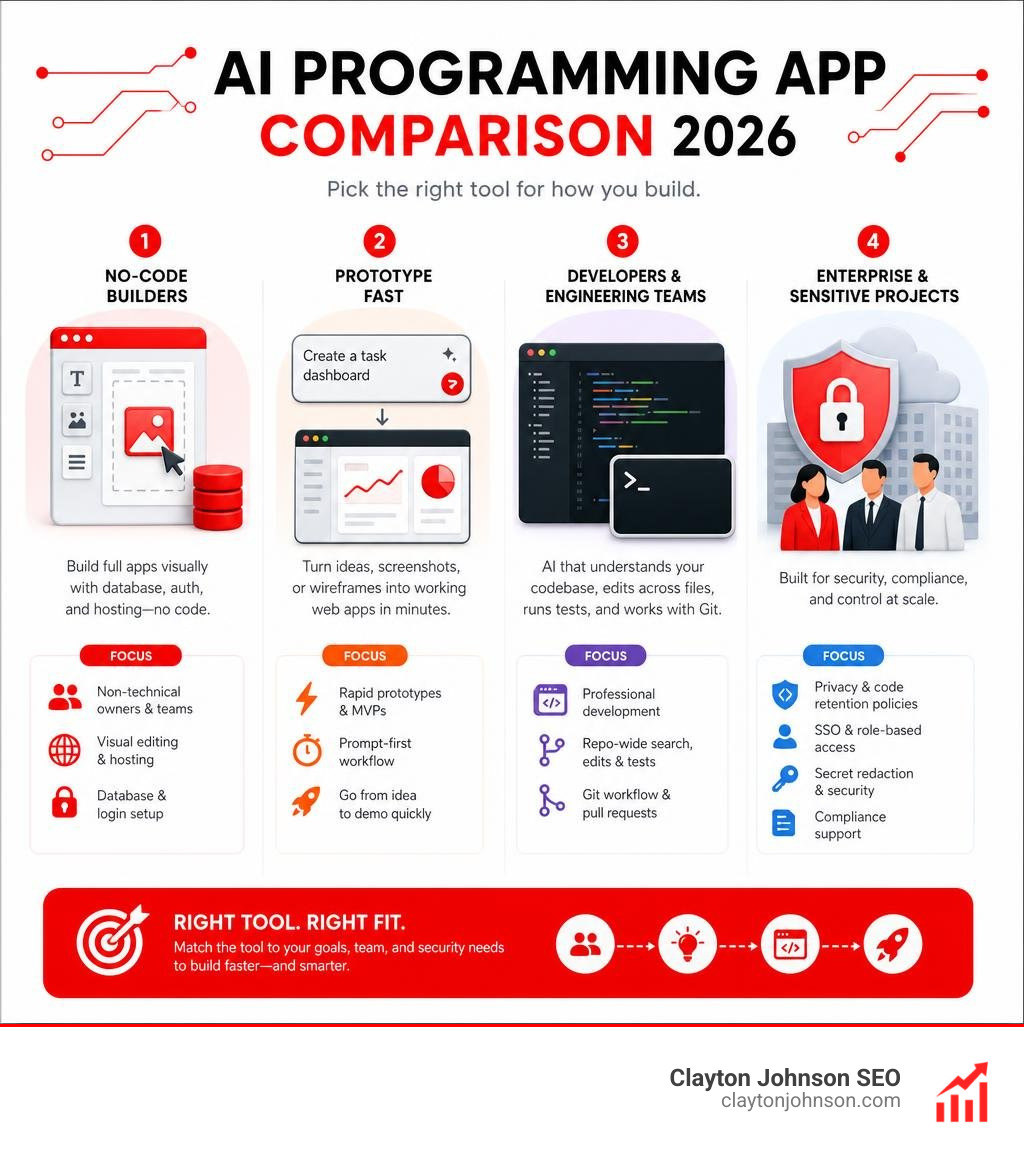
The best AI programming app depends on what you need to build:
- Non-technical owners and teams: Choose a browser-based app builder with visual editing, built-in hosting, and database or login setup.
- Rapid prototypes: Choose a prompt-first tool that can turn an idea, screenshot, or wireframe into a working web app quickly.
- Professional development and long-term maintenance: Choose an AI-powered IDE or terminal agent that can search a full repository, edit multiple files, run tests, and work with Git.
- Enterprise or sensitive projects: Prioritize privacy controls, code-retention policies, SSO, role-based access, secret redaction, and compliance support.
AI coding has moved well beyond autocomplete. The strongest tools can now plan tasks, trace dependencies across files, use the terminal, generate pull requests, and help teams work through much larger projects. That does not make software development automatic, but it can remove a great deal of repetitive work.
For a small business, the practical win is simple: you can validate an internal tool, customer portal, dashboard, or new product idea faster – while still keeping people responsible for decisions, security, testing, and customer needs.
I’m Clayton Johnson, an SEO strategist and technical systems builder with more than a decade of experience connecting emerging technology, analytics, automation, and business growth. I evaluate each AI programming app through the lens that matters to owners: whether it helps create useful, maintainable software without adding avoidable complexity.
Terms related to ai programming app:
How Modern AI Coding Tools Transform Software Development
The software development ecosystem in 2026 has experienced a fundamental shift. We have advanced far beyond simple inline suggestions that predict the next three words of a loop. Today’s modern platforms operate as full-scale agentic systems capable of orchestrating complex, multi-file software engineering tasks across entire repositories.
Instead of writing repetitive boilerplate, engineering teams now utilize dynamic multi-model routing. This allows an assistant to tap into specialized foundation models depending on whether a task requires rapid frontend styling, nuanced system architecture, or deep database query optimization.

When evaluating The Complete Guide to Compare Best AI Coding Tools, the standout breakthrough is deep context synthesis. Modern systems do not just examine the file you have open; they build semantic knowledge graphs of your full workspace. By understanding cross-file imports, configuration files, environment variables, and active terminal outputs, these tools execute structural refactors that previously required days of manual dependency tracing.
Key Evaluation Criteria for Choosing an AI Programming App
Finding the right platform for your tech stack requires looking past surface-level marketing claims. As detailed in our AI Coding Software Guide 2026, teams should evaluate tools across four core technical pillars:
- Repository Mapping and Context Depth: Raw context window sizes (even those reaching 1 million tokens) mean very little without semantic dependency analysis. The best tools index your entire project structure, tracking how changes in a single data schema propagate across API routes and frontend components.
- Execution and Environment Control: Leading assistants feature full terminal execution and automated test runners. They can execute build commands, catch runtime errors, and iterate on fixes autonomously.
- Model Agnosticism and Protocol Support: High-leverage environments avoid vendor lock-in by supporting dynamic model switching across OpenAI, Anthropic, Google, and open-source models, while leveraging standard protocols like the Model Context Protocol (MCP) to access external documentation, issue trackers, and databases.
- Enterprise Governance and Security: Air-tight security demands Zero Data Retention (ZDR) guarantees, SOC 2 Type II certifications, automated secret redaction, and intellectual property indemnification.
Autonomous Agents vs Inline Pair Programmers
Understanding the functional difference between inline assistants and autonomous agents prevents workflow bottlenecks. Traditional assistants act like real-time pair programmers, suggesting code completions as you type. This is ideal for syntax recall and local function generation.
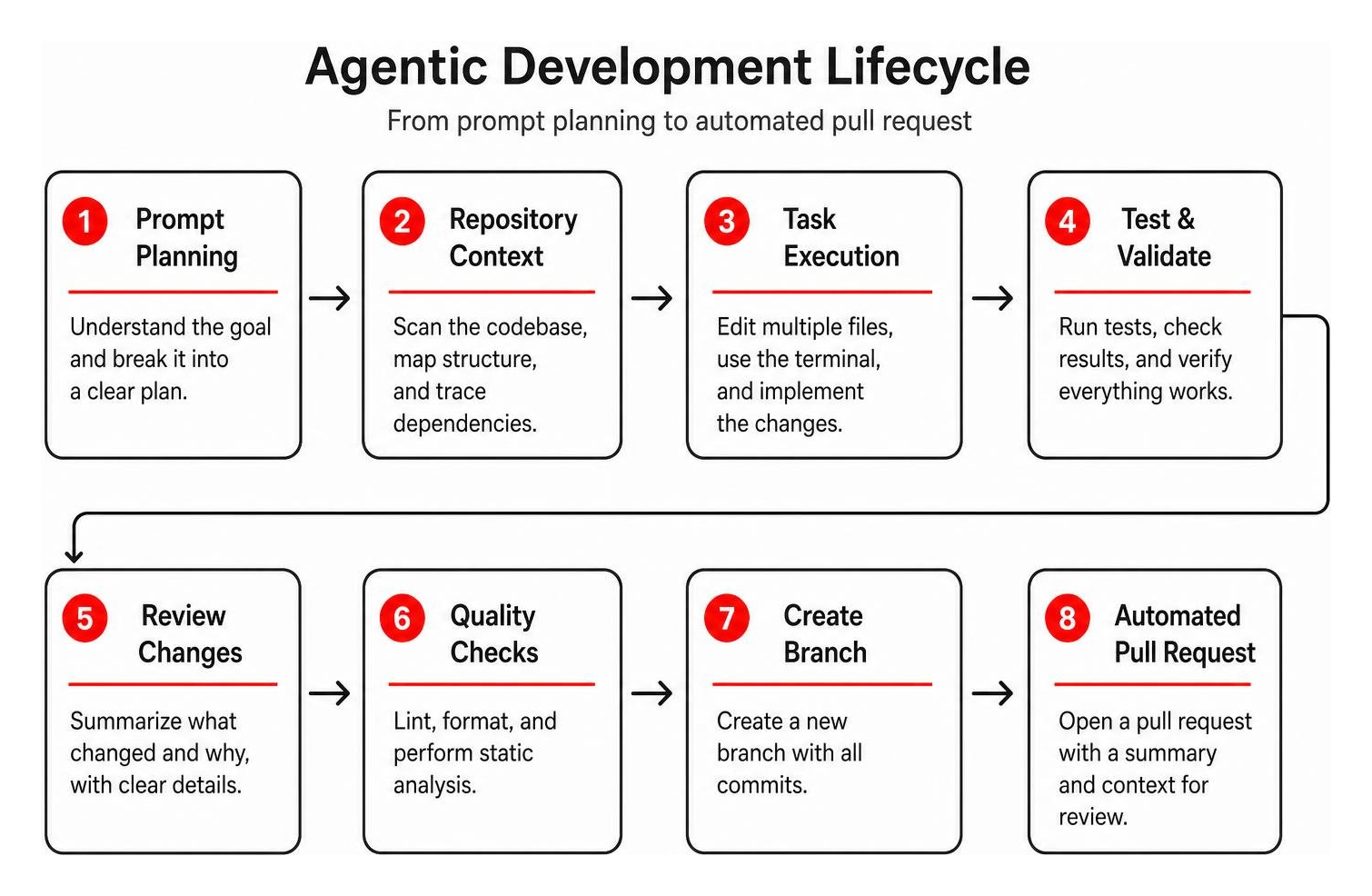
In contrast, autonomous agents act as task-driven collaborators. When given an objective, such as “implement OAuth2 login and connect user profiles to our database,” an agent analyzes the architecture, generates a transparent execution plan, edits dozens of files across frontend and backend boundaries, runs local migration scripts, and generates a clean pull request.
As we explored when reviewing how AI Code Assistants Your New Pair Programmer Doesnt Need Coffee Breaks, autonomous agents do not eliminate the need for software engineers. Instead, they shift the engineer’s primary responsibility from manual syntax typing to architectural direction, system validation, and code review.
Top AI Programming App Contenders for 2026
The market features exceptional tools tailored to distinct engineering environments and technical skill levels. Here is how the top platforms compare across model support, pricing, and context limits:
| Platform | Best For | Model Support | Starting Pricing | Context / Memory Architecture |
|---|---|---|---|---|
| Cursor | Agentic multi-file development & fast refactoring | Multi-model (Claude, GPT, custom models) | Free tier; Pro from $16/mo | Whole-repo vector indexing & parallel cloud agents |
| Claude Code | Terminal-first monorepo navigation & deep reasoning | Anthropic foundation models | Included in Claude Pro ($17/mo) | Up to 1M token context window & CLAUDE.md persistence |
| Warp Code | Terminal-integrated workflows & multi-repo indexing | Multi-model dynamic routing | Free tier; Team plans available | MCP integrations, secret redaction, & full OS terminal |
| Firebase Studio | Browser-based multimodal prototyping | Google Gemini ecosystem | Free tier with cloud billing | Nix-based virtual machines & Figma-to-code pipelines |
| Verdent AI | Autonomous full-stack end-to-end builds | Behavioral SEAlign models | Subscription & BYOK tiers | Asynchronous multi-agent planning & auto-testing |
Cursor: Best for Agentic Multi-File Development
AI Coding Agent for Building Ambitious Software | Cursor has established itself as an industry leader for professional engineering teams. Trusted by over half of the Fortune 500 and deployed across enterprise organizations—including NVIDIA, where 40,000 engineers use it daily—Cursor transforms the standard IDE into an agentic command center.
Cursor operates as a specialized fork of VS Code, meaning developers retain their existing extensions, keybindings, and themes. Its core strength lies in parallel cloud agents and multi-file code editing. Instead of modifying single functions in isolation, Cursor analyzes how a change impacts downstream imports and tests. For teams looking for The Best AI for Coding and Debugging, its Cmd+K inline editing and real-time codebase chat make tracking complex bugs straightforward.
Claude Code: Best for Large Codebases and Terminal Workflows
Claude Code by Anthropic | AI Coding Agent, Terminal, IDE brings agentic software engineering directly into the command line. Designed specifically for deep reasoning across massive repositories, Claude Code leverages a context window of up to 1 million tokens to understand entire monorepos without requiring manual file tagging.
Operating directly within the CLI, Claude Code can onboard developers to unfamiliar codebases in seconds by analyzing package dependencies and architecture maps. By reading persistent project memory via CLAUDE.md files, it retains team conventions and test procedures across sessions. Developers seeking a dedicated Claude AI Programming Assistant can orchestrate dynamic subagent workflows, allowing background tasks to research dependencies, write code, run builds, and format pull requests without manual intervention.
Warp Code: Best for Terminal Execution and Multi-Repo Management
Warp Code: AI-Powered Code Editor for Agents | Warp bridges the gap between terminal execution and code editing. Trusted by over 800,000 developers, Warp integrates an AI coding environment directly into a modern GPU-accelerated terminal interface.
Warp Code excels in multi-repository management and complex operations. If an engineering update requires coordinating schema updates in a backend API repository alongside client updates in a frontend repository, Warp indexes both simultaneously. It also features built-in secret redaction via customizable regex filters, ensuring sensitive credentials and API tokens are stripped before prompts reach external LLMs. Through Model Context Protocol (MCP) integrations, it connects runtime debugging directly to platforms like Sentry, Figma, and Linear.
Firebase Studio: Best for Multimodal Cloud Prototyping
Firebase Studio is Google’s browser-based development workspace that unifies rapid prototyping with professional cloud infrastructure. Built on Project IDX and powered by Gemini models, Firebase Studio allows developers and product teams to prototype full-stack applications directly in the cloud.
The platform provides a dual-mode workflow. Creators can use natural language prompts, sketches, or direct Figma imports to generate functional UI components and full-stack architectures. Once initial scaffolding is complete, developers can switch to a full Code OSS environment powered by customizable Nix virtual machines. Firebase Studio automatically provisions backend services, including Cloud Firestore and authentication, significantly reducing initial infrastructure configuration time.
Verdent AI: Best for Autonomous Full-Stack Software Building
Verdent AI|Agentic Coding with Multiple Parallel Agents approaches software development through autonomous multi-agent orchestration. Recognizing that standard coding models often struggle with complex engineering tasks due to behavioral misalignment, Verdent utilizes specialized SEAlign training to guide AI agents through complex decision points.
Instead of requiring continuous prompt management, Verdent breaks high-level product prompts into modular engineering plans. Autonomous agents work in parallel to scaffold databases, implement business logic, run continuous integration tests, and resolve build errors. Users can monitor progress asynchronously through notifications in Slack or Telegram, reviewing code diffs only when high-level architectural approvals are needed.
Implementing an AI Programming App in Enterprise and Data Science Teams
Deploying AI coding assistants across specialized enterprise environments and data science pipelines requires careful architectural planning. In multi-service ecosystems, basic autocomplete tools frequently generate broken code because they cannot trace how changes in a data ingestion service impact downstream feature transformations.

As highlighted in The Ultimate Guide to Generative AI Coding Tools, enterprise data science workflows require assistants that maintain persistent context across Jupyter notebook cells, SQL query scripts, and production microservice containers. When selecting an enterprise tool, verify that the assistant can parse complex distributed queries (such as Spark SQL and Pandas pipelines) without treating each cell as an isolated sandbox.
Maximizing Developer Output with an AI Programming App
Rigorous field research, including studies conducted by MIT CSAIL, demonstrates that deploying AI pair programming assistants to enterprise engineering teams increases completed tasks by roughly 25% on average. Documented gains across corporate settings consistently range from 7% to 22%, with less-experienced developers experiencing the largest productivity lift.
To maximize these gains, teams must adopt systematic prompt and workflow practices. For detailed guidance on building technical mastery, review How to Enhance Your Coding Skills in the Age of AI. Key strategies include:
- Deconstruct Complex Features: Avoid asking tools to build entire enterprise systems in a single prompt. Break features into architectural contracts, database schemas, API routes, and frontend views.
- Feed Compiler Logs into the Context: When an agent encounters a build error, pipe the terminal stack trace directly into the assistant so it can self-diagnose and correct the failure.
- Maintain Clear Style Guidelines: Store design system tokens, linting configurations, and testing commands in root configuration files (like
CLAUDE.mdor.cursorrules) to ensure generated code matches your codebase standards.
Enterprise Security, Data Privacy, and IP Indemnification
Security and intellectual property integrity remain paramount when integrating AI coding assistants into proprietary codebases. Leading platforms provide robust enterprise governance frameworks designed to protect proprietary intellectual property:
- Zero Data Retention (ZDR): Confirms that source code and prompt payloads are never stored on external servers or used to train third-party foundation models.
- Automated Secret Redaction: Client-side regex engines that automatically scan and mask database passwords, private encryption keys, and environment variables before network transmission.
- SOC 2 Type II and ISO Compliance: Verifiable independent audits demonstrating strict controls around data encryption in transit and at rest.
- Bring Your Own Key (BYOK) & VPC Isolation: Options to route model traffic through private cloud infrastructure (such as AWS Bedrock or Azure OpenAI) to satisfy strict regulatory compliance mandates.
Teams seeking complete infrastructure isolation can consult our Best Open Source AI Coding Tools Guide to evaluate self-hosted and local model architectures.
Frequently Asked Questions About AI Programming Apps
Can an AI programming app completely replace human software engineers?
No. AI programming applications serve as highly efficient accelerators rather than complete replacements for skilled software engineers. While modern tools excel at syntax generation, boilerplate scaffolding, and automated unit testing, they cannot replace human judgment in system architecture design, complex business logic translation, and security threat modeling.
The software engineering role is evolving toward high-level system orchestration, code review, and architectural validation.
What is the difference between visual vibe coding and agentic IDEs?
Visual “vibe coding” tools, such as the full-stack builder available on coding-app, focus on rapid multimodal creation. They combine natural language prompting with point-and-click visual editing, allowing founders and designers to prototype web apps, configure databases, and export clean code without configuring a local development environment.
Agentic IDEs (like Cursor or Warp Code) are built for professional software developers working inside complex local repositories. They provide granular control over the compiler, terminal commands, Git version control, and multi-service debugging workflows.
Are there viable free AI programming app options available?
Yes. Many top platforms offer functional free tiers. Cursor and GitHub Copilot provide free usage tiers with monthly completion limits, while Firebase Studio offers no-cost cloud workspace access.
For developers who want entirely free and private workflows, our breakdown of AI Coding Tools Free covers how to pair open-source models using local runtimes like Ollama with open-source extensions like Continue.dev, giving you capable AI code generation without subscription fees.
Conclusion
The emergence of agentic AI coding assistants has fundamentally transformed modern software development. Whether you are a business owner prototyping a custom customer dashboard or an engineering lead managing multi-service enterprise repositories, adopting the right toolchain directly accelerates development cycles and eliminates repetitive boilerplate.
As software creation becomes faster and more accessible, winning in digital markets comes down to strategic execution, discoverability, and product-market fit. At Clayton Johnson, we help forward-thinking companies navigate technical disruption and turn digital systems into organic business growth. To continue refining your development strategy, explore advanced AI coding resources across our comprehensive technical guides.