Core Approaches to Python Code Generation
When you start generating code, you generally choose between three main architectures: string-based templating, programmatic Abstract Syntax Tree (AST) construction, and direct bytecode synthesis. Each operates at a different level of abstraction, balancing human readability against runtime efficiency and structural safety.
String templating creates raw Python source text using placeholders, rendering code as plain strings before parsing or saving it to disk. AST construction builds an object representation of Python’s abstract grammar, allowing programmatically safe manipulations before transforming the tree into source code or bytecode. Direct bytecode manipulation bypasses text parsing and AST representation entirely, generating lower-level virtual machine opcodes for immediate execution.
| Approach | Typical Use Cases | Key Benefits | Primary Risks |
|---|---|---|---|
| String Templating | Scaffolding, file generators, code generation tools, multi-language source output | Easy to write, highly readable, works with human-friendly templates | Syntax errors discovered late, vulnerability to string injection |
| AST Construction | Domain-specific languages, static analysis, refactoring tools, safe metaprogramming | Guarantees syntactically valid code, protects variable scope | Verbose API, requires understanding Python syntax trees |
| CPython Bytecode | Dynamic JIT compilers, inner-loop speed optimizations, framework wrappers | Bypasses parsing overhead, maximum execution speed | Virtual machine version dependency, difficult to debug, stack risk |
Choosing the wrong approach can introduce unnecessary complexity. For instance, generating Python strings to speed up an inner loop often degrades performance because invoking the parser at runtime takes more time than it saves.
Template Engines and String Manipulation
String manipulation remains the most popular entry point for python code generation. Instead of assembling strings using messy manual concatenation, modern engineering relies on structured template engines like Jinja2 or edit-time tools like Cog.
Templating works exceptionally well when generating predictable source files, such as database models, API clients, or Data Transfer Objects (DTOs). By combining declarative schema files with templates, you enforce a single source of truth across your codebase. To explore how developers leverage these workflows, read our detailed breakdown on What Every Developer Should Know About Python Code Makers.
However, string templates carry inherent limitations. They treat Python code as plain text, meaning a template engine cannot detect missing colons, invalid indentation, or variable shadowing until the rendered text is parsed by Python.
Python Source Code vs Direct Bytecode Execution
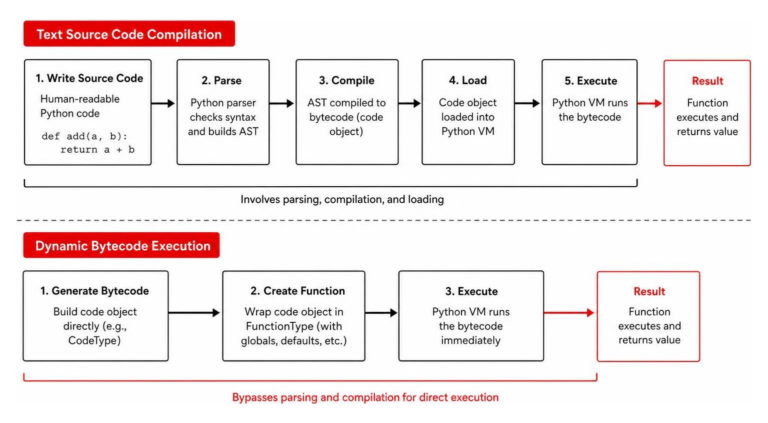
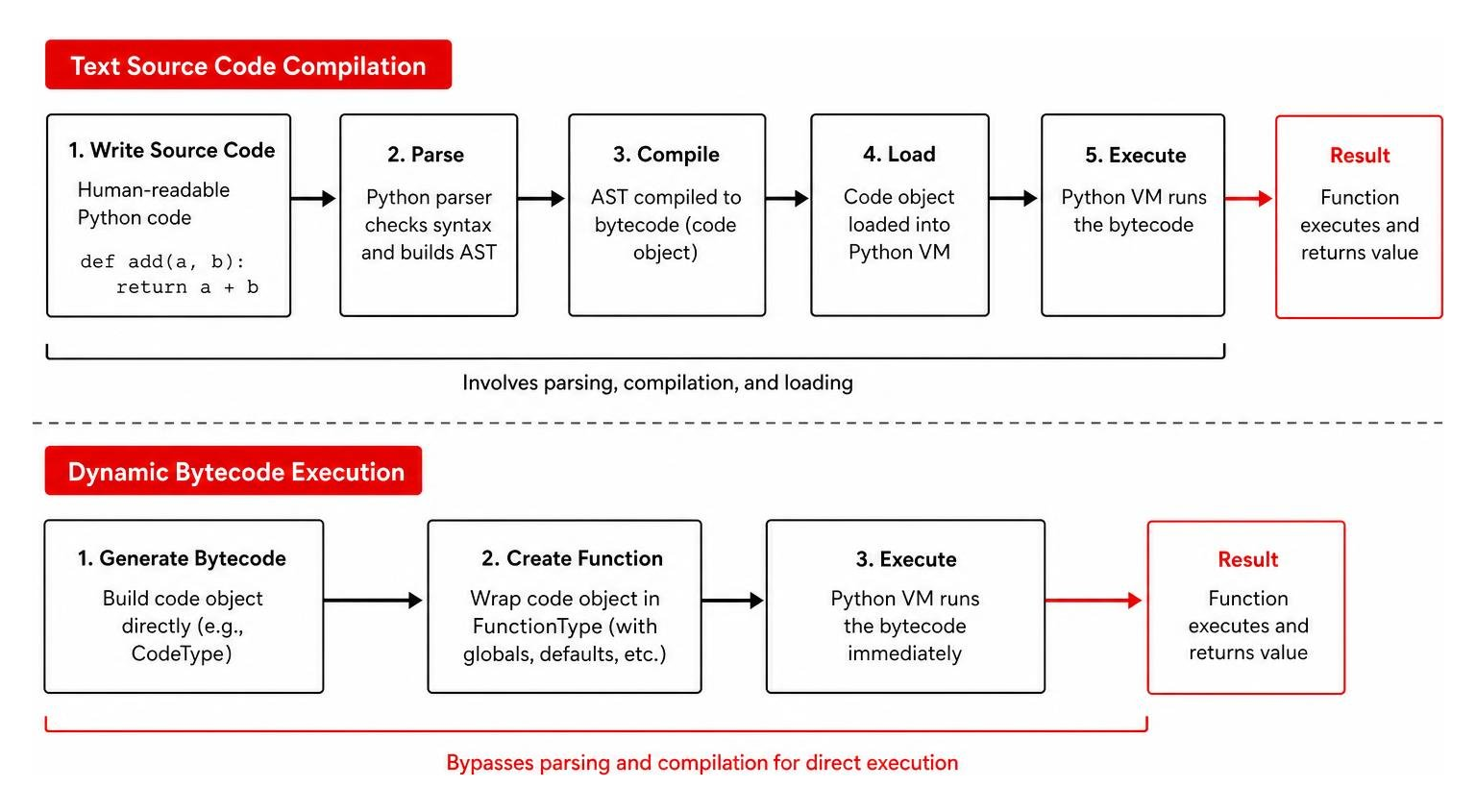
A foundational architectural decision is whether your generator should output human-readable Python source files or executable bytecode in memory.
Source code generation writes standard .py files to disk. This approach optimizes for visibility and debuggability. Developers can inspect generated files, run standard linters, place breakpoints in their IDE, and commit the outputs to version control. The minor trade-off is the file system I/O and parsing overhead required when the generated source is imported.
Direct bytecode execution creates CodeType and FunctionType objects dynamically in memory, bypassing string formatting and AST parsing entirely. While this eliminates compilation latency during execution, it drastically reduces code visibility. Stack traces become cryptic, standard debuggers struggle to attach to dynamically created frame objects, and instructions must be painstakingly maintained across standard Python runtime versions.
Programmatic AST Construction and Modern Builder Libraries
Python includes a standard library module named ast that allows developers to parse, inspect, and construct Abstract Syntax Trees programmatically. Based on Python’s Abstract Syntax Definition Language (ASDL) grammar, the ast module represents every language construct—from simple literals to complex async function definitions—as discrete class nodes. Check out the official AST module documentation to examine the standard grammar specification.

While constructing raw AST nodes guarantees syntactically correct output, doing so manually via the standard library requires significant boilerplate. Creating a simple assignment or binary operation requires instantiating multiple nested objects with precise positional arguments, line numbers, and column offsets.
Modern AST Libraries for Python Code Generation
To eliminate this verbosity, modern third-party libraries wrap standard AST nodes in fluent, object-oriented builder interfaces. Tools such as those found in the fluent-codegen documentation index allow developers to chain method calls to assemble modules, classes, and logic blocks cleanly.
By using high-level abstractions, these builders handle exact node layout and spacing automatically. To see practical implementations of fluent syntax builders, review the fluent-codegen usage guide. Similar design patterns extend beyond pure Python generation; projects like the ojari CodeGen repository demonstrate how object-oriented code models can generate formatted source outputs across C++, C#, and Python from unified representations.
Modern AST builders also streamline post-processing tasks, offering features like automatic dead-code elimination and unused import pruning before emitting finalized source strings via ast.unparse().
Enforcing Scope Safety with Explicit Builders
One major pitfall when generating dynamic code is variable scope leakage and accidental name shadowing. In standard Python, variables declared inside a for loop header remain accessible in the outer scope after loop completion. When programmatically generating thousands of dynamic lines, these implicit leaks can introduce subtle NameError exceptions or overwrite critical variables.
Specialized builder tools solve this problem by introducing explicit symbol tracking. For example, the python-code-builder repository details how builders enforce local variable boundaries during code construction, throwing immediate construction-time errors if a generator attempts to reuse an active outer identifier as a loop target.
By catching scope collisions before runtime execution, explicit builders turn dynamic code generation into a safe, deterministic pipeline. To learn more about combining automation with modern coding workflows, visit our guide on Python Code Generation with AI Made Easy.
High-Performance Bytecode Manipulation and Framework Integrations
For high-throughput systems, dynamic code generation can be used as a targeted optimization tool. When cProfile identifies an inner-loop bottleneck spending up to 50% of CPU time evaluating generic, highly repetitive branch conditions, writing a specialized bytecode function can yield up to a 2x overall runtime speedup.
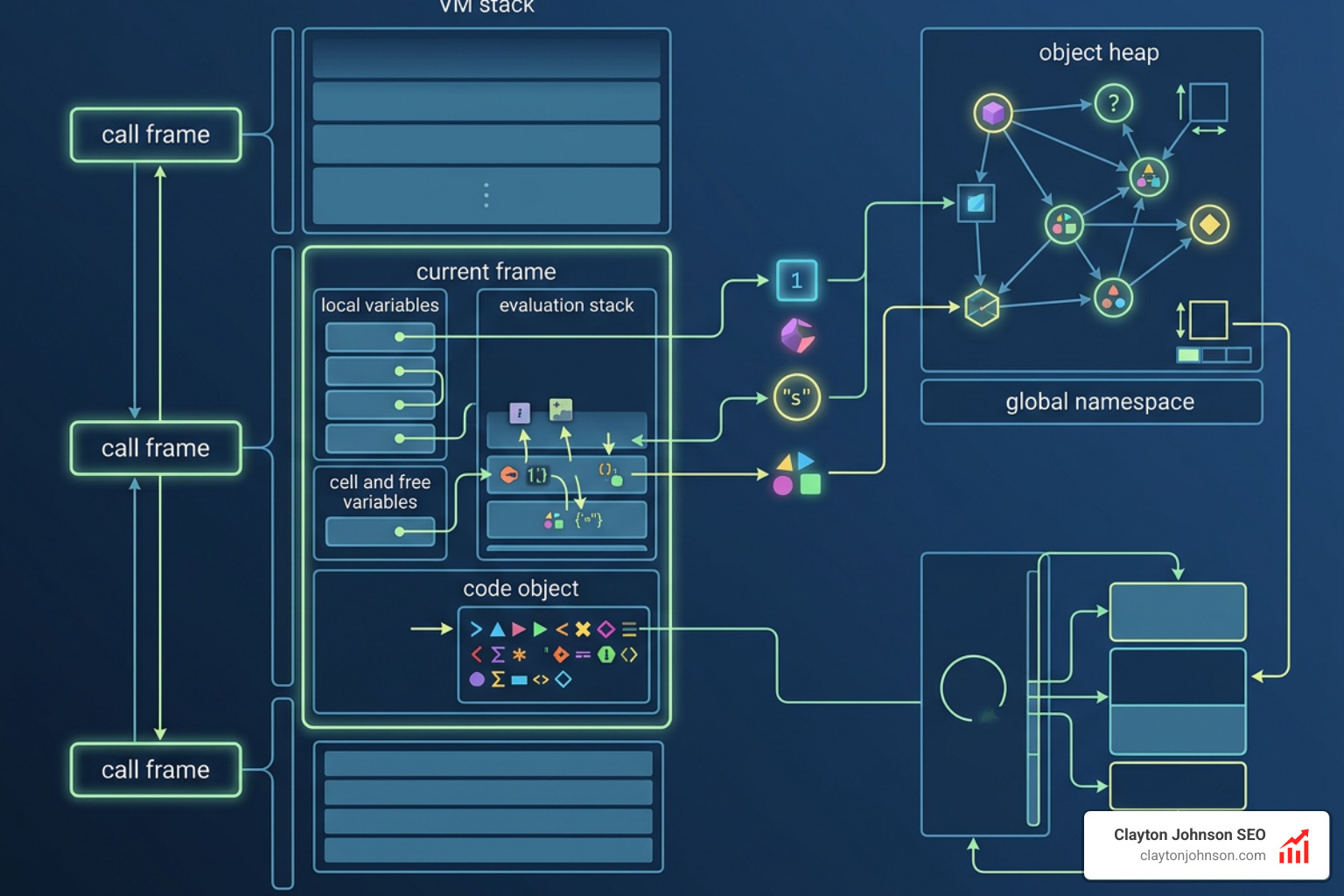
Using Python’s built-in dis module, developers can inspect the CPython virtual machine bytecode stack. In Python 3.6 and newer, CPython bytecode uses standard 2-byte instruction formats consisting of an opcode and an argument. By assembling bytearrays of specific instructions (LOAD_FAST, LOAD_CONST, COMPARE_OP) and wrapping them into a CodeType object, you strip out runtime if conditions entirely, tailoring execution to fixed parameters.
Dynamic Graph Capture in PyTorch Dynamo
The most advanced real-world application of runtime bytecode manipulation lives inside modern machine learning frameworks like PyTorch Dynamo. Dynamo acts as a dynamic Just-In-Time (JIT) compiler, capturing Python frame execution to extract tensor computation graphs while leaving standard language semantics intact.
Deep inside PyTorch’s execution pipeline, the PyCodegen architecture constructs CPython bytecode instructions dynamically. You can inspect the actual source implementation directly in the PyTorch Dynamo codegen implementation.
Dynamo handles continuous stack evolution across target runtimes, supporting CPython versions 3.11, 3.12, and 3.13. Because recent Python releases changed internal evaluation stack mechanics—such as top-of-stack (TOS) tracking, closure creation, and NULL-pushing rules for function calls—Dynamo actively inspects sys.version_info to generate valid bytecode instructions for the active runtime. For a broader look at modern development frameworks, check out The Ultimate Guide to Generative AI Coding Tools.
Performance Gains and Architectural Risks
While direct bytecode manipulation delivers exceptional performance gains, it represents a high-risk technique that should be treated as a method of last resort.
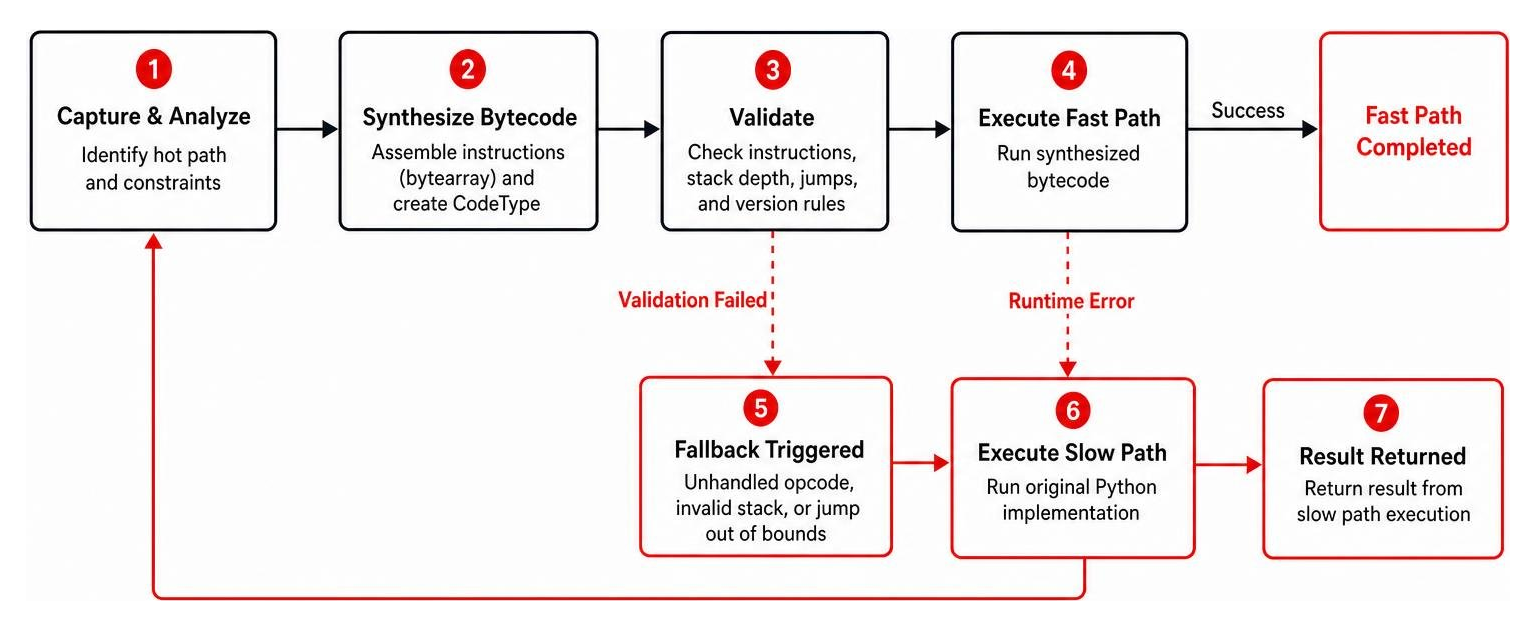
When building high-performance generators, always establish reliable fallback paths. If an unhandled opcode or relative jump offset exceeds safety bounds, your execution pipeline should catch the exception gracefully and fall back to standard Python execution.
Best Practices and Mitigating Pitfalls in Python Code Generation
To keep dynamic systems maintainable over time, follow strict architectural boundary rules. Code generation should simplify your code base, reducing repetitive boilerplate while preserving system readability.
Applying edit-time generation keeps your system transparent. When source code is generated ahead of time and committed to repository control, team members can review pull request diffs, debug issues using standard tools, and avoid adding secret runtime build steps.

Avoiding Security and Scoping Pitfalls in Python Code Generation
The most dangerous security vulnerability in python code generation occurs when untrusted user inputs enter string-based dynamic code execution. Invoking eval() or exec() on raw strings constructed from external web requests exposes your application to arbitrary code execution attacks.
To mitigate security risks, never use naive string formatters to insert external data directly into code bodies. If runtime evaluation is unavoidable, parse inputs using restricted syntax trees, sanitize variable names, and execute generated code inside isolated dictionary namespaces.
To review recommended open-source execution engines and security auditing tools, explore our Best Open Source AI Coding Tools Guide.
Multi-Language Inline Generation with Cog
Managing multi-language schemas across distributed systems presents another common architectural challenge. For example, when an enterprise application must synchronize data structures across C++ backend servers, Python analytics scripts, and C# client interfaces, manually updating definitions across languages often introduces bugs.
The Cog code generation tool solves this problem using inline execution markers embedded within source comments. Cog scans target files, executes embedded Python scripts against a centralized XML or JSON schema, and splices the formatted outputs directly between marker lines.
By keeping generator code co-located inside destination files, developers preserve context while keeping multi-language codebases strictly synchronized.
Frequently Asked Questions
What is the fastest method for Python code generation at runtime?
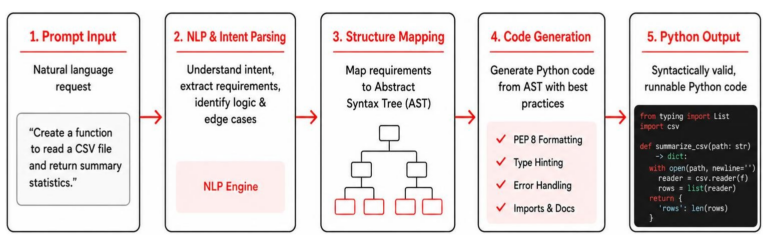
Direct CPython bytecode synthesis is the fastest execution method at runtime because it bypasses string tokenizing, parsing, and AST generation. By generating opcodes directly into a CodeType object, the execution engine skips compilation entirely. However, because compiling Python source strings using compile() takes only milliseconds, bytecode synthesis is usually only justified inside high-frequency inner loops or specialized JIT engines.
When should I store data files instead of generating Python code?
You should store human-readable data files (such as JSON or YAML) whenever objects differ only by parameters, settings, or variable values. If your dynamically generated Python classes do not override logic, execute custom algorithms, or alter control flow, generating source code adds unnecessary complexity. Storing plain data and passing it into generic class constructors keeps your codebase simpler and easier to maintain.
How do AI tools assist with Python code generation in 2026?
Modern AI platforms use large language models trained on software engineering patterns to generate clean, standard-compliant Python code from natural language instructions. Today’s tools can draft unit test suites, translate complex algorithms across 50+ programming languages, and integrate directly into IDE workflows to eliminate repetitive boilerplate. To explore current platforms, read our comprehensive AI Coding Software Guide 2026.
Conclusion
Mastering python code generation requires selecting the right approach for your specific use case. For template scaffolding and multi-language schema generation, string engines like Jinja2 and inline tools like Cog offer clean, human-readable outputs. When syntax safety and scope management are top priorities, standard ast modules and fluent builder libraries provide robust structural guarantees. For specialized runtime performance bottlenecks, direct bytecode synthesis offers deep virtual machine control.
As software architecture evolves toward higher levels of automation, understanding how to generate, transform, and evaluate code programmatically remains a crucial skill for senior developers. By enforcing strict scope safety, sanitizing dynamic inputs, and prioritizing edit-time visibility, you can harness code generation to build maintainable, high-performance Python systems.
To discover how our strategic technical content and search capabilities can help your business connect with technical audiences, explore our solutions for Strategic AI Coding Solutions.