What Small Business SEO Actually Is (And Why It Matters Right Now)
Small business SEO is the process of improving your website’s visibility in search engines like Google so that customers can find you when they search for what you offer.
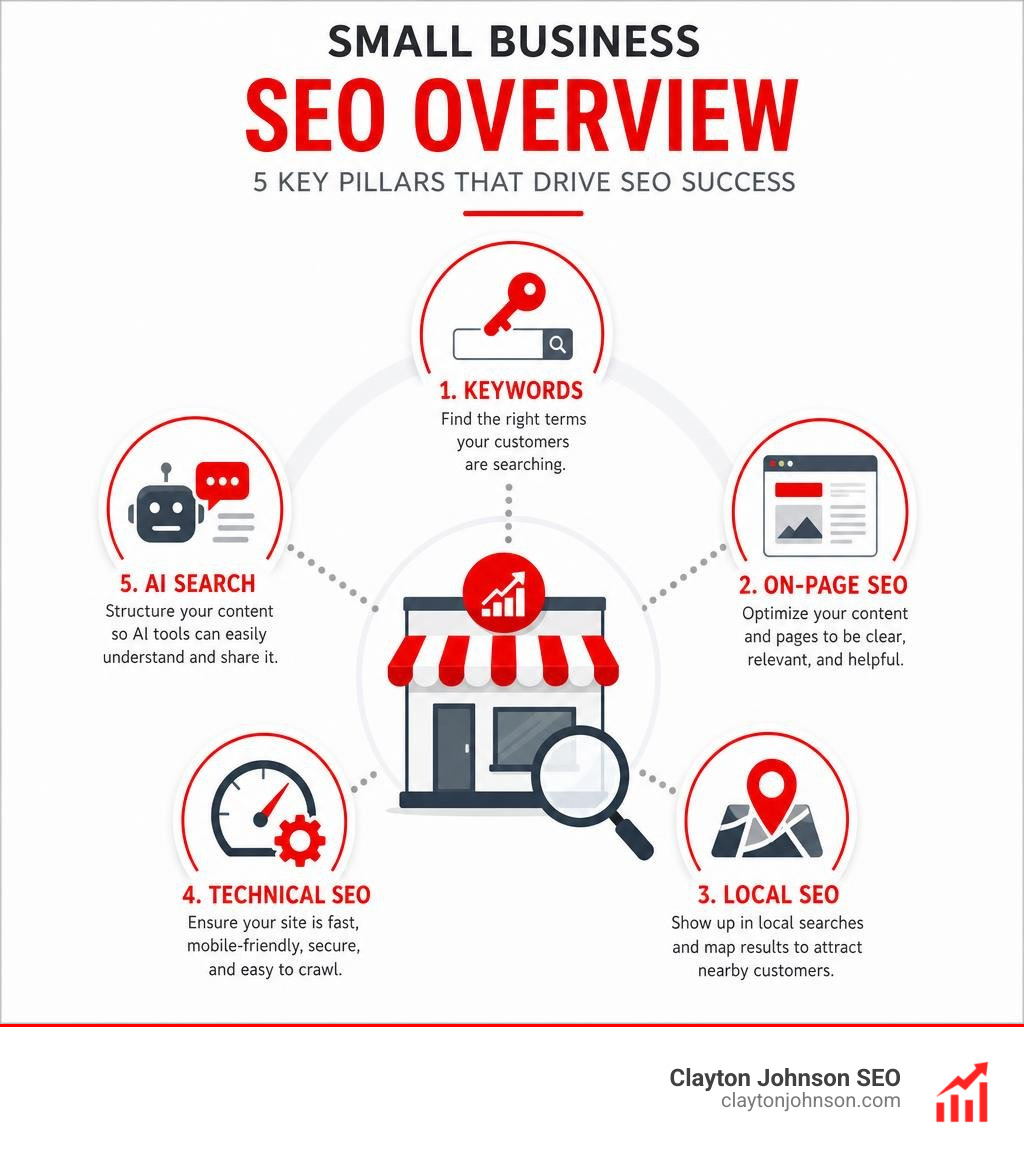
Here’s what it covers at a glance:
| What It Is | What It Includes |
|---|---|
| Optimizing your website for search engines | Keywords, page titles, meta descriptions, headers |
| Building authority online | Backlinks, reviews, mentions, E-E-A-T signals |
| Local search visibility | Google Business Profile, map rankings, local citations |
| Technical site health | Site speed, mobile optimization, crawlability |
| AI search visibility | Structured content for Google AI Overviews, ChatGPT, Perplexity |
The stakes are real. Organic search drives 53% of all website traffic and contributes to 44% of revenue share. Meanwhile, only 0.63% of Google users ever click to page two of results. If you’re not on page one, you’re essentially invisible.
And yet, many small business owners feel like SEO is too technical, too slow, or only built for big brands with big budgets. That’s not true — and this guide will show you why.
I’m Clayton Johnson, founder of Clayton Johnson SEO and SmallBizSEO, and I’ve spent more than a decade building search strategies specifically for small business SEO — helping local companies, service providers, and growing brands turn organic visibility into real revenue. In this guide, I’ll walk you through everything you need to know to get started, avoid common mistakes, and build a search presence that compounds over time.
What Is Small Business SEO and Why It Matters in 2026
To understand how to grow your business today, we have to look at the current search landscape of July 2026. The days of simply throwing a few keywords onto a slow-loading page and ranking overnight are long gone. Search engines have evolved, but the core mission remains the same: connecting users with the most relevant, trustworthy, and high-quality answers to their questions.
For small businesses, search engine optimization is the ultimate equalizer. It levels the playing field, allowing a 10-person local clinic or a boutique e-commerce shop to compete directly with massive, multi-million-dollar corporations.
However, we must first clear up a very common point of confusion: What is the difference between general small business SEO and local SEO?
While they share the same foundational mechanics, they serve different business goals:
- Local SEO is geographically constrained. It is designed to attract physical foot traffic or local service calls. If you run a brick-and-mortar shoe store in Boston, a dental practice, or a local plumbing service, you rely heavily on local search signals, Google Maps, and your Google Business Profile.
- Organic Small Business SEO is broader. It focuses on ranking for search queries that aren’t tied to a specific physical location. If you run an online-only consulting firm, ship products nationwide, or sell software, you want to rank for high-intent search terms regardless of where the searcher is located.
| Feature | Local SEO | General Organic SEO |
|---|---|---|
| Primary Goal | Drive physical foot traffic or local service inquiries | Drive website traffic, leads, and online sales |
| Key Asset | Google Business Profile, Local Map Pack | Optimized website pages, deep content clusters |
| Geographic Focus | Highly localized (specific neighborhood, city, or zip code) | National or global |
| Results Timeline | Often faster (6 to 10 weeks) | Moderate to long-term (4 to 8 months) |
| Key Ranking Factors | Proximity, reviews, local citations (NAP consistency) | Backlink authority, technical site health, content depth |
If you want a solid baseline of how search engines view your site, we highly recommend reading the official Google Search Starter Guide to understand the technical prerequisites of search.
The Shift to AI Search and Generative Engine Optimization (GEO)
As we navigate 2026, the biggest shift in search behavior is the rise of AI-synthesized answers. Traditional “blue-link” search engine results pages (SERPs) have transformed. Google AI Overviews now appear on roughly 16% of all search queries, and platforms like ChatGPT, Perplexity, and Gemini have become active, viable traffic sources.
This evolution has given rise to three new acronyms you need to know:
- GEO (Generative Engine Optimization): Optimizing your content so AI engines cite your website as a source in their summaries.
- AEO (Answer Engine Optimization): Structuring your content to answer conversational, voice-based queries directly.
- AIO (Artificial Intelligence Optimization): The overarching practice of preparing your digital footprint for AI-driven crawlers.
AI search engines do not “split the vote” like traditional search pages. When a user asks an AI engine a question, the AI often summarizes the web and highlights just one or two clear winners. If your business is vague or lacks structured data, you become completely invisible to these engines. In fact, failing to optimize for this AI layer means leaving an estimated 30% to 42% of your potential search traffic on the table.
To win in the age of AI search, your content must be highly structured, incredibly specific, and deeply credible. AI engines prioritize fast-loading sources that provide direct, conversational answers (ideally 50–60 words for quick summaries) backed by undeniable proof.
Why Small Businesses Can Outrank Large Enterprises
It is easy to look at giant competitors and assume they will always win. But in search, small businesses actually possess a massive, community-based advantage.
Large enterprises are forced to target broad, high-volume keywords because they need to feed a massive corporate machine. They write generic content designed to appeal to everyone, which often means it appeals deeply to no one.
As a small business, you can play where the real money is: long-tail keywords. These are highly specific, multi-word search queries. While they have lower search volumes, they carry incredibly high purchase intent.
For example, a national home services brand might try to rank for “landscaping.” A local business, however, can dominate search by targeting “organic garden design for historic homes in South Manchester.” By focusing on this narrow niche, you can build a highly concentrated “topic cluster” that demonstrates undeniable expertise. Google’s algorithms reward this depth of coverage, allowing you to outrank the giant brands for the exact queries that convert into paying customers.
If you are starting from scratch and want to build this foundational knowledge yourself, check out our guide on How to Master SEO Basics Without a Degree.
The Core Pillars of Organic Search Success
To build a website that search engines love and AI engines recommend, you must focus on what actually moves the needle. We break this down into a comprehensive, multi-layered framework. For a deep dive into the absolute fundamentals, consult The Only Complete Guide to Search Engine Optimization You’ll Ever Need.
To visualize how these elements work together to build search dominance, we use a strategic model called the Authority Ladder.

How to Conduct Keyword Research for Small Business SEO
Keyword research is the process of discovering the exact words and phrases your target buyers use when they are looking for your products or services.
When conducting keyword research, we evaluate three key metrics:
- Search Volume: How many times a keyword is searched for each month.
- Keyword Difficulty (KD): Scored from 0% to 100%, this tells you how competitive a keyword is. For small businesses, we want to target keywords with a manageable difficulty score (usually under 30% to 40%).
- Search Intent: The why behind the search. Are they looking for information (Informational), comparing options (Consideration), or ready to buy right now (Transactional)?
To get started, we recommend building an initial list of 20 to 50 target keywords. You can brainstorm these by thinking about the questions your customers ask you every day. From there, use tools like Semrush, Ahrefs, or Google Keyword Planner to validate their search frequency and competitiveness.
Instead of chasing highly competitive generic terms, focus your energy on localized and long-tail phrases where searchers are actively looking to make a decision. For more on this localized strategy, read our guide on Local SEO.
Essential On-Page Elements for Small Business SEO
Once you have your target keywords, you must place them strategically on your website. This is called on-page optimization. The goal is to make it incredibly easy for search engine crawlers (and AI models) to understand exactly what your page is about.
Here are the most critical on-page elements to optimize:
- Title Tags: This is the blue clickable link that appears in search results. Keep it under 60 characters, place your primary keyword near the front, and make it compelling for users to click.
- Meta Descriptions: The short summary paragraph below your title tag. While not a direct ranking factor, a well-written meta description directly improves your click-through rate.
- Header Tags (H1, H2, H3): Use these to structure your content logically. Your page should only have one H1 tag (your main title), followed by H2s and H3s for subtopics.
- Image Alt Text: Search engines cannot “see” images the way humans do. Adding descriptive, keyword-conscious alt text (ideally under 60 characters) helps search engines index your images and assists visually impaired users.
- Internal Linking: Link your pages together naturally. This establishes a clear site hierarchy and ensures that your high-value commercial pages receive authority from your informative blog posts.
To make sure you aren’t missing any of these on-page quick wins, review our checklist in SEO 101.
Building Authority with E-E-A-T and Backlinks
Google utilizes a framework known as E-E-A-T to evaluate the quality of a website’s content:
- Experience: Does the content creator have real-world, hands-on experience?
- Expertise: Does the author possess the professional credentials or deep knowledge required?
- Authoritativeness: Is the website a recognized, go-to source for this topic?
- Trustworthiness: Is the information accurate, safe, and honest? (This is the most critical element of the framework).
E-E-A-T is especially crucial for “Your Money or Your Life” (YMYL) industries, such as healthcare, legal, and finance, where incorrect information could directly harm a searcher’s physical or financial well-being. Google’s manual Search Quality Raters use these exact criteria to grade search results, as outlined in the official Google Search Quality Rater Guidelines.
The primary way search engines measure your authoritativeness is through backlinks — links from other reputable websites to yours. Think of a backlink as a digital “vote of confidence.”
However, in 2026, quality beats quantity every single time. Buying bulk backlinks from cheap, spammy directories will get your site penalized. Instead, focus on building high-quality, organic links. You can do this by sponsoring local community events, getting listed on partner or supplier directories, or writing guest articles for reputable industry publications.
For a complete blueprint on building high-value local authority, read our guide on how to Stop Being Invisible With These Local Backlink Strategies.
Step-by-Step Action Plan for Small Businesses
Now that you understand the theory, let’s turn it into a practical, step-by-step action plan that you can execute over the next 30 days.
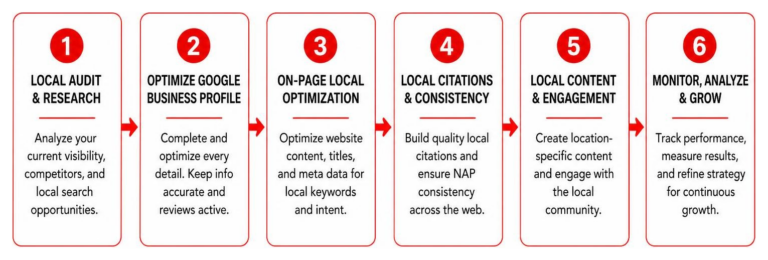
Week 1: Claim Your Foundations & Fix NAP Consistency
The very first step is to claim and fully complete your Google Business Profile (GBP). Ensure that every single field is filled out, including your services, business hours, and description.
Next, audit your NAP (Name, Address, Phone) consistency across the web. Inconsistent business data quietly suppresses your local rankings and confuses AI search engines. Ensure your business name, physical address, and phone number are formatted identically on your website footer, your GBP, and top business directories like Yelp, Bing Places, and YellowPages.
Week 2: Target Your “Money Queries”
Identify five highly specific search queries that represent a customer who is ready to buy right now. Create one dedicated, high-quality page for each query. Answer the searcher’s primary question directly in the very first paragraph to optimize for AI search summaries, then build out deep, helpful content below.
Week 3: Launch Systematic Review Generation
Reviews are a massive ranking signal for both Google Maps and generative search engines. Set up a system to ask every single satisfied customer for a review. You can do this by sending a short, automated text message or email immediately after a job is completed, containing a direct link to your Google Business Profile review section.
Week 4: Technical Health & Mobile Optimization
Google indexes the mobile version of your website first (mobile-first indexing). If your site is slow or hard to navigate on a smartphone, your rankings will suffer. Compress all images to keep page sizes small, delete any unused website plugins, and ensure your site loads in under 3 seconds on a standard mobile connection.
For a deeper look into maximizing these local search signals, check out The Secret Sauce for Local SEO Success.
Setting Up Your Analytics and Tracking
You cannot improve what you do not measure. Far too many small business owners fly blind, guessing whether their marketing efforts are actually working.
To track your progress, you must set up two free tools provided by Google:
- Google Analytics 4 (GA4): This tracks user behavior on your website. It tells you where your visitors come from, what pages they look at, and how long they stay.
- Google Search Console (GSC): This monitors your site’s health in Google’s eyes. It shows you the exact keywords people typed to find your site, how many times your pages appeared in search results, and if there are any indexing or crawl errors.
Once these tools are installed, set up conversion tracking. A conversion is any valuable action a user takes on your site, such as filling out a contact form, clicking your phone number to call you, or making a purchase.
To learn how to connect these metrics to actual lead generation, read our guide on How to Drive More Leads Using Smart SEO Planning.
DIY SEO vs Hiring an Agency
One of the most common dilemmas for small business owners is deciding whether to tackle SEO themselves or hire professional help. Both paths are viable, depending on your budget, available time, and technical comfort.
The DIY Route
If you are operating on a tight budget, doing your own SEO is a great way to get started. Plan to spend roughly 5 to 10 hours per week focusing on the basics: creating high-quality content, systematically requesting customer reviews, and keeping your Google Business Profile updated.
Hiring an Agency
As your business grows, your time becomes your most valuable asset. If you find that technical issues are stalling your growth, or if you simply do not have the hours to spare, it may be time to hire professional support.
When evaluating SEO agencies, avoid anyone who promises “instant page-one rankings” or refuses to explain their process. Good SEO takes time and strategic planning. Look for partners who offer transparent pricing, focus on actual business metrics (leads and revenue rather than just “traffic” or “domain authority”), and can show real-world case studies of similar businesses they have helped.
For an in-depth breakdown of how to structure your marketing spend effectively, read The Advisor Guide to Budget-Friendly Search Engine Optimization.
Frequently Asked Questions
How long does it take to see organic search results?
SEO is a long-term digital investment, not a quick-fix ad campaign.
- Local SEO and Google Business Profile updates can show positive movement in as little as 4 to 8 weeks as local citations and fresh customer reviews begin to register.
- Organic SEO and Content Marketing programs typically hit their stride within 3 to 6 months.
The results of SEO compound over time. While paid ads stop generating leads the second you stop paying, the organic authority you build keeps driving traffic and leads for months and years down the road.
What is the typical budget for professional optimization services?
SEO pricing varies widely depending on your industry’s competitiveness, your geographic market, and the scope of work required.
- DIY with guidance or basic software tools can cost anywhere from $0 to $150 per month.
- One-time foundation sprints (where an expert sets up your technical SEO, GA4, and claims your directories) typically cost around $700 to $1,500.
- Ongoing, focused monthly agency retainers for small businesses generally range between $750 and $2,000 per month.
To help you find the right fit for your budget, we have compiled a list of the Top 10 Small Business SEO Companies.
What are the most common optimization mistakes to avoid?
- Keyword Stuffing: Forcing your target keyword into your content dozens of times. This makes your text unreadable for humans and will get your site penalized by modern search engines.
- Buying Bulk Backlinks: Purchasing cheap links from low-quality sites. This adds massive risk to your domain health without adding any real authority.
- Duplicate Content: Copying text verbatim from competitor websites or spinning out hundreds of thin, AI-generated filler posts. Search engines value originality and depth.
- Ignoring Mobile Users: Failing to check how your website looks and loads on smartphones. With mobile-first indexing, a poor mobile experience will destroy your desktop rankings as well.
Conclusion
Building a strong organic search presence is one of the most powerful things you can do for your small business. In a digital landscape increasingly shaped by AI-driven search engines, having a structured, authoritative, and trustworthy website is no longer optional — it is the key to survival.
By focusing on the core pillars of technical health, localized search intent, high-quality content, and genuine E-E-A-T signals, you can build an organic marketing engine that drives high-intent leads to your business around the clock.
If you are ready to find a trusted partner to handle this growth for you, take a look at our curated list of the 8 Best SEO Companies for Small Businesses That Actually Deliver Results.
Alternatively, if you want a strategic, customized roadmap tailored specifically to your target audience and business goals, we are here to help. You can learn more and take the first step by visiting our page to Get Professional SEO Services.