How to Find the Right Business Marketing Agency for Your Small Business
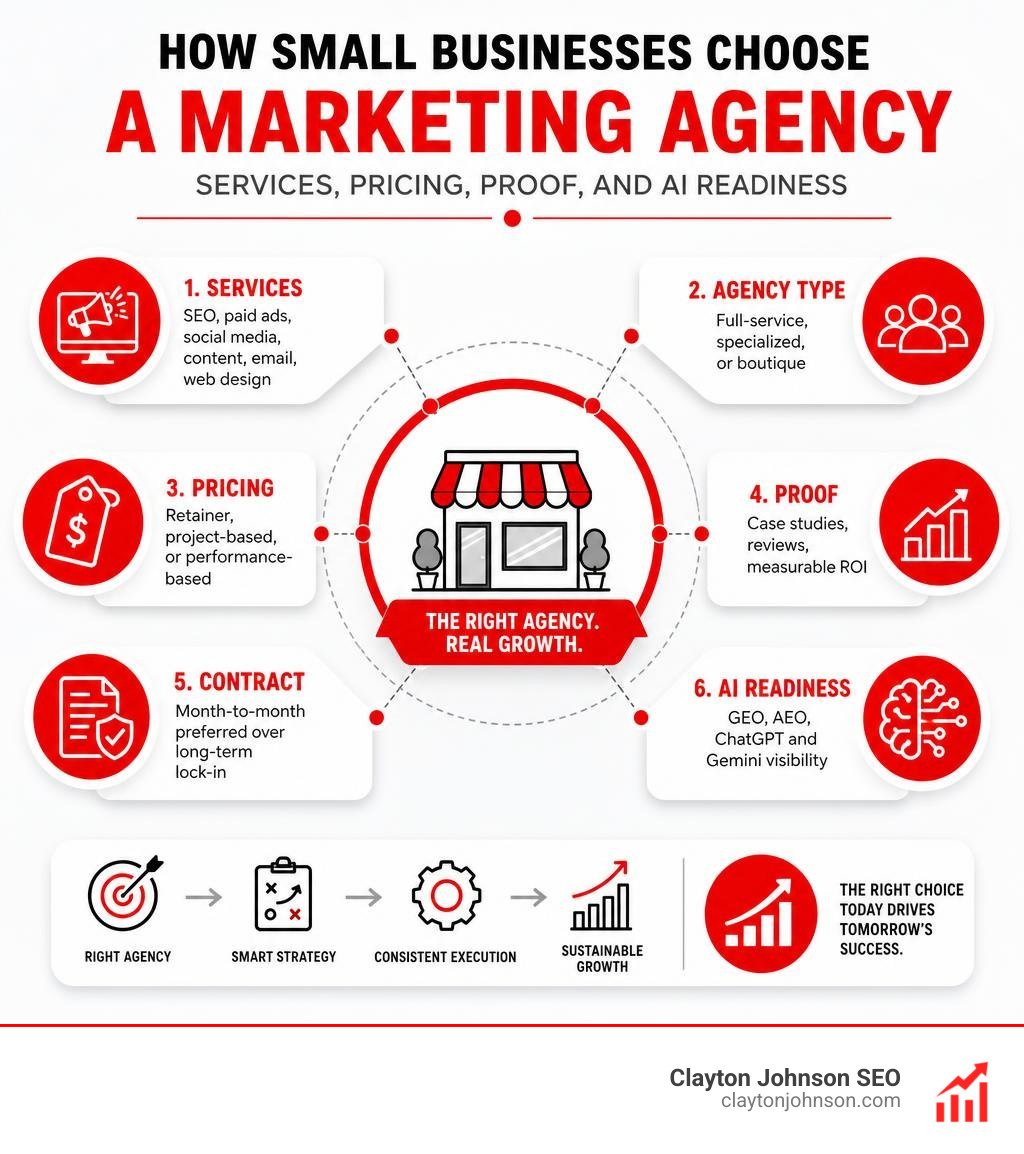
Quick answer: Here is what to look for when choosing a business marketing agency:
| Factor | What to Look For |
|---|---|
| Services | SEO, paid ads, social media, content, email, web design |
| Agency type | Full-service, specialized, or boutique |
| Pricing | Retainer, project-based, or performance-based |
| Proof | Case studies, reviews, measurable ROI |
| Contract | Month-to-month preferred over long-term lock-in |
| AI readiness | GEO, AEO, ChatGPT and Gemini visibility |
Not all marketing agencies are built the same. Some focus on a single channel. Others manage everything under one roof. A few have gone all-in on AI-driven visibility and answer engine optimization. And most of them will tell you they are the best choice for your business.
That makes the selection process genuinely hard — especially if you are a small business owner without a dedicated marketing team to help evaluate the options.
The stakes are real. A well-matched agency can drive compounding growth. The wrong one costs you time, budget, and momentum. One widely cited benchmark from research firm Litmus puts email marketing ROI at $36 for every $1 spent — but only when the strategy and execution are dialed in. Results like a +427% increase in top 10 organic keywords or a 23X return on ad spend are achievable, but they do not happen by accident.
This guide cuts through the noise. It explains what agencies actually do, what they cost, how to vet them, and how to avoid the most common mistakes small businesses make when hiring one.
I’m Clayton Johnson, an SEO strategist and founder of SmallBizSEO, and I have spent more than a decade helping small businesses build visibility systems that connect them with the right business marketing agency partners and digital strategies for long-term growth.
Business marketing agency terms made easy:
What Services Does a Business Marketing Agency Provide?
A business marketing agency serves as an external growth engine for companies that want to scale without managing every execution layer in-house. Rather than relying on fragmented tactics, a modern agency aligns digital marketing channels—organic search, paid advertising, content creation, brand positioning, and conversion design—into an integrated acquisition operating system.
When we evaluate digital marketing strategies, we look beyond basic campaign setup. A capable agency builds holistic systems that identify your high-value target audiences, craft messages that resonate with buyer psychology, and optimize every touchpoint along the customer conversion journey.
Core Services Offered by a Business Marketing Agency
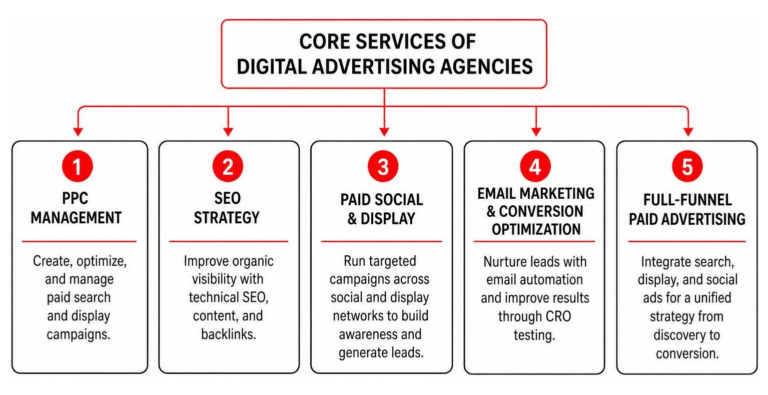
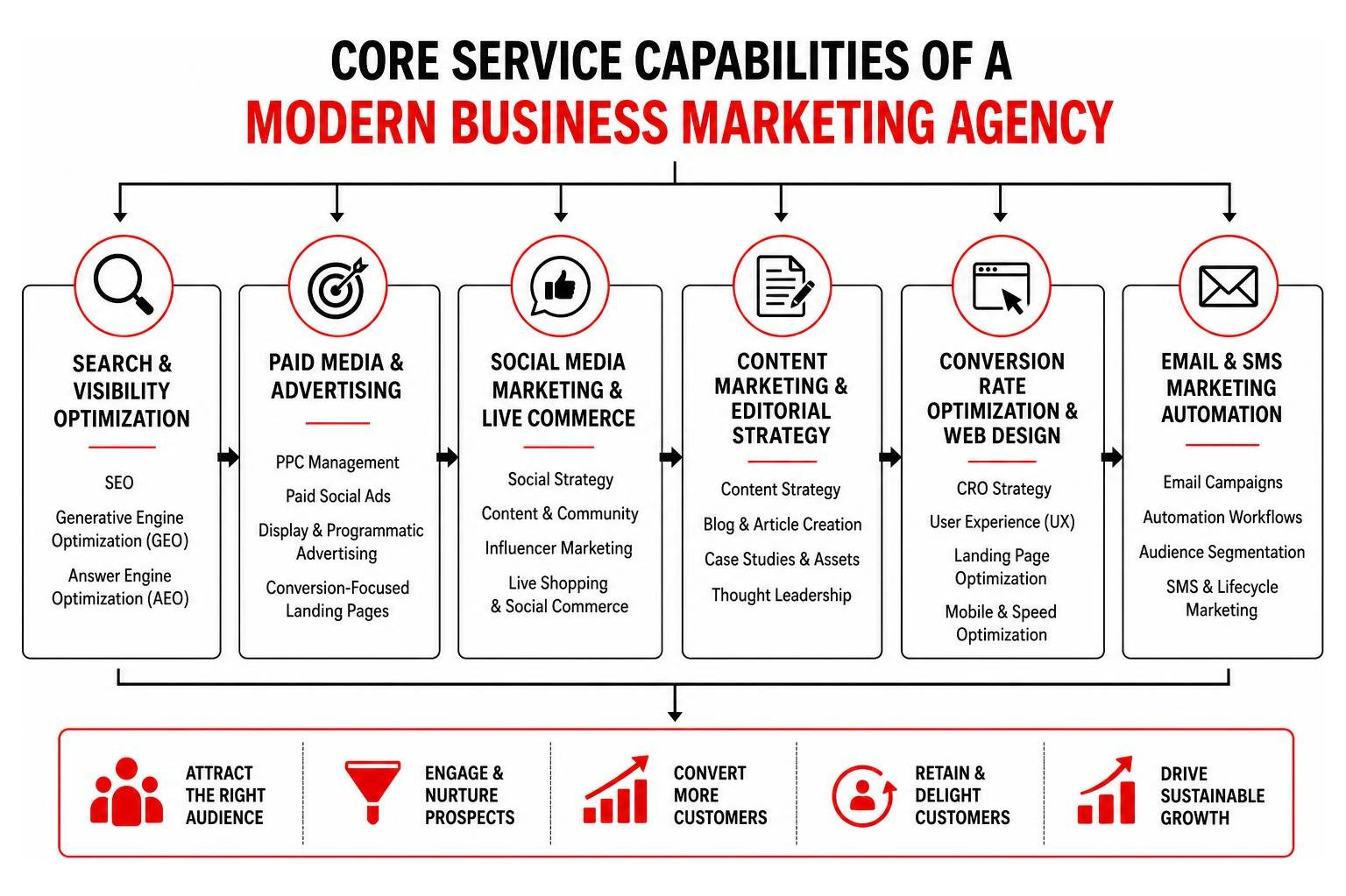
The operational scope of a growth firm typically spans several specialized capabilities. Depending on your primary growth objectives, top digital marketing agencies deliver:
- Search Engine & Search Visibility Optimization (SEO & SVO): Modern organic search spans traditional Google keyword rankings as well as Generative Engine Optimization (GEO) and Answer Engine Optimization (AEO). This ensures your business gets cited directly in AI responses on ChatGPT, Gemini, Perplexity, and Google AI Overviews.
- Pay-Per-Click (PPC) & Paid Media Management: Managing campaigns across Google Ads, Bing, Meta, LinkedIn, and programmatic ad networks. Expert media buyers test copy variations, build high-converting landing pages, and optimize bids toward target Customer Acquisition Costs (CAC) and Return on Ad Spend (ROAS).
- Social Media Marketing & Live Commerce: According to research from Statista, over 77.6% of small businesses utilize social channels to promote their products and services. Beyond standard posting, modern agencies capture active attention through short-form video, influencer coordination, and interactive platforms. For instance, roughly 70% of Gen Z consumers have made direct purchases through live shopping experiences, making social commerce a vital revenue driver.
- Content Marketing & Editorial Strategy: Developing high-impact assets such as white papers, customer case studies, expert interviews, and instructional guides that build topical authority and satisfy search engines.
- Conversion Rate Optimization (CRO) & Web Design: Structuring user-centric web pages and landing flows. By resolving technical friction, improving mobile loading speeds, and refining calls-to-action, agencies help convert raw web traffic into qualified sales leads.
- Email & SMS Marketing Automation: Implementing automated lifecycle workflows, welcome sequences, and audience segmentation. Email marketing continues to offer unmatched effectiveness, generating an average return of $36 for every $1 invested when properly deployed.
Different Agency Models: Full-Service, Specialized, and Boutique
Choosing the best external growth partner requires understanding how different agency structures operate:
- Full-Service Marketing Agencies: These firms manage everything from strategic planning and web design to multi-channel ad management and media strategy under a single roof. Full-service agencies eliminate the operational headache of managing multiple vendors, offering unified reporting across all marketing touchpoints.
- Specialized Agencies & Content Marketing Studios: These specialized firms focus strictly on a single channel or execution discipline—such as technical B2B content, local SEO, or performance paid search. If your business already possesses strong internal marketing leadership but lacks tactical capacity in one domain, a specialized partner delivers concentrated expertise.
- Creative Boutiques: Boutique agencies prioritize visual identity, brand messaging, packaging design, and video production. While they excel at creative branding assets, they often partner with performance marketing agencies to execute data-driven media distribution.
Key Benefits of Hiring an Agency vs. Building an In-House Team
Building an internal marketing department requires significant capital, human resources management, and time. Hiring individual specialists—such as an SEO strategist, PPC manager, graphic designer, copywriter, and marketing operations manager—rapidly inflates overhead expenses.

Cost Efficiency, Scalability, and Tool Access
Outsourcing execution when hiring a marketing agency provides immediate advantages:
- Lower Overhead & Predictable Costs: Recruiting, onboarding, and retaining full-time employees carries fixed salaries, payroll taxes, health benefits, and equipment costs. Partnering with an agency gives you access to a complete multi-disciplinary team for less than the annual salary of a single senior marketing executive.
- Instant Enterprise Tool Access: Modern digital marketing relies on enterprise software for rank tracking, competitive research, conversion heatmaps, AI analytics, and ad intelligence. Premium tools can easily cost thousands of dollars per month in direct subscriptions. Agencies bundle these advanced martech platforms directly into their client engagements.
- Rapid Scalability: When market opportunities emerge or seasonal demand shifts, an agency can scale campaign velocity up or down instantly. You can expand into new performance ad channels or deploy fresh content formats without suffering hiring bottlenecks.
Avoiding Common Challenges and Pitfalls
Working with an external team is not without potential friction points. Small businesses occasionally run into challenges like misaligned communication, slow response times, or unexpected scope creep.
To protect your investment and maintain complete transparency, we advocate for clear operational standards:
- Demand Flexible, Month-to-Month Contracts: Avoid rigid annual commitments during initial engagements. Performance-minded agencies earn client retention through measurable outcomes rather than long-term contract lock-ins.
- Establish Transparent SLAs and Reporting Dashboards: Ensure you maintain full direct ownership of all digital assets, ad accounts, analytics properties, and creative domain files. Your agency should provide transparent, real-time dashboards tracking core lead and revenue metrics rather than vanity impressions.
- Define Strategy Before Execution: Campaign errors often occur when execution begins before core audience targeting and competitive messaging are locked down. Insist on a formal strategy roadmap or comprehensive discovery audit before launching active media spend.
Agency Selection Framework and Pricing Models
Finding the right service provider requires a structured framework. Consulting resources like the definitive list of top 100 marketing agencies can help you build an initial candidate list, but evaluating individual agency capability demands deeper diligence.
How to Choose a Business Marketing Agency for Your Budget
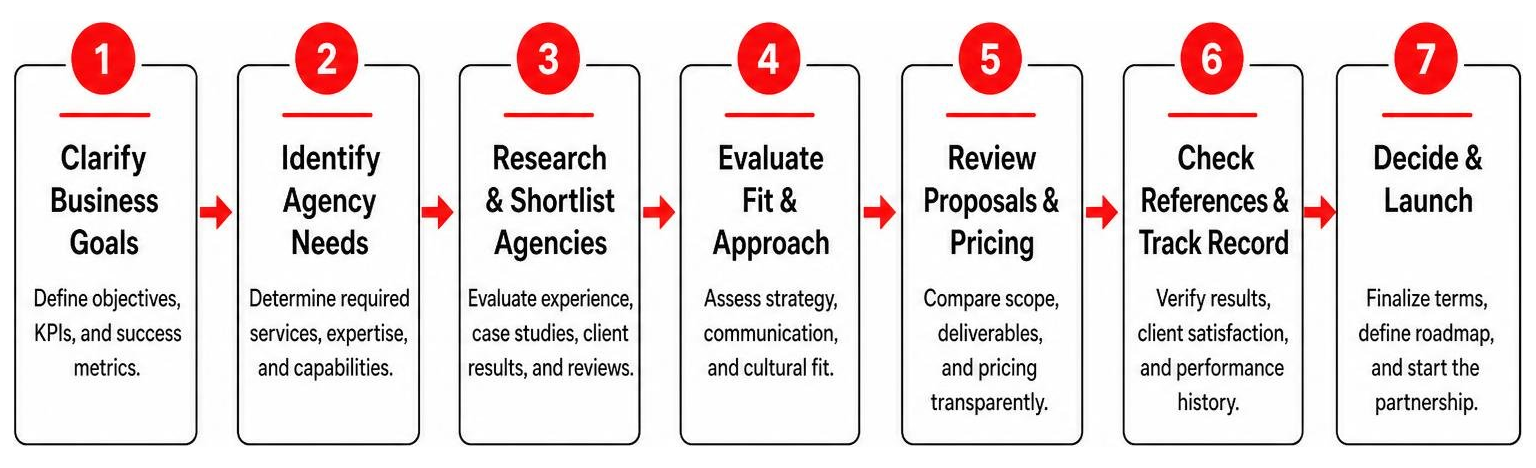
When evaluating potential agency partners, follow a clear decision checklist:
- Clarify Strategic Business Goals: Identify whether your immediate priority is generating qualified local service leads, lowering customer acquisition costs for e-commerce, or expanding B2B search pipeline.
- Review Niche Industry Experience: Choose an agency that understands your sector’s buying cycles, compliance requirements, and market dynamics. B2B SaaS companies, for instance, need partners who understand complex multi-month sales funnels, whereas local contractors need hyper-targeted geo-location visibility.
- Assess Team Composition: Confirm who will actually execute your work day-to-day. You want assurance that experienced strategists will manage your account rather than handing execution over to junior interns after contracts are signed.
Vetting Reputation, Reviews, and Case Studies

Third-party proof provides critical context when vetting an agency’s reputation:
- Evaluate Verified Client Reviews: Online social proof strongly dictates decision-making; roughly 91% of 18-to-34-year-olds trust online reviews as much as personal recommendations, and 93% of consumers report that online feedback directly influences buying choices. Look for consistent pattern feedback across independent review platforms.
- Inspect Detailed Case Studies: Look past basic percentage increases and examine specific campaign parameters. Valid case studies clearly detail the baseline starting point, exact strategies implemented, execution timeline, and bottom-line revenue impact.
- Request Live Reference Calls: Ask prospective agency candidates for reference calls with current or former clients whose business size and market parameters closely mirror yours.
Understanding Pricing Structures and Retainers
Agencies typically structure pricing under three primary commercial models:
| Pricing Model | Average Investment Range | Ideal Use Case | Pros & Cons |
|---|---|---|---|
| Monthly Retainer | $1,500 – $10,000+ / month | Ongoing full-service SEO, content, PPC management, and strategic execution | Pros: Consistent support, continuous testing. Cons: Requires ongoing budget allocation. |
| Project-Based Fees | $3,000 – $25,000+ per project | Website redesigns, initial SEO audits, branding overhauls, custom funnels | Pros: Defined scope and fixed cost. Cons: Lacks ongoing campaign optimization after launch. |
| Outcome / Performance-Based | Base fee + revenue share or cost-per-lead bonus | E-commerce scaling, direct-response lead generation campaigns | Pros: Directly aligns agency incentives with growth. Cons: May require strict revenue-sharing terms. |
Strategy Execution, AI Visibility, and Proving Agency ROI
Executing a successful marketing program requires connecting creative campaigns with solid tracking systems. Reviewing innovative industry frameworks or reviewing the best marketing examples to spark your creativity can help shape your initial positioning, but sustainable growth ultimately depends on multi-channel execution and continuous data optimization.
Modern Search Visibility: AI Overviews and Generative Engine Optimization
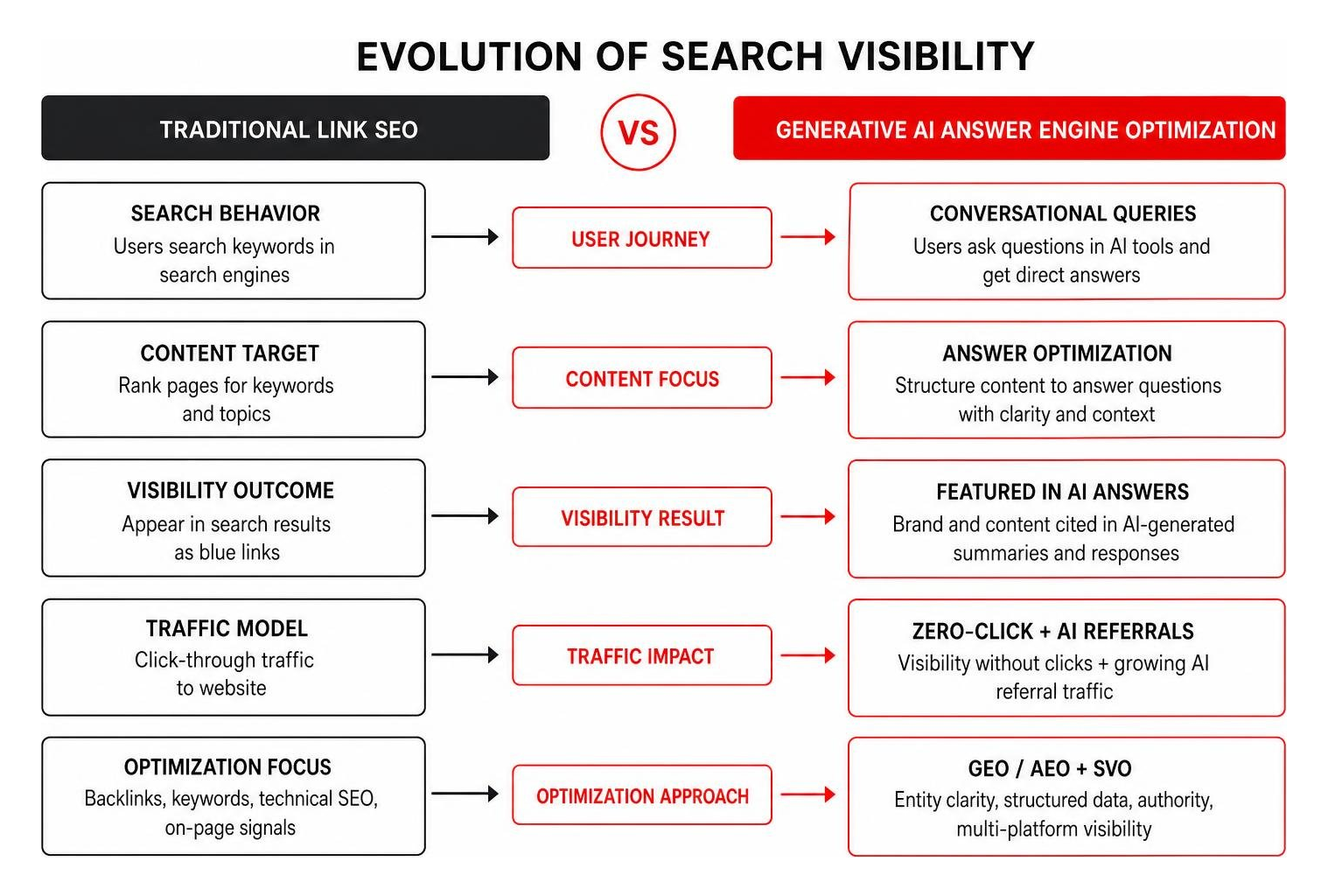
Search behavior has shifted dramatically. Consumers no longer rely solely on standard search engine results pages; they actively query conversational AI tools like ChatGPT, Google Gemini, Perplexity, and Google AI Overviews to gather product recommendations and answer buying questions.
To remain competitive, top growth firms integrate Generative Engine Optimization (GEO) and Answer Engine Optimization (AEO) alongside traditional technical SEO practices:
- Optimizing for Zero-Click AI Answers: Modern AI engines summarize web pages to deliver direct answers without requiring users to click standard links. By structuring content around clear, entity-focused answers and schema markup, agencies help ensure your brand is cited directly within generative AI summaries.
- Capturing Generative Traffic Surges: Brands optimizing for conversational search surfaces have experienced massive visibility spikes—including verified shifts such as +5,556% in AI referral traffic, +404% in Gemini search visibility, and +1,078% in ChatGPT search traffic.
- Unified Search Visibility Optimization (SVO): Integrating traditional organic search, social media signals, and AI platform recommendations ensures your business remains visible across every discovery touchpoint. For actionable guidance on selecting specialized partners in this space, explore our guide on finding the best seo and social media services for your brand.
Data Metrics, SLAs, and Bottom-Line Revenue Growth
A reliable business marketing agency holds itself accountable to commercial financial performance rather than superficial vanity metrics. When reviewing performance reports with your agency, focus on core executive health indicators:
- Customer Acquisition Cost (CAC): Calculating the precise total marketing spend required to acquire a paying customer across individual acquisition channels.
- Return on Ad Spend (ROAS): Tracking net revenue generated directly per dollar invested in paid ad networks (targeting performance levels such as 5X to 23X ROAS).
- Marketing-Sourced Pipeline & Closed Revenue: Measuring how inbound content, organic rankings, and paid campaigns directly contribute to booked calls, sales opportunities, and closed customer contracts.
- Targeted Keyword & Conversion Growth: Monitoring core performance benchmarks, such as achieving a +68% increase in organic conversions or driving substantial revenue expansion within six months of campaign optimization.
For a deeper dive into top-performing providers evaluated on strict delivery standards, check out our review of the 8 best seo companies for small businesses that actually deliver results.
Frequently Asked Questions
How long does it take to see results from a marketing agency?
Timeline expectations vary depending on the specific channels deployed:
- Paid Advertising (PPC & Paid Social): Campaigns can generate traffic, qualified inbound phone calls, and sales inquiries within the first 1 to 2 weeks following initial launch and pixel configuration.
- Search Engine Optimization & Content Strategy: Organic search optimization, GEO implementation, and topical authority building generally require 3 to 6 months to demonstrate compound growth in keyword positions, organic traffic, and conversion volume.
- Brand Strategy & Web Redesigns: Strategic identity overhauls and technical website development projects typically span 1 to 3 months from discovery audits through final deployment.
What are typical monthly costs for small business marketing services?
For small to medium-sized businesses, standard agency service packages typically range between $1,000 and $10,000 per month.
- Local SEO & Social Management Tiers: $650 to $2,000 per month.
- Comprehensive Mid-Market Growth Retainers: $3,000 to $7,500 per month (combining search optimization, content creation, paid ad management, and conversion tracking).
- Enterprise SaaS & Full-Service GTM Retainers: $8,000 to $20,000+ per month.
Startup agencies themselves can launch with overhead ranging from $1,000 to $30,000 and take 1 to 3 months to build operational capacity. Understanding agency overhead helps business owners evaluate fair contract pricing and retainer expectations.
Should a business hire a specialized boutique or a full-service agency?
If your business lacks a complete marketing foundation, partnering with a full-service agency ensures strategic alignment across web development, content creation, paid acquisition, and analytics without juggling separate partners.
If you already maintain strong internal marketing management and simply require dedicated tactical execution—such as high-end video production, technical schema optimization, or specialized PR—hiring a boutique firm or specialized studio is often the most cost-effective path. For additional agency rankings and specialized recommendations, see our breakdown of the top 10 small business seo companies.
Conclusion
Finding the right business marketing agency comes down to matching your company’s growth stage, budget, and revenue goals with a partner that brings real technical capability and operational transparency to the table.
Whether you need to capture zero-click visibility in AI search platforms, scale paid ad channels, or rebuild your content lead engine, the right agency operates as a true extension of your business—driving predictable pipeline and long-term enterprise value.
At Clayton Johnson SEO, we help businesses build search visibility systems, navigate digital marketing strategy, and connect with top-tier growth solutions. Explore our comprehensive directory of verified marketing agencies to take the next step in scaling your business today.