What to Know Before You Hire a Marketing Agency
Marketing agencies range from large global networks managing billions in ad spend to small boutique shops laser-focused on a single channel. Before you sign a contract, it helps to know what separates a great agency partnership from a costly mistake.
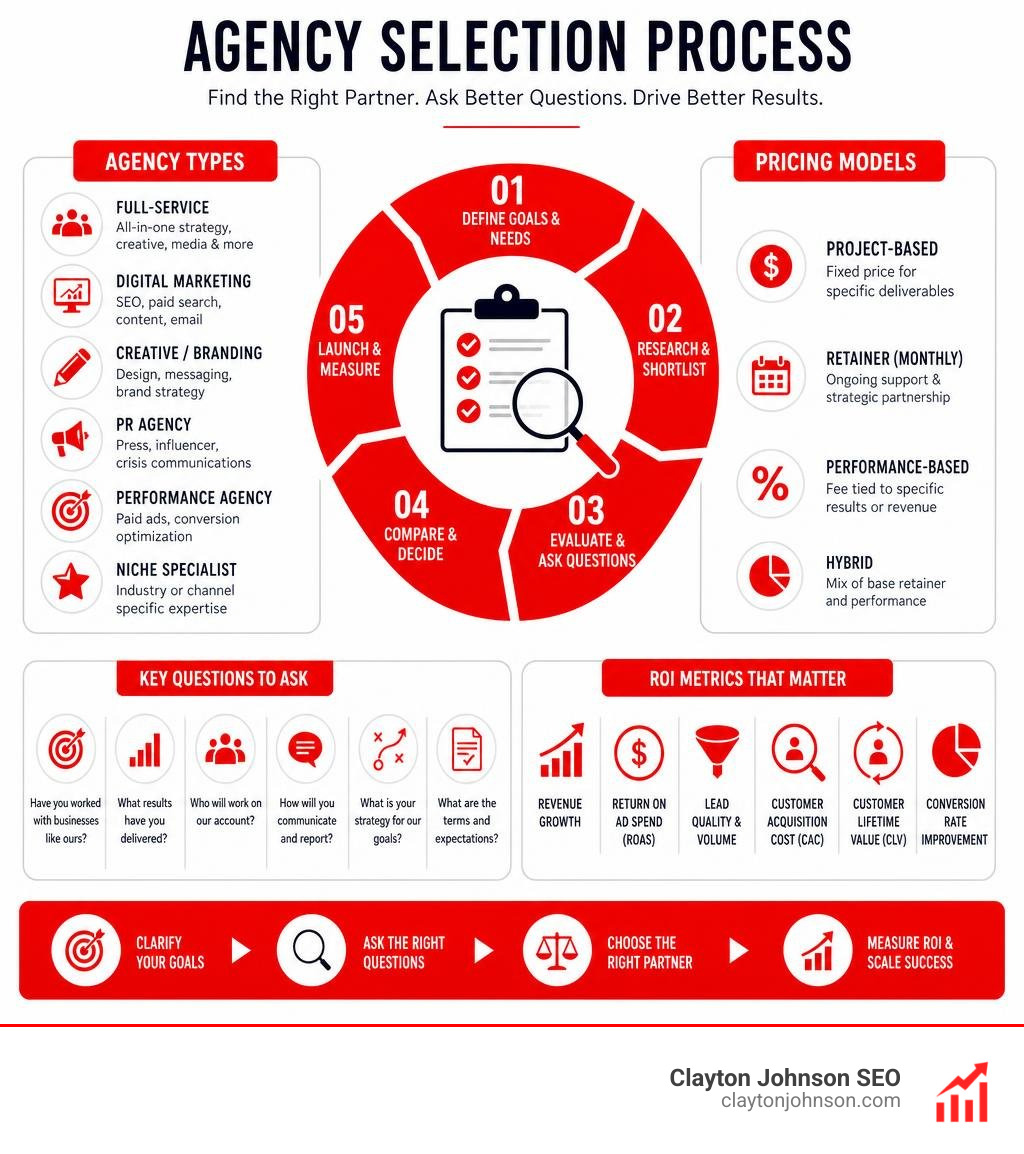
Here is a quick overview of the main agency types to help you orient fast:
| Agency Type | Best For | Common Services |
|---|---|---|
| Full-service | Brands wanting one partner | Strategy, creative, media, SEO, social |
| Digital marketing | Online growth focus | SEO, paid search, content, email |
| Creative / branding | Brand identity work | Design, messaging, brand strategy |
| PR agency | Reputation and earned media | Press, influencer, crisis comms |
| Performance agency | ROI-driven campaigns | Paid ads, conversion optimization |
| Niche specialist | Specific industries or channels | Fintech, healthcare, social-first, etc. |
The global advertising agency market was valued at around $66.5 billion in 2023 and is projected to hit $100 billion by 2030. That means the number of agencies competing for your budget is only growing — making the right choice harder, and more important, than ever.
Hiring the wrong agency does not just waste money. It costs you time, momentum, and market position you may not get back.
The questions in this guide are designed to cut through the noise so you can evaluate any agency with confidence — before you commit.
I’m Clayton Johnson SEO, an SEO strategist who has spent over a decade building visibility systems for businesses across industries, including working alongside and evaluating marketing agencies of all types and sizes. That experience is the foundation for every question in this list.
1. What Type of Marketing Agencies Best Fit Our Business Goals?
Selecting the right partner starts with understanding the landscape. If you hire a hammer, every problem looks like a nail. Similarly, if you hire a specialized PR firm when you actually need technical search visibility, you will end up with great press clippings but zero organic leads.
When researching The Definitive List of Top 100 Marketing Agencies, you will find that agencies generally fall into two categories: broad-scale full-service partners and hyper-focused niche specialists.

Evaluating Niche vs. Broad-Scale Marketing Agencies
A full-service agency handles everything from your high-level brand strategy down to your daily social media posts. This is highly convenient because you only have one point of contact. However, “full-service” can sometimes mean “master of none.”
If your primary challenge is building a memorable brand identity, you should look specifically at Marketing Agencies / Branding Agencies. These firms specialize in visual identity, positioning, and market perception.
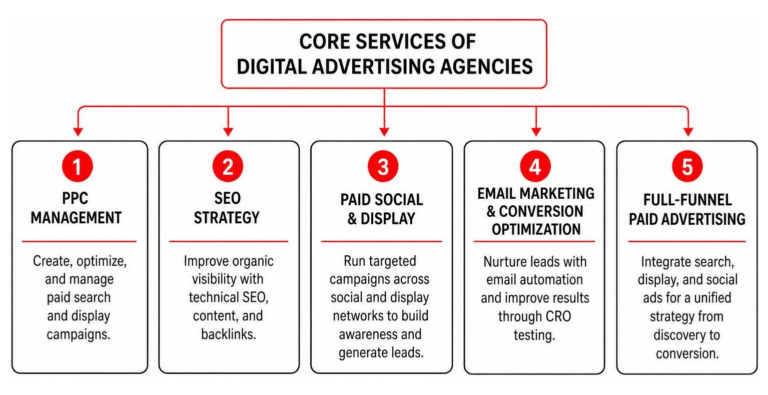
On the other hand, if your goal is immediate online customer acquisition, working with Marketing Agencies / Digital Marketing Agencies is usually the smarter play. They focus directly on channels like search engine optimization, paid media, and conversion pipelines.
Understanding Global Networks vs. Boutique Partners
The scale of your agency partner dictates the type of relationship you will have.
Global holding networks offer massive global reach, deep research departments, and unmatched media buying power. They are built to handle multinational brands with massive budgets.
For mid-market and growing businesses, boutique partners often provide better agility and more direct attention. Boutique agencies work closely with your internal team, offering a shared sense of purpose. Many boutique agencies maintain exceptionally high client retention rates by focusing on highly customized, results-driven creative work rather than applying a cookie-cutter template to hundreds of clients.
2. How Do You Structure Your Pricing and Billing Models?
Understanding how an agency bills for its services is critical to preventing budget creep and aligning your business incentives.
Navigating Retainers and Project Fees
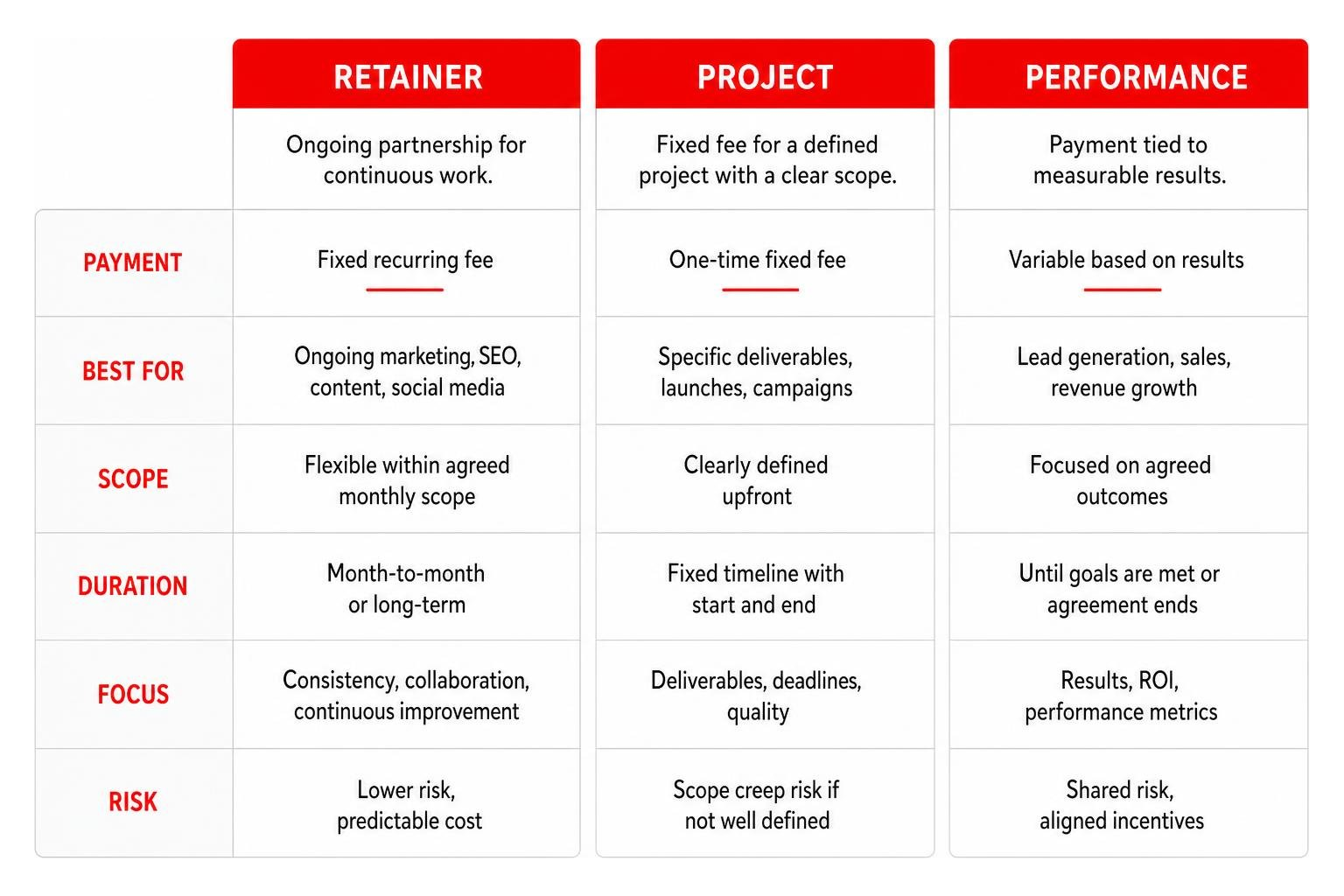
The most common agency billing structures are retainers and project-based fees:
- Monthly Retainers: You pay a fixed fee every month (typically ranging from $2,500 to $15,000+ depending on agency size and scope) for a set allocation of hours or deliverables. This model is excellent for ongoing work like SEO, content creation, and continuous social media management because it offers predictable budgeting for both parties.
- Project-Based Fees: You pay a flat fee for a defined project with a clear start and end date (such as a website redesign or a brand identity package). This requires a highly detailed scope of work to avoid “scope creep,” where extra tasks are added and billed retroactively.
Aligning Incentives with Performance-Based Billing
Some modern marketing agencies offer performance-based pricing, where their compensation is tied directly to the results they generate (such as leads, sales, or revenue share). While this sounds ideal because it minimizes your upfront risk, it requires absolute transparency and agreement on attribution. You must establish exactly what constitutes a qualified lead and how external factors (like seasonal market shifts) are handled.
Regardless of the model, look for agencies that treat your marketing budget with the same discipline they would apply to their own money.
3. What Core Services Do You Provide to Drive 2026 ROI?
The marketing tactics that worked a few years ago are rapidly losing effectiveness. As search engines evolve and social media feeds become more crowded, you need to know exactly which services an agency offers to drive actual business outcomes today.
When looking at Finding the Best SEO and Social Media Services for Your Brand, you must ensure your partner isn’t relying on outdated playbooks.
In-Demand Services: From SEO to Social-First Storytelling
In 2026, search visibility is no longer just about ranking on page one of Google; it is about showing up where your customers are searching, swiping, scrolling, and asking questions. This includes optimizing for AI-driven platforms like ChatGPT and other Large Language Models (LLMs)—a process known as Generative Engine Optimization (GEO) or Answer Engine Optimization (AEO). Modern agencies are seeing massive traffic growth (sometimes over 2,000% increases in referral traffic) by optimizing content specifically for these AI systems.
To capture this traffic, you need an integrated approach:
- Content Creation: Working with specialized Marketing Agencies / Content Marketing Studios to produce high-quality, authoritative content clusters that answer complex search queries.
- Distribution: Utilizing Marketing Agencies / Email Marketing Agencies to nurture leads and deliver personalized content directly to your audience’s inbox.
- Social-First Storytelling: Creating engaging, platform-native video and social content that builds genuine community rather than just broadcasting generic corporate messages.
How Modern Marketing Agencies Balance Creativity and Data
A great agency does not make you choose between beautiful creative work and hard data. Instead, they use data to inform their creativity.
Modern agencies leverage deep audience analysis, consumer roadmapping, and advanced analytics to ensure their creative campaigns are grounded in real-world human behavior. Similarly, some agencies build their strategies around the fact that 80% of consumers discover brands through cultural advocacy and fandom, turning cultural insights into highly engaging participation systems.
Once that creative content drives traffic to your site, you need to convert those visitors. This is where Marketing Agencies / Conversion Rate Optimization come in, using technical A/B testing and user experience data to turn attention into revenue.
4. How Do You Integrate AI and Automation into Your Workflows?
AI is no longer a futuristic buzzword; it is a core component of modern agency efficiency. If your agency is not actively using AI and automation, you are likely paying for manual hours that could be automated, resulting in slower turnaround times and higher costs.
The best agencies use The Ultimate Guide to Digital Marketing AI in 2026 as a roadmap to streamline their workflows and deliver better results.
Leveraging AI for SEO and Content Systems
AI-driven SEO is about speed, scale, and precision. Agencies use AI systems to analyze search intent, map out content gaps, and optimize technical site health at scale.
To see how this works in practice, you can explore:
- The Ultimate Guide to AI Driven SEO Strategy and Systems to understand how machine learning models predict search trends.
- The Best AI SEO Workflow Systems for Modern Marketers to see how agencies automate keyword research and on-page optimization.
By automating these technical tasks, agency strategists can spend less time pulling spreadsheets and more time focusing on your high-level business strategy.
Streamlining Workflows with SOPs and Dashboards
To ensure consistency and quality control, modern agencies rely heavily on structured processes and automated reporting.
- SOP Templates: Ask your agency if they use standardized operating procedures. As outlined in The Secret Sauce Why Your Agency Needs SOP Templates Yesterday, strong SOPs prevent human error and ensure that every campaign deliverable meets strict quality standards.
- AI-Powered Dashboards: You should not have to wait until the end of the month to see how your campaigns are performing. Platforms described in Why Your Agency Needs an AI Powered SEO Dashboard Yesterday provide real-time visibility into your traffic, rankings, and conversions, keeping both teams fully aligned.
Frequently Asked Questions About Marketing Agencies
What is the average cost of hiring a marketing agency in 2026?
Most professional marketing agencies charge monthly retainers between $2,500 and $15,000+ depending on the complexity of your campaigns and the size of the agency. High-end global firms or specialized boutique agencies working on complex enterprise projects can easily exceed $50,000 per month.
How do agencies measure and report campaign ROI?
Top-tier agencies look beyond vanity metrics like “likes,” “impressions,” or “shares.” They measure performance using hard business metrics:
- Customer Acquisition Cost (CAC): How much it costs to acquire a single customer.
- Lifetime Value (LTV): The total revenue a customer generates over their relationship with your brand.
- Return on Ad Spend (ROAS): Direct revenue generated for every dollar spent on paid advertising.
- Organic Search Growth: Consistent increases in high-intent organic traffic and keyword rankings.
Why are some marketer-agency partnerships strained, and how can they be saved?
Many partnerships fail due to poor communication, misaligned expectations, and a lack of transparency. When brands feel like they are shouting into a void and agencies feel micromanaged, the relationship breaks down.
To dive deeper into how technology is helping bridge this gap, read Marketers Agency Partnerships Are Strained Can AI Save the Marriage. By using collaborative AI tools and shared dashboards, agencies and clients can communicate more clearly and work together as true business partners.
Conclusion
Hiring a marketing agency is not about outsourcing your marketing and walking away. It is about finding a strategic growth partner that understands your business goals, respects your budget, and has the technical capability to navigate the rapidly changing digital landscape.
At Clayton Johnson SEO, we focus on helping businesses map and understand their target audiences through strategic content and advanced SEO services. We build custom visibility systems that make sure your brand shows up exactly where your ideal customers are searching.
If you are ready to stop guessing and start growing your organic pipeline, explore our specialized Marketing Agencies solutions today. Let’s build a system that drives real, measurable ROI for your business.