What AI Implementation Really Means for Your Business in 2026
AI implementation is the process of integrating artificial intelligence tools and systems into your business operations to solve real problems and drive measurable results.
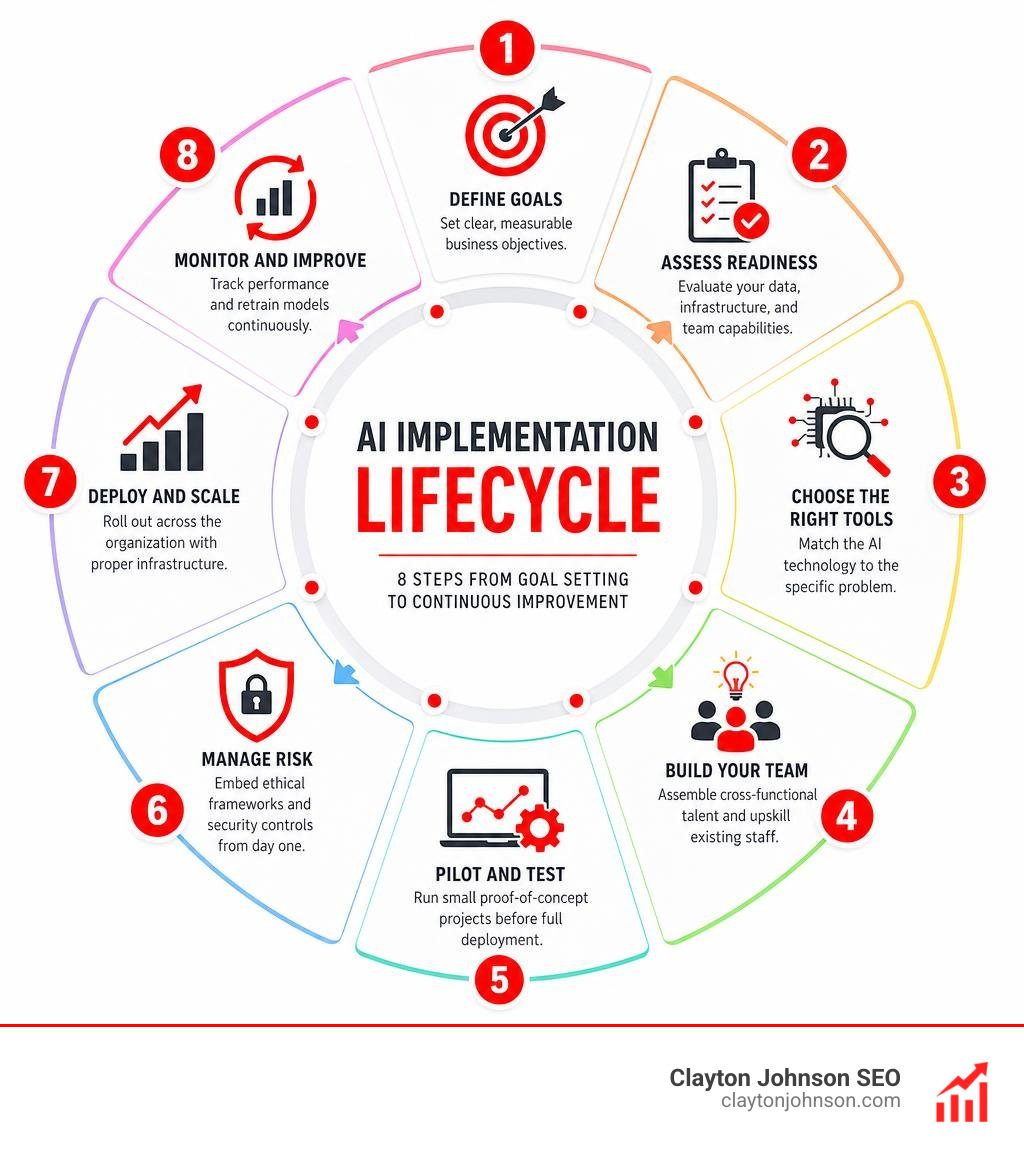
Here is a quick overview of how it works:
- Assess readiness – Evaluate your data, infrastructure, and team capabilities
- Define goals – Set clear, measurable business objectives for AI
- Choose the right tools – Match the AI technology to the specific problem
- Build your team – Assemble cross-functional talent and upskill existing staff
- Pilot and test – Run small proof-of-concept projects before full deployment
- Manage risk – Embed ethical frameworks and security controls from day one
- Deploy and scale – Roll out across the organization with proper infrastructure
- Monitor and improve – Track performance and retrain models continuously
AI is no longer an experimental technology reserved for large enterprises. According to McKinsey, 88% of organizations now use AI in at least one business function. By July 2026, the question is no longer whether to implement AI — it is how to do it well.
The problem is that most businesses rush into AI adoption without a clear plan. They chase the latest tools, skip the foundational work, and end up with systems that underperform or fail entirely.
The good news? A structured approach changes everything. Companies with high AI adoption are seeing a 30% reduction in operational costs, and for every $1 invested in AI, businesses are realizing a $3.50 return. Those numbers are not accidental — they come from organizations that treat AI as a strategic system, not a shiny new toy.
This guide walks you through every stage of that process, from assessing your readiness to measuring ROI after deployment.
I’m Clayton Johnson, an SEO strategist and digital marketing systems architect who has spent over a decade helping businesses build compounding digital infrastructure — including AI implementation systems that connect search visibility, marketing automation, and measurable business growth. This guide draws on both hands-on implementation experience and the latest research to give you a practical, no-fluff roadmap.
Assessing Organizational Readiness and AI Maturity
Before we write a single line of code or sign a software contract, we must ask ourselves a simple, sometimes painful question: Are we actually ready for this?
Too many companies jump headfirst into complex machine learning projects before they have even figured out how to share data between their marketing and sales departments. To help organizations understand where they stand, researchers at the MIT Center for Information Systems Research developed a comprehensive four-stage AI maturity framework.
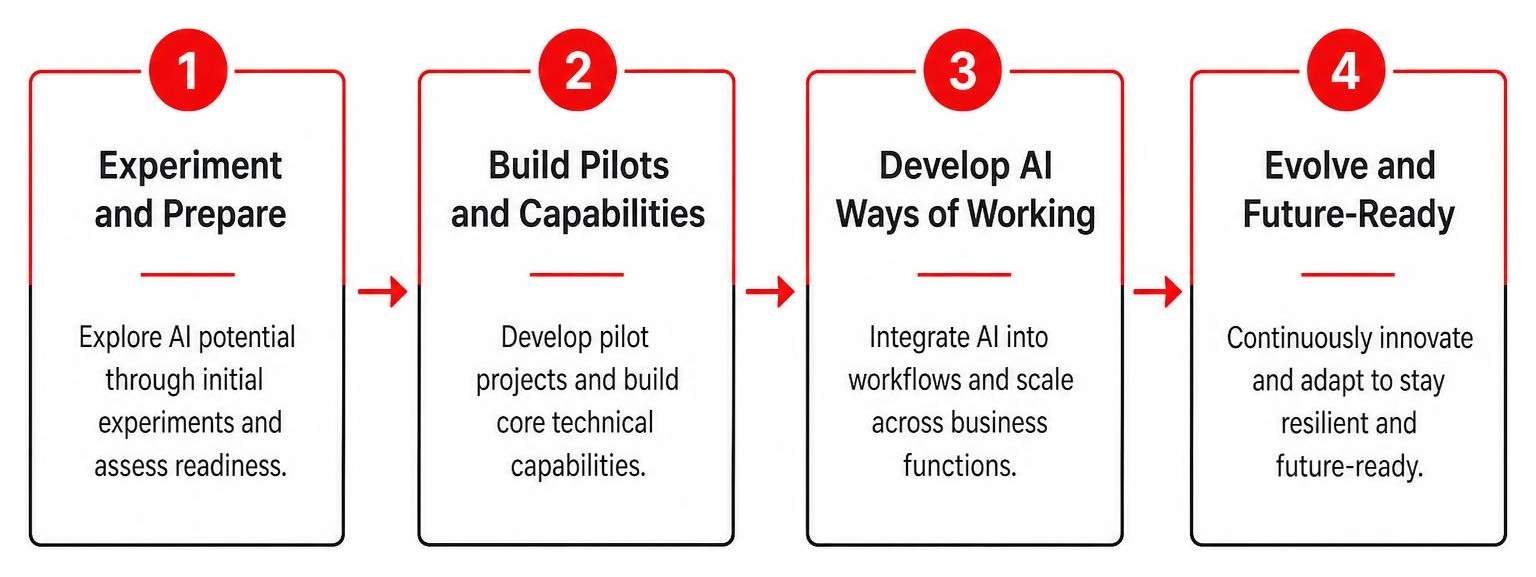
According to MIT’s research, which surveyed 771 companies and interviewed executives across multiple industries, an organization’s maturity level directly correlates with its financial performance:
- Experiment and Prepare: Companies at this stage are just getting their feet wet. They are running basic trials and trying to understand what the technology can do.
- Build Pilots and Capabilities: Here, organizations begin building specialized tools and proving technical feasibility on a small scale.
- Develop AI Ways of Working: At this stage, AI moves out of isolated labs and is integrated into daily business processes.
- Become AI Future-Ready: AI is part of the organizational DNA, driving continuous, automated decision-making across all business units.
An incredibly valuable insight from this study is that companies in the first two stages (experimenting and building pilots) actually perform below their industry average financially. It is only when businesses cross the threshold into stages three and four—where they develop true AI ways of working and become future-ready—that they begin to outperform their competitors.
To make this leap, we must honestly evaluate our organizational readiness across data quality, technical infrastructure, existing talent, and change management.
Evaluating Your Infrastructure and Data Availability
An AI model is only as good as the data we feed it. If we feed a state-of-the-art model messy, incomplete, or siloed data, we will get highly optimized, lightning-fast nonsense in return.
Data silos are the single biggest bottleneck in any modern ai implementation strategy. When customer support logs live in one system, sales histories in another, and website analytics in a third, our AI systems cannot paint a complete picture. To build a solid foundation, we must consolidate data from various systems into a centralized, machine-readable repository.
We also need to evaluate our hosting infrastructure. Should we run our workloads on cloud platforms like AWS, Azure, or Google Cloud, or do we require on-premise hardware for strict compliance? Cloud platforms offer unparalleled scalability and pre-built tools, but they require robust data pipelines to keep information flowing securely.
To dive deeper into how you can plan your technical and strategic foundations without buying into the hype, check out our guide on AI Strategy 101 Don’t Just Buy It Plan It.
Defining Clear Objectives for AI Implementation
Once we understand our maturity level and data availability, we must define exactly what we want our AI systems to achieve. We should never adopt AI just because our competitors are doing it or because a software vendor sent a compelling pitch.
A successful, ROI-driven strategy connects every single technical capability directly to a high-level business goal. We start by identifying specific organizational inefficiencies. For example:
- Are our customer support response times too slow?
- Are our inventory holding costs too high?
- Is our marketing copy failing to convert?
Once we identify the problems, we translate them into precise, measurable metrics. Instead of saying “we want to use AI to improve customer service,” we say “we will deploy an AI-powered assistant to reduce customer inquiry response times by 40% while maintaining a 90% satisfaction rate.”
This clear connection is how leading companies achieve that massive 30% reduction in operational costs. If you want a step-by-step framework for mapping out these goals across your entire organization, read our guide on How to Build a Winning Enterprise AI Implementation Roadmap.
The 8-Step Strategy for Successful AI Implementation
To take your business from AI aspirations to real-world outcomes, we recommend a structured, eight-step implementation strategy. This framework balances technical deployment with the cultural shifts required to make the technology stick.
- Define Goals: Translate your biggest business inefficiencies into precise, measurable technical objectives.
- Assess Data Quality and Accessibility: Perform rigorous data cleaning, break down internal silos, and establish secure data pipelines.
- Choose the Right AI Technology: Determine whether your goals require predictive machine learning, generative AI, or a hybrid of both.
- Build an AI-Proficient Team: Bring together technical specialists and domain experts who understand your business inside and out.
- Foster a Culture of AI Innovation: Encourage open experimentation while actively addressing employee anxieties about automation.
- Manage Risks and Build Ethical Frameworks: Establish strict data privacy controls and guidelines for responsible tool usage.
- Test and Evaluate Models: Run small-scale pilot projects and validate performance using separate testing datasets.
- Plan for Scalability and Continuous Improvement: Deploy your solutions using flexible infrastructure and set up automated monitoring to catch performance drops.
This structured approach ensures that you build systems that scale naturally. For a deeper, jargon-free look at how this process works in a real business environment, explore The Non-Robotic Guide to Implementing AI in Business.
Building a Cross-Functional AI Team and Culture
One of the most common mistakes we see is treating ai implementation as a project that belongs solely to the IT department. If your technical team builds an incredibly advanced tool without input from the people who will actually use it, the project will fail.

We need to build a cross-functional team that brings together three distinct perspectives:
- The Technical Drivers: Data scientists, machine learning engineers, and software developers who understand model architectures and system integrations.
- The Business Champions: Domain experts from sales, marketing, finance, or HR who deeply understand the workflows we are trying to optimize.
- The Operational Overseers: IT specialists and security officers who ensure the systems are secure, compliant, and well-integrated.
Building this team does not mean you have to run out and hire an expensive army of external specialists. In fact, upskilling your existing team is often far more cost-effective and helps retain invaluable institutional knowledge.
When upskilling, we recommend focusing on the EPOCH framework—five core human capabilities that complement AI rather than being replaced by it:
- Empathy: Understanding human emotions and building deep relationships.
- Personalization: Tailoring experiences and communication to unique human needs.
- Observation: Noticing subtle patterns and contextual details that data might miss.
- Collaboration: Facilitating teamwork and alignment across different departments.
- Holistic Thinking: Seeing the big picture and understanding how different systems interact.
By combining technical AI capabilities with these fundamental human skills, we create roles that are incredibly resilient to automation. If you want to learn how to communicate these concepts to your team without getting bogged down in confusing technical terms, read AI Strategy and Implementation for People Who Hate Jargon.
Developing and Testing Proof of Concepts (PoCs)
Before we deploy an AI system across our entire organization, we must validate our assumptions in a low-risk environment. We do this by developing a Proof of Concept (PoC) or a Minimum Viable Product (MVP).
The goal of a PoC is to quickly test whether a specific AI technology can solve our chosen problem. We start by selecting a narrow, high-impact use case. For example, instead of trying to automate our entire marketing department, we might build a PoC that specifically generates meta descriptions and title tags for our website.
During this phase, we must split our data into separate training, validation, and testing sets. This ensures we can evaluate our model’s performance on entirely new data, checking metrics like precision, recall, and F1 scores to ensure accuracy.
Once the PoC proves successful, we can confidently scale it into a full MVP. If you want to see how we apply this exact testing methodology to complex marketing systems, check out our guide on How to Win at Implementing AI Marketing Systems.
Balancing Generative AI vs. Traditional Machine Learning
With the explosive rise of generative AI over the last few years, it is easy to assume that large language models (LLMs) are the answer to every business problem. However, using a massive generative model to solve a simple forecasting problem is like using a rocket ship to drive to the grocery store—it is incredibly expensive, highly inefficient, and completely unnecessary.
To build an efficient ai implementation strategy, we must understand when to use generative AI and when to rely on traditional machine learning.
| Technology Type | Best Suited For | Core Capabilities | Typical Business Use Cases |
|---|---|---|---|
| Generative AI | Unstructured data, content creation, conversational interfaces | Creating text, images, code; summarizing documents; natural language search | Chatbots, drafting marketing copy, automated code generation, document synthesis |
| Traditional Machine Learning | Structured data, pattern recognition, predictive modeling | Classification, regression, clustering, anomaly detection | Sales forecasting, fraud detection, customer churn prediction, dynamic pricing |
In many cases, the most powerful enterprise systems are hybrids that combine both technologies. For example, a retail business might use traditional machine learning to predict which products will face inventory shortages, and then use generative AI to draft automated purchase orders and supplier emails to resolve the issue.
Leveraging Open-Weight Models for Custom AI Implementation
In the early days of the generative AI boom, businesses had to rely almost entirely on closed-source, proprietary APIs. While these APIs are still excellent for quick prototyping, building a highly customized, cost-effective enterprise system in 2026 often means looking to open-weight models.
The open-source AI landscape has evolved rapidly, shifting from simple text generation to highly complex “agentic engineering”—systems capable of planning, using tools, and executing multi-step tasks over long horizons.
If you are planning a custom deployment, several open-source repositories and model families are leading the industry:
- OpenAI GPT-OSS: OpenAI’s open-weight reasoning models, accessible via the openai/gpt-oss repository, provide developers with incredible reasoning and agentic capabilities. These models use advanced quantization formats like MXFP4, allowing massive models to run efficiently on enterprise hardware.
- MiniMax-M2.5: Known for turning the promise of “intelligence too cheap to meter” into a reality, this model can be explored via the MiniMax-AI/MiniMax-M2.5 repository. It is highly cost-effective, running at a fraction of the cost of comparable closed models while delivering incredible performance on coding and office automation tasks.
- Tencent Hunyuan Hy3: This massive Mixture-of-Experts (MoE) model, available in the Tencent-Hunyuan/Hy3 repository, is engineered for production-grade reliability, offering incredible tool-calling stability and a massive reduction in model hallucinations.
- GLM-5: For businesses tackling long-horizon engineering tasks, the zai-org/GLM-5 repository introduces models designed to sustain optimization and tool execution over hundreds of rounds, supporting a massive 1-million-token context window.
By leveraging these open-weight models, we can keep our data entirely within our own secure environments while avoiding expensive API call costs.
Infrastructure, Data Management, and Security Considerations
As we transition from pilot projects to full-scale enterprise systems, our underlying infrastructure must be incredibly secure, reliable, and scalable.

To support this, we must build robust Machine Learning Operations (MLOps) pipelines. MLOps is the practice of unifying machine learning model development with software engineering and IT operations. This ensures we can automate the deployment, monitoring, and retraining of our models.
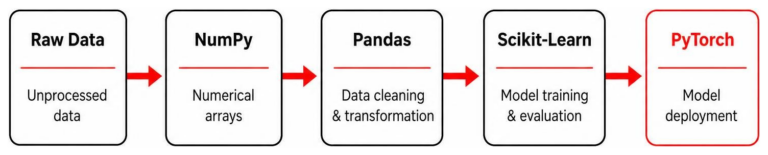
When building these pipelines, developers rely on core deep learning libraries like pytorch/pytorch to build and train models with strong GPU acceleration. To optimize the underlying system software for these deep learning workloads, researchers are even using AI agents to generate entire system stacks, as demonstrated in the NVlabs/vibetensor project.
On the security side, we must protect our data and models by applying strict security controls:
- Zero Trust Framework: Never trust, always verify. Every user, device, and API call must be authenticated and authorized.
- Data Lineage Tracking: Maintain a clear, auditable trail of how data moves through your systems, ensuring transparency and compliance.
- Privacy-by-Design: Embed data privacy controls directly into your storage and processing systems, ensuring sensitive data is encrypted at rest and in transit.
Mitigating Common Challenges in AI Deployment
Even with the best planning, deploying AI systems in the real world comes with challenges. The three most common hurdles we see are model drift, poor data quality, and integration friction.
- Model Drift: This occurs when the real-world data our model encounters begins to change, causing the model’s predictions to become less accurate over time. We mitigate this by setting up automated performance dashboards and scheduling regular model retraining.
- Data Quality: If our inputs are messy, our outputs will be too. We must establish automated data-cleaning pipelines that flag missing values, remove duplicates, and validate data formats before they ever reach our models.
- Integration Friction: Employees are often slow to adopt new tools if they disrupt their existing workflows. We must focus on building seamless integrations that place AI directly inside the software our team already uses every day.
By proactively addressing these challenges, we can build highly resilient systems. If you want to see how we apply these robust data and optimization frameworks to search engine optimization, read Your Step-by-Step AI SEO Implementation Guide.
Ethical Frameworks and Risk Management
We cannot talk about ai implementation without addressing ethics and risk management. As these systems make more decisions that impact our customers and employees, we must ensure they operate fairly, transparently, and in full compliance with the law.
First, we must comply with strict data privacy regulations like GDPR in Europe and CCPA in California. These laws dictate how we can collect, store, and process sensitive user data. If our AI models train on personal data without proper consent, we risk massive legal and financial penalties.
Second, we must actively mitigate bias in our models. AI models learn from historical data, and if that historical data contains human biases, the model will replicate and amplify them. We must establish a cross-functional AI ethics committee to oversee our projects, conduct regular fairness testing, and ensure our systems explain how they reached a specific decision.
To learn how to build a practical, responsible framework that protects your brand and builds trust with your audience, explore our comprehensive guide on Charting the Course for Ethical AI Implementation.
Measuring ROI and Ensuring Continuous Post-Deployment Improvement
How do we know if our ai implementation was actually successful? We must continuously measure our Return on Investment (ROI) and refine our systems post-deployment.
As we noted earlier, the financial returns of a well-executed AI strategy are massive, with companies realizing an average of $3.50 for every $1 invested. Furthermore, generative AI is delivering an incredible 44% to 54% increase in human productivity across administrative functions like human resources, procurement, and finance.
To track these results in your own business, we recommend setting up automated performance dashboards. These dashboards should track both technical metrics (like model latency, API costs, and prediction accuracy) and business metrics (like hours saved, support ticket resolution times, and conversion rates).
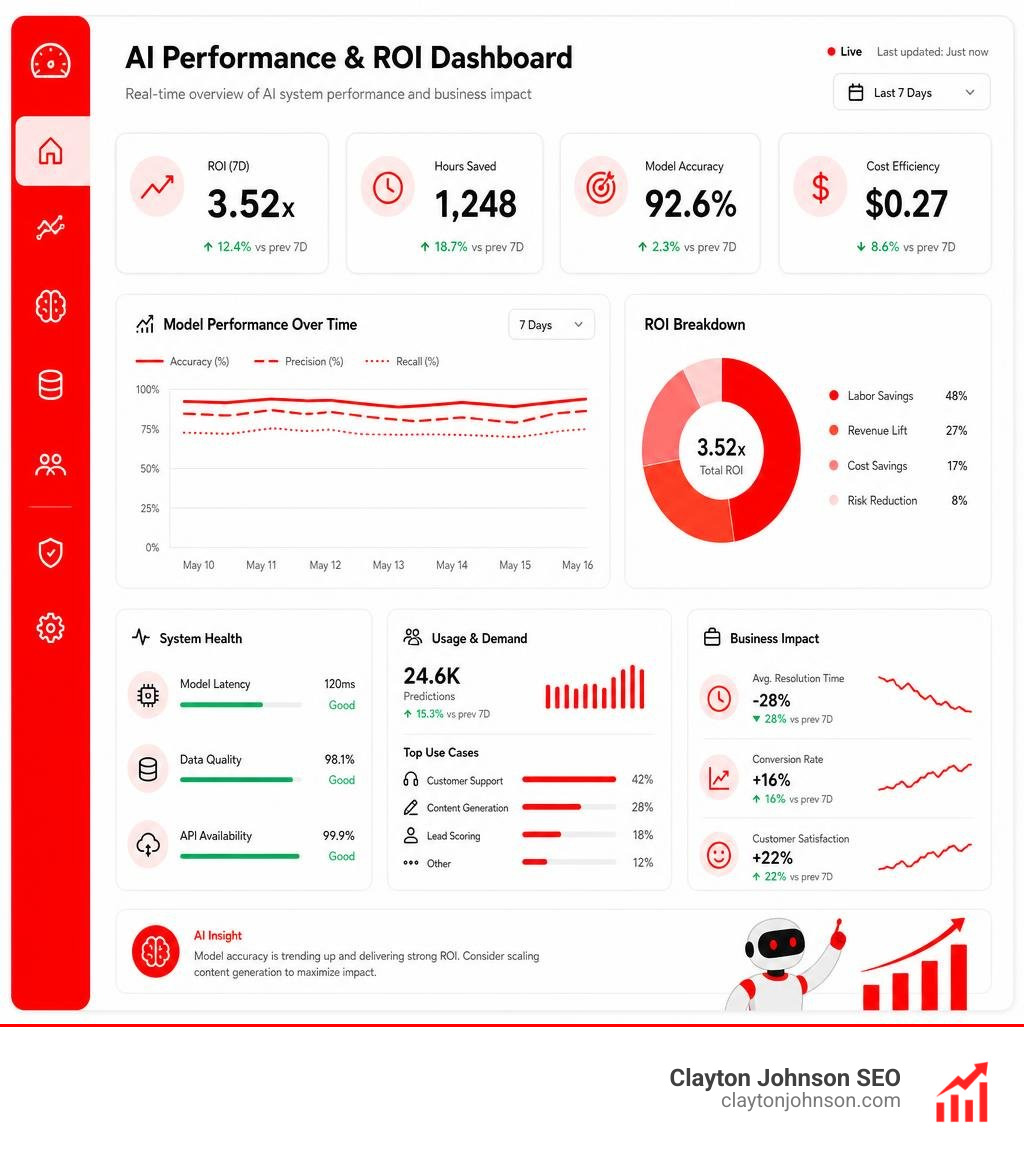
Finally, we must remember that deployment is not the finish line. AI systems require continuous maintenance. We must monitor our models for drift, regularly update them with fresh data, and constantly seek feedback from our team to find new ways to improve.
Frequently Asked Questions about AI Implementation
What is the average ROI of an enterprise AI implementation?
On average, companies realize a $3.50 return for every $1 invested in AI. Furthermore, businesses with high AI adoption rates see a 30% reduction in operational costs and massive productivity gains, particularly in back-office and customer-facing functions.
How do we choose between building custom models or using pre-trained APIs?
For quick prototyping and standard tasks (like basic text generation), pre-trained APIs are highly cost-effective and easy to set up. However, if you require strict data privacy, have highly specialized industry data, or want to avoid ongoing API call costs, leveraging open-weight models and applying transfer learning is often the best long-term strategy.
What are the biggest security risks during AI deployment?
The biggest risks include data leaks (where sensitive customer data is accidentally exposed or used to train public models), model vulnerabilities (like prompt injection attacks), and compliance violations (such as failing to meet GDPR or CCPA standards). Implementing a Zero Trust framework and tracking data lineage are critical for mitigating these risks.
Conclusion
Successfully implementing AI is not about buying the trendiest software or trying to automate your entire business overnight. It is about taking a deliberate, structured approach that aligns powerful technical tools with your core business objectives.
By assessing your readiness, building a cross-functional team, maintaining clean data pipelines, and continuously monitoring your systems, you can build AI infrastructure that drives measurable, compounding growth.
At Clayton Johnson SEO, we help businesses map and understand their target audiences through strategic content and search engine optimization. We build digital marketing systems that turn search visibility into predictable business revenue. If you want to make sure your AI tools and marketing systems are built on best practices without going off course, read our guide on AI Implementation Best Practices Don’t Let Your Bot Go Rogue.