Why Artificial Intelligence Python Code Is the Skill Every Developer Needs Right Now
Artificial intelligence Python code is the foundation of nearly every modern AI application — from chatbots and recommendation engines to autonomous agents and large language models.
Here is a quick look at what you can build and which tools matter most:
| Goal | Key Tool or Library | Why It Matters |
|---|---|---|
| Machine learning models | scikit-learn, PyTorch, TensorFlow | Train and deploy predictive models |
| LLMs from scratch | Pure Python or PyTorch | Understand transformers at the code level |
| AI coding assistance | GitHub Copilot, Cursor | Write and debug code up to 40% faster |
| AI agents | Google Gemini SDK, OpenAI API | Build autonomous, task-completing programs |
| Neuro-symbolic AI | SymbolicAI | Combine logic and LLMs in Python |
| Biologically-inspired AI | Modular architectures, genetic algorithms | Build adaptive, evolving AI systems |
Python has become the dominant language for AI development — and for good reason. Its readable syntax, massive library ecosystem, and active community make it the fastest path from idea to working model. Whether you want to fine-tune a language model, build an agent that fixes its own bugs, or understand exactly how a transformer works under the hood, Python is where it happens.
The pace of change is real. Senior developers today spend up to 50% of their time on tasks like writing unit tests and docstrings — work where AI tools now achieve a 96% success rate. That shift is reshaping how Python code gets written, reviewed, and shipped.
This guide cuts through the noise and gives you a practical, code-level map of the AI Python landscape in 2026.
I’m Clayton Johnson, an SEO strategist and technical marketer who works at the intersection of search, content, and artificial intelligence Python code applications to help businesses build smarter digital systems. In this guide, I’ll walk you through the essential libraries, tools, architectures, and best practices you need — whether you’re just starting out or scaling up.
Essential Libraries for Artificial Intelligence Python Code
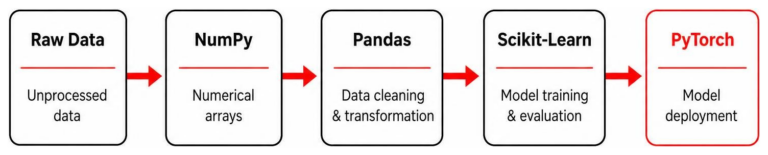
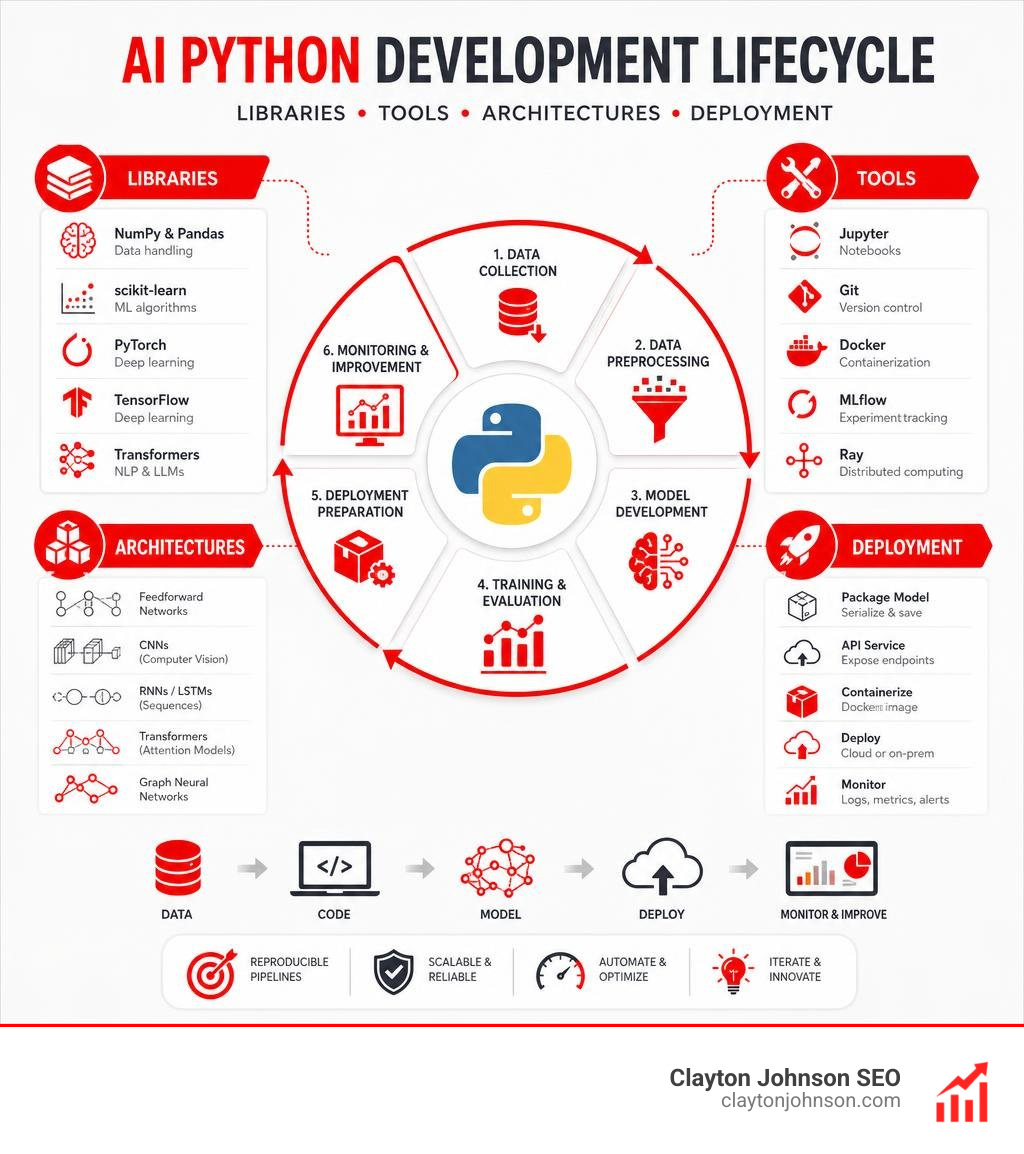
When we begin our journey into artificial intelligence Python code, we quickly realize that we do not have to build everything from scratch. The Python ecosystem is packed with specialized libraries designed for different stages of the AI lifecycle.
For classical machine learning and statistical modeling, scikit-learn remains the gold standard. It is built on top of NumPy and SciPy, making it incredibly efficient for tasks like classification, regression, clustering, and data preprocessing. If you are predicting house prices, classifying customer churn, or analyzing simple numerical datasets, scikit-learn is your best starting point.
When your projects scale to deep learning, neural networks, and computer vision, you will need to transition to PyTorch or TensorFlow. PyTorch has captured the hearts of researchers and modern developers alike due to its dynamic computation graphs and Pythonic design. It feels like native Python, which makes debugging much more intuitive. TensorFlow, backed by Google, remains a powerful competitor, particularly in massive enterprise settings where rigid production pipelines and static graphs are preferred.
In 2026, the frontier of AI is moving toward neuro-symbolic AI. Traditional deep learning excels at pattern recognition but struggles with strict logic and reasoning. Conversely, classical symbolic AI excels at logic but cannot learn from raw data. Neuro-symbolic AI bridges this gap by combining the differentiable, learning-focused nature of Large Language Models (LLMs) with logical rules.
A prime example of this paradigm is the SymbolicAI framework, which you can explore further at GitHub – BhodiSea/symbolicai: Compositional Differentiable Programming Library · GitHub . SymbolicAI allows us to write neuro-symbolic Python code naturally. It introduces the concept of Symbols, which can operate in either a syntactic (standard Python) or semantic (LLM-driven) mode. For instance, a Symbol representing text can perform normal string operations, but with a simple semantic trigger, it can map a list of fruits to vegetables conceptually, or perform fuzzy equivalence tests.
To make these semantic operations reliable, SymbolicAI leverages Design by Contract principles. In traditional software engineering, contracts ensure that functions receive valid inputs and return valid outputs. In the context of LLMs, contracts are used to prevent hallucinations. By using validation constraints and pre- or post-remedy decorators, developers can automatically catch bad LLM outputs, trigger retries, and clean up formatting issues before they break the application.
To find more open-source options for your stack, check out our Best Open Source AI Coding Tools Guide.
Accelerating Development with AI-Powered Code Generators
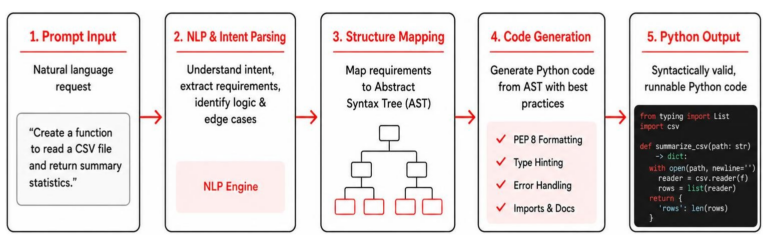
Writing artificial intelligence Python code does not mean staring at a blank text editor. Modern AI-powered code generators have fundamentally changed how we write, debug, and optimize our software.

Tools like GitHub Copilot, Cursor, and Windsurf act as highly capable execution partners. GitHub Copilot integrates seamlessly into traditional IDEs, offering inline autocompletions that can generate code up to 40% faster than coding manually. For developers who want a more immersive AI experience, AI-native editors like Cursor and Windsurf offer multi-file reasoning capabilities.
Instead of just autocompleting a single line, these advanced editors can analyze your entire project directory. They use index-aware context to understand how your database models, API endpoints, and frontend components interact. This allows you to prompt the AI to build complete features across multiple files simultaneously, such as adding a JWT authentication layer across your entire Flask or FastAPI backend.
Using these tools effectively cuts debugging time in half and allows us to refactor entire modules in seconds. To explore the best tools available for this workflow, check out The Best AI for Coding and Debugging and see how easy it is to get started with our guide on Python Code Generation with AI Made Easy.
Writing and Debugging Artificial Intelligence Python Code
To get the most out of AI code generators, we must move beyond simple, single-sentence prompts. Effective prompt engineering involves providing clear context, specifying input/output formats, and defining constraints.
One of the most powerful strategies for high-quality generation is dual-model logic. This involves using one LLM (such as GPT-4o) to generate your initial Python code, and a second, different LLM (such as Claude 3.7) to audit and review the generated output. This dual-model approach is incredibly effective at spotting subtle logical errors, edge cases, and hallucinations before the code ever reaches a human reviewer.
Another best practice is test-driven prompting. Instead of asking the AI to write a function directly, first ask it to generate a comprehensive suite of Pytest unit tests that cover edge cases, boundary conditions, and potential error states. Once the tests are written, pass them back to the AI and ask it to write the Python function that passes all of those tests. This dramatically reduces the verification bottleneck and ensures your code is robust from day one.
For a humorous yet highly practical look at automated refactoring, read our guide on Code Refactoring with Claude AI for the Lazy but Brilliant.
Optimizing Artificial Intelligence Python Code
AI assistants are not just for writing new code; they are exceptionally good at optimizing legacy codebases. If you inherit a massive, undocumented Python repository, you can use an index-aware AI tool to parse the entire codebase, map the dependencies, and explain how the modules interact.
When refactoring legacy code, AI can automatically update outdated string formatting to modern f-strings, convert synchronous code to asynchronous structures using asyncio, and ensure compliance with PEP 8 style standards. By automating these repetitive formatting and optimization tasks, we can focus our mental energy on high-level architecture and system design.
For a deeper dive into optimizing your code with state-of-the-art models, take a look at our Claude AI Code Completion Guide.
Building a Transformer Language Model from Scratch
While calling API endpoints is sufficient for many applications, truly mastering artificial intelligence Python code requires understanding how large language models are built from the ground up.
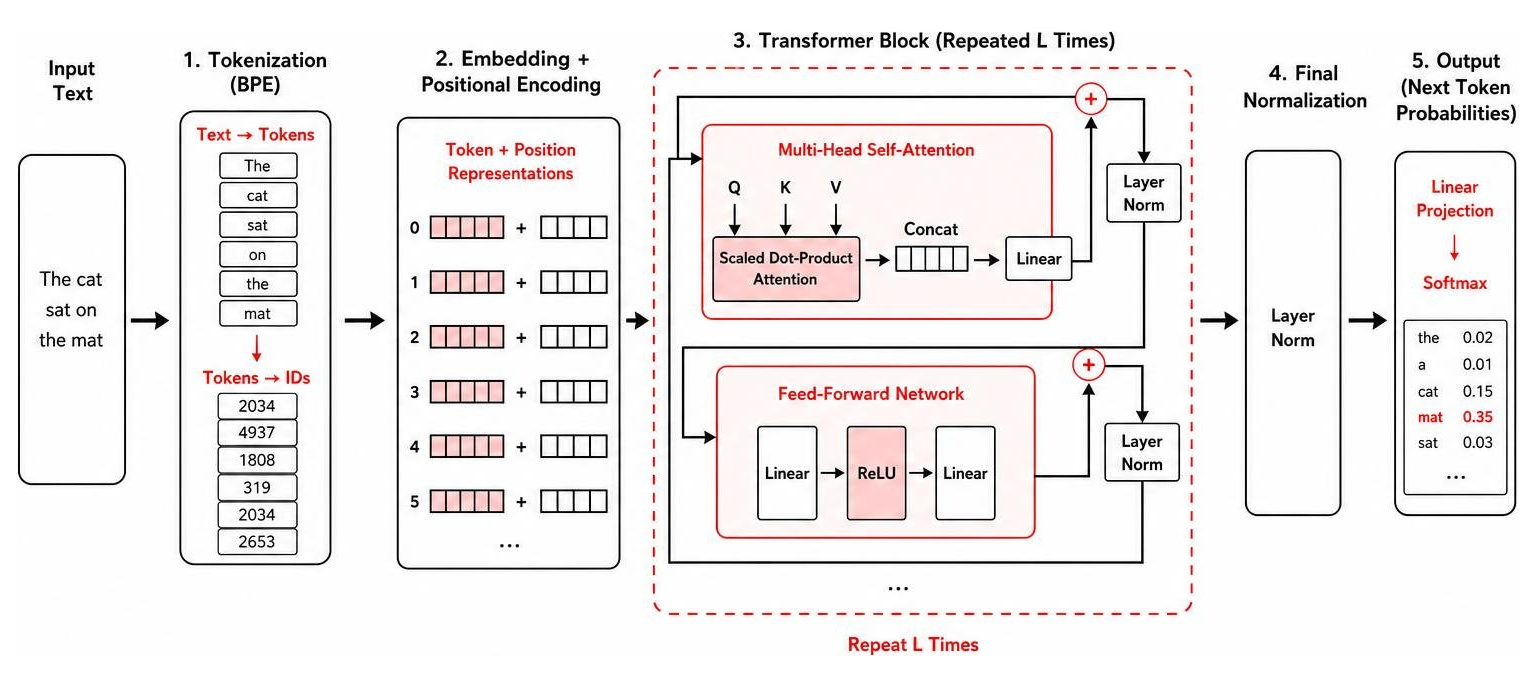
Building a Generative Pre-trained Transformer (GPT) model from scratch forces us to understand the mathematical mechanics of AI without relying on high-level framework abstractions. To see complete, educational implementations of this process, you can explore the highly detailed raiyanyahya/how-to-train-your-gpt repository, which features over 7,500 lines of fully commented code. Additionally, the andresveraf/Build-GPT-model-with-Python repository provides a pure Python, dependency-free implementation of a character-level GPT model.
The pipeline of a transformer model consists of several key components:
First, we have tokenization. Raw text must be converted into numerical representations. Modern LLMs use Byte Pair Encoding (BPE), a subword tokenization algorithm that splits words into common subwords. This allows the model to handle unseen words, typos, and emojis gracefully without needing an infinitely large vocabulary.
Once tokenized, the integers are mapped to dense vector representations called embeddings. These embeddings position words in a high-dimensional space where words with similar meanings are clustered close to one another.
To stabilize the training of deep transformer networks, we use normalization layers. While older architectures used LayerNorm, modern models favor RMSNorm (Root Mean Square Normalization). RMSNorm is approximately 15% faster because it only scales the inputs by their root mean square, skipping the mean-centering step while remaining equally effective at preventing gradient explosions.
For the feed-forward network within each transformer block, modern architectures use the SwiGLU activation function. SwiGLU combines the Swish activation function with Gated Linear Units, providing smoother gradient flow and better learning capacity compared to traditional ReLU activations.
Implementing Attention Mechanisms in Artificial Intelligence Python Code
The core engine of any transformer is the self-attention mechanism. Self-attention allows the model to weigh the relevance of different words in a sentence relative to a target word, regardless of how far apart they are.
This is achieved through Query, Key, and Value (QKV) computations. For each token, the model projects its embedding into three vectors: a Query (what the token is looking for), a Key (what the token contains), and a Value (the actual content). By calculating the dot product of the Queries and Keys, the model computes attention scores, applies a scaling factor, and runs them through a Softmax function to produce a weighted sum of the Values.
To preserve the sequential order of words, we must inject positional information. Modern models use Rotary Position Embedding (RoPE). Instead of adding static positional values to the embeddings, RoPE rotates the Query and Key vectors in complex space. This elegant approach captures the relative distance between tokens purely through vector rotation, eliminating the need for learned positional parameters.
Finally, when deploying these models for real-time inference, speed is critical. Generating text token-by-token is computationally expensive because the model must recompute the attention matrices for all previous tokens at every step. To solve this, we implement Key-Value (KV) caching. KV caching stores the Key and Value vectors of past tokens in memory, ensuring that we only compute the QKV vectors for the newly generated token. This simple optimization dramatically accelerates inference speeds in production environments.
Biologically-Inspired Modular AI Architectures
As we look beyond monolithic, single-prompt language models, we enter the realm of biologically-inspired modular AI. Instead of relying on one massive neural network to handle everything, we can build systems comprised of smaller, highly specialized modules that interact dynamically.

A fascinating implementation of this approach is the Lilith architecture, which you can study in detail at nhlpl/LiliAI . This framework demonstrates how to combine LLMs, neurotransmitter-inspired signaling, and evolutionary optimization in a modular Python codebase.
In a modular brain-inspired architecture, we divide our AI agent into distinct “brain regions”:
- Sensory Module: Receives raw inputs from the environment and translates them into structured signals.
- Thinking Module: Processes complex reasoning tasks by interacting with LLMs.
- Memory Module: Manages short-term state and retrieves long-term semantic context.
- Regulatory Module: Acts as the emotional and physiological core of the agent.
What makes this setup unique is how these modules communicate. Rather than passing simple text strings, they exchange signals modulated by simulated neurotransmitters like dopamine, serotonin, and norepinephrine.
In Python, we can implement these neurotransmitters as float variables bounded between 0.0 and 1.0. These values dynamically alter how the other modules behave. For example, a high level of dopamine (simulating reward or excitement) might increase the agent’s exploration rate, while a high level of serotonin (simulating satisfaction) might reduce its urgency.
In the Thinking Module, we can use these chemical signals to adjust the LLM’s parameters in real-time. An inhibitory signal might lower the temperature of the LLM call, making the output highly conservative, precise, and cautious. Conversely, an excitatory signal might raise the temperature, encouraging creative, non-linear problem-solving.
To optimize these complex, multi-module systems, we can use genetic algorithms. Instead of manually tuning the prompt templates, signal thresholds, and learning rates of our modules, we can represent these parameters as a digital “genome.” By running populations of agents through simulated environments, evaluating their performance, and applying crossover and mutation operations, we can evolve highly optimized AI agents over successive generations.
Best Practices for Training, Fine-Tuning, and Deploying AI Models
Building a model is only half the battle; deploying it safely and efficiently in a production environment is where engineering rigor is truly tested.
When scaling up your deployment pipeline, keep these best practices in mind:
- Use Parameter-Efficient Fine-Tuning (PEFT): Instead of updating all billions of parameters in a model, use Low-Rank Adaptation (LoRA). LoRA freezes the original model weights and injects small, trainable rank-decomposition matrices into the attention layers, reducing training memory requirements by up to 3x.
- Enforce Strict Path Sandboxing: If your AI agent has the ability to read, write, or execute files on a local system, you must jail its file operations. Never allow the LLM to define file paths directly, as this makes the system vulnerable to path traversal attacks. Always resolve and validate paths server-side within a secure, isolated directory.
- Optimize API Integrations: When connecting to commercial LLMs, structure your API calls efficiently. While legacy codebases still reference the standard Completions endpoint, modern production applications should use ChatCompletions. You can inspect the underlying structure of these API requests in the official SDK files at src/openai/resources/completions.py .
- Design Framework-Free Agentic Loops: Heavy orchestration frameworks can add unnecessary latency and complexity to your application. Building lightweight, native Python agentic loops allows you to maintain full control over conversation history, tool registration, and error handling. You can study a production-grade, framework-free coding agent at Adrianbrou/AI-AGENT .
For a complete overview of the commercial and open-source tooling landscape, check out The Ultimate Guide to Generative AI Coding Tools.
Frequently Asked Questions about AI Python Coding
Navigating the rapidly evolving world of AI and Python can be challenging. Here are answers to some of the most common questions developers face.
Can AI tools help debug Python code automatically?
Yes, modern AI tools are incredibly efficient at automated debugging. By analyzing the contextual flow of your program, AI assistants can quickly spot syntax errors, logical bugs, and unhandled edge cases. When an error occurs, you can feed the traceback directly into the AI to receive real-time feedback, an explanation of why the bug occurred, and a clean, refactored solution.
How do you build an AI agent in Python without frameworks?
To build an AI agent without heavy frameworks, you need to implement a simple, continuous execution loop known as an agentic loop. First, define a tool registry in Python, which is a collection of standard Python functions (like searching a directory or running a test) mapped to JSON schemas that describe their parameters.
When you pass a task to the LLM, it returns a structured JSON object describing which tool to call and with what arguments. Your local Python runtime parses this description, executes the actual code, converts the result into a string, appends it to the conversation history, and sends it back to the LLM. The loop continues until the LLM determines the task is complete.
What is the difference between temperature and top_p in text generation?
Temperature and top_p are sampling parameters that control the randomness of the model’s text generation:
- Temperature: Scales the raw logits before they are passed to the Softmax function. A temperature closer to 0 makes the output highly deterministic and focused on the most likely tokens, while a temperature closer to 1.0 or higher increases randomness and creativity.
- top_p (Nucleus Sampling): Limits the pool of candidate tokens to those whose cumulative probability meets a specific threshold. For example, a top_p of 0.1 means the model will only consider the top 10% most probable tokens, discarding the rest.
It is highly recommended to adjust either temperature or top_p, but never both simultaneously, as they can interfere with one another and produce unpredictable outputs.
Conclusion
Mastering artificial intelligence Python code is no longer just about writing manual algorithms; it is about knowing how to orchestrate libraries, build solid architectures, and leverage AI code generators to accelerate your development workflow. From neuro-symbolic logic to biologically-inspired agents, Python remains the ultimate playground for modern AI innovation.
At Clayton Johnson, we are an SEO agency that helps companies map, understand, and capture their target developer audiences through strategic content and advanced SEO services. Building high-performance digital systems requires both technical depth and a clear market strategy.
If you are ready to build advanced, custom SEO and content strategies tailored to your target audience, explore our Clayton Johnson AI Coding Services and let us help you map your path to search success.