What a Search Engine Consultant Actually Does (And Why It Matters)
A search engine consultant is a strategic advisor who helps businesses improve how they appear in search results — and ultimately attract more qualified customers online.
Quick answer for small business owners:
| Question | Answer |
|---|---|
| What do they do? | Audit your site, research keywords, build an SEO strategy, and guide execution |
| Who needs one? | Businesses losing traffic, scaling up, redesigning a site, or struggling to generate leads |
| How are they different from an SEO specialist? | Consultants set strategy; specialists execute the technical work |
| How much do they cost? | Roughly $300–$1,500+/month depending on scope and experience |
| How long until results? | Most businesses see meaningful progress within 3–6 months |
| Biggest risk of hiring wrong? | Black-hat tactics can get your site penalized or removed from Google entirely |
Over 68% of online experiences start with a search engine. Yet nearly 70% of marketers say attracting quality traffic is their single biggest challenge. That gap — between where customers are looking and where businesses actually show up — is exactly the problem a search engine consultant is hired to close.
The stakes are real. Done right, SEO can cost 87% less per customer acquired than paid search. Done wrong — or handed to the wrong person — it can actively damage your site’s standing with Google for months or years.
This guide breaks down exactly what a search engine consultant does, when you need one, how to hire the right one, and what it should cost.
I’m Clayton Johnson, a technical SEO strategist and founder of SmallBizSEO with over a decade of experience working as a search engine consultant for small businesses, service providers, and growing brands. My work sits at the intersection of site architecture, content strategy, local search, and AI search optimization — focused on turning search visibility into real revenue.
What is a Search Engine Consultant and What Do They Do?
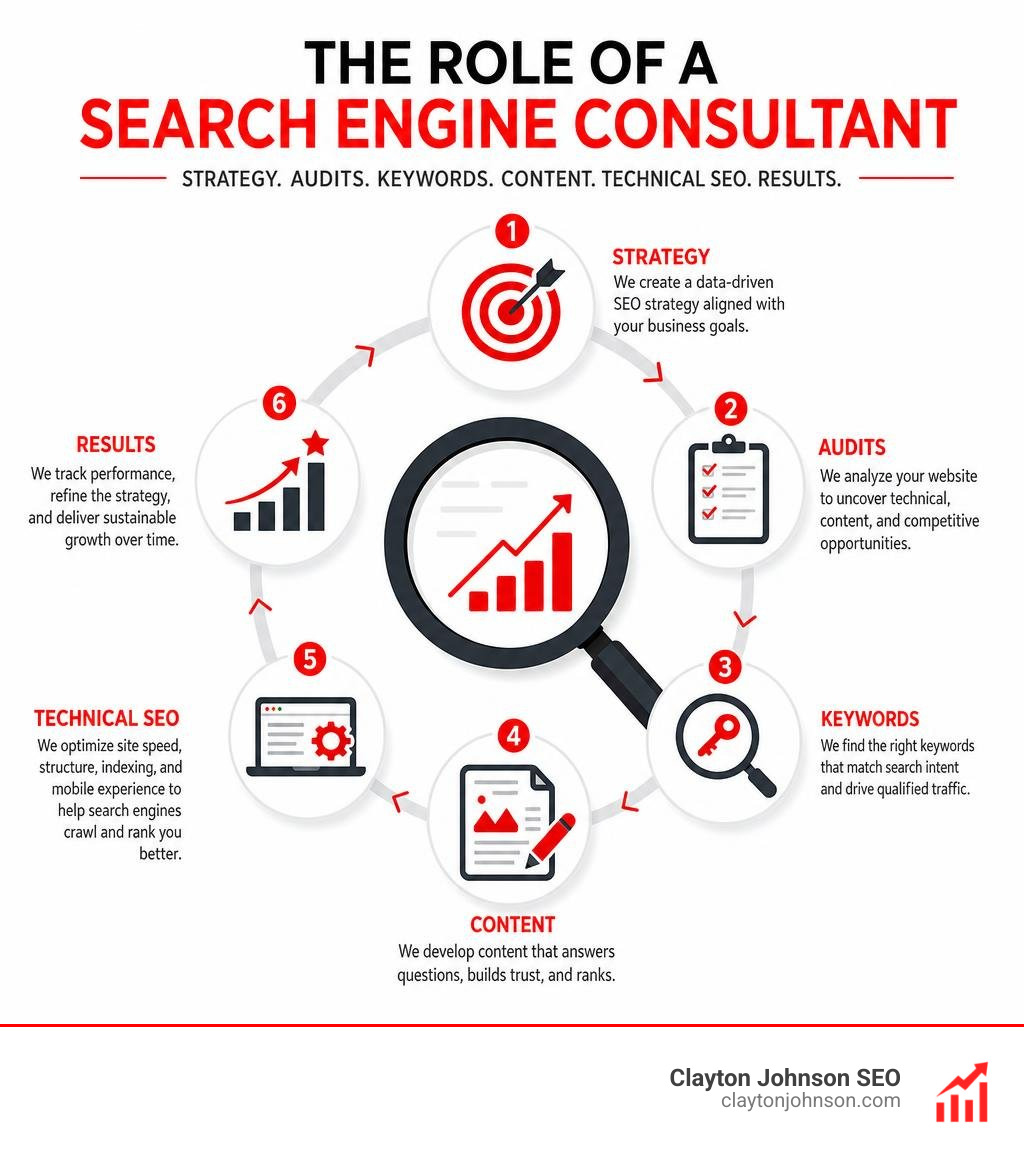
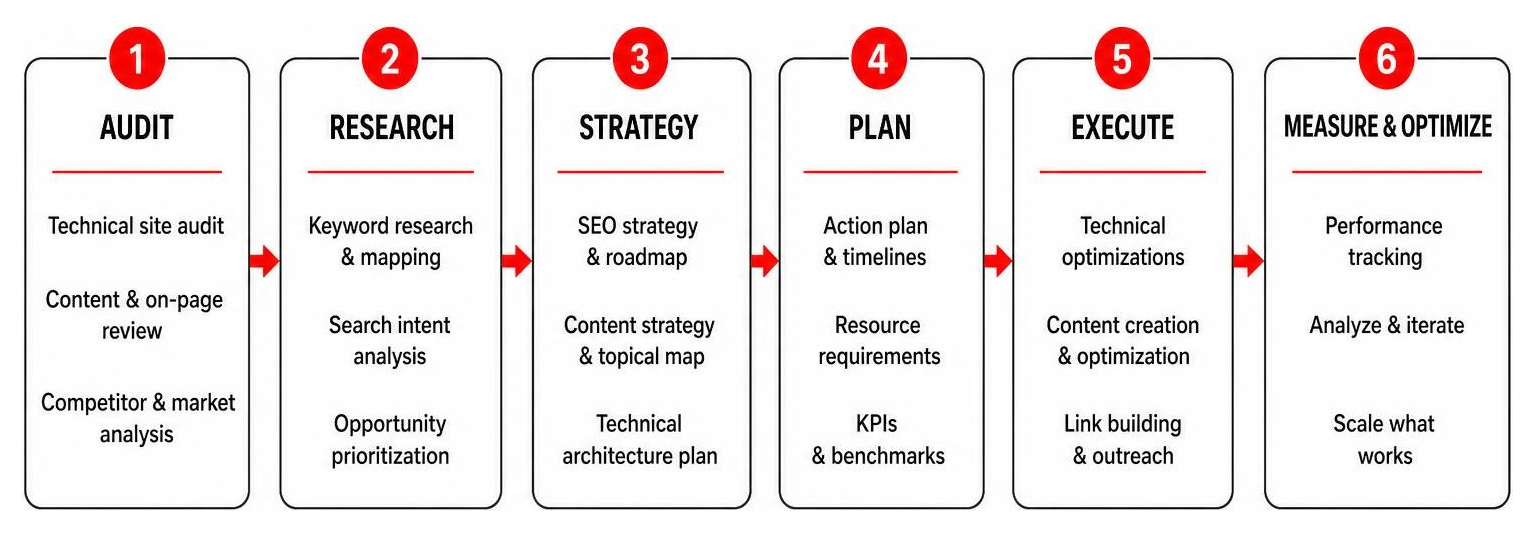
At its core, a search engine consultant is a high-level digital marketing advisor who looks at your website through a commercial lens. While many people think search engine optimization is just about sprinkling keywords onto a page, we know it goes much deeper than that.
A consultant’s role is to align your organic search strategy directly with your overarching business objectives. We don’t just ask, “What keywords can we rank for?” Instead, we ask, “Which search terms will actually drive sales, and how can we structure your digital presence to capture that demand?”
To do this successfully, we rely on a combination of strategic vision and deep business alignment. We begin by diagnosing your website’s current health through comprehensive SEO audits. These audits look under the hood of your website to identify indexing bottlenecks, page speed issues, and crawl errors. From there, we dive into exhaustive keyword research to understand the search intent of your target audience.
If you are new to this landscape and want a primer on how search engines work, we highly recommend reading our guide on SEO 101 to build your foundational knowledge.
How a Search Engine Consultant Differs from an SEO Specialist
It is common to hear the terms “SEO consultant,” “SEO specialist,” and “SEO technician” used interchangeably. However, in practice, these roles require vastly different skill sets.
- SEO Specialists and Technicians are the builders. They excel at technical execution. They are the ones who write the schema markup, optimize individual meta tags, clean up broken links, and configure redirect maps.
- Search Engine Consultants, on the other hand, focus on strategy design, team management, and client communication. We bring a high level of business acumen to the table, analyzing market trends, running competitive benchmarks, and coordinating with your internal product, editorial, and engineering teams to ensure SEO recommendations are actually built.
Think of it like building a house: the consultant is the architect who designs the blueprint and ensures the layout matches your lifestyle; the specialist is the carpenter who frames the walls and installs the windows. Both are essential, but they serve different functions.
| Feature | SEO Consultant | SEO Specialist / Technician |
|---|---|---|
| Primary Focus | High-level strategy, business alignment, ROI | Hands-on execution, technical fixes, on-page optimization |
| Key Deliverables | Custom roadmaps, competitive audits, team training | Meta tags, schema markup, backlink building, site clean-up |
| Communication | Direct collaboration with executives and team leads | Direct execution of technical tasks and reporting |
| Business Value | Connects organic search to revenue and lead generation | Ensures the site is technically compliant with search guidelines |
Core Services Offered by Modern Consultants
As search engines have evolved, so too has the role of the consultant. Today, we offer a comprehensive suite of services designed to capture traffic across every organic touchpoint:
- Technical SEO: Ensuring search engine crawlers can easily access, read, and index your pages. This includes optimizing site architecture, improving page load speeds, and organizing sitemaps.
- Content Strategy: Designing a conversion-focused content plan that targets users at all stages of the buying journey. If you want to understand how to build a sustainable visibility plan, check out The Only Complete Guide to Search Engine Optimization You’ll Ever Need.
- Digital PR and Link Building: Earning high-quality backlinks from authoritative, trusted websites to build your domain’s credibility.
- Conversion Rate Optimization (CRO): Ensuring that once a user lands on your site from a search engine, they actually take action—whether that means filling out a contact form, downloading a resource, or making a purchase.
Signs Your Business Needs Strategic SEO Consulting
Not every business needs to hire an outside consultant immediately. If you are a brand-new startup with a three-page website, you can often handle the basics yourself. However, as your business grows, your digital complexity grows with it.

Here are the most common signs that it’s time to bring in professional guidance:
- You are scaling your business: You are expanding your product lines, entering new geographic markets, or targeting new customer demographics, and your website’s current structure cannot support that growth.
- Your organic traffic has stagnated or dropped: You’ve hit a ceiling with your organic traffic, or worse, your rankings have taken a sudden dive after a search engine algorithm update.
- You want to implement a new content strategy: You are writing blog posts and publishing landing pages, but you aren’t seeing any corresponding increase in qualified leads or sales.
- You are planning a website redesign or platform migration: You are preparing to launch a new look, change your domain name, or move to a new Content Management System (CMS).
If you want to dive deeper into how organic search fits into your broader marketing mix, read our comprehensive resource, The Ultimate Guide to SEO Marketing Success.
Navigating Site Migrations and Redesigns
A website migration is one of the highest-stakes events a business can undergo. Changing your domain name, restructuring your URLs, or moving from a platform like WordPress to Shopify carries a massive risk of search ranking fluctuations. Without careful planning, you can easily lose years of accumulated search authority overnight.
A skilled search engine consultant acts as your safety net during this transition. We monitor your primary keywords and high-performing landing pages closely throughout the migration process. We map out precise 301 redirect strategies, identify and resolve critical technical errors before they go live, and ensure your site’s structural authority remains intact.
In fact, we have seen businesses turn a risky site migration into a major growth opportunity. For example, by carefully managing keyword transition and landing page health during a platform move, we’ve helped clients watch their rankings jump from page three (around position 30) straight to the top of page one.
Adapting to AI Search and Generative Engine Optimization (GEO)
Search in 2026 looks radically different than it did just a few years ago. Today, over 50% of searches are influenced by AI-generated results, conversational search assistants, and platform-based discovery.
Users are no longer just clicking on the classic “ten blue links.” Instead, they are reading Google’s AI Overviews, asking ChatGPT for product recommendations, and querying tools like Gemini or Perplexity. This shift has given rise to two critical optimization frameworks:
- Answer Engine Optimization (AEO): Structuring your content to directly answer conversational, long-tail search queries.
- Generative Engine Optimization (GEO): Optimizing your digital footprint so that Large Language Models (LLMs) cite and recommend your brand.
To succeed in this environment, a modern consultant will help you restructure your website content into modular blocks. This format makes it incredibly easy for AI crawlers to parse, understand, and extract your brand’s information.
The results of adapting to this new landscape are staggering. In one case study, optimizing a premium brand’s e-commerce content for AI search and GEO drove a 78% growth in revenue directly from ChatGPT referrals. Ignoring AI search is no longer an option; it is a core pillar of modern search consulting.
How to Hire the Right SEO Consultant for Your Business
Hiring an SEO consultant is a significant decision. Because the SEO industry is unregulated, anyone can buy a domain name, call themselves an expert, and start charging for advice. To protect your business, you need a rigorous, structured vetting process.
First, look for a consultant who relies on proven frameworks rather than “secret strategies.” A trustworthy professional will be transparent about their methods and happy to share anonymized case studies or put you in touch with client references.
We always tell business owners that having a basic understanding of SEO is incredibly helpful when hiring. It allows you to ask the right questions and spot empty promises. If you want to build your own baseline knowledge, take a look at our guide on How to Master SEO Basics Without a Degree.
Key Questions to Ask a Search Engine Consultant Before Hiring
When you interview potential consultants, don’t just ask about their pricing. Dig into their processes, their communication styles, and how they stay up-to-date with search trends.
Here is a list of essential questions to ask during your vetting process:
- How do you measure the success of your campaigns? (Look for answers tied to business outcomes like qualified leads, conversions, and revenue—not just keyword rankings or organic traffic volume.)
- How often will we communicate, and what will our reporting look like? (You want a partner who provides regular, transparent updates and is available to answer questions as they arise.)
- Which SEO tools do you use on a daily basis? (An experienced consultant should be fluent in industry-standard tools like Google Search Console, Ahrefs, SEMrush, Screaming Frog, and Looker Studio.)
- How do you stay up-to-date with search engine algorithm changes? (They should be able to explain how they analyze and adapt to core algorithm updates.)
- Can you share a case study where you helped a business similar to mine? (Look for concrete examples of organic growth and problem-solving.)
Red Flags and the Risks of Unethical SEO
Hiring an unqualified or unethical consultant can do serious, long-term damage to your business. Unethical practitioners often rely on “black-hat SEO” techniques—tactics designed to trick search engine algorithms to get quick, short-term ranking spikes.
These shortcuts violate search engine guidelines and can result in severe Google penalties or your website being completely removed from search indexes.
Be on high alert for these common red flags:
- Guaranteed #1 Rankings: No one can guarantee a specific ranking on Google. The algorithms are proprietary and constantly changing. Anyone making this promise is using deceptive sales tactics.
- Unsolicited Outreach: Be highly skeptical of cold emails claiming your website is “broken” or “not indexed.” Google itself receives these spam emails and warns businesses to ignore them.
- Secretive Techniques: If a consultant cannot or will not clearly explain the changes they plan to make to your website, walk away. You have a right to know exactly what is being done to your digital property.
- Link Buying Schemes: Buying cheap backlinks in bulk from low-quality “link farms” is a surefire way to trigger a manual action from Google’s search quality team.
For official guidance on how to safely evaluate search professionals, you can always consult the Google SEO Starter Guide or report deceptive business practices directly to the Federal Trade Commission.
The Cost and ROI of Professional SEO Consulting
One of the first questions business owners ask is: How much does this cost?
Because every website has different technical needs, competitive landscapes, and growth goals, there is no single “standard” price. However, professional consulting typically falls into three main pricing models:
- Hourly Consulting: Often ranging from $100 to $300+ per hour, best for quick technical audits or specific troubleshooting.
- Monthly Retainers: Typically ranging from $500 to $1,500+ per month for ongoing strategy, keyword monitoring, content planning, and technical oversight.
- Project-Based Pricing: A flat fee for a specific scope of work, such as a comprehensive site migration or a complete technical audit.

When evaluating the cost, it is vital to look at the potential Return on Investment (ROI). Unlike paid advertising, where your traffic stops the moment you stop paying for ads, the work of a search engine consultant builds long-term, compounding value.
To help you map out your investment, here are real-world outcomes from structured, data-driven SEO strategies:
- Massive Traffic Growth: For a specialized technical staffing platform, implementing a structured keyword and content strategy grew organic traffic from 960 to over 17,000 monthly visits.
- E-commerce Revenue Spikes: An online fashion accessories store resolved critical page speed errors and optimized its site layout, resulting in a 346,000 increase in search impressions and a massive rise in conversions.
- Lead Generation Boost: Across industries, businesses partnering with strategic consultants consistently generate 2x to 5x more qualified leads through data-driven search execution.
If you are ready to build a customized plan for your business, take a look at our A-Z Guide to SEO Strategy to see how we structure our campaigns for maximum ROI.
Frequently Asked Questions about SEO Consulting
How long does it take to see results from SEO consulting?
SEO is a long-term investment, not a quick fix. While you might see some quick wins within the first few weeks by fixing glaring technical errors, most businesses should expect to commit to a minimum of six months to see significant, sustainable results.
True search authority takes time to build, but once those traffic spikes begin, they provide a steady stream of leads and customers for years to come.
Why is an agency consultant better than a ‘one-man band’?
While there are incredibly talented independent consultants, partnering with an agency like Clayton Johnson SEO offers several distinct advantages.
Agencies provide scalable resources and a broader range of specialized skills. Instead of relying on a single person to handle technical code, write content, build backlinks, and analyze data, you get access to a team of specialists.
Furthermore, agencies offer redundancy; your organic search campaign won’t grind to a halt if your primary consultant gets sick or goes on vacation.
Can an SEO consultant guarantee a #1 ranking on Google?
No, and you should immediately run away from any consultant who claims they can. Search engine algorithms are incredibly complex and undergo hundreds of updates every year.
A professional consultant focuses on building sustainable search visibility, improving user experience, and driving qualified traffic that converts into revenue—not making empty promises about guaranteed keyword positions.
Conclusion
In the modern digital landscape, your website is often the very first interaction a potential customer has with your brand. If you aren’t visible on the search engines and AI platforms where they are looking for answers, you are handing market share directly to your competitors.
At Clayton Johnson SEO, we help growing companies map and understand their target audiences through strategic content and advanced SEO services. We don’t believe in generic, “box-ticking” checklists. We build custom, conversion-focused search strategies designed to turn organic visibility into measurable revenue growth.
Whether you are navigating a complex site migration, struggling with flatlining organic traffic, or looking to prepare your brand for the era of AI search, we are here to help.
Ready to take your search presence to the next level? Explore our Services page today to learn more about how we can partner for your long-term growth.