AI Personalized Search Engines and the End of Generic Results


The Dawn of AI Personalized Search Engines
It often feels like Google search has gotten worse. For many, finding answers online has become a chore, navigating endless links, ads, and pop-ups. But a new era is here: ai personalized search engines. These powerful tools are fundamentally changing how we discover information.
What are AI Personalized Search Engines?
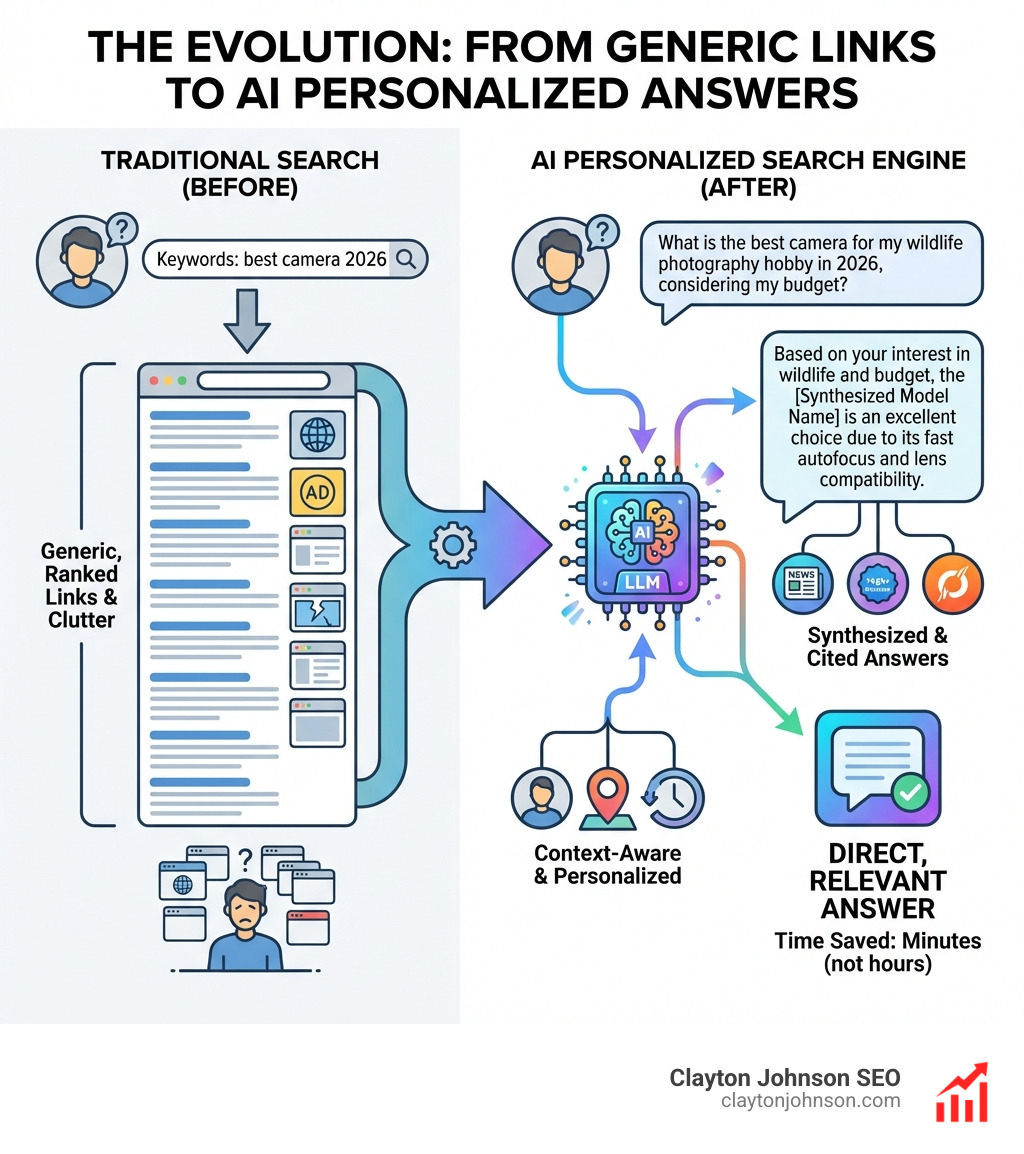
- Understand Intent: They use advanced AI, like Large Language Models (LLMs), to deeply understand your natural language questions and true intent, not just keywords.
- Synthesize Answers: Instead of just listing links, they synthesize information from multiple web sources into direct, concise answers, often with citations.
- Personalize Results: They tailor these answers based on your past searches, preferences, behavior, and real-time context, offering a uniquely relevant experience.
- Shift from Links: This differs greatly from traditional search engines, which primarily provide a ranked list of web pages for you to click through.
This shift marks a move from “link aggregators” to “answer engines,” making research quicker and more efficient. In fact, over 50% of consumers in a McKinsey survey now actively prefer AI search for everything from research to buying decisions. AI-powered search aims to cut down research time significantly, transforming a half-hour task into just 10-15 minutes by summarizing key points.
I’m Clayton Johnson, and my work focuses on engineering scalable traffic systems and AI-augmented marketing workflows. I help businesses transform fragmented efforts into cohesive growth engines, specializing in strategies that leverage ai personalized search engines for measurable outcomes.
What are AI Personalized Search Engines?
To understand ai personalized search engines, we first need to look at what they are replacing. Traditional search engines like Google have historically relied on keyword matching and link authority. You type in a phrase, and Google gives you a list of “blue links” that it thinks might contain the answer. You then do the heavy lifting—clicking, reading, and piecing the information together.
AI search engines turn this model on its head. Instead of asking you to be the detective, they act as the research assistant. They use Large Language Models (LLMs) to read the web for you.
The Power of Retrieval-Augmented Generation (RAG)
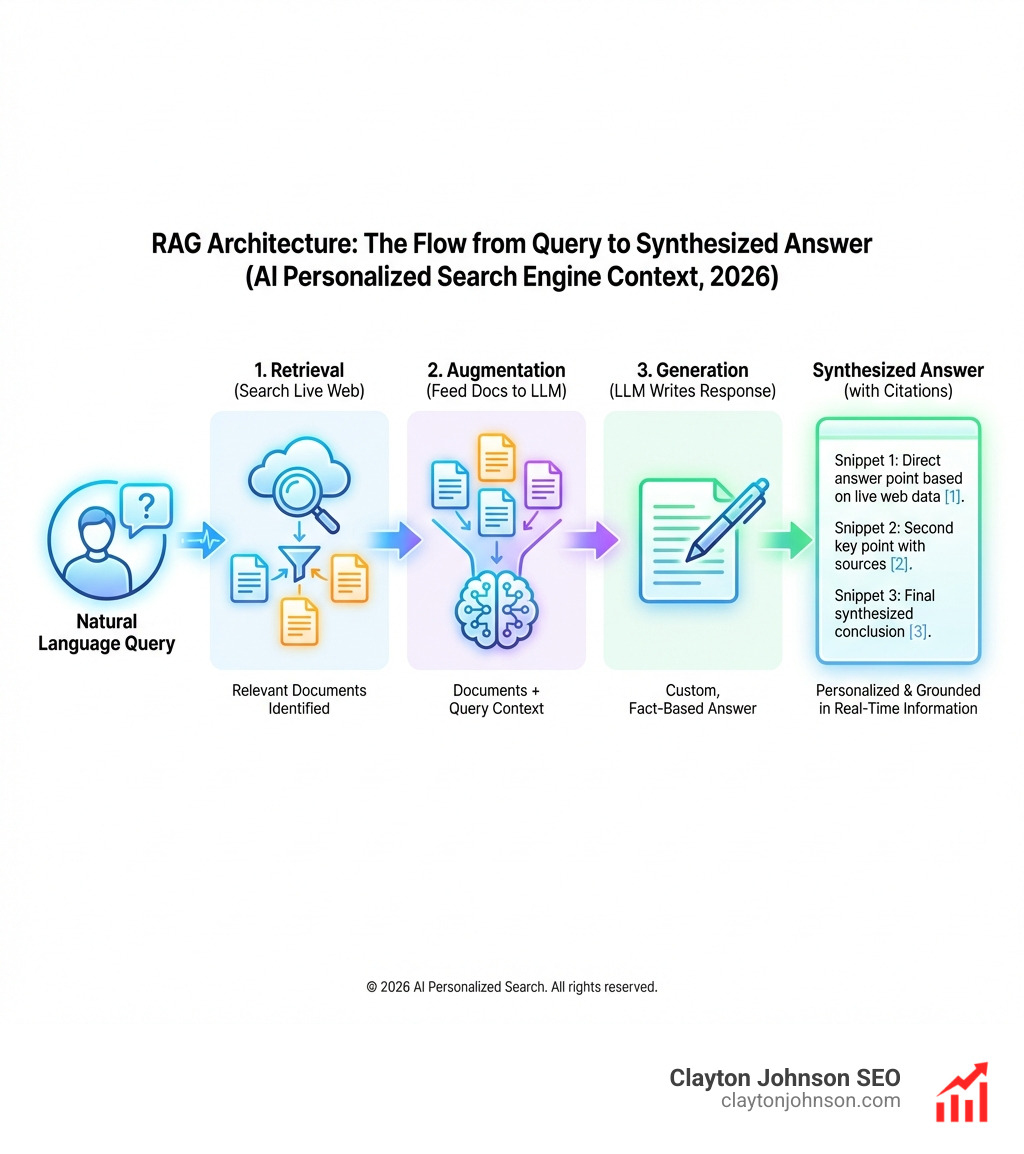
The “magic” behind these engines is a technology called Retrieval-Augmented Generation (RAG). Here is how it works:
- Retrieval: The engine searches the live web for the most relevant documents related to your query.
- Augmentation: It feeds these documents into an LLM.
- Generation: The LLM writes a custom response that answers your specific question, using the retrieved documents as the factual “grounding.”
This process ensures that the AI isn’t just “guessing” based on its training data (which might be outdated), but is looking at live, real-time information. Currently, 47% of search results now feature some form of AI-generated overview, showing that even the giants are moving toward this model.
| Feature | Traditional Keyword Search | AI Semantic Search |
|---|---|---|
| Input | Keywords and phrases | Natural language, conversational questions |
| Logic | Matching words and backlinks | Understanding intent and context |
| Output | A list of URLs (Blue links) | A synthesized, written answer with citations |
| Context | Single-query focus | Session-aware and history-driven |
| Efficiency | High manual effort to synthesize | Rapid, direct answers |
The Mechanics of AI Search Personalization
The “personalized” part of ai personalized search engines is where things get truly interesting for us as users and marketers. In the old days, personalization mostly meant showing you local weather or news based on your IP address. Today, it is about deep contextual awareness.
How Personalization Factors Work
Modern AI engines build a profile of your needs through several layers:
- User History: The engine remembers previous questions within a session (and sometimes across sessions) to provide continuity. If we ask about “best hiking boots” and then follow up with “are they waterproof?”, the engine knows “they” refers to the boots.
- Contextual Awareness: It looks at your location, device, and even the time of day to prioritize results.
- Diagnostic Feedback: Advanced systems use scientific research on search personalization to refine their models. Benchmarks like BESPOKE allow these engines to analyze human feedback and chat histories to better align their answers with what a specific user actually wants.
- Query Expansion: The AI doesn’t just search for what you typed; it expands your query behind the scenes to include related concepts that help find a more comprehensive answer.
This level of personalization eliminates the “generic” result. Two people searching for “impact of social media” might get very different answers: one might get a technical breakdown of algorithm psychology, while another gets a summary of social trends, depending on their past interests and professional background.
Top AI Search Platforms for Modern Research
We have spent a lot of time testing these platforms in our office in Minneapolis. While Google is still the king of volume, these AI-first platforms are winning on utility.
- Perplexity: Often considered the gold standard for general research. It provides source-backed answers and allows you to toggle between different AI models like GPT-4o or Claude 3.5 Sonnet.
- Komo: Excellent for exploratory research. It features a “Perspective Pulse” that summarizes how different parts of the web feel about a topic.
- Brave Search: A privacy-first option that uses its own independent index. It offers “Ask Brave,” which synthesizes content from billions of pages without tracking your every move.
- Glean: This is the powerhouse for businesses. Glean connects to over 100 enterprise apps (Slack, Google Drive, Jira) to provide a “Work AI” that searches your company’s internal knowledge base.
- Consensus: A specialized engine for academic work. It searches over 200 million peer-reviewed papers to give you evidence-based answers.
- Phind: Optimized for developers and technical queries. It generates code snippets alongside explanations.
- Andi: A free, simple interface that feels like chatting with a very smart friend who has read the entire internet.
For those looking to integrate these tools into their broader marketing strategy, we offer more info about SEO services that bridge the gap between traditional search and these new AI platforms.

Standout Features of Leading Engines
Each of these engines has a “killer feature” that makes it worth a try:
- Pro Search (Perplexity): This isn’t just a search; it’s a multi-step research agent. It will ask you clarifying questions to make sure it gets the right answer.
- Perspective Pulse (Komo): Provides a percentage-based breakdown of opinions on a topic, helping you see the “consensus” at a glance.
- Ask Brave: Delivers AI answers right in the search results while maintaining “best-in-class” privacy protections.
- Academic Citations (Consensus): Every claim made by the AI is linked to a specific, peer-reviewed study.
Pricing Models and Free Tiers
Most ai personalized search engines follow a freemium model. You can get a lot done for free, but power users will want the paid tiers.
- Free Tiers: Usually include unlimited basic searches but limit the number of “Pro” or “Reasoning” searches per day.
- Subscription Tiers: Most Pro plans, like the Perplexity Pro plan, cost around $20/month. This usually unlocks advanced models, file uploads, and API credits.
- Enterprise Seats: Tools like Glean or Perplexity Enterprise are priced per user (ranging from $20 to $40 per seat) and include administrative controls and enhanced data security.
Answer Engine Optimization (AEO) for Businesses
As search changes, so must our marketing. We are moving away from traditional SEO and into Answer Engine Optimization (AEO). In this new world, it isn’t just about ranking #1; it is about being the source the AI chooses to cite.
AI search engines characterize brands based on the “sentiment” and “authority” they find across the web. If an AI engine doesn’t “mention” your brand when someone asks for a solution in your niche, you effectively don’t exist in that search session.
To see where you stand, we recommend using a tool like the AEO grader. This tool helps analyze your brand’s AI visibility and competitive positioning.
Maximizing Brand Presence in AI Results
To stay visible in ai personalized search engines, we focus on three core pillars:
- Structured Data: Use Schema markup to help AI crawlers understand the facts about your business, products, and reviews.
- Citation Building: AI engines love “consensus.” The more high-authority sites that mention your expertise, the more likely the AI is to trust you.
- Answer-Based Content: We structure our content to answer specific questions. Use H2s and H3s that mirror the questions your customers are asking.
If you want to see how your brand stacks up, you can Grade Your Brand to assess your visibility in AI-powered search results.
Evaluating Accuracy and Privacy in AI Search
We have to address the elephant in the room: AI can make mistakes. “Hallucinations”—where the AI confidently states something that is flat-out wrong—are a significant concern.
Accuracy and Source Verification
The best way to combat hallucinations is through source-backed citations. A reliable AI search engine should always show you exactly where it got its information.
- Verify Citations: We always recommend clicking through to the source for critical information.
- Responsible AI: Platforms like Consensus are very clear about the mitigations they’re taking to ensure their data is grounded in scientific fact.
Privacy Concerns
When you use a personalized engine, you are often sharing your search history and preferences. For users in Minnesota and beyond, data privacy is a top priority.
- Encryption: Look for engines that encrypt your data and offer “zero data retention” policies.
- Privacy-First Models: Brave and DuckDuckGo lead the pack here by not training their AI models on your personal data and storing your prompts locally whenever possible.
Frequently Asked Questions about AI Search
Which is the best AI personalized search engine?
It depends on what you need!
- For General Research: Perplexity is hard to beat for its depth and model choice.
- For Work/Internal Info: Glean is the clear winner for searching through company documents and chats.
- For Scientific Evidence: Consensus is the best tool for finding peer-reviewed answers.
How do AI personalized search engines handle privacy?
Privacy varies by platform. Brave and DuckDuckGo are built specifically to protect your identity, often avoiding data tracking entirely. Other platforms like Perplexity offer “Incognito” modes or allow you to opt-out of having your data used for model training. Always check the settings to ensure your data is being handled according to your comfort level.
Can AI search replace Google?
For many “discovery” and “research” tasks, yes. AI search is significantly faster at synthesizing complex information. However, Google still excels at “navigational” search (e.g., “login to my bank”) and local business discovery (e.g., “pizza near me”). A McKinsey survey suggests that AI search could redirect 20-50% of traditional search traffic in the coming years, but for now, they often exist side-by-side.
Conclusion
The era of generic, one-size-fits-all search results is ending. ai personalized search engines are providing us with a more efficient, context-aware, and direct way to access the world’s knowledge. Whether you are a researcher in Minneapolis looking for academic papers or a business owner trying to increase your AI visibility, these tools are no longer optional—they are the new standard.
At Demandflow.ai, we believe that clarity leads to structure, and structure leads to compounding growth. We build the growth architecture that helps founders and marketing leaders leverage these AI-augmented workflows to stay ahead of the curve.
If you are ready to move beyond “tactics” and build a structured growth engine for your business, we invite you to work with me to implement these next-gen systems. Let’s stop searching and start finding.