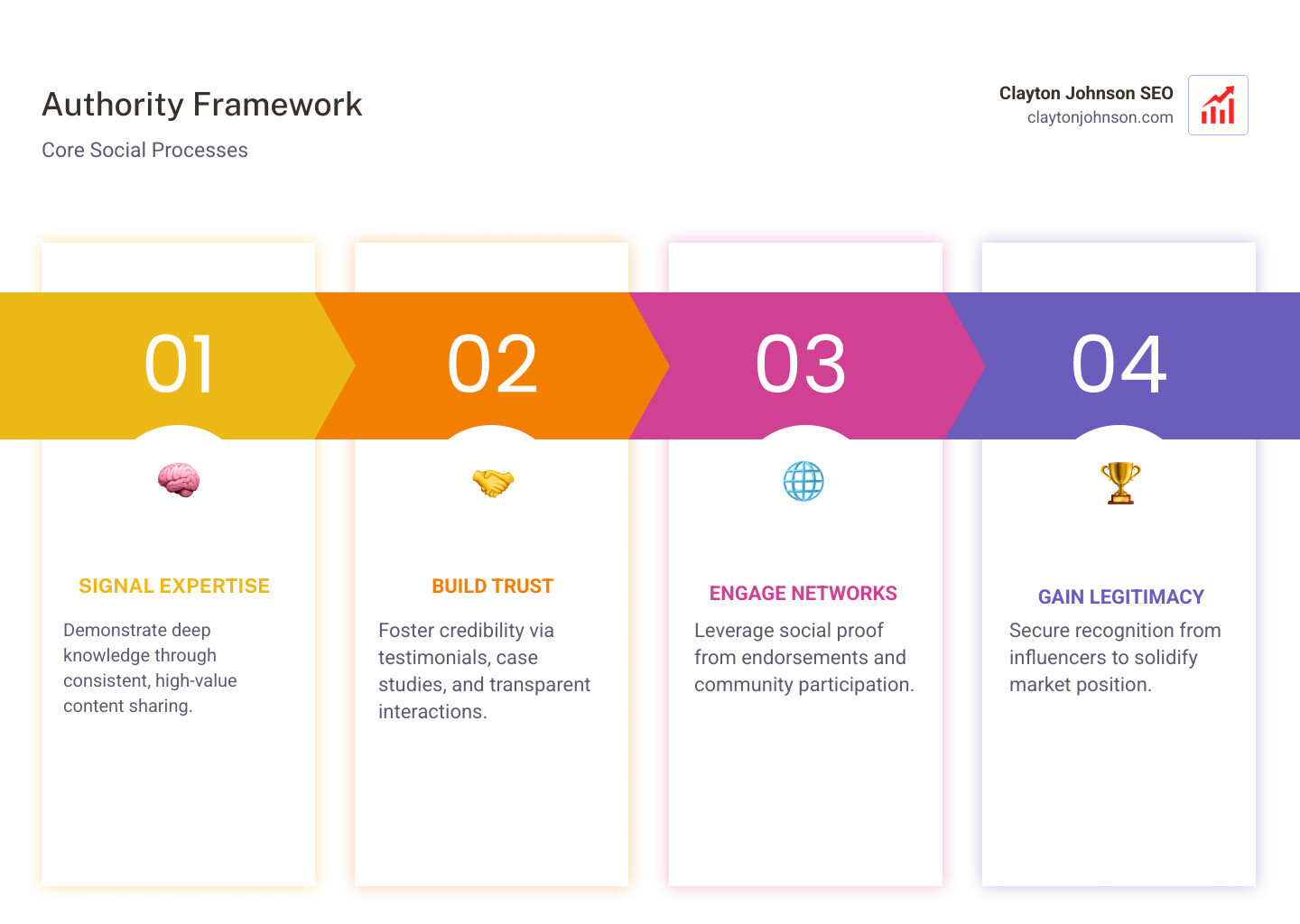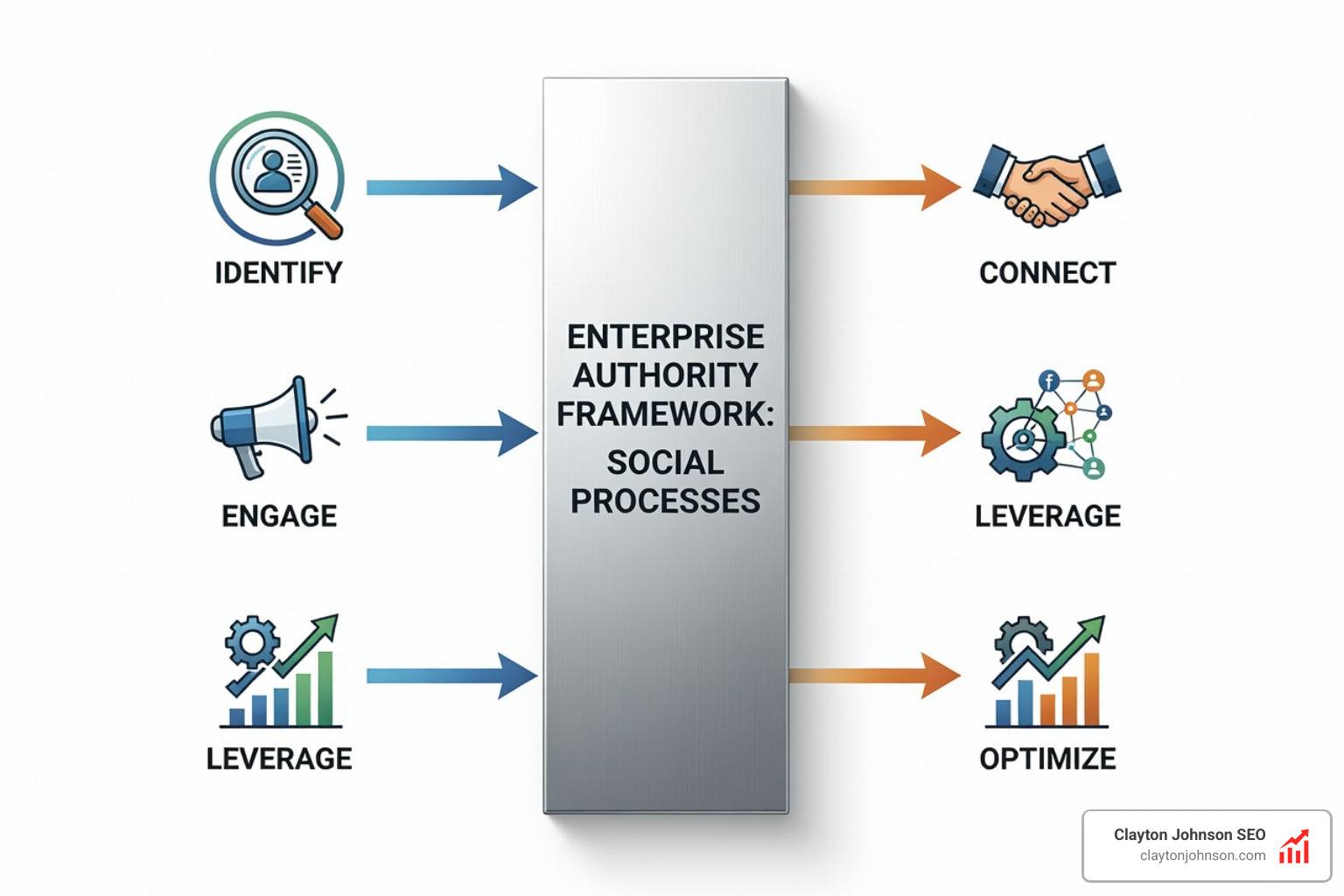
Why Authority Framework Social Processes Determine Who Wins in Modern Markets
Authority framework social processes are the systems through which people recognize, accept, and defer to power — and they are the hidden engine behind every brand that dominates its market.
Here is a quick breakdown of what this means in practice:
- Authority = the right to lead, recognized voluntarily by others (not just forced compliance)
- Legitimacy = what makes authority stick — built through trust, values, and consistent action
- Social processes = the ongoing interactions, stories, and exchanges through which authority is either earned or eroded
- Framework = the structure you deliberately build so authority compounds over time, rather than fading
Max Weber identified legitimacy as the ultimate stabilizing factor of any social order — the point where people follow not out of habit or fear, but out of genuine belief in the system.
This matters for your brand because online visibility works the same way. Search engines and buyers alike follow authority signals. If your brand lacks a clear authority framework, you are invisible — no matter how good your product or service actually is.
Most business owners focus on tactics: keywords, backlinks, social posts. But tactics without an authority framework are just noise. The brands that consistently attract high-value clients are the ones that have built systems where their authority grows automatically through every interaction, piece of content, and social signal.
I’m Clayton Johnson, an SEO strategist with nearly two decades of experience building scalable authority framework social processes for ambitious brands — turning invisible businesses into recognized market leaders through data-driven systems. In this guide, I’ll show you exactly how to apply these principles to your brand.
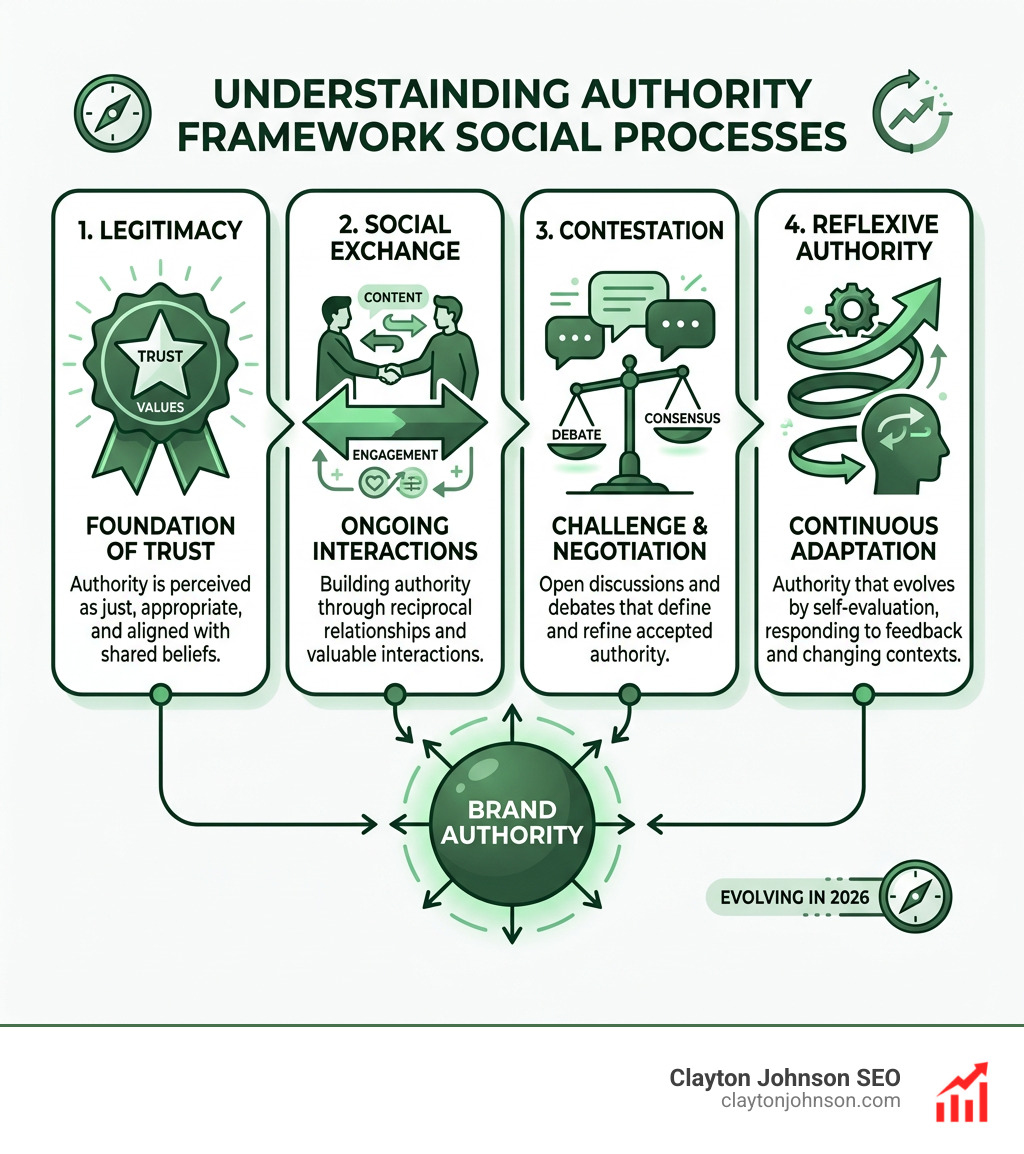
Building an Authority Framework: Social Processes and Strategic Legitimacy
When we talk about an authority framework, we are essentially discussing the “hardware” of your brand’s social world. Just as a building requires a wooden frame before the walls can be set, your brand needs a structured social order to support its growth.
In sociology, Max Weber’s theories suggest that legitimacy is the lifeblood of any structure. Without it, power is just raw force. In modern branding, “raw force” looks like intrusive ads and spammy outreach. Authority, on the other hand, is when your audience voluntarily chooses to listen to you because they perceive your position as just and appropriate.
According to Scientific research on Rule in International Politics, rule and authority are analytical concepts that capture forms of domination based on recognition. For a brand, this recognition is the difference between being a “vendor” and being a “partner.” To move from one to the other, we must understand the nuances between power, authority, and legitimacy.
| Concept | Definition | Source of Strength |
|---|---|---|
| Power | The ability to carry out one’s will despite resistance. | Coercion, rewards, or force. |
| Authority | Legitimate power that is accepted as right. | Social position, expertise, or tradition. |
| Legitimacy | The belief that a rule or institution has the right to govern. | Shared values, legal-rational rules, or “faith.” |
To build a durable system, we need to move beyond chasing temporary traffic and start building strategic frameworks that align with how humans naturally perceive authority.
Defining Authority Framework Social Processes in Modern Markets
Modern markets are not just places where money is exchanged; they are social ecosystems. Adam Smith, often called the father of economics, believed that social harmony could emerge from individual self-interest through natural social processes—the “invisible hand.”
In our work at Clayton Johnson SEO, we view the market as a series of social exchanges. Social exchange theory (pioneered by scholars like George C. Homans) posits that human interactions are guided by a “cost-benefit” analysis. If your audience feels that the reward of engaging with your content outweighs the cost (their time and attention), they grant you authority.
Conflict arises when there is a perceived imbalance in these exchanges. If a brand takes too much (aggressive selling) and gives too little (low-value content), its authority erodes. By focusing on equity and fairness, we can mitigate conflict and build a “life space” where your brand is the natural leader. You can explore more about these systems in our guide to top strategic frameworks every business strategist must know.
Leveraging Weberian Legitimacy and Value-Oriented Action
To make your authority stick, we have to look at what Weber called wertrationales Handeln—or value-oriented action. This is action taken because of a belief in an absolute value (like “integrity” or “innovation”), regardless of the immediate outcome.
Weber identified four “internal and external springs” that guarantee the legitimacy of an order:
- Emotional devotion: A deep connection to a leader or brand’s mission.
- Faith in absolute values: Submitting to an order because it represents what is “right.”
- Religious/Moral faith: Internalizing the rules as a part of one’s identity.
- Custom and Law: External self-interest linked to established provisions.
In contemporary bureaucratic systems, most legitimacy derives from “faith in institutionalism”—the submission to positive provisions. For a brand, this means your “legal-rational” authority comes from your professional certifications, your transparent processes, and your “office” in the market.
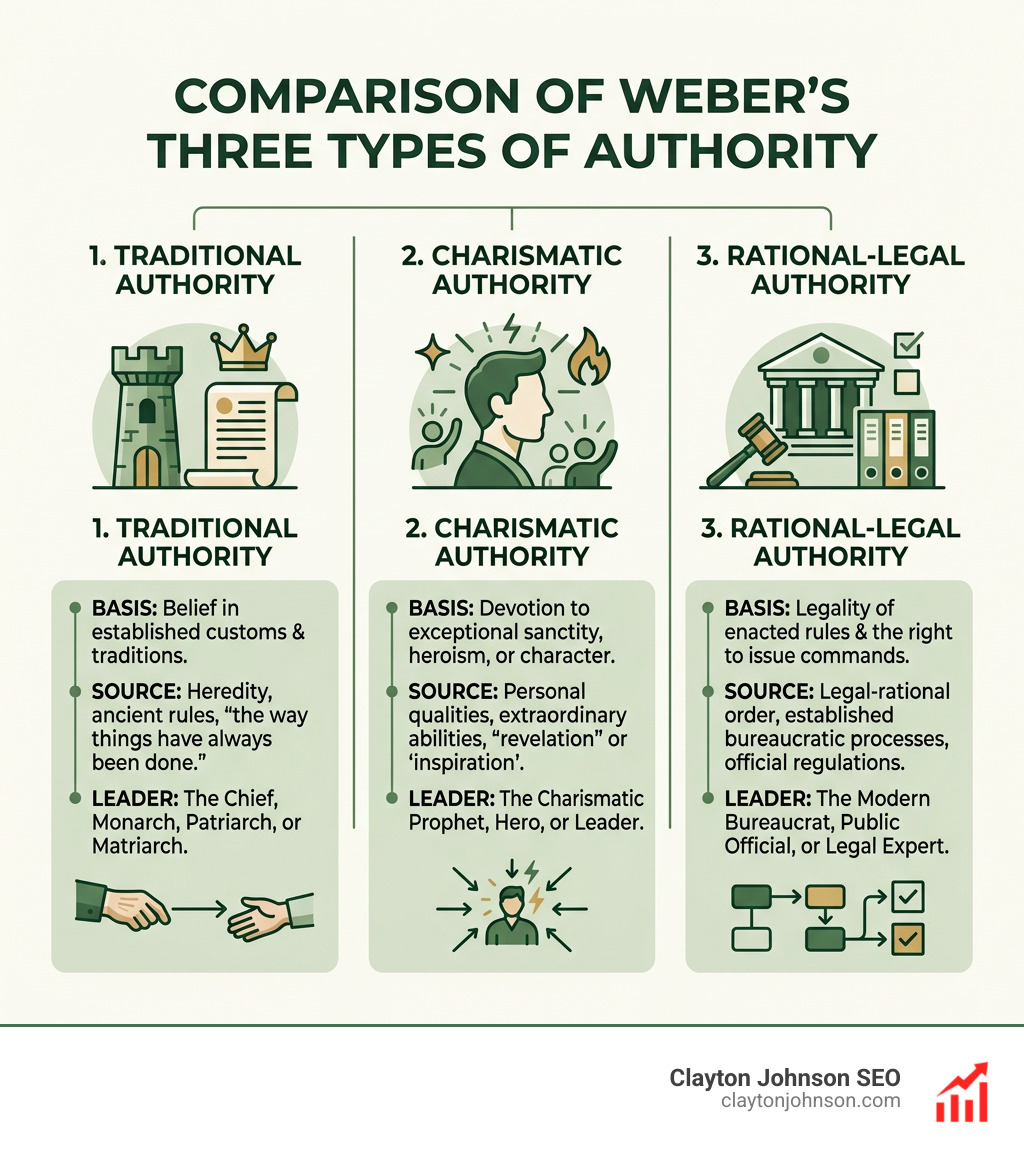
Check out this Scientific research on Max Weber’s Framework of Authority for a deeper dive into how these types of domination have shaped human history.
Narrative Power and the Authority Framework Social Processes
Authority isn’t just about what you do; it’s about the stories people tell about what you do. Ewick and Silbey’s research on “narratives of resistance” shows us that storytelling is a mechanism that can either reinforce or challenge authority.
Hegemony refers to the “taken-for-granted” assumptions of a society—the things that are so ingrained they become “unthinkable” to challenge. Resistance happens when a story “names” these assumptions and makes them problematic.
For a brand, this is a double-edged sword. If you are the incumbent leader, you must ensure your narrative remains “world-making” and aligns with your audience’s sociocultural resources. If you are the challenger, you use storytelling to expose the gaps in the current leader’s authority. This is why we focus so heavily on helping you build a social media content strategy from scratch that uses narrative to cement your position.
Reflexive Authority and Global Governance Models
As markets become more complex and “liquid,” traditional models of authority (like “contracted” or “inscribed” authority) often fall short. Contracted authority is based on a specific deal, while inscribed authority is based on a fixed status.
Michael Zürn proposes a third model: Reflexive Authority.
Reflexive authority resolves the “paradox of voluntary subordination” through:
- Epistemic foundations: Authority based on superior knowledge and expertise.
- Ongoing monitoring: Subordinates (your audience) constantly evaluate the authority’s performance.
- Critical deference: The audience follows the authority not blindly, but because they recognize their own limitations in a specific area.
In this model, the authority holder doesn’t issue “commands”—they send “requests.” This is exactly how high-end consulting and modern brand leadership work. We don’t tell our clients what to do; we provide the expert framework that makes the right path obvious. This “reflexive” relationship is common in Scientific research on Who Governs the Globe?, where international organizations must earn their keep through transparency and results.
Managing Contestation and Delegitimization Crises
No authority framework is permanent. Every system faces “contestation”—acts of non-compliance, delegitimation, or dissidence.
In a business context, a legitimacy crisis might look like a sudden drop in customer retention or a “politicization” of your brand’s niche. Weber noted that delegitimization can actually be a positive process because it leads to the transformation of social orders and the birth of new, more stable forms of power.
When a crisis hits, brands must employ change management frameworks to pivot their authority base. Whether you are moving from “charismatic” leadership (the founder’s personality) to “rational-legal” leadership (the company’s systems), managing the transition is key to survival.

Field Theory and Social Exchange in Brand Communities
To understand why your audience behaves the way it does, we can look at Kurt Lewin’s Field Theory. Lewin argued that behavior is a product of social forces within an individual’s “life space.”
Think of your brand community as a “field.” Within this field, there are driving forces (aspirations, rewards) and restraining forces (costs, negative exchanges). Our goal is to alter the social field to promote harmonious interactions.
By applying social exchange theory, we can see that if a community member feels their contributions aren’t reciprocated, they will create “negative exchanges” that lead to conflict. Building a successful community requires constant monitoring of these forces to ensure equity. We’ve found that this is the “secret sauce” for social marketing success.
Conclusion: Scaling Authority with Clayton Johnson SEO
Building an authority framework social processes isn’t about a single viral post or a lucky break in the search results. It’s about building a durable, scalable system that aligns with how humans naturally organize themselves.
At Clayton Johnson SEO, we don’t just “do SEO.” We build growth engines. We take the complex sociological theories of Weber, Lewin, and Zürn and translate them into usable tools—internal linking structures, taxonomy-driven content ecosystems, and AI-augmented workflows that compound your brand’s authority over time.
Our philosophy is simple: Clarity → Structure → Leverage → Compounding Growth.
We help you find clarity in your strategic positioning, build the structure of your authority framework, leverage AI and technical SEO to scale your reach, and achieve the compounding growth that only comes from being a recognized leader in your field.
Ready to turn your fragmented marketing efforts into a coherent growth engine? Let’s build your blueprint together. Explore our social media marketing services and see how we can help you dominate your market.