Beginner’s Guide to JTBD in Customer Strategy


Why Customer Strategy & JTBD Transforms Innovation
Customer Strategy & JTBD (Jobs-to-be-Done) is a framework that shifts focus from product features to the underlying progress customers seek, enabling companies to innovate with an 86% success rate versus traditional methods. Here’s what you need to know:
Core Concept: Customers don’t buy products—they “hire” them to get specific jobs done in their lives.
Key Benefits:
- Uncovers true customer motivations beyond demographics
- Identifies unmet needs competitors miss
- Aligns product development with real-world problems
- Drives predictable innovation and market differentiation
Strategic Applications:
- Define markets around customer jobs, not product categories
- Segment by behavioral priorities, not age or income
- Map the complete job journey to find innovation gaps
- Build value propositions that address functional, emotional, and social progress
After losing four deals in a row, one CEO finally asked a client directly: “Why did you choose our competitor?” The answer wasn’t about features or price—it was about understanding what the customer was truly trying to accomplish. This insight represents the fundamental shift from product-centric to job-centric thinking.
The Jobs-to-be-Done theory, popularized by Harvard Business School professor Clayton Christensen, emerged from a simple observation: people don’t want a quarter-inch drill; they want a quarter-inch hole—or more accurately, they want to hang a picture and enjoy looking at it. This reframing transforms how companies approach innovation, moving from “what features should we build?” to “what progress are customers trying to make?”
I’m Clayton Johnson, an SEO and growth strategist who has applied Customer Strategy & JTBD frameworks across multiple industries to help companies build measurable growth systems rooted in deep customer understanding. My work focuses on translating strategic frameworks like JTBD into actionable workflows that drive real business outcomes.
What is Jobs-to-be-Done (JTBD) Theory?
At its heart, the Jobs-to-be-Done (JTBD) theory is a lens through which we view commerce not as a collection of products, but as a series of problems seeking solutions. We often get bogged down in the “what” of our products—the specs, the speeds, the colors—while completely ignoring the “why.”
The most famous illustration of this is the Milkshake story. A fast-food chain wanted to increase milkshake sales. They initially tried traditional methods: making them thicker, chocolatier, or cheaper. Nothing worked. It wasn’t until they observed when and why people bought milkshakes that they realized the “job.” Many customers were commuters who “hired” the milkshake to keep them occupied during a long, boring drive and to stave off hunger until lunch. The milkshake was competing against bagels, bananas, and doughnuts—not just other milkshakes.
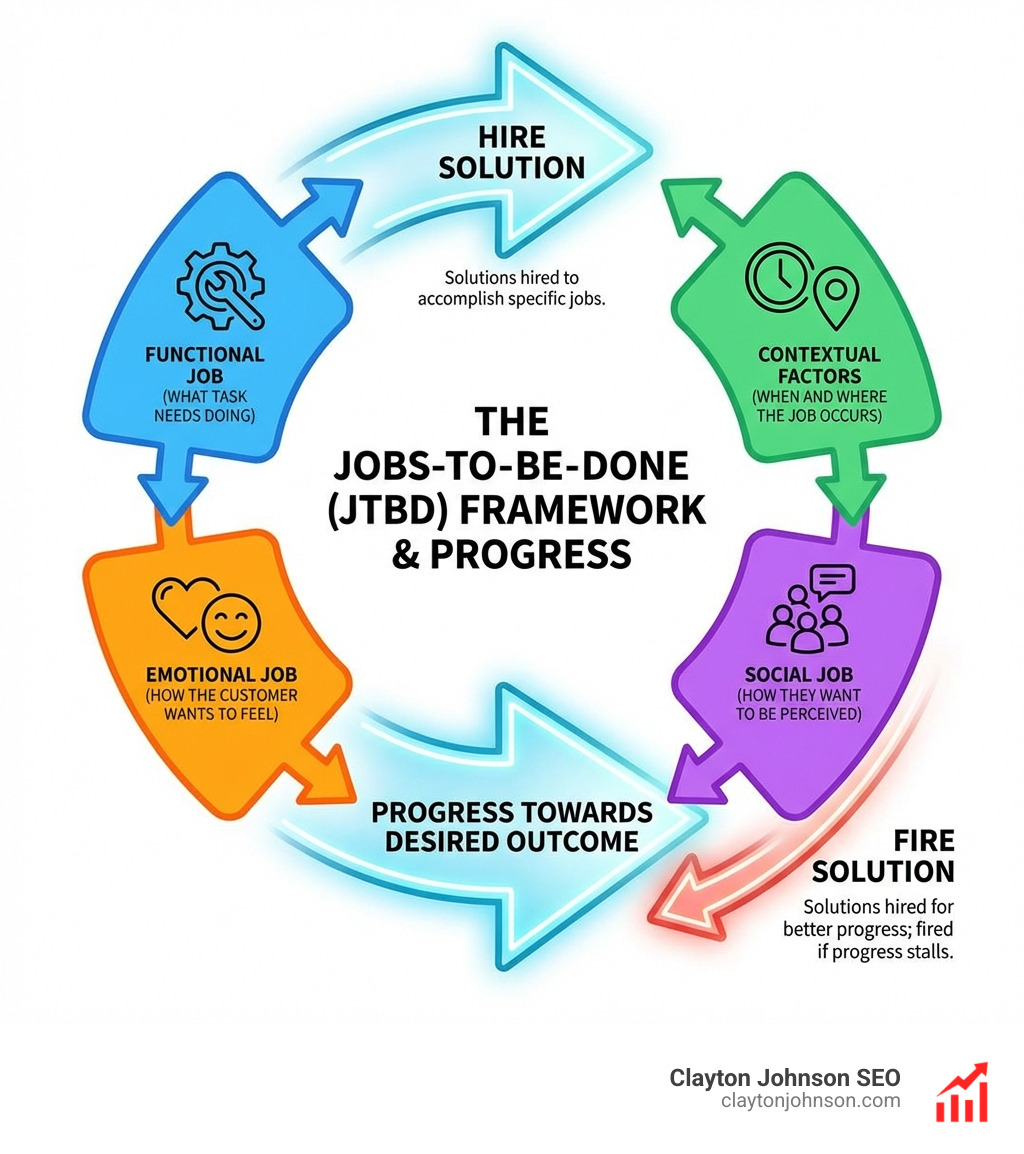
When we talk about a Customer Strategy, we are looking at three layers of a “job”:
- Functional Jobs: The specific task the customer wants to achieve (e.g., getting from point A to point B).
- Emotional Outcomes: How the customer wants to feel (e.g., feeling safe or feeling stylish while traveling).
- Social Progress: How the customer wants to be perceived by others (e.g., looking like a successful professional).
While Christensen popularized the theory, Tony Ulwick pioneered the practical application through his Outcome-Driven Innovation (ODI) process. Ulwick’s research shows that an average job consists of anywhere from 10 to 20 steps, and businesses using this framework have enjoyed an 86% success rate in product development.
Redefining Needs Through the JTBD Lens
Traditional market research asks customers what they want. The problem? Customers are often the worst experts on their own behavior. They might say they want a “faster horse” when what they really need is a way to get to town in twenty minutes.
JTBD focuses on progress. Every time a customer buys something, they are “hiring” that product to help them make progress in a specific circumstance. Conversely, when they switch to a new solution, they are “firing” their old one. If we understand the forces that cause a customer to fire their current solution—the “push” of their current pain points and the “pull” of a new solution’s promise—we can build a much more effective Customer Strategy & JTBD.
The Evolution of Customer Understanding
The transition from product-centric to customer-centric thinking has been decades in the making. It started with Theodore Levitt’s famous “quarter-inch hole” analogy and has evolved into sophisticated Customer Segmentation Product Insight.
We’ve moved from:
- Surface Level: What do they say they want? (Surveys)
- Behavioral Level: What do they actually do? (Analytics)
- Causal Level: Why do they do it? (JTBD Interviews)
Causal research is the “holy grail” of customer understanding. It allows us to stop reacting to data and start predicting what customers will hire next.
Core Principles of Customer Strategy & JTBD
To build a winning strategy, we must align our company’s identity and capabilities with the specific jobs our customers are trying to get done. This isn’t just a marketing exercise; it’s a fundamental business shift.
A strong Customer Strategy & JTBD requires us to move away from static Buyer Personas that focus on age, gender, or income. Instead, we look at the “Job Statement”: When [situation], I want to [motivation], so I can [expected outcome].
| Feature | Product-Centric Strategy | Job-Centric Strategy |
|---|---|---|
| Focus | Product features and specs | Customer progress and outcomes |
| Market Definition | Product category (e.g., “The SUV market”) | The job (e.g., “Transporting the family safely”) |
| Competition | Direct competitors in the same category | Anything that can do the job (including “nothing”) |
| Innovation | Adding more features (feature creep) | Removing friction from the job journey |
| Success Metric | Market share in category | Job completion and satisfaction |
Moving Beyond Demographics with Customer Strategy & JTBD
Demographics tell you who bought your product, but they rarely tell you why. For example, two 40-year-old men living in Minneapolis might both buy a luxury car, but one hires it for the social progress of looking successful, while the other hires it for the functional job of high-performance handling on icy roads.
By focusing on psychographics and true motivations, we can create more accurate profiles. Consider 👤 Buyer Persona Example: Startup Founder Sam or 👤 Buyer Persona Example: Marketing Manager Mike. Their needs aren’t defined by their age; they are defined by the “fires” they are trying to put out every day in their businesses.
Redefining the Innovation Process
Innovation is often a source of frustration for leaders. In fact, 94% of global executives are dissatisfied with their organization’s innovation performance. The The Innovator’s Toolkit suggests that the missing link is a clear definition of the “job.”
When we use prioritization frameworks for product development, JTBD helps us identify market gaps. We aren’t just looking for what customers say they want; we are looking for the “workarounds” they’ve created because no current product does the job perfectly.
Practical Steps for Implementing JTBD in Your Organization
Implementing Customer Strategy & JTBD isn’t about a single brainstorming session. It’s an iterative process that requires empathy and rigorous mapping.
If you want to dive deep, we highly recommend you Download The Free Book by Tony Ulwick. It provides a structured approach to Customer Segmentation Product Insight that goes far beyond traditional methods.
Identifying and Prioritizing the Customer Strategy & JTBD
To find the real jobs, you have to look for the “struggling moment.” This is where empathy comes in. We need to step into the shoes of someone like 👤 Buyer Persona Example: Local Business Owner Laura and ask:
- What are the workarounds? Are they using a spreadsheet for something that should be an app?
- What are the unusual uses? Are people using your “baby wipes” to clean their car dashboards? (That’s a new job!)
- What jobs are they trying to avoid? Sometimes the job is “avoiding a difficult conversation” or “avoiding extra taxes.”
Following the 10 Principles of Customer Strategy, we must treat customers as growing assets and link our strategy to our core company identity.
Mapping the Customer Job Journey
Every job follows a predictable path. By breaking the job down into these 8 universal steps, we can find exactly where the customer is struggling:
- Define: The customer determines their goals and plans the job.
- Locate: The customer gathers the inputs and resources needed.
- Prepare: The customer sets up the environment to do the work.
- Confirm: The customer verifies they are ready to proceed.
- Execute: The customer performs the core task.
- Monitor: The customer checks to see if the job is going well.
- Modify: The customer makes adjustments if things go off-track.
- Conclude: The customer finishes the job and prepares for the next time.
Real-World Impact: Success Stories and Case Studies
The proof, as they say, is in the pudding—or in this case, the market share. Companies that master Customer Strategy & JTBD don’t just survive; they disrupt entire industries.
Take Cordis Corporation. By applying the JTBD framework to their medical device products, their market share skyrocketed from 1% to over 20%, and their stock price more than quadrupled.
You can see more examples in this entertaining video project which explores how companies like Netflix and Airbnb utilized these principles. For instance, Netflix didn’t just compete with Blockbuster on “movie selection”; they solved the job of “relaxing at home without the hassle of a store visit.”
Another great example is how Trader Joe’s sells more than twice what Whole Foods does per square foot. They don’t try to be a mass-market grocery store. They hire themselves out for the job of “providing unique, budget-friendly, health-conscious meals for the ‘over-educated and underpaid’.”
How Electronic Arts (EA) Rebounded Through Customer Centricity
In 2013, EA was named the “worst company in America” for two years running. They were seen as a “greedy” corporation that didn’t care about players. Their turnaround is a masterclass in shifting to a customer-centric culture.
By focusing on “Player First” initiatives and using data to drive creativity, their stock value rebounded 1,000% over six years. They realized that player engagement was the best predictor of future purchases. Instead of “spray and pray” marketing (which at one point cost 22% of their revenue), they optimized their spend by focusing on high-value players and what those players were trying to achieve in the games. You can check out this PowerPoint Presentation for a deeper breakdown of their strategy.
Disruptive Innovation in the Smart Home Market
Nest Labs is a classic JTBD success story. Before Nest, thermostats were ugly, beige boxes that people ignored. Nest realized the job wasn’t “measuring temperature”; it was “feeling comfortable while saving money effortlessly.”
By making the thermostat smart, beautiful, and energy-efficient, they disrupted a stagnant market. According to Sandler Research, the smart thermostat market was expected to generate over $1.3 billion in revenue as a result of this shift in perspective.
Overcoming Challenges in Adopting a JTBD Approach
If JTBD is so great, why isn’t everyone doing it? Because it’s hard. It requires a complete mindset shift from the C-suite down to the front lines.
Common challenges include:
- Organizational Silos: Marketing, Product, and Sales often have different definitions of the customer.
- Innovation Frustration: As we mentioned, 94% of execs are unhappy with their innovation results.
- Short-term Thinking: JTBD is a long-term Customer Strategy & JTBD that doesn’t always show results in the next quarter.
To overcome these, companies must stop Competing on Customer Journeys in a reactive way and start proactively designing them based on the jobs to be done.
Fostering a Customer-Centric Culture
Culture is either an accelerant or a brake on your strategy. Among companies that prioritize customer expectations, only 51% use culture as a differentiator.
A great example of culture driving JTBD is LEGO: Fostering Brand Love through Customer Communities. LEGO nearly collapsed in 2003, but they saved themselves by listening to their “AFOLs” (Adult Fans of LEGO) and understanding that the “job” of a LEGO set isn’t just “playing with toys”—it’s a creative outlet, a stress reliever, and a community-building tool.
Frequently Asked Questions about JTBD
What is the difference between JTBD and traditional personas?
Traditional Buyer Personas are often built on demographics (age, location, job title). While these are helpful for media buying, they don’t explain causality. JTBD focuses on behavioral criteria and causal insights. A 20-year-old student and a 70-year-old retiree might “hire” a Kindle for the exact same job: “Reading comfortably in bed without waking my partner.” Demographics would put them in different buckets; JTBD puts them in the same one.
How does JTBD integrate with Design Thinking?
Design Thinking is a human-centered approach to problem-solving. Where JTBD Meets Design Thinking is in the “Define” phase. JTBD provides the “why” behind user actions, which helps refine the problem definition. Once you have a clear “Job to be Done,” you can use the ideation, prototyping, and testing phases of Design Thinking to build the perfect solution for that job.
Can JTBD be applied to B2B organizations?
Absolutely. In fact, it’s often more critical in B2B because the “customer” is actually a group of people. You have the Economic Buyer (who cares about ROI), the Technical Buyer (who cares about integration), and the End User (who cares about ease of use).
In B2B, the dominant emotion is often “career risk.” The “job” for an Economic Buyer might be “looking like a hero to the board” or “avoiding a project failure that could get me fired.” Understanding The Activator Advantage helps sales teams address these deep-seated emotional jobs to win and grow client relationships.
Conclusion
Mastering Customer Strategy & JTBD is the difference between guessing what your customers want and knowing what they need. It moves your business from a reactive state—scrambling to keep up with competitors—to a proactive state where you are the one defining the market.
At Clayton Johnson SEO, we are growth strategists dedicated to helping you achieve measurable results. Whether you need an SEO strategy that aligns with your customers’ search intent or a content system that speaks to their specific “jobs,” we are here to help you execute with precision.
Ready to transform your approach? More info about customer strategy services is just a click away. Let’s start building a strategy that your customers will want to “hire” every single day.