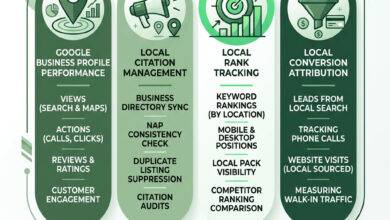
Beginner’s Guide to Orthodontist SEO

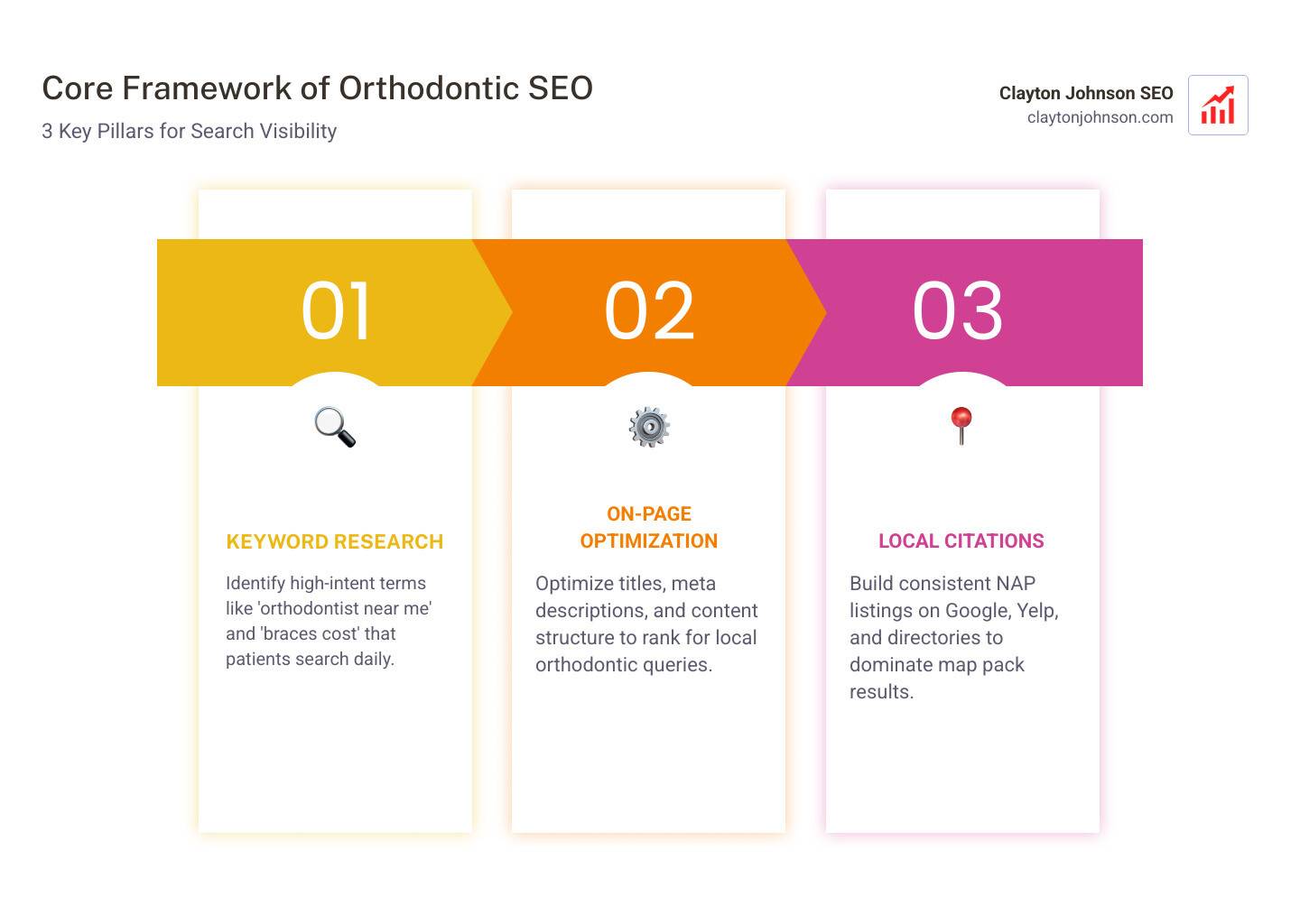
SEO for orthodontists is the process of optimizing your practice’s online presence so that local families and patients find you — not your competitors — when they search for braces, Invisalign, or orthodontic consultations nearby.
Here’s a quick summary of what effective orthodontic SEO involves:
- Google Business Profile optimization — the single biggest factor in local search rankings
- Treatment-specific pages — dedicated pages for braces, Invisalign, retainers, and more
- Local keyword targeting — phrases like “braces near me” or “Invisalign in [your city]”
- Patient reviews — consistent, high-quality reviews that build trust and boost rankings
- Technical SEO — fast load times, mobile responsiveness, and secure HTTPS
- Educational content — blog posts and FAQs that answer real patient questions
Think about this for a moment.
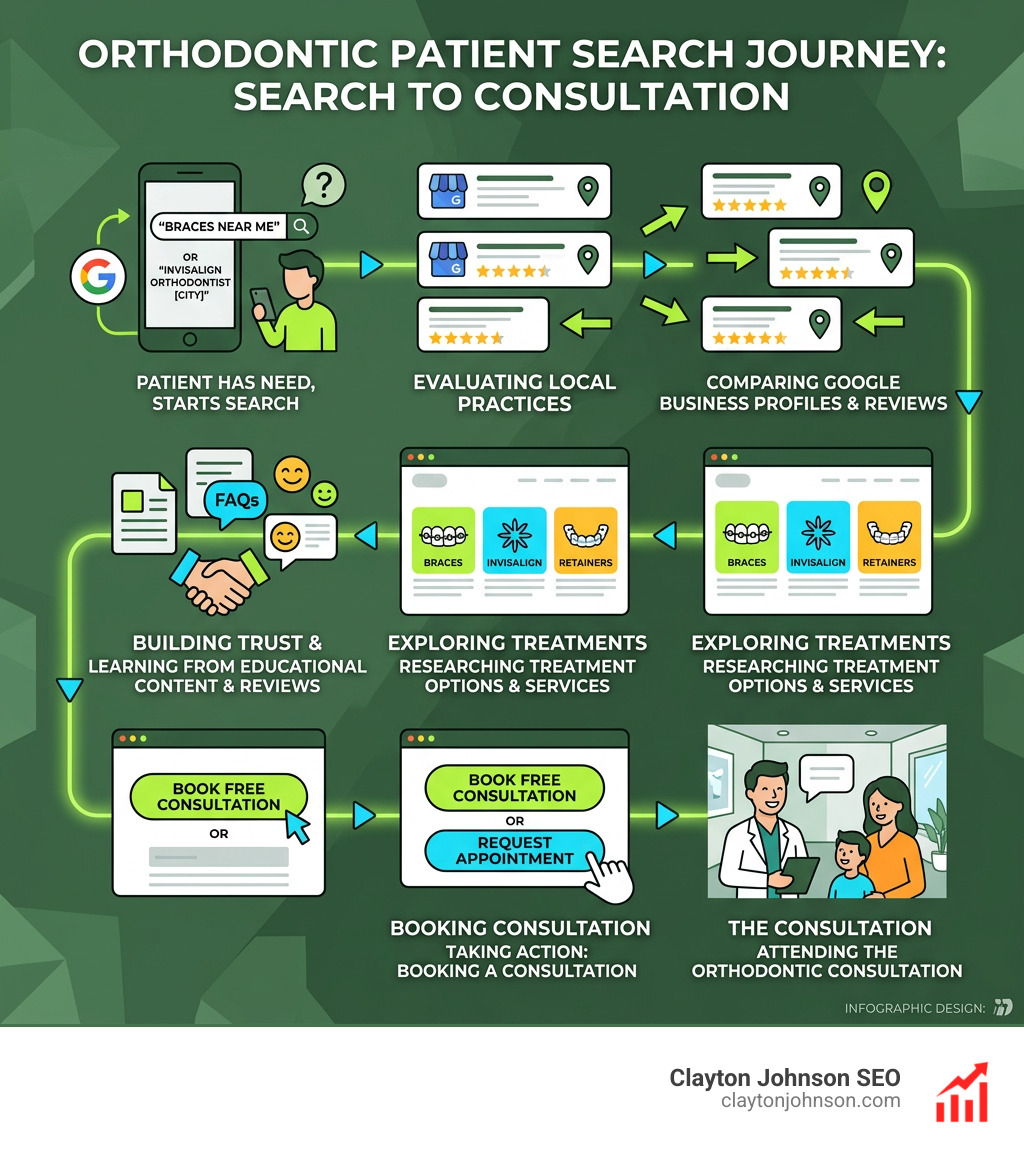
Right now, a parent is searching “braces for teens near me” on their phone. A young professional is comparing Invisalign during lunch. They’re both ready to book a consultation.
The question is: does your practice show up?
The reality is that 95% of orthodontic patients come from within a 15-mile radius of a practice. That means your competition isn’t global — it’s local. And local visibility is almost entirely determined by how well your SEO is set up.
Most orthodontists focus on clinical excellence. That’s important. But if your website is slow, your Google Business Profile is incomplete, or your treatment pages don’t match what patients are actually searching for, you’re handing patients to the practice down the street.
SEO changes that. Organic search traffic can generate the majority of new patient inquiries — consistently, without paying for every click.
Why SEO for Orthodontists is the Engine of Practice Growth
In the modern landscape, word-of-mouth is no longer enough. While a referral from a friend is great, most people will still “Google” you before they pick up the phone. If your digital curb appeal doesn’t match your clinical expertise, you lose the lead.
Because a single comprehensive orthodontic case is often worth between $5,000 and $7,000, the stakes are high. Effective seo for orthodontists can bring in 3 to 5 new patients every month. That represents a potential revenue increase of $15,000 to $35,000 monthly. Unlike a billboard that people drive past, SEO puts you exactly where people are looking when they have a specific need.
| Feature | SEO (Organic) | Paid Ads (PPC) |
|---|---|---|
| Cost | Upfront investment, low long-term | Pay-per-click ($5-$25/click) |
| Trust | High (70% of clicks go to organic) | Lower (clearly marked as ads) |
| Sustainability | Traffic continues if you stop paying | Traffic stops the second you stop |
| ROI | Compounding over time | Linear and fixed |
For those just starting, understanding SEO basics is the first step toward reclaiming your local market share.
High-Intent Patient Acquisition
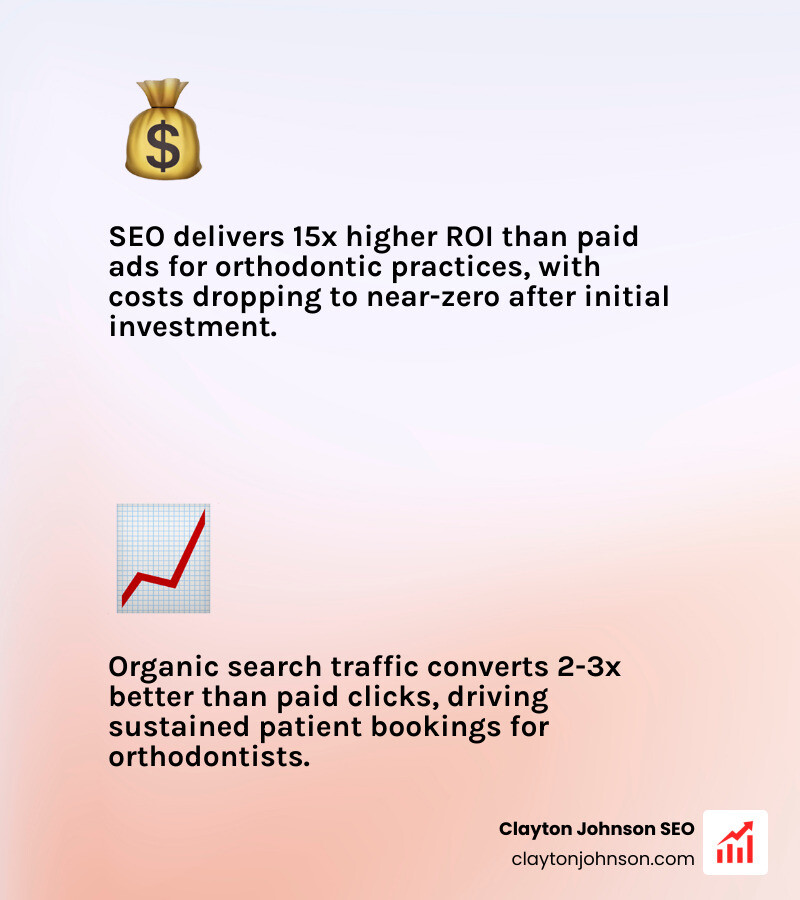
When someone searches for “best orthodontist in Harrisonburg” or “Invisalign near me in Palm Beach County,” they aren’t just browsing; they have high intent. They are looking for a solution to a problem. By ranking for these specific terms, you capture patients at the exact moment they are ready to convert. Organic search traffic often converts at a rate 3.2 times better than paid search because users inherently trust organic results more than sponsored ads.
Long-Term ROI and Compounding Growth
Think of SEO like a retirement account. You put in the work (and the investment) early on, and it grows over time. While Google Ads can provide a quick spike, they disappear the moment your budget runs out. SEO builds a durable asset. As your site gains authority, it becomes harder for competitors to knock you off the top spot. This creates a sustainable flow of leads that lowers your overall patient acquisition cost by up to 40% over time.
The Core Framework of Orthodontic Search Visibility
To win at SEO, we have to look at the “SEO Triangle”: Content, Technical SEO, and Backlinks. If one side is missing, the whole structure collapses. You might have the best blog posts in the world, but if your site takes 10 seconds to load, Google won’t show it to anyone.
A high-performing site needs a solid technical architecture to ensure search engines can crawl and index your pages effectively.
Technical Foundations of SEO for Orthodontists
Technical SEO is the “behind-the-scenes” work that makes your site run smoothly.
- Site Speed: 53% of patients will abandon a website that takes longer than 3 seconds to load. Aim for under 2.5 seconds to meet Core Web Vitals standards.
- Mobile Responsiveness: Over 70% of orthodontic searches happen on mobile devices. If your site looks clunky on a smartphone, you’re losing patients.
- Security: Patients are sharing sensitive health information. A secure HTTPS setup is non-negotiable for trust and ranking.
On-Page Content and E-E-A-T
Google prioritizes websites that demonstrate E-E-A-T (Experience, Expertise, Authoritativeness, and Trust). For orthodontists, this means your website should be more than just a digital brochure.
- Doctor Credentials: Include detailed bios, proofs of certification, and memberships in reputable professional organizations.
- Treatment Pages: Don’t just list “Braces.” Create separate pages for braces, clear aligners, and adult orthodontics so each service matches what patients are actually searching.
- Patient Testimonials: Use real stories and before-and-after galleries. These act as “digital diplomas” that prove you can deliver results.
Dominating the Local Map Pack
The “Local Pack” is the box at the top of Google search results that shows a map and three local businesses. For orthodontists, this is prime real estate. Since 95% of your patients are local, appearing here is often more important than ranking #1 in the standard blue links.
How Local SEO for Orthodontists Drives High-Intent Leads
Google determines local rankings based on three things: Proximity, Relevance, and Prominence.
- Proximity: How close is your office to the searcher?
- Relevance: Does your Google Business Profile clearly state you are an “Orthodontist” (not just a dentist)?
- Prominence: How well-known is your practice online? This is where citations and links from local sources like the Chamber of Commerce come into play.
Using hyperlocal keywords—like mentioning specific neighborhoods or landmarks—can help Google understand exactly which service area you cover.
Reputation Management and Patient Reviews
Online reviews are the second most important factor in local pack rankings. 9 out of 10 people check reviews before choosing a business.
- Velocity: You need a steady stream of new reviews, not just a bunch from five years ago.
- Response: Respond to every review—especially the negative ones—with empathy and professionalism.
- Direct Links: Make it easy for happy patients to leave feedback by providing direct links to your profile right after their “reveal” appointment.
Advanced Keyword Strategy and Content Architecture
Keywords are the bridge between what patients are typing and the content you provide. Many practices make the mistake of only targeting broad terms like “orthodontist.” While those are good, the real gold is in long-tail keywords and question-based searches.
Targeting Invisalign vs. Braces Search Intent
The person searching for “Invisalign cost for adults” has a different mindset than a parent searching for “when should a child see an orthodontist?”
- Invisalign: Often focused on aesthetics, comfort, and cost.
- Braces: Often focused on durability, teen-specific concerns, and insurance coverage.
- Educational Content: Question-based headers like “How long do braces take?” drive more qualified traffic than generic pages. Use tools like keyword research platforms and Search Console data to find what your local community is asking.
Leveraging AI and Answer Engine Optimization
Search is changing. With the rise of AI-driven search, Google is now looking for direct answers to specific questions. This is called Answer Engine Optimization (AEO).
- Structured Data: Use schema markup (like LocalBusiness schema or FAQ schema) to help AI “read” your site.
- Direct Answers: Structure your FAQ sections to provide clear, concise answers that AI can easily pull into search snippets. For a deeper look, check out our guide to AI SEO.
Measuring Success and Avoiding Common Pitfalls
If you can’t measure it, you can’t improve it. We use data to turn fragmented marketing into a coherent growth engine.
Essential Metrics for Orthodontic Practices
Don’t get distracted by “vanity metrics” like total hits. Focus on:
- Organic Sessions: How many people found you through a search engine?
- Keyword Rankings: Are you moving up for “Invisalign [City]”?
- Conversion Tracking: Use Google Analytics and Search Console to see how many people clicked “Schedule Consultation.”
- Call Tracking: Since many patients still prefer to call, use dynamic number insertion to see which search terms are actually ringing your phone.
Common Mistakes to Avoid
- Keyword Stuffing: Writing for robots instead of humans makes your practice look unprofessional.
- Duplicate Content: Never copy-paste descriptions from manufacturers or other sites. Google rewards high-quality content that is original.
- Neglecting Mobile: If your “Book Now” button is too small to click on a phone, your SEO efforts are wasted.
- NAP Inconsistency: Ensure your Name, Address, and Phone number are identical across every directory on the web.
Frequently Asked Questions about Orthodontic SEO
How long does it take to see results from SEO?
SEO is a long-term play. While you might see some movement in Google Maps within 30 to 45 days, consistent lead growth usually takes 60 to 90 days. To become the dominant authority in your city, expect a timeline of about six months.
Is SEO better than Google Ads for my practice?
They work best together, but SEO has a better long-term ROI. Paid ads are great for immediate visibility, but organic search builds a brand that lasts. Organic traffic converts at a much higher rate because it carries more “earned” trust.
Can I handle my practice’s SEO in-house?
You can handle basic tasks like posting weekly updates to your Google Business Profile or requesting reviews. However, the technical side-like HTTPS setup, schema markup, and advanced link building-usually requires a specialist. Most busy orthodontists find that partnering with a dedicated SEO strategist yields better results with less frustration.
Conclusion
At the end of the day, seo for orthodontists isn’t just about rankings; it’s about making sure the best care is findable by the people who need it most. By building a system-level growth engine, you stop “guessing” where your next patient will come from and start creating a predictable pipeline of high-value cases.
Whether you are a solo practitioner or managing multiple locations, the goal is clarity and structure. Don’t let your practice remain invisible. Take a strategic approach to your digital presence and watch your practice compound in value year after year.
Ready to turn your website into your most productive employee? Scale your practice with expert SEO services and start dominating your local market today.