An Essential Guide to Demand Generation


Why Demand Generation Is the Foundation of Sustainable Growth
Demand generation is the strategic process of creating awareness, building trust, and driving long-term engagement with potential customers—before they’re ready to buy. Unlike traditional lead generation that focuses on capturing contact information, demand generation encompasses the full customer journey from first impression to brand advocacy.
Key elements of demand generation:
- Creates awareness through educational content and thought leadership
- Builds trust by solving problems before asking for a sale
- Nurtures relationships across multiple touchpoints and channels
- Drives revenue by generating high-quality leads that convert
- Supports retention by continuing engagement after purchase
The difference matters because B2B buyers spend only 17% of their time talking to sales. The other 83%? They’re researching, comparing, and forming opinions about your brand. Demand generation ensures you’re present and valuable during that critical window.
Most marketing teams treat demand generation and lead generation as the same thing. They’re not. Demand gen plants and cultivates—it builds the field. Lead gen harvests—it captures what’s ready. If you only harvest, you eventually run out of crops.
I’m Clayton Johnson, and I’ve spent years building scalable demand generation systems that align content strategy, search intent, and revenue outcomes. My work focuses on creating structured frameworks that turn fragmented marketing efforts into coherent growth engines that compound over time.
Defining the Pillars of Demand Generation
When we talk about Demand Generation, we are looking at an umbrella term that covers a wide range of marketing activities designed to drive long-term engagement. It isn’t just a single campaign or a clever ad; it’s a holistic philosophy that positions marketing as a revenue generator rather than a cost center.
By focusing on the entire marketing funnel, we move away from the “spray and pray” tactics of the past and toward a model that fosters genuine brand loyalty. According to Marketo’s definition of demand generation, it involves a series of touchpoints designed to raise awareness, position your brand as a trusted advisor, and ultimately sell solutions.
Demand Generation vs. Lead Generation
The most common mistake we see in Minneapolis businesses is using these terms interchangeably. To succeed, you must understand the nuance. Demand Generation is about creating the spark of interest and building a brand that people actually want to buy from. It’s about problem-solving and establishing authority. Lead Generation, on the other hand, is the specific act of capturing a prospect’s information (like an email address) so that sales can follow up.
If your website isn’t attracting the right kind of attention, you likely have a demand problem, not just a lead problem. This is where More info about SEO services becomes vital—SEO isn’t just about ranking; it’s about being visible exactly when your audience is looking for an answer to their problem.
| Feature | Demand Generation | Lead Generation |
|---|---|---|
| Primary Goal | Build brand interest and authority | Capture contact information |
| Gating | Usually ungated (free access) | Usually gated (form fills) |
| Focus | Long-term brand affinity | Short-term sales pipeline |
| Metrics | Brand awareness, market share | MQLs, SQLs, Conversion rate |
Demand Capture and Pipeline Acceleration
Once you’ve created demand, you have to capture it. This is where intent data and sales alignment come into play. We use lead scoring to determine which prospects are just “looking” and which ones are ready to talk to a human.
Pipeline acceleration is the “gas pedal” of the process. It involves removing friction from the buying journey so that a lead moves from “interested” to “closed-won” faster. This requires a rock-solid Sales Strategy where marketing and sales are speaking the same language. Without this alignment, you end up with “garbage leads” that sales ignores, or “hot leads” that marketing never follows up on.
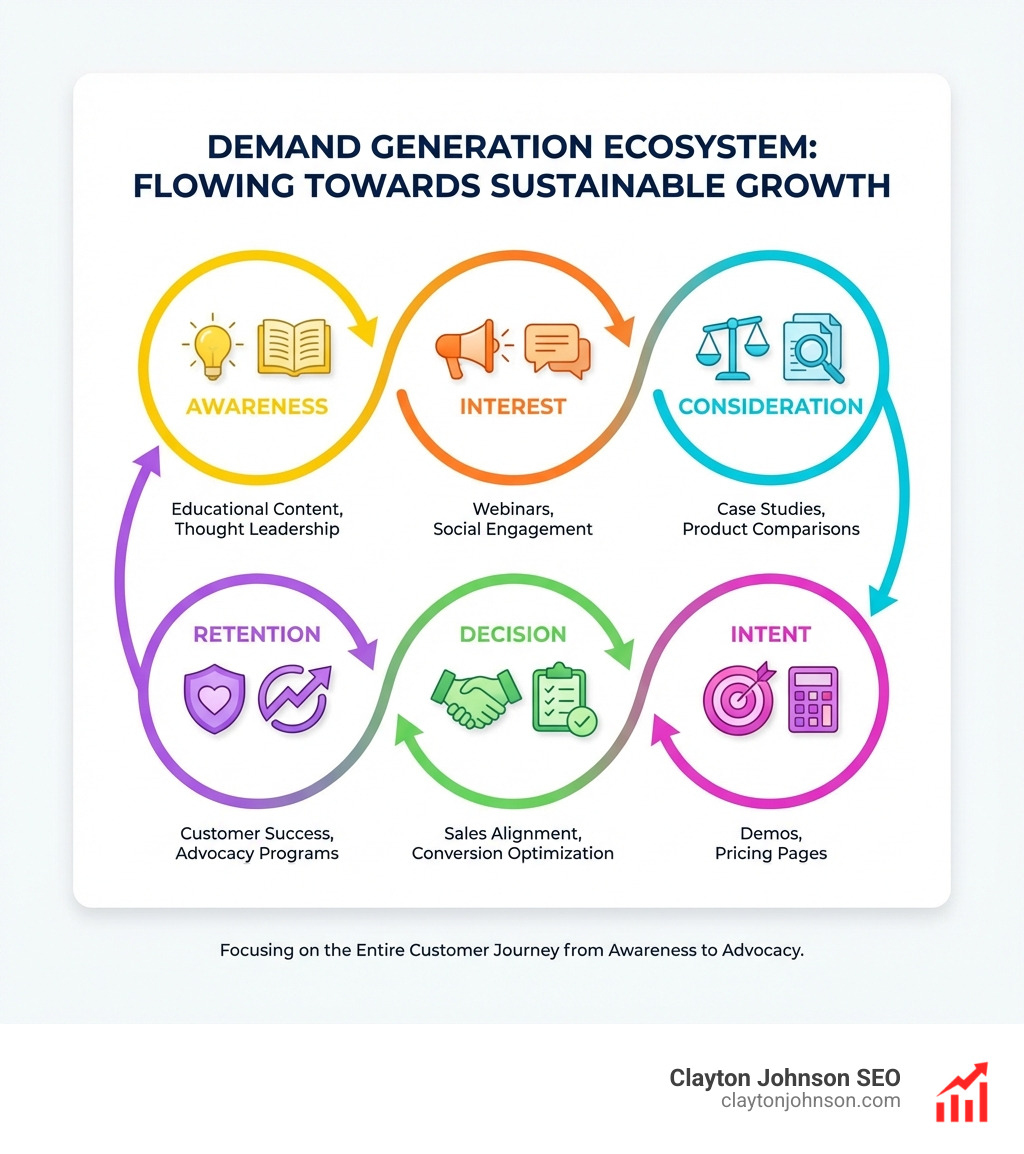
The 6 Stages of the Customer Journey
The B2B buyer journey is no longer a straight line. It’s a messy, multi-stage process where buyers might visit your site five or six times before ever reaching out. Research shows that 82% of buyers viewed at least five pieces of content from the winning vendor.
Building Awareness and Interest
In the early stages, your job is to be helpful, not salesy. We do this through thought leadership, social media, and educational content. This is the time to develop deep Buyer Personas so you know exactly what keeps your audience up at night.
For those looking to scale quickly, Google Ads Demand Gen campaigns can be a powerful tool. These AI-powered campaigns reach users across YouTube, Discover, and Gmail, using immersive visuals to grab attention before the buyer even realizes they are in the market for a solution.
Guiding Intent and Retention
As the prospect moves closer to a decision, the content must shift. We move from “How-to” blogs to case studies, product demos, and ROI calculators. The goal here is to prove that your solution works and that you are a safe bet.
But the journey doesn’t end at the sale. Retention is a critical, often overlooked pillar of Demand Generation. By using Services: Email Marketing, we can nurture existing customers, turning them into long-term advocates who provide the referrals and reviews that fuel the next cycle of demand.
Proven Strategies for Effective Execution
Successful demand generation is driven by data and powered by technology. You can’t just guess what your audience wants; you have to use a multichannel approach guided by SMART goals (Specific, Measurable, Attainable, Relevant, and Timely).
Content Systems and Thought Leadership
Content is the fuel for your demand engine. However, “content for content’s sake” is a waste of money. We build content systems that align with the buyer’s journey. This includes:
- Webinars and Seminars: To facilitate discovery and deep-dive into complex problems.
- Whitepapers and eBooks: To establish authority (though we recommend gating these selectively).
- SEO Strategy: Ensuring your content is “findable” by the right people at the right time.
Our Services: SEO Content Marketing focus on creating “MUD” content—Meaningful, Unique, and Defensible—to help you stand out in a noisy marketplace.
Integrating AI in Demand Generation
AI is no longer a futuristic concept; it’s a daily tool for high-performance marketing. From marketing automation that sends the right email at the right time to data insights that predict which accounts are about to buy, AI allows us to personalize at a scale that was previously impossible.
If you aren’t already leveraging these tools, you’re falling behind. We discuss this in detail in our guide on Why Your Brand Needs an AI Growth Strategy Right Now. AI doesn’t replace the human element; it amplifies it by handling the heavy lifting of data analysis and repetitive tasks.
Measuring Success with Key Metrics
If you can’t measure it, you can’t improve it. Traditional marketing focuses on “vanity metrics” like likes and shares. While those are nice, they don’t pay the bills. We focus on metrics that impact the bottom line.
Tracking Leading and Lagging Indicators
We divide our metrics into two categories:
- Leading Indicators: These signal momentum. Think of direct traffic, newsletter growth, and clickthrough rates on your ads.
- Lagging Indicators: These are the outcome signals, such as pipeline contribution, Win Rate, and the holy grail of metrics: LTV:CAC (Lifetime Value to Customer Acquisition Cost).
Successful companies in the Minneapolis area know that a healthy LTV:CAC ratio is typically 3:1 or higher. If you’re spending more to acquire a customer than they are worth over their lifetime, your demand gen engine needs a tune-up. This is where Services: Conversion Optimization becomes essential—it ensures that the traffic you’re generating actually turns into revenue. For a deeper look at your numbers, check out our Analytics and Data resources.
Conclusion
At Clayton Johnson SEO, we believe that Demand Generation is the only way to build a sustainable, scalable business in the modern age. By moving away from the “lead gen treadmill” and toward a value-led, revenue-driven system, you create a brand that doesn’t just survive but thrives.
Our diagnostic frameworks and strategic execution are designed to help you find the gaps in your funnel and fill them with high-performing content and AI-assisted workflows.
Frequently Asked Questions about Demand Generation
How does demand generation differ from inbound marketing?
Think of Demand Generation as the function and inbound marketing as the method. Inbound (SEO, content, social) is the most effective way to generate demand, but you could technically use outbound methods (like cold calling) to generate demand as well.
What are the biggest challenges in implementing demand generation?
The biggest hurdles are usually a lack of understanding of the target audience, a website that doesn’t attract visitors, and a disconnect between marketing and sales. If marketing is focused on “lead count” and sales is focused on “revenue,” you’ll always have friction.
How do we align sales and marketing?
Alignment starts with shared goals. Both teams should be measured on pipeline contribution and revenue. Regular meetings to discuss lead quality and buyer feedback are essential to keep both teams moving in the same direction.
Take the Next Step in Your Growth Journey
Stop chasing low-quality leads and start building a demand engine that works for you. Whether you need a complete SEO overhaul or an AI-driven growth strategy, we have the tools and expertise to deliver measurable results.
Ready to see how we can help your business grow? Work with me and let’s start building your sustainable growth engine today.