Digital Brand Positioning Terms Demystified


You’re Invisible Online — and Digital Brand Positioning Is the Fix
Digital brand positioning is the strategic process of shaping how your target audience perceives your brand across online channels — making you the obvious choice over competitors.
Here’s a quick breakdown:
- What it is: Designing your brand’s identity, message, and value so it occupies a distinct, memorable space in customers’ minds online
- Why it matters: Consistent positioning can increase brand recognition by 3.5x and drive up to 23% higher customer loyalty
- Who needs it: Any business struggling to stand out, attract the right clients, or convert online traffic into leads
- How it works: Through clear messaging, a strong unique value proposition (UVP), and consistent presence across digital channels
Think about your own day for a moment. You scroll through social media, check email, listen to a podcast — and absorb hundreds of brand messages without registering most of them. Research suggests the average person scrolls past around 300 brand messages before breakfast. Most brands never break through.
The ones that do aren’t necessarily louder. They’re clearer.
As marketing scholars Kotler and Armstrong put it, brand positioning is about designing your offering and image to occupy a distinctive place in the mind of your target market. In a digital context, that means every touchpoint — your website, your social profiles, your content — needs to reinforce the same sharp, coherent story.
For ambitious business owners trying to attract high-value clients online, that clarity isn’t optional. It’s the foundation everything else is built on.
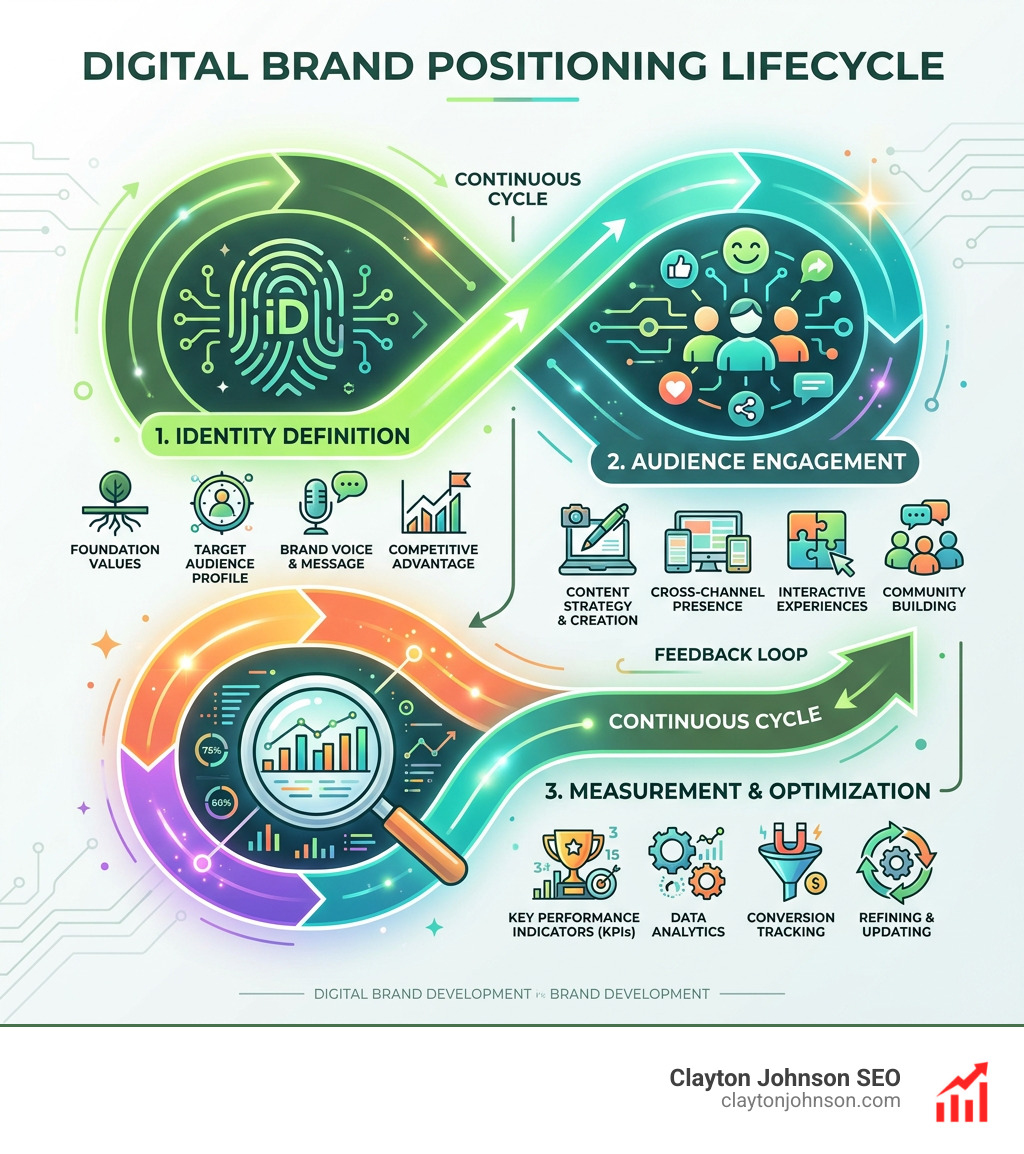
What is Digital Brand Positioning and Why Does It Matter?
At its core, digital brand positioning is about mental real estate. In the classic text Principles of Marketing, Kotler and Armstrong define positioning as the act of designing a company’s offering so it occupies a “distinctive place” in the target market’s mind. In the analog world, this might have been a billboard or a catchy TV jingle. In the digital world, it’s much more complex.
Traditional positioning was often a one-way broadcast. You told the world who you were, and they listened (or didn’t). Digital positioning is a living, breathing ecosystem. It’s the difference between a static storefront and a 24/7 interactive experience. It involves the art of being different and better by leveraging data to meet customers exactly where they are—whether that’s in a Google search result or an Instagram story.
Why should you care? Because the stakes are higher than ever. Brands with strong positioning achieve up to 23% higher customer loyalty. When your audience knows exactly what you stand for, they don’t just buy from you; they buy into you. This clarity leads to a 3.5x increase in brand recognition, turning casual browsers into vocal advocates.
The Shift from Physical to Virtual Organizations
The rise of the “virtual organization” has fundamentally changed the barrier to entry for internet entrepreneurship. We no longer need massive physical headquarters to build global brands. Today, small teams—often entirely remote—leverage virtual collaboration tools to outmaneuver legacy corporations.
This shift allows for incredibly low operating costs, which means more resources can be poured into startup branding frameworks that actually scale. In this environment, your “position” isn’t tied to a zip code; it’s tied to your digital authority. Market accessibility is now universal, but that also means competition is global. To survive, you must move beyond being a “commodity” and become a “category of one.”
Why Clarity Trumps Noise in a Saturated Market
We are living through an era of ad oversaturation. When everyone is shouting, the person who whispers a perfectly timed, relevant solution is the one who gets heard. Most brands fail because they have a clarity problem, not a traffic problem. They try to be everything to everyone, which results in being nothing to anyone.
Forrester research indicates that digital tools are now essential for creating the personalized experiences that modern consumers demand. If you aren’t using data to refine your message, you’re just adding to the noise. Building emotional connections is the only way to bypass the “scroll-past” reflex. We recommend focusing on not being a brand nobody by identifying the specific “white space” in your market that no one else is brave enough to claim.
Core Elements of an Effective Digital Brand Positioning Strategy
To build a brand that sticks, you need more than a nice logo. You need a foundation. An effective digital brand positioning strategy is built on four main pillars:
- Mission and Vision: Why do you exist beyond making a profit?
- Unique Value Proposition (UVP): What do you do that no one else can (or will) do?
- Brand Personality: If your brand were a person, how would they speak and act?
- Target Audience: Who are the specific people whose lives you are trying to change?
When these elements align, you create a “gravitational pull” that attracts your ideal clients. This is how to position your brand so competitors cry—by making the competition irrelevant through sheer specificity. According to research on brand-positioning effectiveness, the most successful brands are those that focus on a single, compelling benefit that resonates deeply with the consumer’s self-image.
Defining Your UVP for Digital Brand Positioning
Your Unique Value Proposition is the “meat” of your strategy. It’s not a list of features; it’s a promise of a transformation. To find your UVP, you must stop guessing and start positioning with competitive intelligence. Look at what your competitors are promising and find the gaps they’ve left behind.
Are they too expensive? Too slow? Too corporate? Use those weaknesses to define your strengths. Smart Insights suggests that the best digital strategies are those that solve a very specific pain point for a very specific audience. If you try to solve everyone’s problems, your UVP becomes diluted and forgettable.
Building a Consistent Brand Voice and Image
Consistency is the “secret sauce” of digital authority. If your website feels like a law firm but your Instagram feels like a circus, you’re eroding trust. 80% of consumers say the quality of a brand’s digital experience influences their purchasing decisions.
We suggest using a brand consistency checklist to ensure your voice, values, and visuals match across every platform. This includes everything from your logo’s memorability to the “micro-copy” on your checkout buttons.
Types of Digital Marketing Positioning Models
Not every brand positions itself the same way. Depending on your goals and your market, you might choose one of several primary models.
| Positioning Type | Focus | Example Goal |
|---|---|---|
| Quality | Superior craftsmanship or results | Be the “luxury” or “pro” choice |
| Price | Best value or lowest cost | Attract budget-conscious buyers |
| Benefit | A specific outcome (e.g., “Save 10 hours a week”) | Solve a nagging problem |
| Solution | Holistic help for a complex situation | Be the “all-in-one” partner |
| Competitor | Why you are better than “Brand X” | Disrupt the market leader |
Choosing the right model is essential for navigating market positioning. For instance, if you’re a premium service provider, trying to compete on price will only hurt your brand. Instead, focus on “Benefit” or “Quality” positioning to justify your rates. You can see this in action through various brand positioning examples where straplines (taglines) are used to instantly communicate a brand’s specific “lane.”
Leveraging Social Media for Digital Brand Positioning
Social media isn’t just for cat videos; it’s a primary discovery engine. According to HubSpot’s marketing industry trends, 64% of Gen Z and 59% of Millennials discover products on social platforms.
- Facebook: Great for community building and long-form storytelling.
- Instagram: The home of visual identity and lifestyle positioning.
- YouTube: The ultimate platform for “Solution” positioning through educational video content.
Deloitte’s Digital Media Trends highlight that brands that integrate social commerce and viral marketing into their strategy gain a massive competitive edge. It’s not about being on every platform; it’s about being on the right platforms with a message that fits the “vibe” of that specific digital space.
Real-World Success Stories: Nike, Patagonia, and REI
Looking at the “giants” can provide a roadmap for your own digital brand positioning.
- Nike: They don’t just sell shoes; they sell “greatness.” Their “Just Do It” ethos is a classic example of aspirational positioning that transcends product features.
- Patagonia: They have mastered “Benefit” and “Value” positioning by focusing on climate activism and sustainability. They’ve built such a strong emotional connection that their customers are willing to pay a premium to support their mission.
- REI: They position themselves as the “anti-corporate” outdoor gear shop. By focusing on outdoor enthusiasts rather than casual shoppers, they’ve created a loyal member base that feels like a club rather than a customer list.
These brands succeed because they aren’t afraid to take a stand. They know that by being “for someone,” they are inherently “not for everyone.”
Overcoming Challenges in the Digital Landscape
Digital positioning isn’t a “set it and forget it” task. The landscape changes every day, and several common traps can derail your progress:
- Market Saturation: Too many voices saying the same thing.
- Inconsistent Messaging: Confusing your audience by changing your “vibe” too often.
- AI Disruption: The sudden commoditization of content and features.
To stay ahead, you need to stop blending in. This requires constant auditing of your brand’s digital presence. Are you still solving the same problem? Has a new competitor entered the space? You must understand what an AI positioning model is and how it affects the way people search for and find your brand.
Navigating AI and Future Technologies
The rise of generative AI is both a threat and a massive opportunity. On one hand, it’s easier than ever for competitors to churn out content. On the other hand, AI allows for unprecedented levels of personalization.
The key is to use AI for positioning without looking like a robot. Use AI to analyze data and find patterns in what your customers want, but keep your brand’s “soul” human. Deloitte’s research suggests that the brands that win over time will be those that use first-party data to create hyper-personalized experiences that feel authentic, not automated.
Maintaining Integrity Across Fragmented Channels
Today’s consumer might find you on TikTok, research you on Google, and finally buy from you via an email link. This fragmentation makes “omnichannel consistency” vital. Industry experts emphasize that internal branding is just as important as external marketing. If your team doesn’t understand your positioning, they can’t deliver a consistent user experience (UX).
The Digital Marketing Institute notes that the average user spends over two hours a day across nearly seven different platforms. If your message is fractured across those touchpoints, you’ll never build the “equity” needed to dominate your niche.
Measuring the Impact of Your Digital Brand Positioning
How do you know if your positioning is actually working? You can’t just rely on “gut feeling.” You need Key Performance Indicators (KPIs) that track both awareness and sentiment.
- Brand Search Volume: Are more people searching for your brand name specifically?
- Sentiment Analysis: When people talk about you online, is it positive? Do they use the words you want them to use?
- Share of Voice: How much of the digital conversation in your industry are you owning?
Measuring brand positioning success requires looking at leading indicators like engagement quality, not just vanity metrics like follower counts. Industry research points out that AI is revolutionizing this space by allowing us to analyze thousands of data points in seconds to see how our brand is actually perceived versus how we want it to be perceived.
Tools for Tracking and Optimization
You don’t have to do this manually. A robust tech stack is your best friend in digital brand positioning.
- Google Analytics: To see how people interact with your “home base” (your website).
- SEMrush: To track your keyword rankings and see how you stack up against competitors.
- Survey Tools: Market research tools allow you to get direct feedback from your audience.
In a rapidly expanding digital marketing landscape—with consistent double-digit annual growth according to Unity Connect—staying stagnant is the same as moving backward. You need an AI growth strategy that allows you to iterate your positioning in real-time based on what the data is telling you.
Frequently Asked Questions about Digital Brand Positioning
How does digital brand positioning differ from traditional positioning?
The biggest difference is speed and interaction. Traditional positioning was static; digital positioning is dynamic. In the digital world, you have access to real-time data that allows for constant iteration. Furthermore, digital positioning is a two-way street. Your customers can talk back to you (and each other) instantly, which means your reputation is co-created with your audience. DigitalOcean notes that digital positioning is the “engine” behind modern business growth because it directly influences online conversion rates.
What are the most common mistakes in digital positioning?
The “fatal” mistake is targeting everyone. When you try to appeal to the whole world, your message becomes “vanilla” and boring. Other common errors include skipping the foundational research and failing to maintain consistency across channels. According to industry leaders, many brands treat positioning as a one-time project rather than a continuous strategic process.
How can small businesses compete with larger brands online?
Small businesses have a “secret weapon”: Agility. You can specialize in a tiny niche that is too small for a giant corporation to care about. By focusing on authentic storytelling and deep strategic positioning, you can build a “cult following” that larger brands can’t touch. You don’t need the biggest budget; you just need the clearest message.
Conclusion
At Clayton Johnson SEO, we believe that clarity is the ultimate competitive advantage. We don’t just chase temporary traffic spikes; we build durable systems that turn search intent into compounding growth. By combining technical SEO depth with strategic digital brand positioning, we help founders and operators turn fragmented marketing efforts into coherent growth engines.
Our philosophy is simple: Clarity → Structure → Leverage → Compounding Growth.
If you’re ready to stop blending in and start occupying a “distinctive place” in your market’s mind, we’re here to build the systems that make it happen. Whether it’s through structured content ecosystems or AI-enhanced workflows, we focus on measurable business impact—not just vanity metrics.
Ready to dominate your niche? Explore our SEO Services and let’s start building your digital authority today.