Goal-Getter’s Guide: How to set and achieve meaningful social media goals


Why “Post and Pray” Is Not a Social Media Strategy 🎯
Setting social media goals is the difference between a strategy that drives real business growth and one that just fills a content calendar.
Here is a quick-start answer if you need it fast:
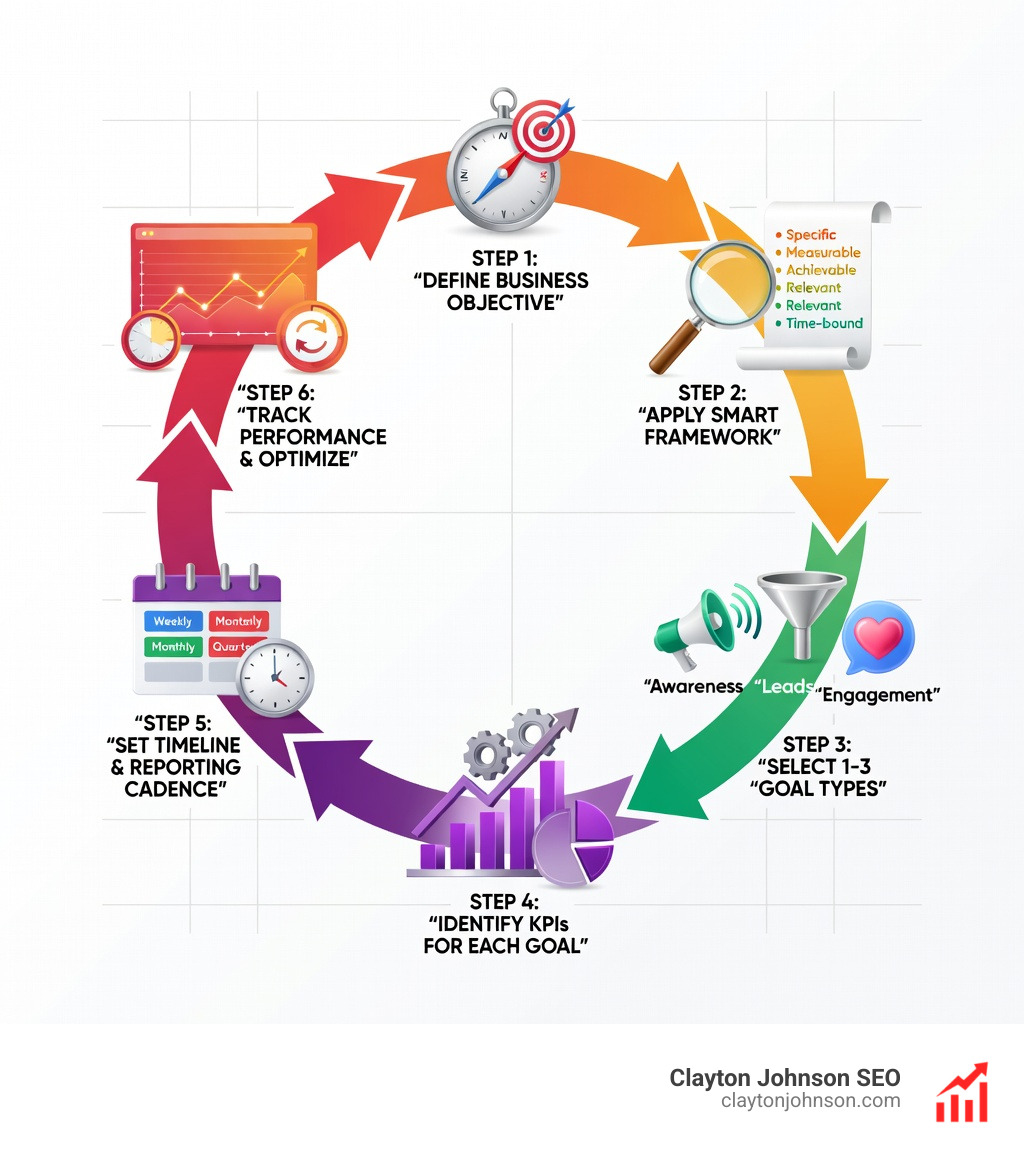
How to set social media goals (step-by-step):
- Start with your business objective — what does the business need to achieve?
- Apply the SMART framework — make goals Specific, Measurable, Achievable, Relevant, and Time-bound
- Pick 1–3 focused goals — brand awareness, lead generation, engagement, traffic, or customer service
- Identify your KPIs — the exact metrics you will track (reach, conversions, engagement rate, etc.)
- Set a timeline — weekly check-ins, monthly deep-dives, quarterly pivots
- Track, optimize, repeat — adjust based on real data, not gut feel
Most brands skip step one entirely. They post consistently, chase likes, and wonder why social media never seems to move the needle on revenue.
The problem is not effort. It is the absence of a defined objective.
According to research, 66% of business leaders say social media data positively impacts brand reputation, and 65% say it helps them understand customers better. Yet most social teams still struggle to connect their daily activity to those outcomes.
Demonstrating how social media campaigns tie to business goals is also the #1 way social teams secure more investment from leadership. That connection starts with clear, intentional goal-setting — not reactive posting.
I’m Clayton Johnson — an SEO strategist and growth operator who has helped founders and marketing leaders build structured, measurable growth systems across SEO, content, and social media channels, including developing the frameworks behind setting social media goals that compound over time. The guide below gives you the exact approach I use to turn scattered social activity into a focused, ROI-driven engine.
Why strategic objectives beat “Post and Pray” tactics
We’ve all seen it: a brand posts a viral meme, gets thousands of likes, and then… nothing happens. No sales increase, no new leads, and no measurable impact on the bottom line. This is the “post and pray” method. It feels productive because you’re “active,” but without strategic objectives, you’re essentially driving in the dark without a GPS.
Setting social media goals is vital because it provides a foundation for accountability. When we set a goal, we aren’t just guessing; we are making a commitment to a specific outcome. This accountability is what allows marketing teams to justify their role and secure the necessary budget for future campaigns. If you can’t show how a TikTok video contributed to a business objective, it’s hard to ask for more money to make the next one.
Furthermore, goals guide our budget allocation. Should we spend $500 on Facebook ads for reach or $500 on LinkedIn for lead generation? The answer depends entirely on your goals. Without them, budget decisions are made on a whim rather than on data. Speaking of data, scientific research on goal setting suggests that setting specific and challenging goals leads to higher performance 90% of the time.
By focusing on social media marketing services that prioritize data-driven approaches, we can improve:
- Brand Reputation: 66% of leaders see a positive impact here.
- Customer Understanding: 65% use social insights to know their audience better.
- Competitive Positioning: 63% of leaders use social data to stay ahead of rivals.
We want to move away from vanity metrics (like total followers) and toward ROI-focused outcomes. Whether it’s increasing website sign-ups or improving customer retention, every post should have a job to do.
A framework for setting social media goals that drive growth
At Clayton Johnson, we believe that most companies don’t lack tactics; they lack structured growth architecture. This applies heavily to social media. To succeed, you need a repeatable framework.
The first step is to ensure your social media objectives aren’t siloed. They must align with your broader business objectives. If your company’s main goal for the quarter is to launch a new product, your social goal shouldn’t be “increase general brand awareness.” It should be “drive 500 pre-orders via Instagram.” This is where aligning OKRs organization-wide becomes critical to ensure every department is pulling in the same direction.

The SMART approach to setting social media goals
The most effective way to refine your objectives is by using the SMART framework. This ensures your goals are actionable and not just “pie in the sky” dreams. You can even use a SMART Goals Chart to map this out visually.
- Specific: Instead of saying “I want more followers,” say “I want to increase our LinkedIn followers by 500.”
- Measurable: How will you track it? (e.g., using native analytics or a reporting dashboard).
- Achievable: Is it realistic? If you currently gain 10 followers a month, aiming for 10,000 next month is probably not achievable.
- Relevant: Does this goal actually help the business? If you’re a B2B software company, 1 million views on a dancing video might not be as relevant as 10 high-quality leads.
- Time-bound: Set a deadline. “By the end of the quarter” or “within 30 days.”
Common mistakes when setting social media goals
One of the biggest traps we see is the obsession with vanity metrics. Likes and shares are great for the ego, but they don’t always pay the bills. If your engagement is high but your conversion rate is zero, you have an alignment problem.
Another mistake is having unrealistic expectations. Think of the Olympic athlete analogy: a runner doesn’t just show up at the Olympics and win gold. They set incremental, realistic targets first—regional meets, then state, then national. Your social media should follow the same path. Start with small, achievable wins to build momentum.
| Metric Type | Realistic Goal | Unrealistic Goal |
|---|---|---|
| Follower Growth | 5% increase per month | 500% increase in 1 week |
| Engagement | 2% engagement rate per post | 50% engagement rate on every post |
| Response Time | Under 2 hours for customer queries | Instant responses 24/7 with a 1-person team |
| Conversions | 10 new leads per month from LinkedIn | 1,000 sales from a single organic post |
Common examples and platform-specific objectives
When setting social media goals, we need to recognize that not every platform serves the same purpose. A goal that works on LinkedIn might fail miserably on TikTok.
Common examples of goals include:
- Brand Awareness: Focusing on reach and impressions to get your name in front of new people.
- Lead Generation: Using social media marketing tips to drive users to a landing page where they provide their email.
- Community Engagement: Fostering conversations and building loyalty.
- Web Traffic: Driving clicks to your blog or product pages.
- Customer Service: Reducing response times and resolving issues publicly.
- Recruiting: Attracting top talent, particularly on LinkedIn.
A critical component of achieving these goals is the Call-to-Action (CTA). Without a clear CTA, your audience won’t know what to do next. We also recommend using lead origin tracking—like UTM parameters—to see exactly which post or platform generated a sale. Interestingly, Meta is currently testing Threads Ads, which may open up new conversational lead-gen opportunities in the future.
Aligning goals across Instagram, TikTok, and LinkedIn
Each platform has a “superpower.” We should align our goals to these strengths:
- Instagram: Best for brand affinity and visual storytelling. Use Stories and Reels to build a “vibe” that makes people want to be part of your world.
- TikTok: The king of virality. If your goal is massive reach among younger demographics through unpolished, authentic content, this is the place.
- LinkedIn: The home of B2B leadership and professional networking. Goals here should focus on thought leadership, lead generation, and nurturing business relationships.
- Facebook: Excellent for community building through Groups and providing targeted customer support.
- Threads: Useful for real-time conversations and developing a brand voice that is more informal and approachable.
Measuring, tracking, and optimizing your KPIs
You can’t manage what you don’t measure. Once you’ve set your SMART goals, you need to identify the Key Performance Indicators (KPIs) that tell you if you’re winning.
For brand visibility, we track reach (how many unique people saw it) and impressions (how many times it was seen). For community building, we look at the engagement rate (likes, comments, and shares relative to reach). To measure business impact, we monitor network referrals and conversion rates in web analytics.
We also look at Earned Media Value (EMV), which quantifies the value of your social exposure compared to what you would have paid for the same reach via ads. This is a great way to show leadership the “free” value social media provides.
Essential tools for reporting and analytics
To get a full-funnel view of your progress, you need the right tech stack. We recommend:
- Hootsuite Analytics: Great for tracking metrics across multiple networks in one place.
- Social Listening Tools: Tools like Hootsuite Listening help you track brand mentions and sentiment.
- Google Analytics 4 (GA4): Essential for seeing how social traffic behaves once it hits your website.
- Supermetrics: Excellent for pulling data into a social media reporting template for a high-level view.
- Engagement Calculator: Use a free engagement calculator to quickly check the health of your posts.
By regularly reviewing these digital marketing pillars, we can perform A/B testing on everything from CTA wording to posting times, ensuring we are constantly optimizing for the best results.

Competitive analysis and strategy evolution
We don’t operate in a vacuum. Your competitors are fighting for the same attention you are. This is why competitive analysis is a mandatory part of setting social media goals.
We use competitive intelligence to determine our share of voice—how much of the online conversation in our industry is about us versus our rivals. Benchmarking allows us to see if our 2% engagement rate is actually good for our industry or if we’re lagging behind.
However, don’t just copy what others are doing. Use their data to find “white space”—opportunities they are missing. Perhaps your competitors are all on LinkedIn, but none of them are using TikTok effectively. That’s an opportunity for you to dominate a different channel.
Strategy evolution requires us to be flexible. We recommend:
- Monthly Reviews: Deep-dives into what worked and what didn’t.
- Quarterly Strategic Pivots: Adjusting goals based on platform algorithm changes or shifts in business focus.
- Audience Feedback: Paying attention to comments and DMs to see if your messaging is resonating.
Using scalable marketing frameworks helps ensure that as your business grows, your social media strategy can grow with it without breaking.
Frequently Asked Questions
What are the most common social media goals?
The most common goals we see are increasing brand awareness, generating new leads, boosting community engagement, driving website traffic, providing customer service, and managing brand reputation. Most businesses focus on 1–3 of these at a time to avoid spreading their resources too thin.
How do you align social media with business objectives?
Start with your high-level business goals (e.g., “increase revenue by 20%”). Then, map social actions to the customer funnel. If you need revenue, your social goal should be “conversion” or “lead generation.” Assign a financial value to social actions—like the value of a newsletter sign-up—to ensure leadership sees the ROI.
How often should you adjust your social media goals?
We recommend weekly pulse-checks to make sure nothing is broken, but save the big changes for monthly deep-dive reports. Every quarter, you should do a strategic pivot to account for major performance data or platform algorithm shifts.
Conclusion
Setting social media goals shouldn’t be a chore—it’s the roadmap to your success. By moving away from “post and pray” and toward a structured growth architecture, you can turn social media into a compounding asset for your business.
At Clayton Johnson, we help founders and marketing leaders build these systems through Demandflow.ai, providing the leverage needed for sustainable growth. If you’re ready to stop guessing and start growing, explore our social media marketing services today. Clarity leads to structure, and structure leads to compounding growth. Let’s build your growth infrastructure together.