Enterprise AI Strategy 101

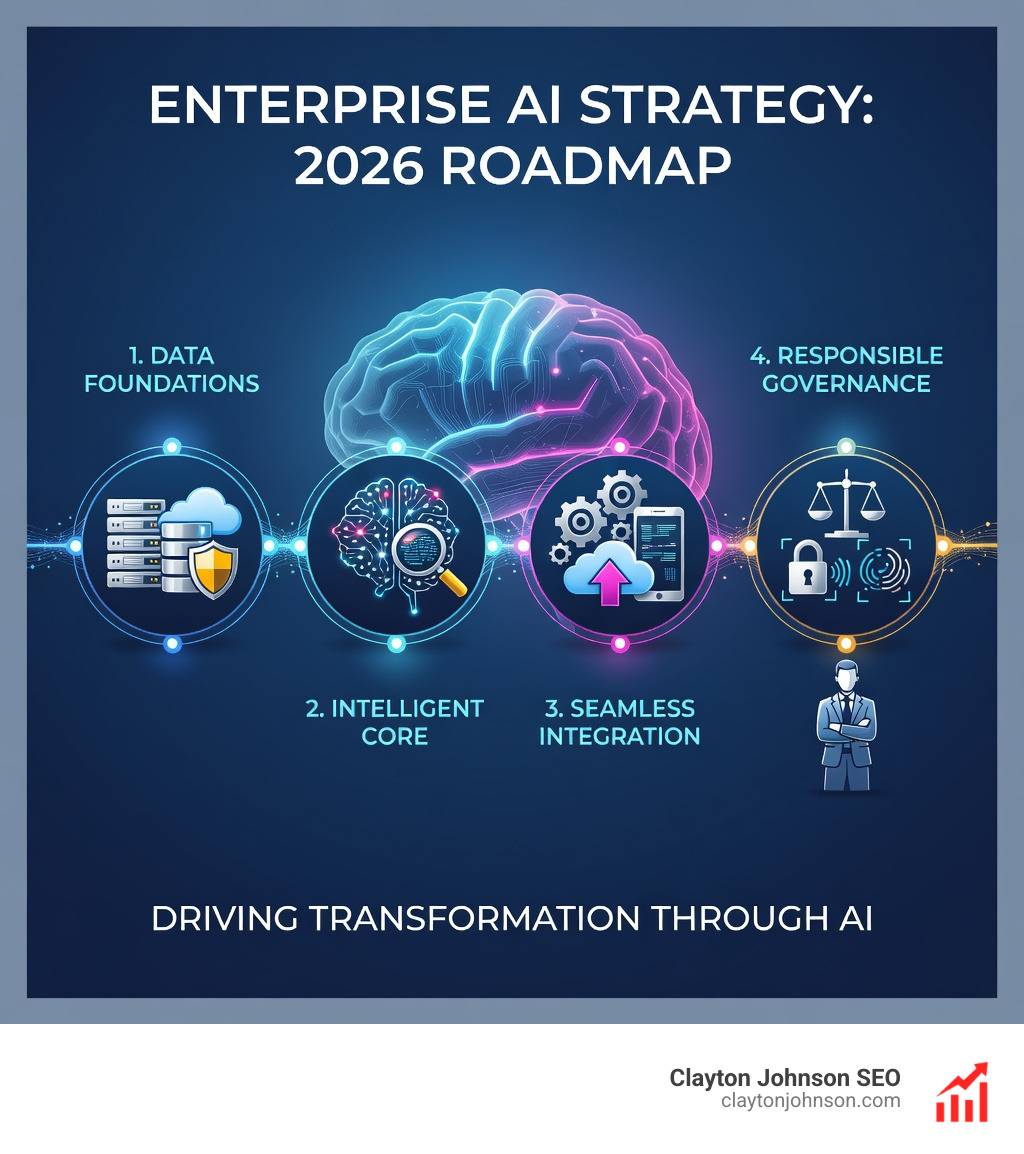
The Three Pillars of a Successful Enterprise AI Strategy
Enterprise AI Strategy is the blueprint for integrating artificial intelligence across your organization to drive measurable growth, operational efficiency, and competitive advantage. At its core, it’s about answering: How will AI support your business goals, and what systems do you need to make it work?
Key components of an effective Enterprise AI Strategy:
- Business Alignment – Tie AI initiatives directly to revenue, efficiency, or customer outcomes
- Data Foundation – Unified, clean, accessible data pipelines
- Three Core Pillars – AI agents (workforce), AI models (intelligence), infrastructure (backbone)
- Governance Framework – Ethics, risk controls, compliance-by-design
- Execution Roadmap – Phased approach from foundation to scale (typically 12-18 months)
- Measurement System – KPIs tracking productivity, cost reduction, and ROI
The stakes are high. According to MIT research, 95% of generative AI pilots fail to reach production, and only 31% of enterprises have an AI strategy in place. Yet organizations with extensive AI adoption report 40-55% productivity gains for knowledge workers and 30% faster time-to-market for new products.
The difference between success and failure isn’t technology—it’s strategic clarity. Companies that treat AI as scattered experiments stall in “pilot purgatory.” Those that build coherent systems—aligning agents, models, and infrastructure with business priorities—unlock transformational value.
This isn’t about deploying chatbots. It’s about redesigning how work gets done: automating routine decisions, augmenting human expertise, and building adaptive systems that learn and improve over time. The transition from steam to electricity required factories to rebuild their production lines. AI demands the same level of organizational reimagining.
I’m Clayton Johnson, and I’ve spent years building scalable growth systems and AI-augmented workflows for companies navigating this shift. A strong Enterprise AI Strategy isn’t a vision deck—it’s a practical framework for moving from fragmented pilots to measurable, enterprise-wide capability.
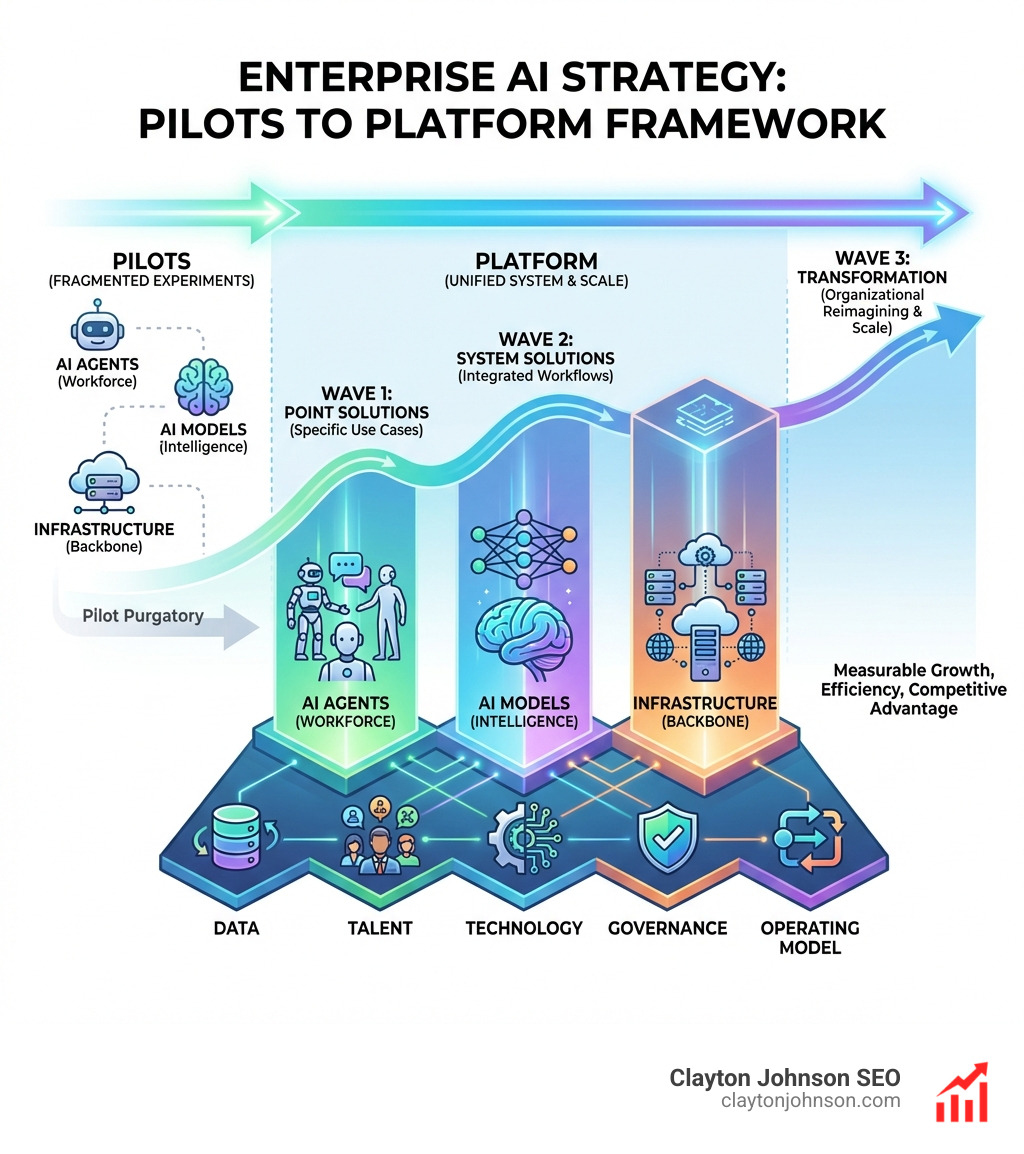
What happens when you don’t have a strategy? Data silos block model training. Agents operate without guardrails. Quick wins don’t scale. And your competitors—who started with a roadmap—capture the compounding benefits of AI while you’re still debugging prototypes.
The rest of this guide walks through the three pillars, the phased roadmap, common pitfalls, and emerging trends like agentic RAG and composite AI. You’ll see what separates front-runners (who scale 34% of strategic bets) from experimenters stuck at the starting line.
To move beyond simple automation, we must view the Enterprise AI Strategy as a cohesive ecosystem. It’s not just a collection of tools; it is an AI-first operating model. This shift requires us to rethink our digital transformation through three fundamental pillars: Agents, Models, and Infrastructure. Without all three working in harmony, the system collapses into expensive, siloed experiments.
Understanding why your brand needs an AI growth strategy right now starts with recognizing that AI is the most powerful lever for business resilience. It allows us to process vast amounts of data, predict market shifts, and respond with a speed that was previously impossible.
AI Agents: The Digital Workforce
If models are the “brain,” then AI agents are the “hands and feet” of your enterprise. Unlike traditional software that simply follows a script, autonomous AI agents can reason, adapt, and execute complex workflows. They function as a collaborative digital workforce that coordinates across departments.
We categorize these agents into three primary roles:
- Decision Agents: These analyze market trends, evaluate risks, and provide strategic recommendations to human leaders.
- Operational Agents: These handle the heavy lifting—optimizing resource allocation, detecting supply chain bottlenecks, or processing purchase orders without human intervention.
- Customer Service Agents: These provide 24/7 personalized support, handling up to 82% of interactions autonomously while knowing exactly when to escalate to a human.
For more information on how these roles are evolving, you can visit the learner help center to explore emerging skills in agentic workflows.
AI Models: The Brain Power
The “intelligence” layer of your Enterprise AI Strategy isn’t a one-size-fits-all solution. Modern enterprises use a portfolio approach:
- Foundation Models: Large, general-purpose models (like GPT-4 or Claude) that handle broad reasoning.
- Specialized Models: Smaller, fine-tuned models trained on proprietary data for specific tasks like fraud detection or legal document analysis.
- Hybrid Approach: Combining the reasoning of large models with the precision of specialized ones.
A critical part of managing these models is MLOps (Machine Learning Operations), which ensures continuous learning and prevents “model drift.” We must also remain vigilant about scientific research on data bias, as AI is only as good as the data it consumes. If our data is biased, our AI-driven decisions will be too.
Infrastructure: The Backbone of Enterprise AI Strategy
Infrastructure is the often-overlooked hero of AI success. You can’t run a world-class AI on legacy hardware and fragmented data. A future-ready backbone must be:
- Cloud-Native: Allowing for the massive compute power required for training and inference.
- Data-Centric: Built on unified data pipelines that break down silos. Gartner notes that data fragmentation is the #1 barrier to AI maturity.
- Scalable: Capable of handling rapid annual growth in AI workloads.
As we build this backbone, we also need to invest in our people. Learning essential AI skills every marketer needs to survive ensures that your team can actually pilot the sophisticated infrastructure you’re building.
Building Your Roadmap: From Foundation to Scale
Most enterprises fail because they try to do too much, too soon. A successful Enterprise AI Strategy requires a phased rollout that balances “quick wins” with long-term systemic change. We recommend a 12-to-18-month roadmap divided into three distinct phases.
| Feature | Build (In-House) | Buy (SaaS) | Partner (Hybrid) |
|---|---|---|---|
| Control | Maximum | Minimum | High |
| Speed to Market | Slow | Fast | Moderate |
| Cost | High (Upfront) | Low (Subscription) | Balanced |
| Customization | Full | Limited | Tailored |
| Maintenance | Internal Team | Vendor | Shared |
Phase 1: Establishing the Foundation (Months 1-3)
The first 90 days are about readiness. We begin with a comprehensive audit of your data, tech stack, and human resources. This is where we align the C-suite on the “North Star”—the core business objectives AI must support.
Shockingly, Asana reports that only 31% of enterprises have a strategy in place. To avoid being part of the 69% that are “winging it,” this phase must focus on data cleansing and stakeholder alignment. If your data is messy, your AI will be useless.
Phase 2: Implementation and Pilot Projects (Months 4-9)
Once the foundation is set, we identify 3-6 high-impact use cases. We score these based on feasibility and potential ROI. This is the stage where we deploy “Agentic RAG” (Retrieval-Augmented Generation)—a technique that allows AI to “read” your company’s internal documents to provide accurate, context-aware answers.
Using AI competitive insights to outsmart your rivals can give you an immediate edge during this phase, allowing you to see where competitors are lagging and where you can strike first.
Scaling the Enterprise AI Strategy (Months 10-18)
Scaling is where “systemic industrialization” happens. We move from isolated pilots to embedding AI into the very fabric of the organization. This involves:
- Continuous Optimization: Retraining models on a quarterly cycle to prevent drift.
- Expansion: Rolling out successful pilots from one department (e.g., HR) to the entire enterprise (e.g., Supply Chain, Marketing).
- ROI Measurement: Using hard metrics like a 40% reduction in operational costs or a 25% improvement in decision-making speed.
Overcoming Pitfalls in AI Adoption and Governance
The road to AI maturity is littered with failed pilots. Gartner warns that 40% of enterprise AI projects will fail to scale without a cohesive strategy. The most common traps include “pilot purgatory”—where projects never leave the sandbox—and extreme data fragmentation.
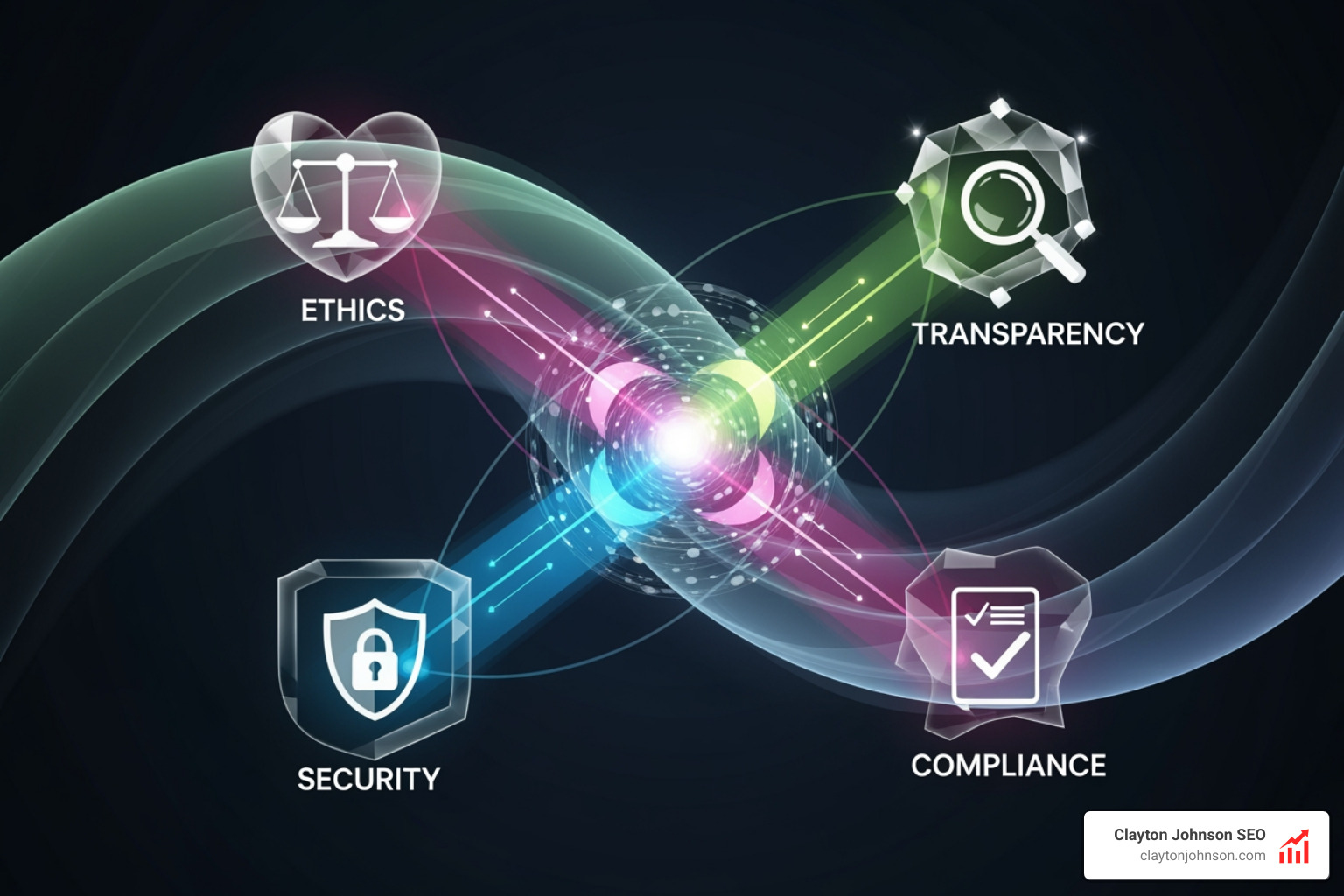
Governance isn’t just a hurdle; it’s a competitive differentiator. However, PwC found that only 11% of executives apply policies for responsible AI completely. This lack of oversight leaves companies open to lawsuits and reputational damage.
Navigating Ethics and Responsible Deployment
Responsible AI requires a framework we call AI TRiSM (Trust, Risk, and Security Management). This means building “compliance-by-design” into every model. We must address:
- Bias Mitigation: Constantly auditing models for unfair outcomes.
- Transparency: Ensuring AI decisions are explainable, not “black boxes.”
- Security: Protecting against scientific research on AI vulnerabilities, where cyberattacks target AI models to manipulate data or cause service denials.
Fostering an AI-First Culture
Transformation is 20% technology and 80% people. Cultural resistance is the second biggest factor in failed digital transformations. We have to address the “elephant in the room”: 28% of workers fear replacement by AI.
Our strategy must focus on AI augmentation, not just replacement. When workers see AI as a “coworker” that handles the boring, rote tasks, adoption skyrockets. Upskilling and workforce enablement aren’t optional—they are the only way to ensure your team doesn’t sabotage the very systems you’re trying to build.
Measuring ROI and Future Trends
How do we know if the Enterprise AI Strategy is working? We track a balanced scorecard of KPIs. While “hard” metrics like revenue uplift and cost reduction are vital, we also look at “soft” metrics like decision velocity and employee sentiment.

Leading organizations use specific KPI frameworks to measure AI success. For instance, if an AI agent handles 80% of customer queries, we don’t just measure the money saved on labor; we measure the 35% increase in customer satisfaction that comes from instant, accurate responses.
Emerging Trends: Autonomous Systems and Agentic RAG
The future of AI is “agentic.” We are moving away from chatbots that wait for a prompt toward autonomous systems that anticipate needs. Key trends include:
- Model Context Protocol (MCP): A new standard that allows AI models to work seamlessly across different enterprise tools (CRM, ERP, Slack) without custom APIs.
- Composite AI: Combining different types of AI (generative, analytical, and robotic) to solve complex problems that no single model can handle.
- Human-AI Collaboration: Redesigning workflows where humans act as “orchestrators” of AI teams.
Learning how to extend Claude with custom agent skills is a great way to stay ahead of these trends and build proprietary value within your own tech stack.
Frequently Asked Questions about Enterprise AI Strategy
What is the biggest mistake in AI strategy?
The single biggest mistake is treating AI as an IT project rather than a business transformation. Many organizations focus on the “shiny object”—the latest LLM—without fixing their underlying data silos or aligning the technology with P&L priorities. If your business strategy and AI strategy aren’t “bidirectional,” you’re likely building a solution in search of a problem.
How long does it take to see ROI?
While “quick wins” (like automating document summarization or basic HR queries) can show value in 2-3 months, a full enterprise-wide ROI typically takes 12 to 18 months. This timeline accounts for the “knowledge worker productivity gap,” where employees need time to learn how to effectively augment their work with AI tools. Once scaled, however, the benefits compound exponentially.
Should we build or buy AI models?
For 99% of enterprises, building a foundation model from scratch is a mistake. It’s too expensive and the technology moves too fast. The winning approach is a Hybrid Model: buy (or use open-source) the foundation models, and then “build” by fine-tuning them with your proprietary data and custom agentic workflows. This gives you the best of both worlds—cutting-edge reasoning power paired with your unique business intelligence.
Conclusion
Building a successful Enterprise AI Strategy is the defining challenge for modern leadership. It is no longer enough to “experiment” with AI; we must industrialize it. By focusing on the three pillars—Agents, Models, and Infrastructure—and following a disciplined, phased roadmap, we can turn AI from a cost center into a powerful engine for growth.
At Clayton Johnson SEO, we specialize in helping founders and marketing leaders navigate this shift. Whether you are looking for strategic transformation or need to build AI-assisted workflows that deliver measurable results, the time to move from “pilot” to “platform” is now.
The transition to an AI-first operating model isn’t just about efficiency—it’s about survival. Organizations that embrace this shift today will be the “front-runners” of tomorrow, capturing the lion’s share of value in an increasingly autonomous world. Don’t let your AI initiatives get stuck in purgatory. Start your enterprise transformation with a clear, actionable strategy today.