The Essential AI ML Tools Handbook

Why Understanding AI ML Tools is Crucial 🚀
To effectively develop machine learning models, leveraging the right AI ML tools is no longer optional – it’s essential. These powerful tools streamline complex tasks, speed up development, and make advanced AI accessible to more people.
Here are the primary types of AI ML tools crucial for developing machine learning models:
- Cloud-Based Platforms: Comprehensive, managed services like Amazon SageMaker, Microsoft Azure ML, and Google Vertex AI, offering end-to-end ML lifecycle support.
- Open-Source Frameworks: Flexible, community-driven libraries such as TensorFlow and PyTorch for custom model building and research.
- No-Code/Low-Code Tools: Platforms like BigML or SageMaker Canvas that allow users to build models with minimal programming.
- Specialized Libraries: Tools like Apache Mahout and Weka for specific data mining and algorithm needs.
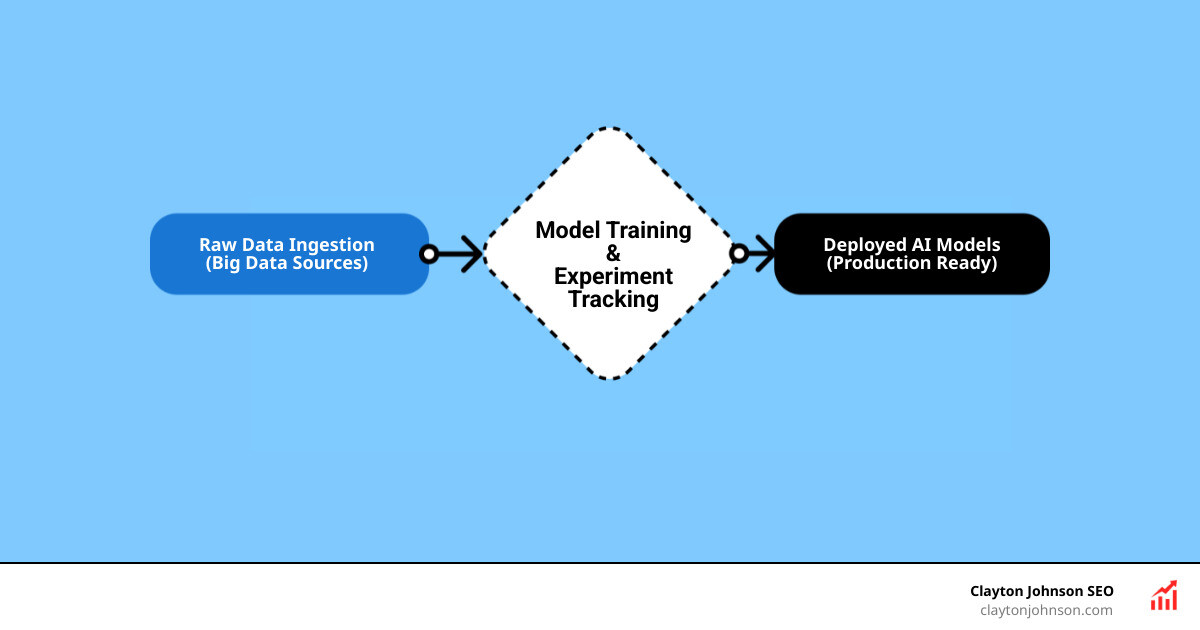
- MLOps Platforms: Solutions like MLflow for managing the entire machine learning lifecycle, including experiment tracking, data governance, and deployment.
The field of machine learning, while not new, has been revitalized by big data, allowing organizations to scale operations and uncover hidden insights like never before. The introduction of various tools has dramatically lowered the barrier to entry, enabling practitioners to implement sophisticated algorithms without needing to code every detail from scratch. The right tools simplify complex processes and accelerate the journey from research to production.
I’m Clayton Johnson, an expert in engineering scalable traffic systems and AI-augmented marketing workflows, and I’ve seen how the right AI ML tools can transform fragmented efforts into cohesive growth engines. This handbook will guide you through the diverse landscape of these tools, helping you understand their features, strengths, and ideal use cases to propel your projects forward.
**Ai ml tools word guide:
Selecting the Best ai ml tools for Your Project
Choosing the right ai ml tools is a lot like picking the right foundation for a skyscraper. If you get it wrong at the start, things get shaky very quickly as you scale. When we evaluate tools for our workflows, we look at five critical pillars:
- Ease of Use: Does the tool have a steep learning curve, or can your team start prototyping immediately?
- Scalability: Can it handle 100 million rows of data, or will it choke when you move from a pilot to a full-scale rollout?
- Cost: Managed cloud services offer convenience but can become “Richie Rich” expensive if not monitored.
- Multi-Framework Support: Does it play well with others? You want a tool that supports PyTorch, TensorFlow, and Scikit-learn interchangeably.
- Responsible AI: With the rise of automated decision-making, Building a Responsible AI Framework is non-negotiable to ensure fairness and transparency.
For organizations in hubs like Minneapolis, Minnesota, the focus is often on bridging the gap between raw data and actionable business intelligence. Having More info about AI infrastructure helps in setting up a system that doesn’t just “do AI” but drives compounding growth.
Cloud-Based ai ml tools for Enterprise Scaling
For enterprises, the “Big Three” cloud providers offer managed ecosystems that handle everything from data labeling to model hosting. These platforms are designed for teams that want to focus on the science rather than the server maintenance.
| Feature | Amazon SageMaker | Microsoft Azure ML | Google Vertex AI |
|---|---|---|---|
| Best For | High-scale production & AWS ecosystem users | Enterprise integration & Responsible AI | Generative AI & Data-to-AI lifecycle |
| Key Differentiator | SageMaker Canvas (No-code) | Azure ML Designer (Drag-and-drop) | Model Garden (200+ models) |
| User Base | 100,000+ customers | Massive enterprise adoption | High growth in GenAI startups |
| Special Feature | Purpose-built MLOps tools | Seamless Power BI integration | BigQuery ML (SQL-based AI) |
- Amazon SageMaker: This is the heavy hitter. With more than 100,000 customers, it’s the go-to for many AWS-native businesses. It offers a single integrated development environment (IDE) to build, train, and deploy models at scale.
- Microsoft Azure Machine Learning: Azure focuses heavily on empowering data scientists to manage the entire lifecycle with “greater confidence.” Its “Designer” tool allows for rapid iteration on data preparation using Apache Spark clusters.
- Vertex AI: Google’s platform is perhaps the most comprehensive for those leaning into the latest trends. Its Model Garden gives you access to over 200 models, including proprietary Google models and third-party open-source options.
Open-Source ai ml tools for Custom Development
If you prefer to get under the hood, open-source frameworks are your best friend. They offer the ultimate flexibility for research and bespoke model architectures.
- PyTorch: Created for flexibility and speed, PyTorch has become the darling of the research community. Its “eager execution” makes debugging much easier than older frameworks. You can explore the vast PyTorch Landscape to see how many sub-projects and libraries are built on top of it.
- TensorFlow: Developed by the Google Brain team, TensorFlow is an end-to-end platform. While it might have a slightly steeper learning curve for some, its “TensorFlow Serving” capabilities make it incredibly robust for production environments and mobile deployment.
The choice between the two often comes down to personal preference or existing team expertise. PyTorch is generally seen as more “Pythonic” and flexible, while TensorFlow is often praised for its enterprise-grade deployment tools.

Specialized and No-Code Solutions for Rapid Prototyping
Not every project requires a PhD in mathematics or 500 lines of Python code. A new crop of ai ml tools focuses on the “democratization” of AI, allowing business analysts and subject matter experts to build models.
- BigML: This cloud-based platform simplifies tasks like classification and time-series forecasting. It is highly consumable and programmable, making it great for teams that need to integrate ML into existing apps quickly.
- Weka: Developed by the University of Waikato, Weka is a collection of algorithms for data mining. It is famous for being able to handle massive datasets—up to 100 million rows—without breaking a sweat.
- Apache Mahout: If you are working within a Hadoop ecosystem, Mahout is a distributed linear algebra framework designed for statisticians and data scientists to build scalable algorithms.
- SageMaker Canvas: This is AWS’s answer to no-code. It allows users to create ML models and generate predictions without writing a single line of code.
For those focused on data analysis, Claude for Data Science has become a powerful “lab partner,” helping to write queries and visualize data trends in real-time.

Mastering the MLOps Lifecycle and Deployment
Building a model is only 20% of the battle. The other 80% is making sure that model stays accurate, secure, and performant in the real world. This is where MLOps tools come in.
Practitioners often use a mix of tools to manage this:
- Experiment Tracking: Tools like MLflow help you keep track of which parameters led to which results. No more writing down results on scraps of paper!
- Data Management: Platforms like OpenML provide a centralized hub for sharing datasets, tasks, and flows, fostering reproducibility.
- Deployment: Google Kubernetes Engine (GKE) is a popular choice for hosting models, supporting up to 15,000 nodes in a single cluster for massive scale.
- Monitoring: Once a model is live, you must monitor it for “drift” (when the model becomes less accurate because the world has changed). Responsible AI with Azure provides deep-dive investigations to ensure your models stay ethical and effective.

Frequently Asked Questions about AI ML Tools
What are the most popular machine learning tools for beginners?
For absolute beginners, we recommend starting with Scikit-learn (a Python library) for its simplicity, or BigML and SageMaker Canvas if you prefer a no-code approach. These tools allow you to understand the logic of machine learning before getting bogged down in complex syntax.
How do I choose between TensorFlow and PyTorch?
If you are doing academic research or want to prototype creative new architectures, PyTorch is usually the winner. If you are building a massive, cross-platform application that needs to run on everything from a server to a smartphone, TensorFlow‘s deployment ecosystem is hard to beat.
Which tools offer the best no-code options for AI development?
Amazon SageMaker Canvas, Google Vertex AI Studio, and BigML are the current leaders. They allow you to upload a CSV file, select your target variable, and let the platform handle the feature engineering and model selection for you.
Conclusion
The landscape of ai ml tools is evolving at a breakneck pace. Whether you are a founder in Minneapolis looking to optimize your local operations or a global enterprise scaling a new generative AI product, the tools you choose will define your trajectory.
At Clayton Johnson SEO, we believe that technology is only as good as the architecture it sits on. Our platform, Demandflow.ai, is built on the philosophy that structured strategy—combined with AI-augmented workflows—creates the leverage needed for compounding growth. We don’t just help you find the tools; we help you build the growth infrastructure that makes those tools effective.
If you’re ready to move beyond tactics and start building a structured growth machine, check out The Ultimate Guide to AI Tools to continue your journey.
Clayton Johnson SEO Scalable Authority Retainer Framework
If you’re looking to build your brand’s authority while leveraging these AI advancements, our structured retainers are designed to help you dominate both traditional search and new AI-driven discovery engines.
- Foundation Authority — $1,997 / month: Best for initial AI eligibility signals and foundational authority.
- Growth Authority — $2,997 / month: Focuses on increased link velocity and expanded topical cluster depth.
- Competitive Authority — $3,997 / month: Designed for multi-cluster ranking expansion and AI Overview positioning.
- Expansion Authority — $4,997 / month: Broadens keyword penetration and increases AI inclusion probability.
- Scale Authority — $6,997 / month: Accelerated authority density for faster SERP capture.
- Market Leader Authority — $9,997 / month: For those seeking durable market dominance and AI citation authority.
Modern SEO is no longer just about keywords; it’s about becoming an authoritative entity that AI systems and search engines trust implicitly. Let’s build that authority together.