How to Blend Lean Startup and BMC for Success

Why Blending Business Model Canvas and Lean Startup Matters
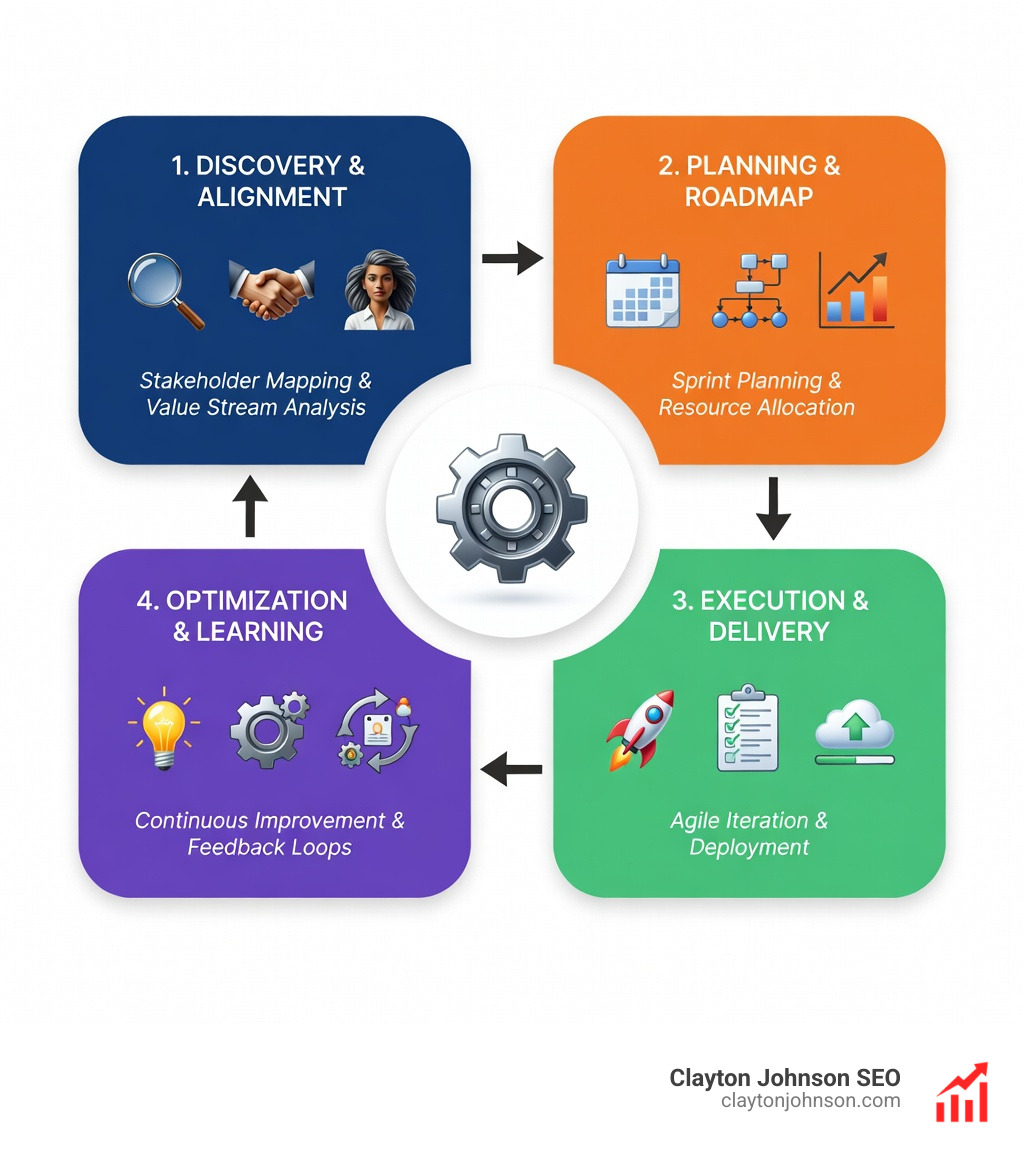
The BMC lean hybrid model combines the strategic overview of the Business Model Canvas with the rapid experimentation of Lean Startup methodology to create a powerful framework for testing, validating, and scaling business ideas.
Quick Answer: What is a BMC Lean Hybrid Model?
- Business Model Canvas (BMC): A visual strategic tool with 9 building blocks (Customer Segments, Value Propositions, Channels, Customer Relationships, Revenue Streams, Key Resources, Key Activities, Key Partners, Cost Structure)
- Lean Startup: An iterative methodology focused on validated learning, MVPs, and Build-Measure-Learn cycles
- Hybrid Approach: Uses the BMC’s strategic framework while applying Lean’s continuous experimentation and waste elimination principles to each building block
Most businesses fail because they build something nobody wants. Traditional business plans are static documents that become outdated before launch. The BMC provides a snapshot of your business model, but without Lean’s validation cycles, you’re still guessing about what customers actually need.
The research is clear: Lean implementation can improve capacity by 30% and reduce waiting time by 50% in complex environments. When you combine this efficiency focus with the BMC’s holistic view of your business, you get a system that identifies both what to build and how to validate it quickly.
This matters because markets move fast. Your initial assumptions about customer needs, pricing, or distribution channels are probably wrong. The hybrid model lets you test those assumptions systematically across all nine BMC blocks—before you waste resources scaling the wrong solution.
As Clayton Johnson, I’ve spent years building growth systems that combine strategic frameworks with measurable execution, and the BMC lean hybrid model is one of the most practical approaches I’ve seen for turning business ideas into validated, scalable models.
Defining the BMC Lean Hybrid Model
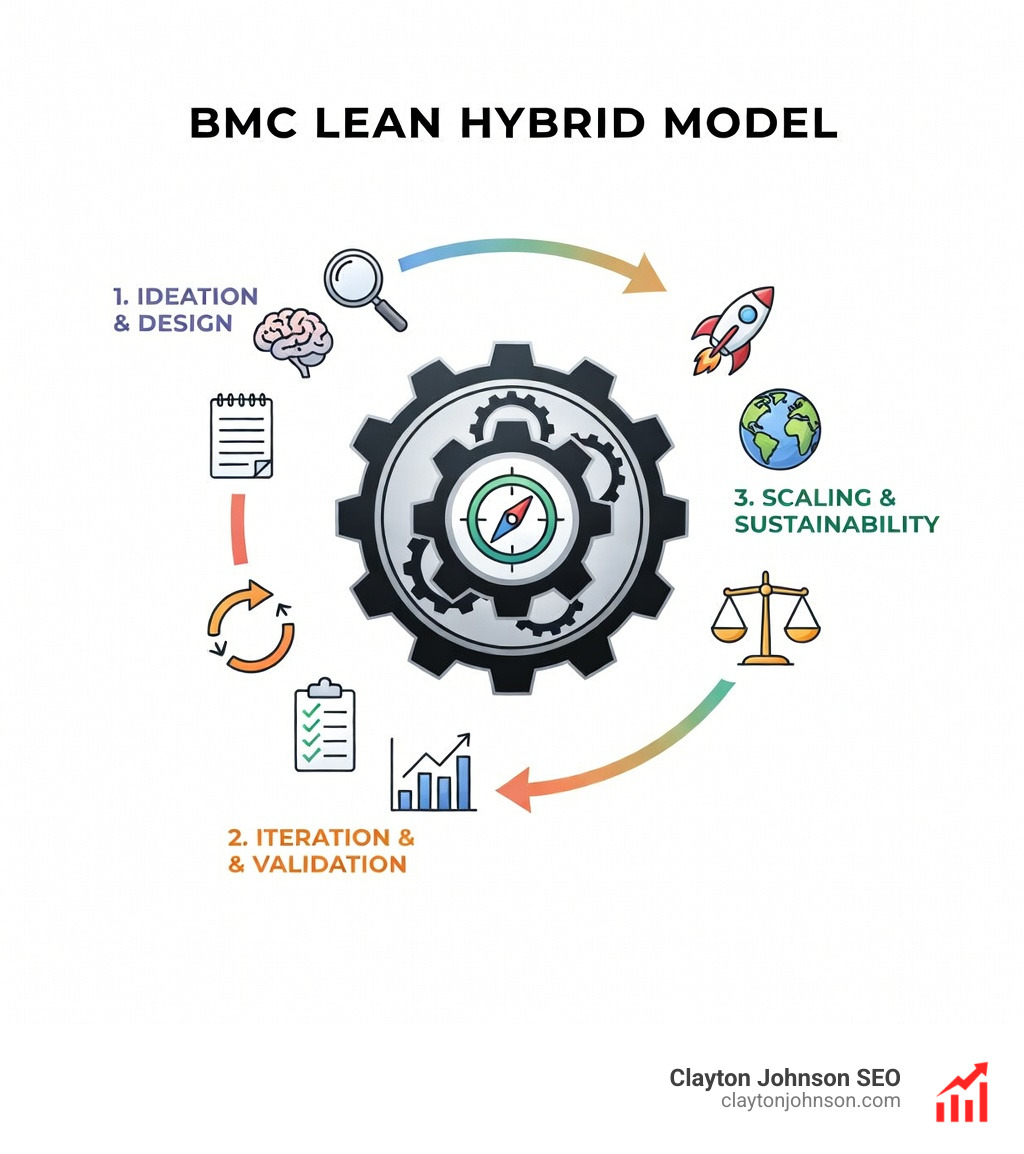
At its core, the BMC lean hybrid model is the marriage of two powerhouses: Alexander Osterwalder’s Business Model Canvas and Eric Ries’s Lean Startup methodology. While the BMC provides us with a high-level strategic snapshot of how a company creates, delivers, and captures value, Lean Startup provides the engine for validated learning.
We often see businesses treat the BMC as a “one-and-done” exercise. They fill it out, frame it, and never look back. That’s a mistake. By integrating efficiency-focused principles, we transform the canvas from a static document into a living, breathing experiment. This approach is rooted in Strategic Design, where we intentionally plan for innovation rather than hoping for it.
Research into Lean-inspired interventions shows that when organizations move away from rigid planning and toward iterative learning, they become significantly more adept at navigating complex environments. In our work here in Minneapolis, we’ve found that this hybridity is what separates “big startups”—established companies that can still innovate—from stagnant legacy firms.
Integrating Strategy and Iteration
The visual framework of the BMC is the perfect “map” for our Lean journey. Every one of the nine blocks contains assumptions. For example, your “Value Proposition” isn’t a fact; it’s a hypothesis. Your “Customer Segment” isn’t a guarantee; it’s a guess.
By applying Lean principles, we create feedback loops for every block. We don’t just list our “Key Activities”; we Analyze them to see which ones actually contribute to customer value and which ones are simply waste. This integration ensures that our strategy isn’t just a dream—it’s a validated path forward.
The Benefits of a Hybrid Approach
Why go through the trouble of blending these two? Because it gives you the best of both worlds:
- Reduced Risk: You don’t spend $50,000 building a feature no one wants.
- Increased Speed: You fail fast and pivot even faster.
- Market Fit: You ensure that your product actually solves a problem for a specific group of people.
- Operational Excellence: You use Lean tools to trim the fat from your cost structure.
When we Diagnose growth problems for our clients, we often find that the “plan” was fine, but the “execution” was blind to market feedback. The hybrid model fixes this by making feedback the lynchpin of the entire operation.
Applying Lean Startup Concepts to the Nine Building Blocks
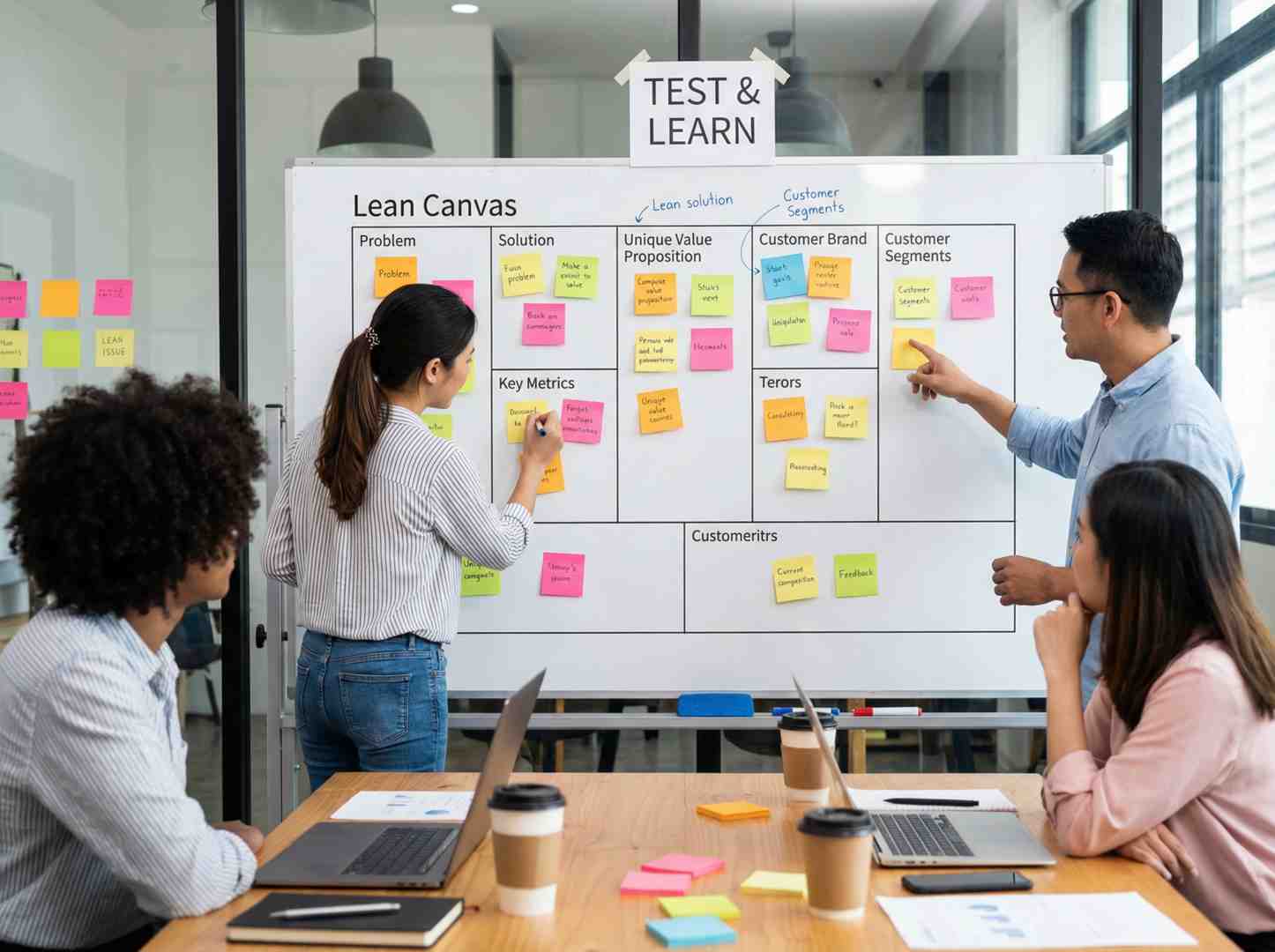
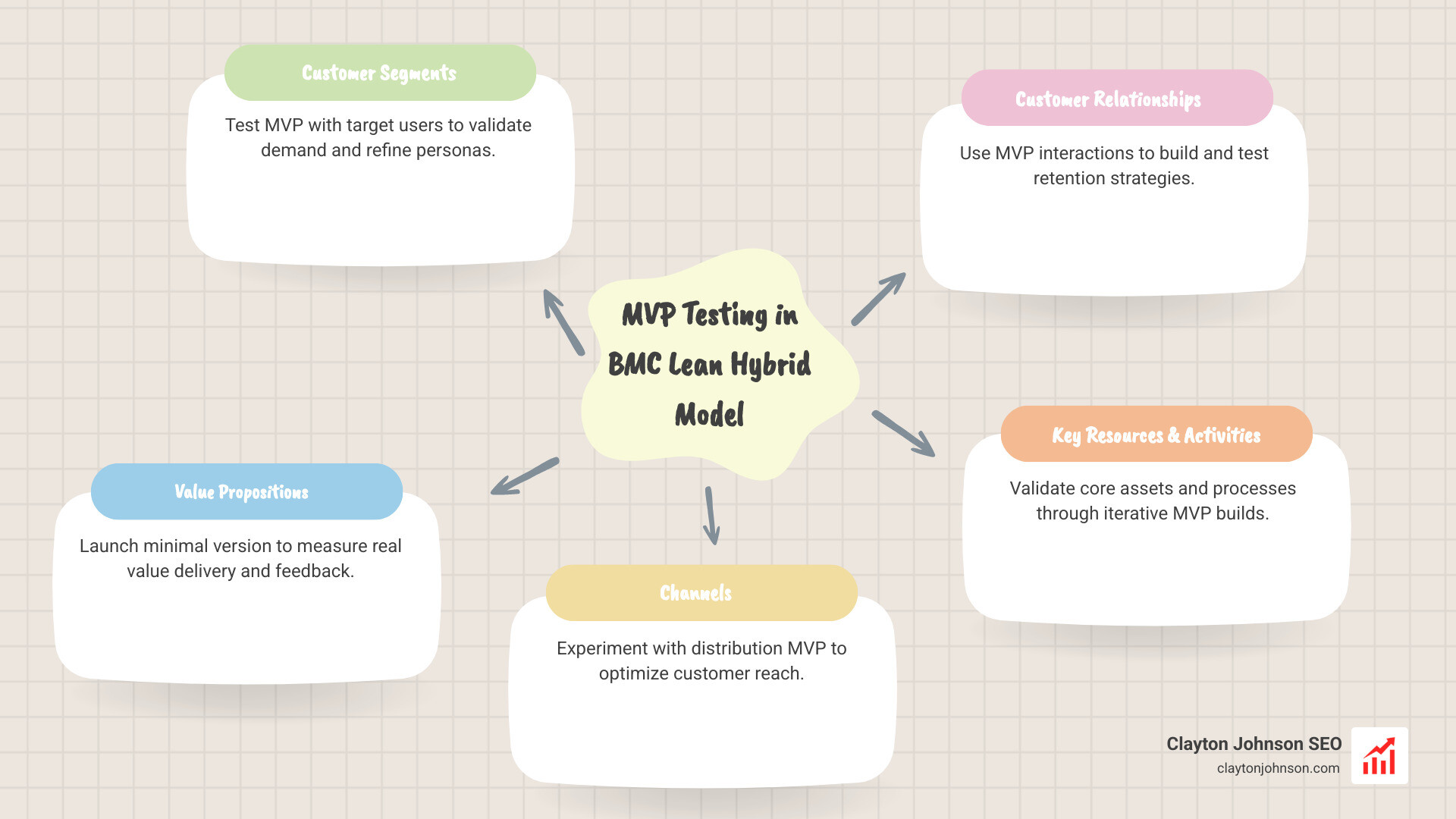
To truly master the BMC lean hybrid model, we have to look at the nine building blocks through the lens of the Minimum Viable Product (MVP) and the Build-Measure-Learn cycle. We aren’t just filling out a chart; we are designing a series of experiments.
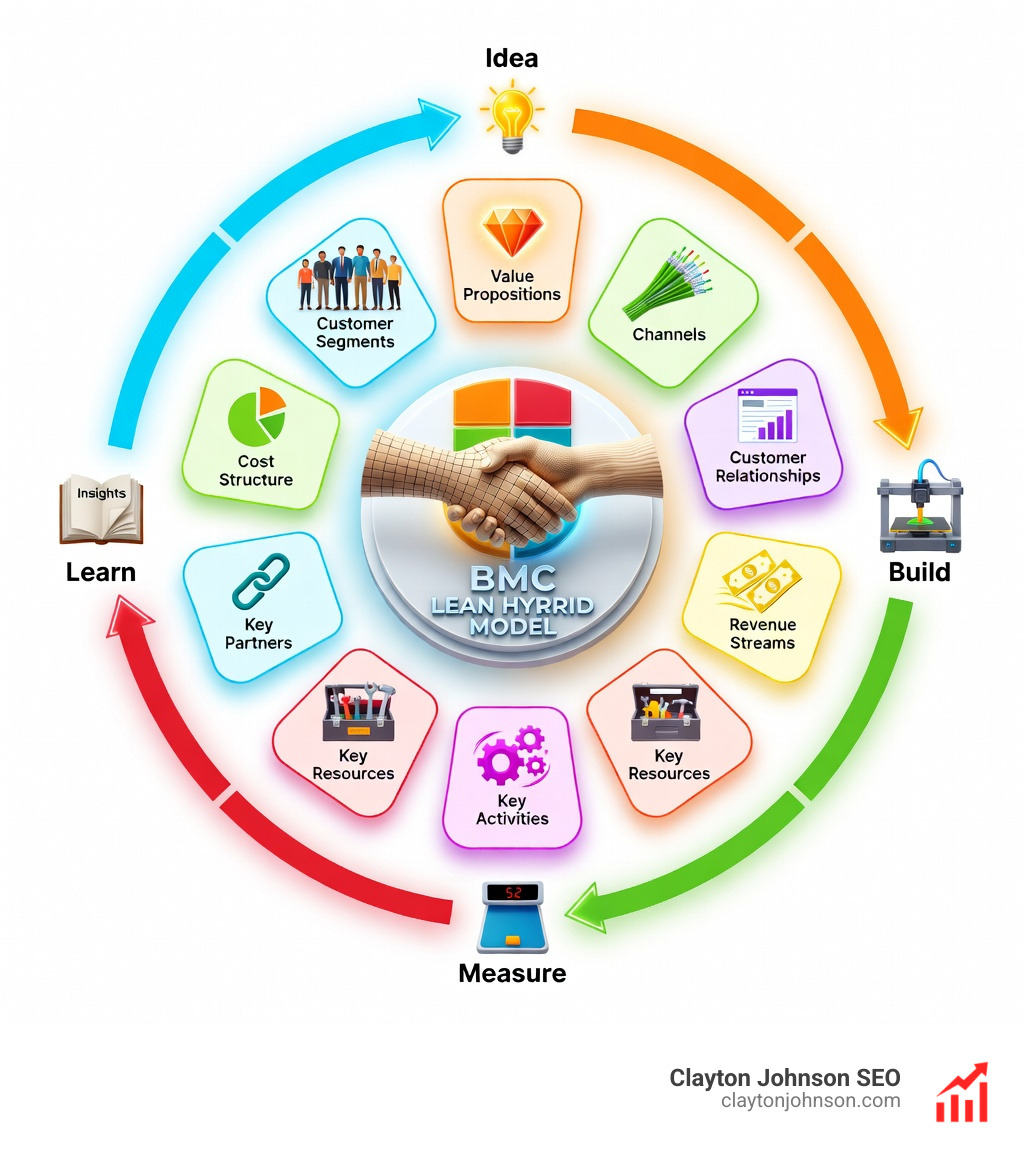
In our Customer Strategy, we start by defining Buyer Personas. But in a Lean Hybrid model, those personas are just the starting point for interviews and behavioral observation. We want to see if the “Value Proposition” we’ve sketched in the center of our canvas actually resonates with the “Customer Segment” on the right.
Validating Value Propositions in a BMC Lean Hybrid Model
The “Opportunity-Solution Fit” is the holy grail of early-stage business development. This is the alignment between what the customer needs (their pains and desired gains) and what you are offering.
We use Strategic Design: Customer Segmentation and Product Insight to dig deeper into these segments. Are you solving a “hair-on-fire” problem, or are you just a “nice-to-have”? Lean principles force us to quantify these outcomes. If we can’t measure the value we provide, we haven’t validated the model yet.
Iterating Channels and Relationships via the BMC Lean Hybrid Model
Channels and Customer Relationships are the “front stage” of your business. In a traditional model, you might just say “Social Media” or “Direct Sales.” In a BMC lean hybrid model, we treat these as engagement strategies that must be tested.
Reaching potential customers is a lynchpin for success. We might run small-scale ad tests to see which “Channels” have the lowest acquisition cost before committing our full marketing budget. This aligns perfectly with a modern Sales Strategy, where we use data to drive our distribution decisions.
Optimizing Operations with Lean Tools and Techniques
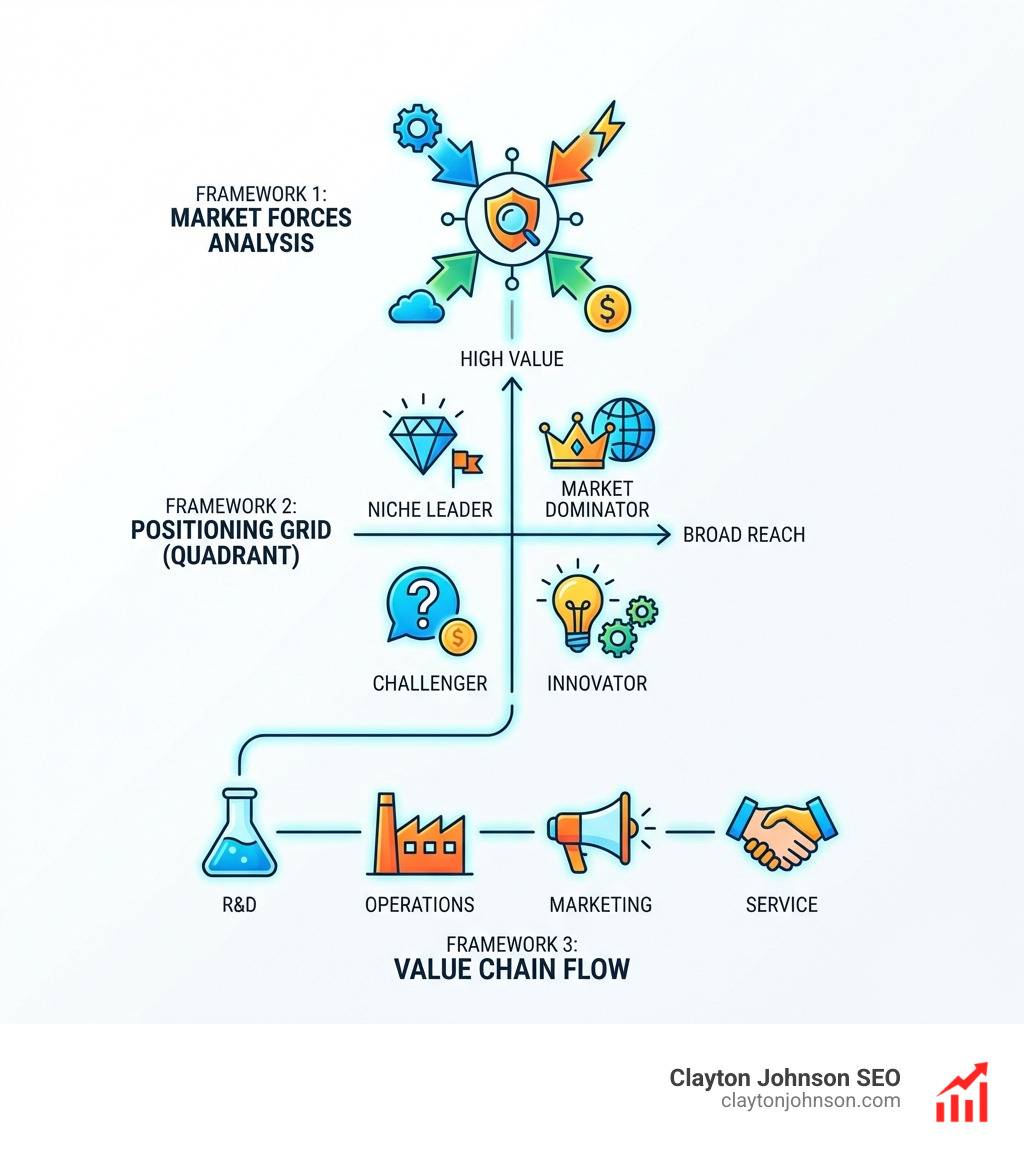
While the right side of the canvas is about the “Market,” the left side is about “Operations.” This is where classic Lean tools like Value Stream Mapping, Kaizen, and Just-In-Time (JIT) come into play. We use these to achieve Operational Alignment and ensure the “back stage” of our business is as efficient as possible.
| BMC Block | Lean Tool | Objective |
|---|---|---|
| Key Activities | Value Stream Mapping | Identify and eliminate non-value-added steps. |
| Cost Structure | Kaizen | Continuous, small-scale cost reductions. |
| Key Resources | Just-In-Time | Minimize inventory and idle resource costs. |
| Value Proposition | Poka-yoke | Mistake-proof the service delivery to the customer. |
Enhancing Key Activities and Cost Structure
In the hybrid model, we don’t just list “Manufacturing” as a Key Activity. We apply Research on Lean Six Sigma efficiency to reduce defects and cycle times. For a service-based business, this might mean standardizing your onboarding process to ensure every customer gets the same high-quality experience without wasting staff time.
This leads directly to a more robust Execution Roadmaps and Operational Alignment. By reducing waste (Muda), we lower our “Cost Structure” and increase our margins. It’s not just about being “cheap”; it’s about being lean.
Refining Key Partners and Resources
Finally, we Assess our Key Partners and Resources. In a Lean model, we ask: “Do we really need to own this resource, or can a partner provide it more efficiently?” This is the classic “build vs. buy” decision. By leveraging strategic alliances, we can stay agile and avoid the “Founders’ Tunnel Vision” that comes from trying to do everything in-house.
Overcoming Challenges in Hybrid Implementation
Implementing a BMC lean hybrid model isn’t always sunshine and rainbows. There are significant problems, particularly for established organizations in the Minneapolis area that are used to “the way we’ve always done it.”
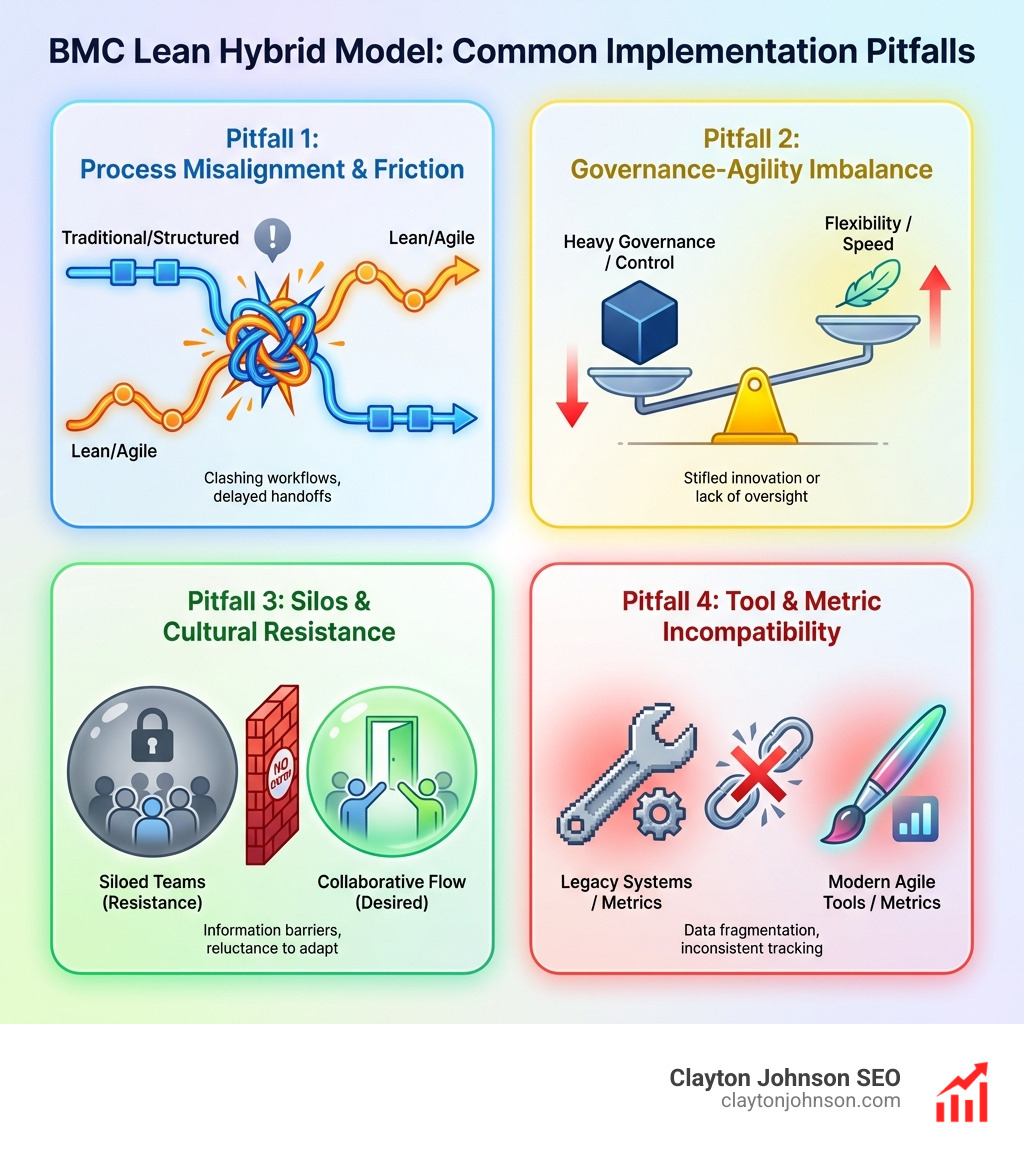
The biggest challenge is often Resistance to Change. People like the certainty of a 50-page business plan, even if it’s wrong. Moving to a model based on “Validated Learning” requires a cultural shift where “I don’t know, let’s test it” becomes an acceptable answer.
We recommend starting with a Market Analysis and a SWOT Analysis to identify where your current model is most vulnerable. This provides the “Why” behind the need for a hybrid approach.
Strategies for Sustainable Growth
To make this model stick, you need leadership buy-in. Leaders must protect the “innovation space” from the “execution space.” This means allowing teams to fail on small-scale experiments without fear of retribution.
We use tools like Clarify to help teams define exactly what they are testing. Additionally, a PESTLE Analysis can help you understand the external factors that might force a pivot, ensuring your hybrid model remains responsive to the real world.
Frequently Asked Questions about BMC and Lean
How does the hybrid model differ from a traditional business plan?
A traditional business plan is static, text-heavy, and often based on unvalidated assumptions. The BMC lean hybrid model is dynamic and visual. It’s designed to change as you learn more about your market. While a traditional plan focuses on “The Answer,” the hybrid model focuses on “The Process” of finding the answer. This is why Market, Industry, and Competitive Analysis is an ongoing activity in our framework, not a one-time chapter in a binder.
Can established organizations use this model to “be a startup”?
Absolutely. In fact, they must if they want to survive. Established firms often have plenty of “Key Resources” but lack “Agility.” By creating “Agile Support Tribes” or internal “Agile Production Units,” they can use the hybrid model to explore new markets without disrupting their core business. We often use Porter’s Five Forces to help these “big startups” identify where a lean, disruptive approach can give them a competitive edge over smaller, more nimble competitors.
What is the most critical block to validate first?
Without question, it’s the Value Proposition/Customer Segment fit. If no one wants what you’re selling, it doesn’t matter how efficient your “Key Activities” are or how great your “Key Partners” are. You are just being “efficiently useless.” Once you’ve validated that people will actually pay for your solution, you can move on to Conversion Optimization Services to scale that success.
Conclusion
The BMC lean hybrid model is more than just a buzzword; it’s a survival strategy for the modern age. By combining the high-level vision of the Business Model Canvas with the tactical, waste-reducing power of Lean Startup, we create businesses that are both strategically sound and operationally agile.
At Clayton Johnson, we specialize in building these types of growth systems. Whether you are a founder in Minneapolis looking to launch a new venture or a marketing leader trying to reinvent an established brand, our goal is to help you diagnose problems and execute with measurable results. From deep-dive strategy sessions to Social Media Marketing Services, we provide the tools you need to stay lean and grow fast.
Innovation isn’t magic—it’s a process. And with the right hybrid model, it’s a process you can master.