How to Build a Content Taxonomy That Doesn’t Suck

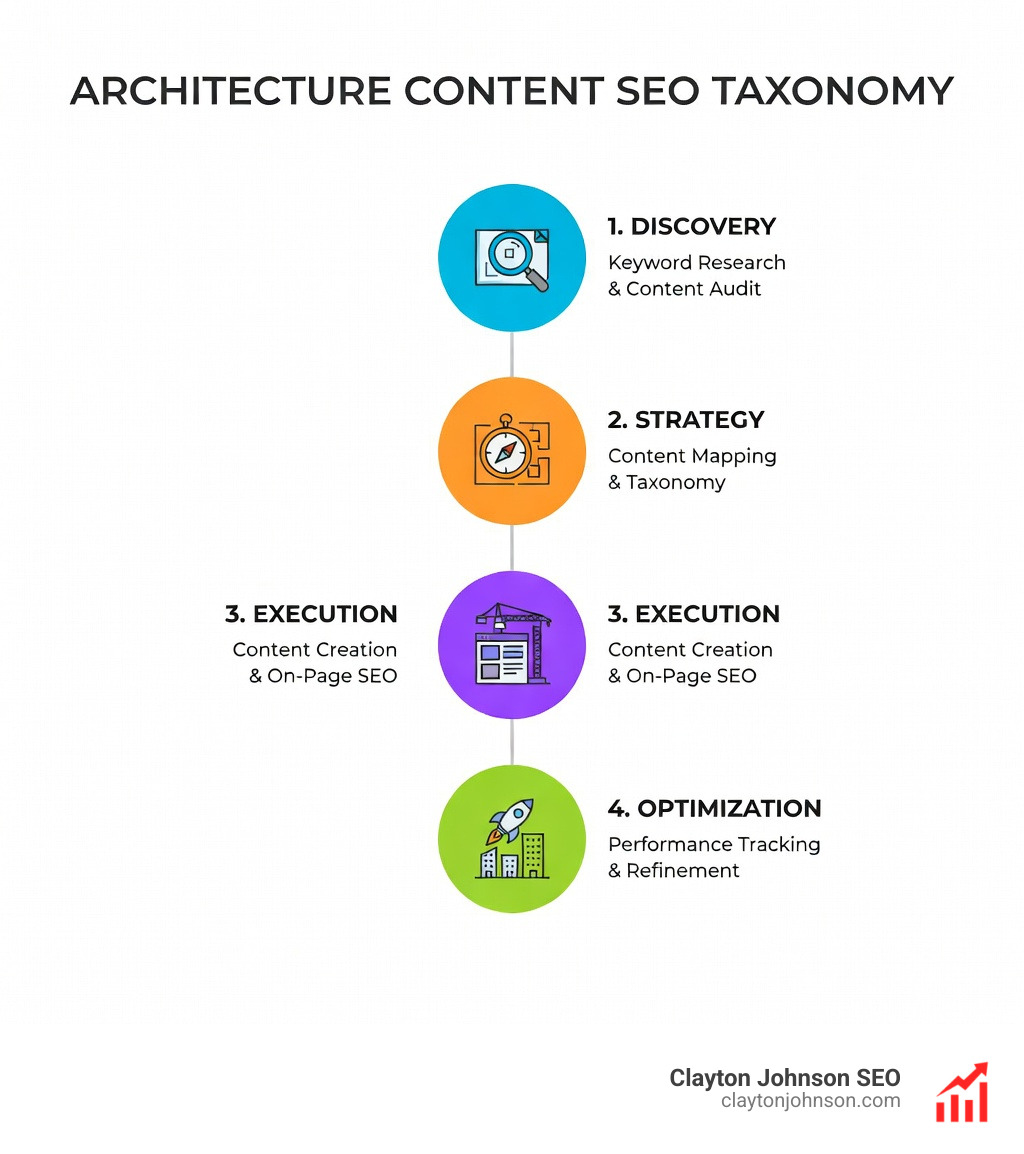
Architecture content seo taxonomy determines whether your content compounds authority over time or fragments into a chaotic graveyard of orphaned pages.
Quick Answer:
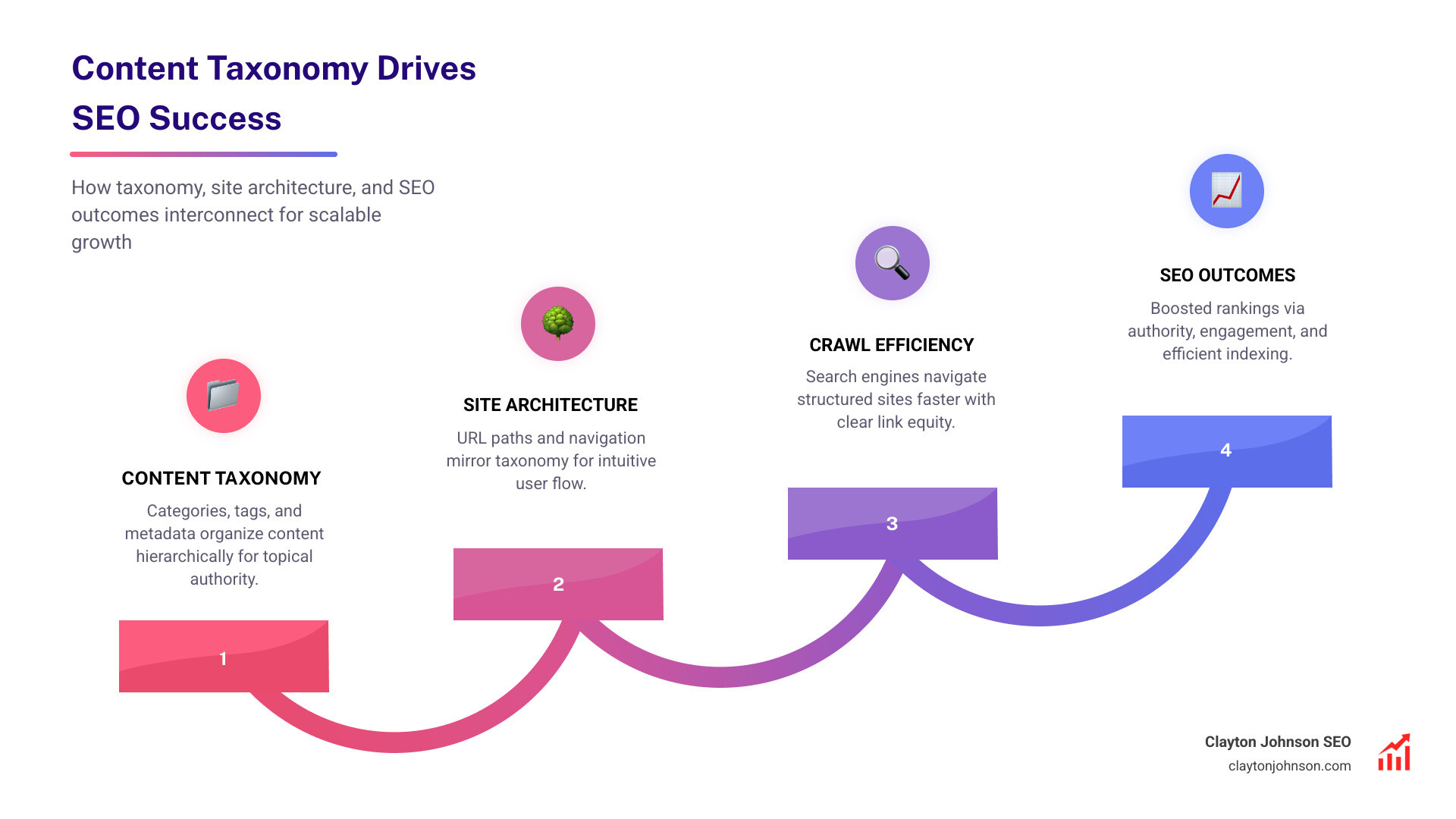
- Content taxonomy = the classification system (categories, tags, metadata) that organizes your content
- Site architecture = the structural implementation (URLs, navigation, internal links) that makes taxonomy crawlable
- SEO taxonomy = aligning both to mirror search intent, topical relationships, and how search engines understand hierarchy
Why it matters:
- Discoverability: 65% of digital content sits unused because nobody can find it
- Crawlability: Poor taxonomy wastes Google’s limited crawl budget
- Authority: Proper structure signals topical expertise and reinforces semantic relationships
- Conversion: Intuitive navigation reduces bounce rates and guides users through conversion paths
Most sites accumulate content like garages collect boxes—random, overlapping, and hard to navigate. The result? Search engines struggle to understand what you’re about. Users pogo-stick away. High-quality content never ranks because it’s structurally orphaned from your topical hubs.
The difference between a site that compounds authority and one that bleeds traffic is intentional architecture. Not more content. Not better keywords. Structure.
I’m Clayton Johnson, and I’ve spent years building architecture content seo taxonomy frameworks that transform fragmented content operations into scalable demand engines for B2B SaaS and enterprise organizations. This guide will show you how to do the same.
Defining the Architecture Content SEO Taxonomy
When we talk about architecture content seo taxonomy, we are looking at the DNA of your website. It is the classification system that controls everything from internal organization to how search engine bots perceive your brand’s expertise.
Site Architecture vs. Information Architecture
While often used interchangeably, there is a nuance we must respect. Information Architecture (IA) is the blueprint—it’s how we map the purpose of pages to user needs and business objectives. Site architecture is the physical manifestation of that map, involving the technical implementation of URLs and navigation.
Semantic Characteristics and Topical Authority
Modern SEO is no longer just about individual keywords; it’s about semantic characteristics. Search engines use your taxonomy to understand the relationships between topics. If your taxonomy is structured correctly, it signals topical authority. For example, if you have a category for “B2B Lead Generation” with subcategories for “LinkedIn Ads” and “Cold Email,” Google understands you are an expert in the broader field of lead gen.
Google’s Webmaster Guidelines and Conceptual Hierarchy
Google’s Webmaster Guidelines explicitly recommend creating a clear conceptual page hierarchy. This means your site should have a logical flow from broad topics to specific sub-topics. A well-organized taxonomic structure acts as “spider food,” providing crawlers with a clear path to follow, which influences how they index and rank your content.
Why Your Current Content Organization is Costing You Money
If your content is a mess, you aren’t just losing sleep—you’re losing revenue. Research shows that 65% of digital content sits unused because nobody can find it. That is millions of dollars in creative assets essentially vanishing into the void.
Even worse, an estimated 50% of sales lost occur because people on websites cannot find what they are looking for.
The Cost of Pogo-Sticking
When a user clicks a search result, arrives at your site, and immediately leaves because the navigation is confusing, that’s called “pogo-sticking.” This signals to search engines that your page didn’t meet the user’s search intent. A robust architecture content seo taxonomy ensures that users find relevant, semantically-related content, which can increase click-through rates (CTR) by over 21%.
Building the Framework: Categories, Tags, and Metadata
Building a taxonomy that doesn’t suck requires us to understand the tools at our disposal. Think of your website like a supermarket: categories are the aisles, tags are the specific attributes (like “organic” or “gluten-free”), and metadata is the label on the back of the box.
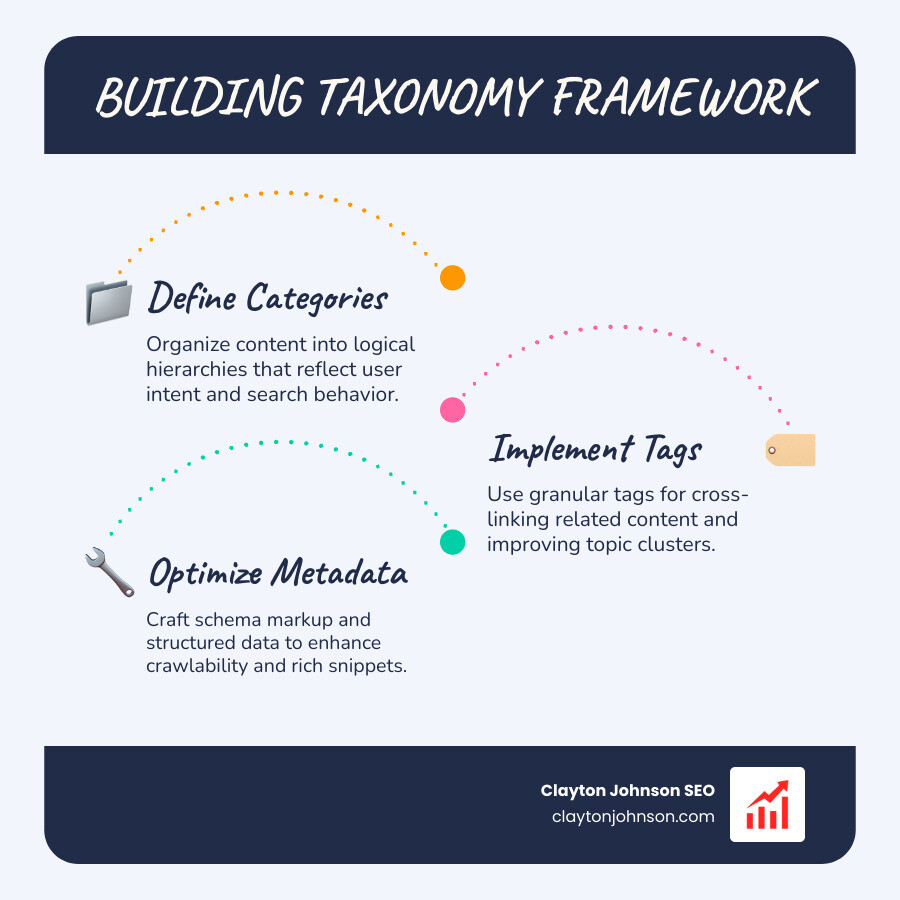
Core Components of an Architecture Content SEO Taxonomy
- Categories: These group similar content into a logical hierarchy. They are usually parent-child relationships (e.g., /Services/SEO-Consulting). We recommend keeping these broad and shallow—ideally no more than three levels deep.
- Tags: These provide cross-linking between categories. While categories are hierarchical, tags are lateral. They help users find content with specific characteristics across different sections of the site.
- Metadata: This is specific information about your content that search engines use to understand context. It acts as a semantic anchor, labeling your assets so they can be retrieved by both users and AI systems.
Faceted Navigation and Search Intent
For larger sites, especially e-commerce or massive resource libraries, faceted navigation is essential. This allows users to filter content by multiple attributes (size, color, brand, or content format).
However, we must be careful. Improperly managed faceted navigation can lead to index bloat, where search engines crawl thousands of near-duplicate filter combinations. Best practices include using canonical tags and noindexing low-value filter pages to preserve your crawl budget.
Advanced Taxonomy for Headless CMS and AI Search
The world of content management has shifted. We’ve moved from traditional, rigid CMS platforms to modern, headless architectures. 77% of organizations using headless can rapidly expand into new channels, compared to only 54% using traditional systems.
Platforms like Kontent.ai and Webflow CMS allow for more flexible, adaptable taxonomy management. In a headless environment, content is decoupled from the presentation layer, meaning your taxonomy can be delivered to websites, mobile apps, and even AI voice assistants simultaneously.
Aligning Architecture Content SEO Taxonomy with LLM Latent Space
We are entering the era of Generative Engine Optimization (GEO). Large Language Models (LLMs) like ChatGPT and Perplexity don’t “crawl” like Googlebot; they map concepts in a multi-dimensional “latent space.”
To rank in AI-powered summaries, we need to reduce the semantic distance between related entities. This involves:
- Entity Audits: Identifying the top 20 concepts your business must own.
- Vector Clusters: Grouping content based on mathematical similarity rather than just keyword volume.
- Answer Engine Optimization: Ensuring every parent category has a clear, dictionary-style definition that AI can easily ingest.
Evolution from Traditional to Modern Content Systems
Traditional CMSs forced us into rigid, nested folders. Modern systems allow for a “network” taxonomy—a hybrid of hierarchical and associative navigation. This creates a more durable structure that can survive algorithm updates and adapt as your business grows.
Technical SEO Best Practices for Taxonomy Implementation
A beautiful taxonomy is useless if the technical foundation is broken. We need to ensure that our architecture content seo taxonomy is reinforced by clean URL structures and internal linking.
| Feature | Good Taxonomy | Bad Taxonomy |
|---|---|---|
| URL Path | /blog/seo/taxonomy-guide |
/p=123?cat=seo&tag=taxonomy |
| URL Length | Under 75 characters | Long, parameter-heavy strings |
| Hierarchy | Mirrors site structure | Flat or random URLs |
| Separators | Hyphens (-) | Underscores (_) or spaces |
Crawl Budget and Orphan Pages
Google has a limited crawl budget for every site. If your taxonomy is too deep (more than 4 clicks from the homepage), important pages may never get indexed. We must also use tools to discover orphan pages—content that isn’t linked to from anywhere else in your structure.
Internal Linking and Breadcrumbs
Internal linking is the primary determinant of page depth. By using breadcrumbs, we provide both users and search engines with a clear “You are here” signal, reinforcing the conceptual hierarchy of the site.
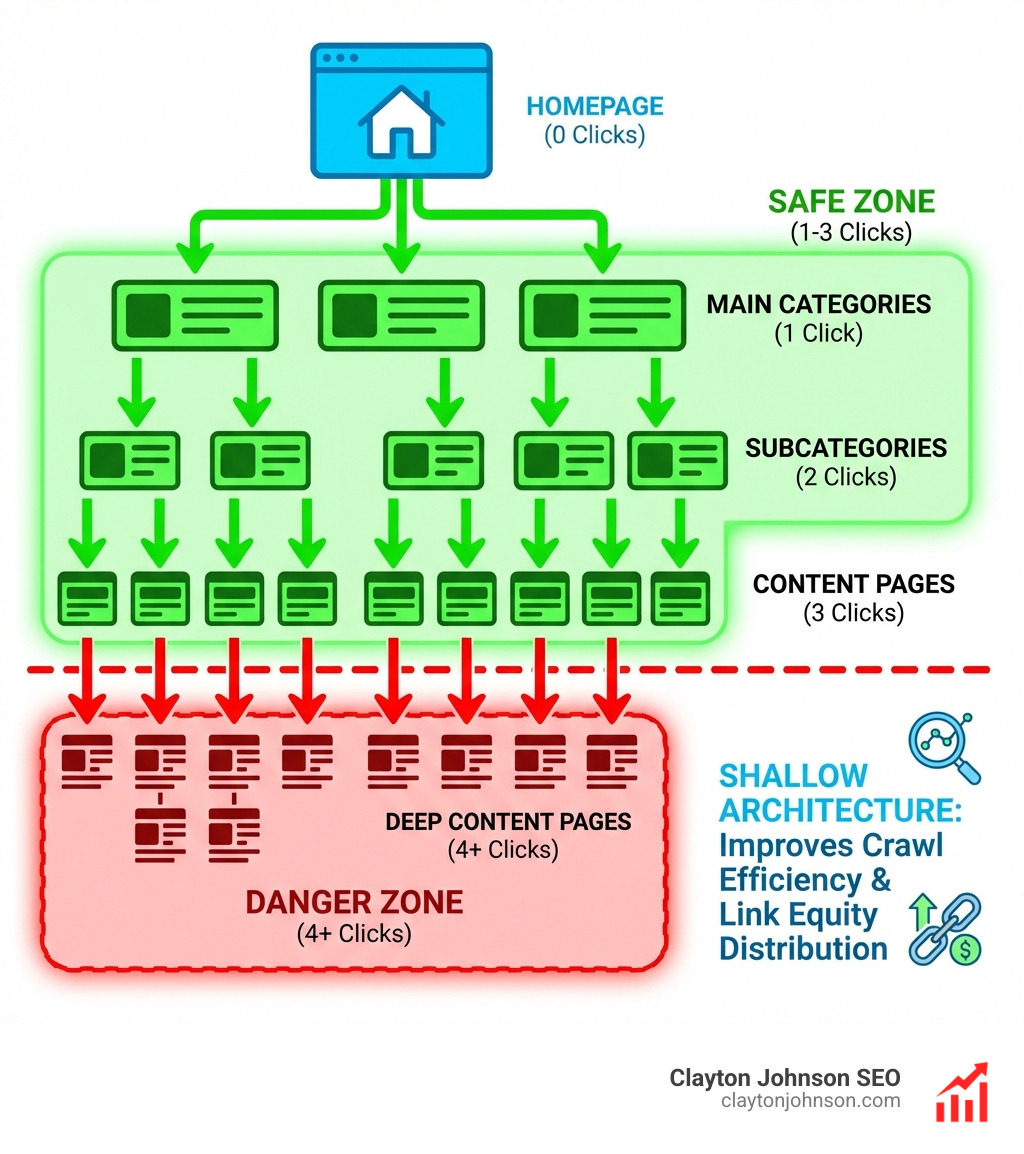
Auditing and Maintaining Your Content Ecosystem
A content taxonomy is not a “set it and forget it” project. It requires regular maintenance to stay effective. We recommend a proactive approach to auditing your content architecture.

The Audit Process
- Analyze Search Logs: What terms are users typing into your internal search bar? This reveals gaps in your current taxonomy.
- Google Search Console: Check for “Crawl Errors” or “Indexed, not submitted in sitemap.” This often points to structural issues.
- Content Pruning: Merge overlapping categories to prevent cannibalization. If you have “SEO Tips” and “SEO Advice,” you are fighting against yourself.
For more hands-on help, you can find more info about SEO content marketing on our site. We believe that a scalable growth model requires a fully documented strategy and a taxonomy that can evolve with your business.
Frequently Asked Questions about Content Taxonomy
How do I avoid keyword cannibalization in my taxonomy?
Cannibalization happens when multiple pages target the same intent. To avoid this, map one primary focus keyword to each unique URL in your taxonomy. Use a “keyword map” to ensure that your category pages target broad “head” terms while your subcategories and blog posts target specific, long-tail queries.
What is the difference between a flat and hierarchical taxonomy?
A flat taxonomy has no subdivision; all categories have equal weight (common on small blogs). A hierarchical taxonomy uses parent-child relationships to create depth. For most businesses, we recommend a broad and shallow hierarchical structure (3-4 levels max) to balance discoverability with organization.
How does taxonomy impact Google’s crawl budget?
If your taxonomy is disorganized, Googlebot will waste its limited “budget” crawling duplicate content, low-value filter pages, or broken links. A clean, logical taxonomy ensures the most important pages are found and indexed quickly, maximizing your organic visibility.
Conclusion
At Clayton Johnson SEO, we aren’t just here to write blog posts. We are here to help you build structured growth infrastructure. Through our platform, Demandflow.ai, we provide the strategic frameworks and taxonomy-driven systems that founders and marketing leaders need to achieve compounding growth.
The thesis is simple: Clarity → Structure → Leverage → Compounding Growth.
If your content feels like a disorganized garage, it’s time to build a library. Stop chasing tactics and start building architecture.
Work with Clayton Johnson today to turn your content into a high-performance engine.