Going Long: Why Long Tail Keywords Are Your Secret Weapon

Why Long Tail SEO Keywords Are the Smartest Traffic Strategy You’re Not Using
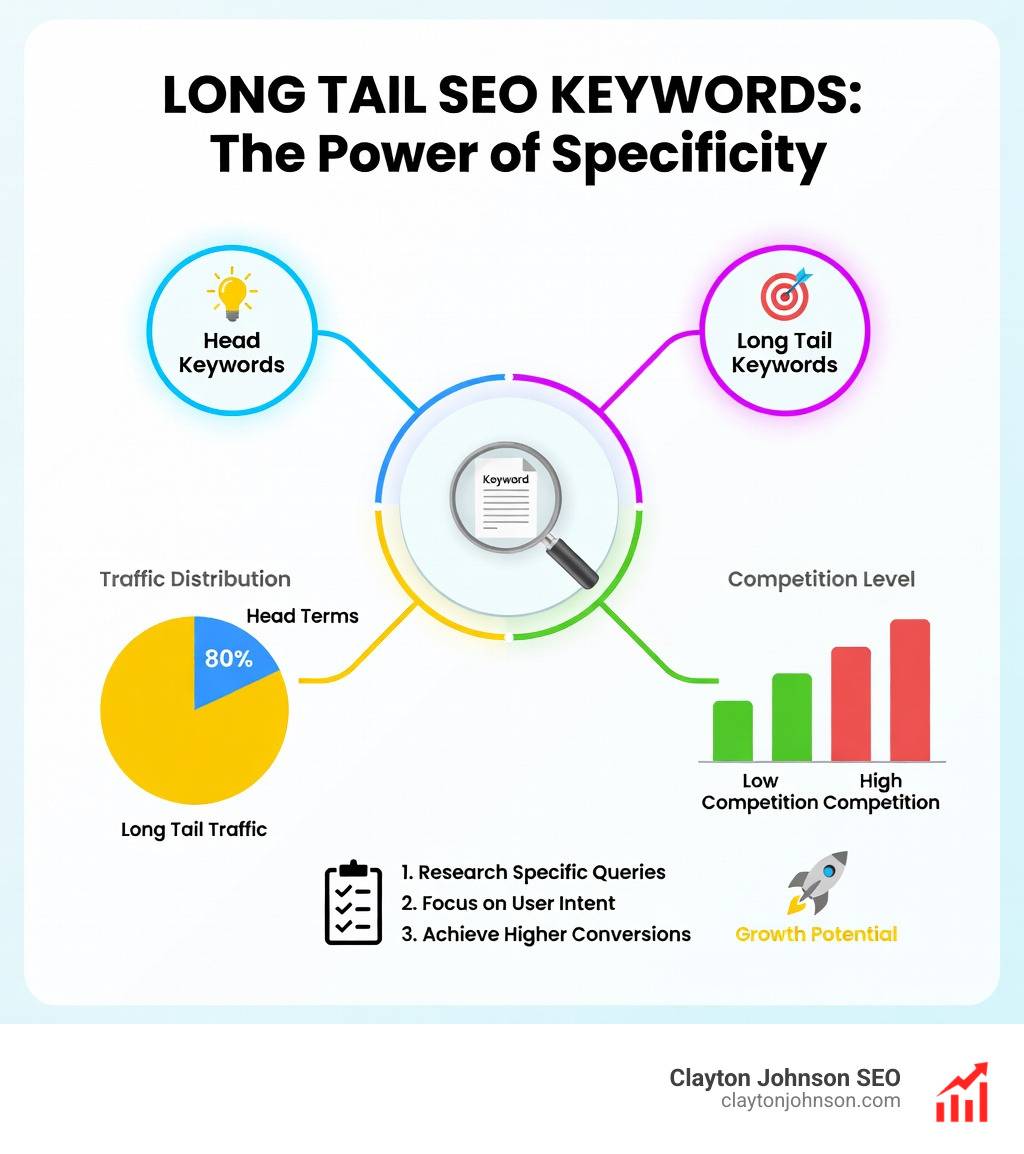
Long tail SEO keywords are specific, multi-word search phrases with lower search volume but higher user intent and less competition than broad “head” terms.
Quick answer — what you need to know:
| Factor | Head Keywords | Long Tail Keywords |
|---|---|---|
| Word count | 1–2 words | 3+ words |
| Search volume | High | Low to moderate |
| Competition | Very high | Low to moderate |
| User intent | Vague | Specific |
| Conversion rate | Lower | Higher |
| Best for | Brand awareness | Targeted traffic |
Key facts:
- Over 70% of all search queries are long tail
- Long tail searches have 3–6% higher clickthrough rates than single-word searches
- Long tail keywords collectively drive the majority of page views across the web
Most founders and marketing leaders chase the same high-volume keywords as everyone else. “Best CRM.” “Email marketing.” “SEO strategy.” The result? You’re competing against companies with 10x your domain authority and 100x your content budget.
Here’s the thing: the majority of searches don’t happen on those big, obvious terms. They happen in the long tail — the specific, nuanced questions and phrases your ideal customer types when they’re actually ready to act.
Searching for “best CRM for nonprofits under $50” is very different from searching for “CRM.” The first person knows what they want. They’re close to a decision. That’s the traffic worth capturing.
The challenge is that most SEO strategies are built around volume instead of intent. That’s a structural problem — and it’s exactly the kind of problem that compounds over time if left unaddressed.
I’m Clayton Johnson, an SEO strategist who specializes in building scalable content architectures and intent-driven keyword systems that turn search traffic into measurable business outcomes — and long tail SEO keywords are one of the highest-leverage tools I use for founders and marketing leaders at every stage. Let’s build the framework that makes this work for your business.
What Are Long Tail SEO Keywords?
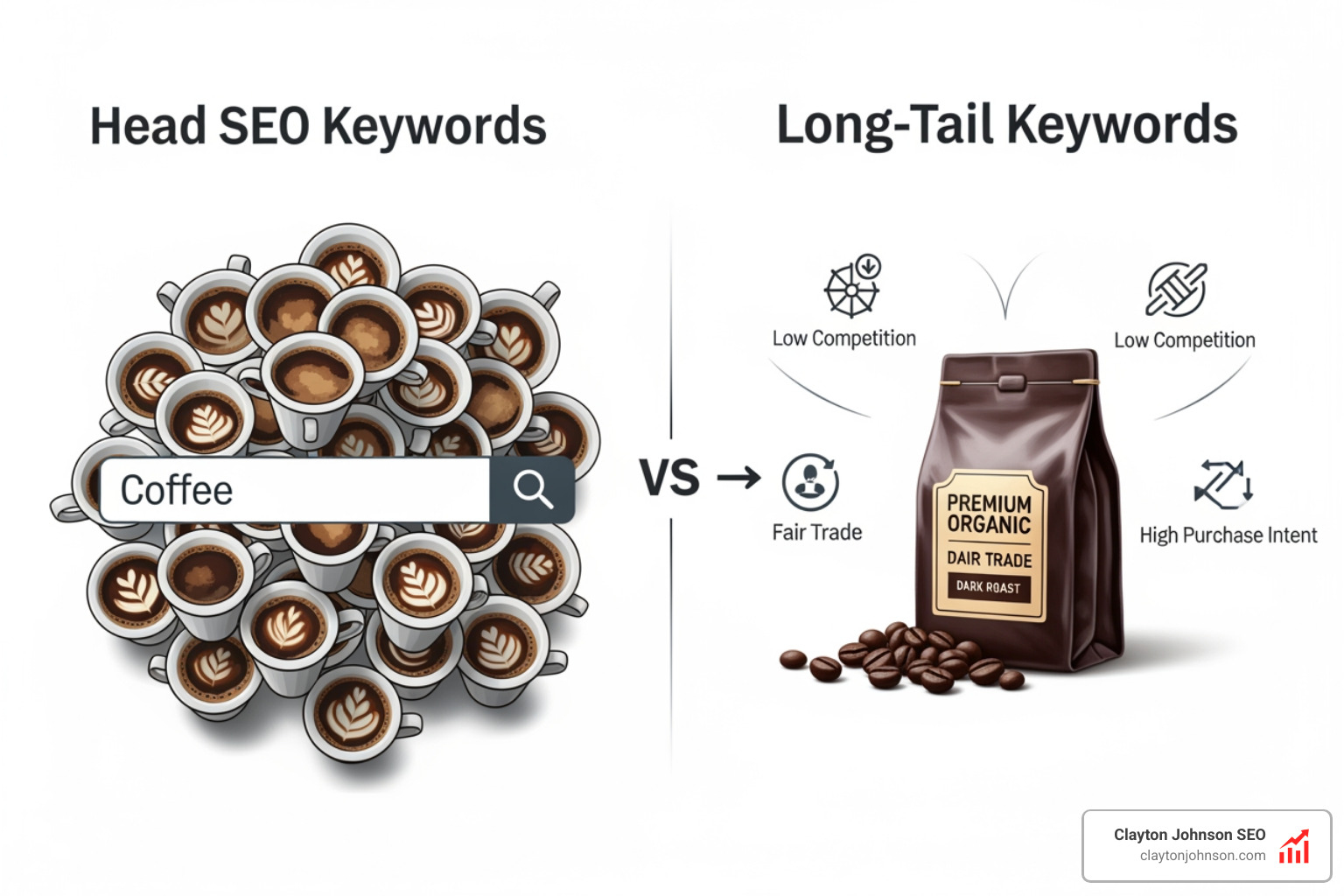
To understand long tail SEO keywords, we have to look at how people actually use the internet. Most of us imagine that everyone is searching for broad terms like “coffee” or “cars.” In reality, those broad terms—known as “head keywords”—represent only a tiny fraction of total search volume.
The term “long tail” was popularized by Chris Anderson in his book The Long Tail. While Anderson was talking about the economics of niche products (like how Amazon sells millions of obscure books that a physical bookstore could never stock), the concept fits SEO perfectly.
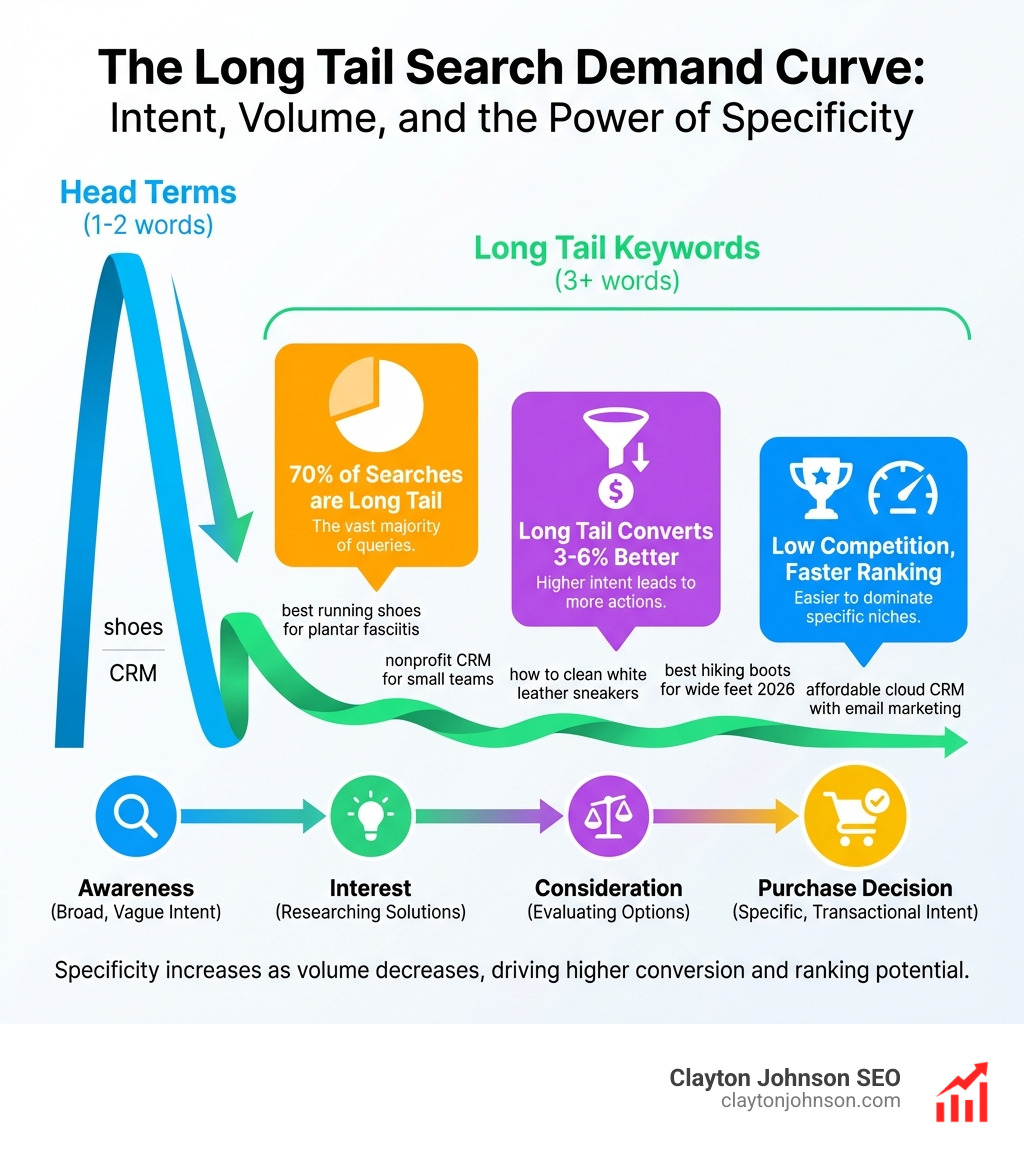
If you plot every search query on a graph by its popularity, you get a “search demand curve.” On the far left, you have a few “head” terms with massive volume. As you move to the right, the curve drops steeply and then trails off into a nearly infinite “tail” of highly specific, low-volume queries.
These long tail SEO keywords are characterized by:
- Low Search Volume: Individually, they might only get 10 or 50 searches a month.
- High Precision: They describe exactly what the user is looking for.
- Lower Competition: Because the volume is low, big brands often ignore them.
- Niche Appeal: They target specific demographics or problem-solving stages.
The 80/20 Rule in Search
In search marketing, we often see a version of the Pareto Principle. While a handful of head terms get the most attention, they only account for about 10% to 15% of all searches. Mid-tail keywords (slightly more specific phrases) account for another 15% to 20%.
That leaves a staggering 70% of search queries residing in the long tail. When you add up the millions of tiny “tails,” they collectively represent the vast majority of all human curiosity online. If you only target the head, you are missing out on 70% of your potential market.
Topical vs Supporting Long Tails
Not all long tails are created equal. We generally categorize them into two types:
- Topical Long Tails: These are unique search queries that represent a distinct topic. For example, “why are huskies so dramatic?” is a specific question that requires a specific answer. It isn’t just a variation of “husky dogs.”
- Supporting Long Tails: These are variations of a more popular “parent” topic. For example, “best running shoes for flat feet” is a long tail, but it’s essentially a subset of the broader “running shoes” topic.
Understanding this distinction is vital for your content architecture. You don’t want to write 50 different articles for 50 supporting long tails; you want one massive, authoritative pillar page that ranks for all of them. But for a topical long tail, you need a dedicated piece of content.
Why Long Tail SEO Keywords Win in Modern Search
Why should you care about a keyword that only gets 10 searches a month? Because those 10 people are worth more to your business than 1,000 people searching for a generic term.
According to a study by Smart Insights, long tail searches have a clickthrough rate (CTR) that is 3% to 6% higher than generic, one-word searches.
When someone searches for “shoes,” they might be looking for the history of footwear, a local repair shop, or just browsing. But when they search for “men’s size 12 waterproof trail running shoes,” they have a credit card in their hand.
Why long tail SEO keywords Convert Better
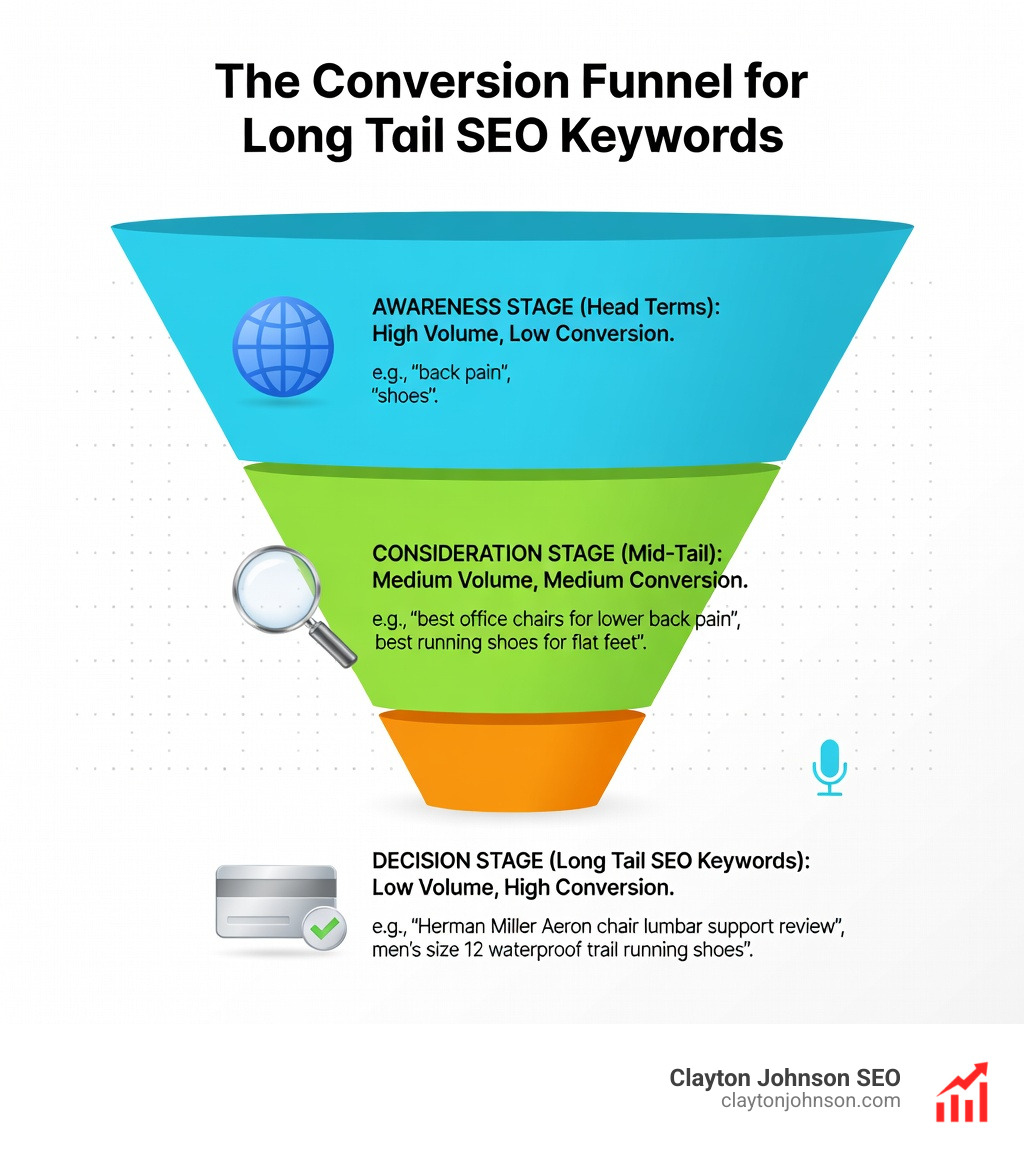
The secret weapon of the long tail is intent. As users move through the customer journey, their searches become longer and more specific.
- Awareness Stage: “Back pain” (Head term – low conversion)
- Consideration Stage: “Best office chairs for lower back pain” (Mid-tail)
- Decision Stage: “Herman Miller Aeron chair lumbar support review” (long tail SEO keywords – high conversion)
By targeting the tail, you are catching qualified traffic at the exact moment they are ready to solve a problem or make a purchase.
The Role of AI and Voice Search
The way we search is changing. With the rise of voice assistants and Google’s AI Overviews, search queries are becoming increasingly conversational. We no longer type “weather Minneapolis”; we ask, “Do I need an umbrella in Minneapolis this afternoon?”
Search queries that trigger AI Overviews have shown a consistent trend toward increasing word counts as search behavior evolves. This shift toward natural language makes long tail SEO keywords even more important. AI systems use “query fan-out” to expand a user’s question into many related sub-queries. If your content provides the specific, deep answers these sub-queries need, you’re far more likely to be cited as a source in an AI response.
How to Find long tail SEO keywords
Finding these hidden gems requires a mix of intuition and the right tools. We don’t just look at spreadsheets; we look at human behavior.
1. Start with Seed Topics
Think about the core problems your business solves. If we’re helping a client in the Minneapolis area with local SEO, our seed might be “Minneapolis SEO.” From there, we branch out.
2. Use Free Discovery Tools
- Google Autocomplete: Start typing your seed keyword and see what Google suggests. These aren’t random; they are based on real, trending searches.
- People Also Ask (PAA): These boxes are a goldmine for question-based long tails. Every time you click a question, more appear.
- AnswerThePublic: This tool visualizes the “who, what, where, why” questions people ask about your topic. It’s perfect for finding topical long tails.
- AlsoAsked: Similar to AnswerThePublic, this tool maps out the relationship between different questions, helping you see the hierarchy of user intent.
3. Mine Online Communities
Reddit and Quora are where people go when they can’t find a good answer on Google. If you see a thread on Reddit with 200 comments about a very specific problem, that is a long tail SEO keyword waiting for a dedicated article.
4. The “Alphabet Trick”
In Google, type your keyword followed by “a,” then “b,” then “c.”
- “SEO strategy a…” (Google suggests “SEO strategy audit”)
- “SEO strategy b…” (Google suggests “SEO strategy blueprint”)
Finding long tail SEO keywords with AI Tools
AI hasn’t just changed how people search; it’s changed how we do research. We use ChatGPT or Gemini to brainstorm “buyer personas.” We ask the AI: “What are 10 specific problems a small business owner in Minnesota faces when trying to rank for local services?”
The AI might suggest “how to optimize a Google Business Profile for multiple suburbs.” We then take that idea and plug it into a tool like the Semrush Keyword Magic Tool to verify that people are actually searching for it.
Leveraging Your Own Data
Don’t ignore the data you already have. Google Search Console is the most accurate tool for finding long tails you’re already starting to rank for.
Look for keywords where you have high impressions but low clicks, and you’re ranking on page two (positions 11-20). Often, these are long tail phrases you’ve mentioned in passing. By creating a dedicated section or a new post for that specific phrase, you can jump to position one almost overnight.
Strategic Content Implementation and Optimization
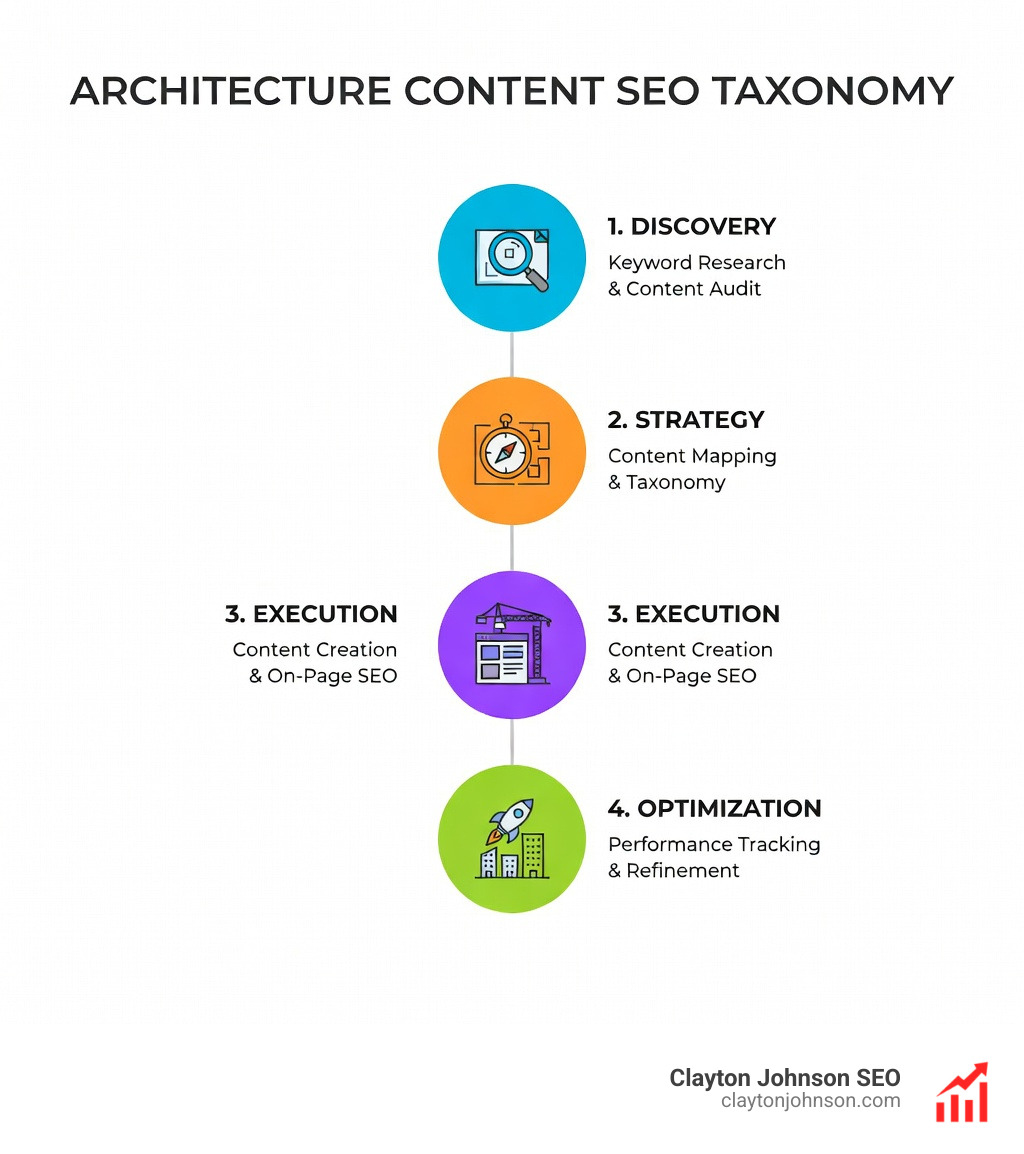
Once you have your list of long tail SEO keywords, you can’t just sprinkle them into your text like salt. You need a structured growth architecture. At Demandflow, we use a “hub-and-spoke” or “topic cluster” model.
- The Pillar (Hub): A comprehensive guide to a broad topic (e.g., “The Ultimate Guide to SEO”).
- The Spokes (Long Tails): Individual articles targeting specific long tails (e.g., “How to use schema markup for local Minneapolis businesses”).
Each spoke links back to the pillar, and the pillar links to the spokes. This tells Google that you aren’t just writing random posts—you are building an authority ecosystem.

Writing for Specificity
When writing for the long tail, you must rebel against “copycat content.” Don’t just summarize what the top three results say.
- Answer the “Why”: Instead of just “how to do X,” explain “why X happens.”
- Get Specific: Use real-world examples. If you’re writing about “why are huskies so dramatic,” include specific anecdotes about their vocalizations.
- Use FAQ Sections: Explicitly use your long tail questions as H3 headers. This makes it easy for both users and AI bots to find the answer.
Technical SEO for the Long Tail
To rank effectively for these specific queries, you need to give Google’s bots a map.
- Schema Markup: Use FAQ schema to help your questions show up directly in the search results.
- Descriptive Anchors: When linking between your pages, don’t use “click here.” Use the long tail keyword as the link text.
- Search-Friendly Filters: For e-commerce sites, ensure your filter pages (e.g., “Organic Dark Roast Coffee”) are indexable. These are often the best-performing long tail pages.
Common Mistakes to Avoid
Even with the best intentions, it’s easy to get long tail SEO wrong. Here are the pitfalls we see most often:
- Keyword Stuffing: Long tail phrases can be clunky. “Best plumber Minneapolis emergency repair” isn’t a natural sentence. Write for humans first. Use the phrase naturally, or break it up.
- Intent Mismatch: If someone searches for “how to fix a leaky faucet,” they want a guide, not a product page for a new wrench. Ensure your content type matches what the user is actually looking for.
- Volume Obsession: Don’t discard a keyword just because a tool says it has “0” volume. Tools are often wrong about the tail. If it’s a real question your customers ask, it’s worth targeting.
- Thin Content: Don’t write a 200-word “stub” article for every long tail. If you don’t have enough to say to provide real value, group several related long tails into one high-quality post.
Frequently Asked Questions about Long Tail SEO
How many words are in a long tail keyword?
While they are typically three to five words or more, the length isn’t the defining factor. A two-word phrase can be “long tail” if it has very low search volume and high specificity. It’s about where it sits on the demand curve, not the word count.
Are long tail keywords easier to rank for?
Generally, yes. Because fewer websites are competing for “best vegan gluten-free bakery in Minneapolis” than for “bakery,” you can often rank on the first page much faster—sometimes within weeks rather than months.
Can I use long tail keywords for local SEO?
Absolutely. In fact, for local businesses in places like Minneapolis, long tail keywords are essential. Adding “near me” or specific neighborhood names to your service keywords is a classic long tail tactic that drives high-intent foot traffic.
Conclusion
Long tail SEO keywords are not just a “tactic”—they are a fundamental shift in how you approach growth. By moving away from the “vanity” of high-volume head terms and focusing on the specific needs of your audience, you build a resilient, high-converting traffic engine.
At Clayton Johnson SEO, we believe that most companies don’t lack tactics; they lack structured growth architecture. We help founders and marketing leaders build systems that turn these insights into compounding results.
If you’re tired of fighting for broad terms that don’t convert, it’s time to change your strategy. Focus on the intent. Focus on the tail. Focus on the structure that supports it all.
Ready to stop chasing volume and start chasing growth? Build your growth infrastructure with us today.