Wealth Manager SEO: Because Your Website Shouldn’t Be a Hidden Asset

Why SEO is the Ultimate Digital Referral System for Wealth Managers
In the wealth management world, trust is the only currency that matters. Traditionally, that trust was built over steak dinners and golf games. Today, it begins with a Google search. We like to think of wealth manager SEO as a digital referral system. Just as a satisfied client wouldn’t recommend an advisor they don’t trust, Google won’t “refer” a user to a website it doesn’t view as credible, relevant, and authoritative.
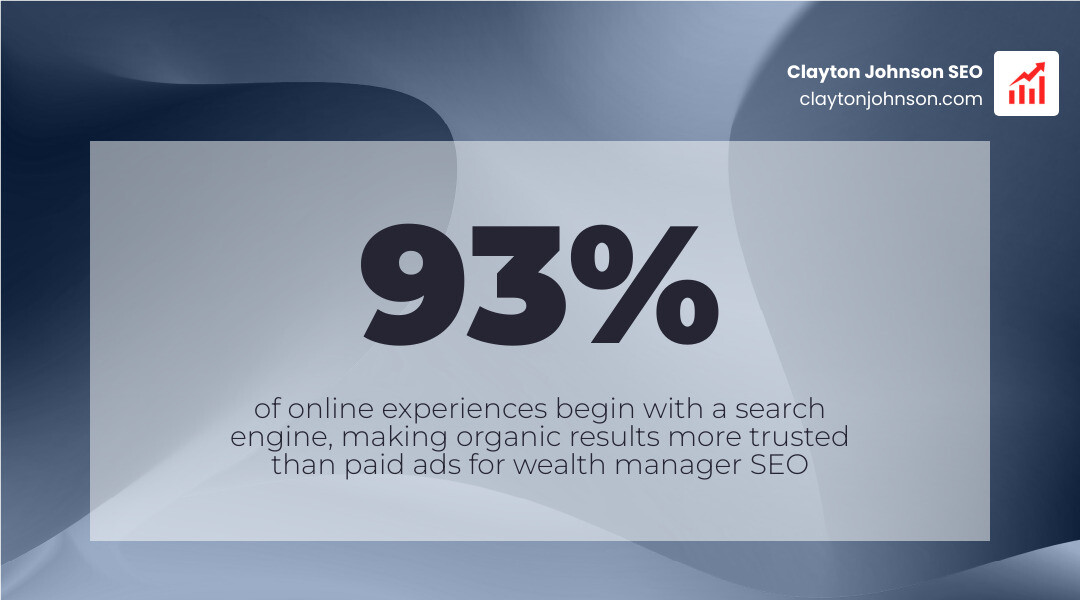
When you rank at the top of organic search results, you aren’t just getting a click; you’re receiving a vote of confidence from the world’s most powerful algorithm. According to Kitces Research, SEO has the lowest Client Acquisition Cost (CAC) of all marketing tactics evaluated. It costs only a fraction of what you would spend to acquire a client through podcasting, social media, or traditional paid advertisements.
By following SEO 101 principles, wealth managers can align their digital presence with Google’s E-E-A-T guidelines (Experience, Expertise, Authoritativeness, and Trustworthiness). This is especially critical for “Your Money or Your Life” (YMYL) industries like financial services, where Google holds content to a much higher standard because it impacts a person’s future financial stability. Investing in wealth manager services ensures that your growth is sustainable and yields compounding returns over time.
SEO vs. Paid Advertising: The Long-Term ROI
Many firms fall into the trap of relying solely on Pay-Per-Click (PPC) advertising. While PPC can get you to the top of the page instantly, the moment you stop paying, your lead flow vanishes. Furthermore, “ad fatigue” is real; many high-net-worth individuals instinctively skip past the “Sponsored” labels to find the organic leaders.
| Feature | SEO (Organic) | PPC (Paid) |
|---|---|---|
| Cost Basis | Sweat equity & strategy | Pay per click ($35–$80+ in finance) |
| Trust Factor | High (Earned authority) | Moderate (Paid placement) |
| Sustainability | Compounding growth | Ends when budget stops |
| Compliance | Static pages (reviewed once) | Ads (require constant approval) |
Organic SEO builds a foundation of credibility that paid ads simply cannot buy. While a PPC campaign might cost $50,000 for 1,000 clicks, a well-optimized SEO strategy can eventually drive those same 1,000 visitors every month for free.
Realistic Timelines and ROI Expectations
We often tell our clients that SEO is a marathon, not a sprint. If you are looking for overnight results, SEO isn’t the answer. However, if you want to build a dominant market position, it is the only answer.
According to industry data, most advisors see improvements in keyword rankings and organic traffic within 2 to 3 months if they maintain a moderate content velocity. However, generating high-quality leads—the kind that turn into AUM—typically takes 6 to 12 months, and sometimes 12 to 18 months for full momentum. This is because high-net-worth prospects have longer sales cycles; they may visit your site five times and read three whitepapers before booking a discovery call.
Our beginner’s guide to wealth manager SEO emphasizes that while the wait is longer, the ROI is significantly higher because organic leads often close at a higher rate than cold paid traffic.
The Four Pillars of a High-Performance Strategy
To dominate the search results, your firm needs more than just a “pretty” website. You need a strategy built on four distinct pillars.
- On-Page Optimization: Aligning your site’s content with user intent.
- Off-Page Authority: Building prestige through external signals.
- Technical Health: Ensuring web crawlers and indexing bots can easily navigate your site.
- Content Strategy: Showcasing your expertise to solve prospect problems.
Strategic Keyword Research for Wealth Manager SEO
Keyword research is the process of discovering the exact questions your future clients are asking. Many firms make the mistake of targeting broad terms like “wealth management,” which are dominated by national giants. Instead, we focus on intent modeling and niche targeting.
For example, while “financial advisor” is searched 165,000 times a month, a term like “fee-only wealth manager for tech executives in Austin” has lower volume but much higher intent. Using leading SEO tools like Semrush, we can identify “long-tail” keywords (phrases with 3+ words) that are easier to rank for and attract more qualified leads.
Consider these search volumes:
- Retirement planning: 40,000 searches/month
- Financial planner: 33,000 searches/month
- Estate planning strategies: High-intent niche volume
By targeting specific “pain point” keywords—such as “how to reduce capital gains tax on business sale”—you position yourself as the expert before the prospect even knows they need a full-time advisor.
Building High-Quality Backlinks and Internal Linking
Backlinks are essentially “digital referrals.” When a reputable site links to yours, it passes “link juice” and signals to Google that you are a trusted authority. For wealth managers, getting listed in top financial directories like the NAPFA directory or the CFP Board is a non-negotiable first step.
Beyond directories, we focus on:
- Guest Posting: Writing for industry publications.
- Local Partnerships: Getting links from local Chambers of Commerce or estate attorneys.
- Thought Leadership: Creating reports that other journalists want to cite.
Equally important is your internal linking guide strategy. By linking related blog posts together, you help Google understand the “taxonomy” of your site, ensuring that your most important service pages receive the most authority.
Local SEO: Dominating Your Regional Market
For most wealth managers, the “low-hanging fruit” is their local market. When someone searches for an advisor “near me,” Google displays the “Local Pack”—a map featuring three local businesses.
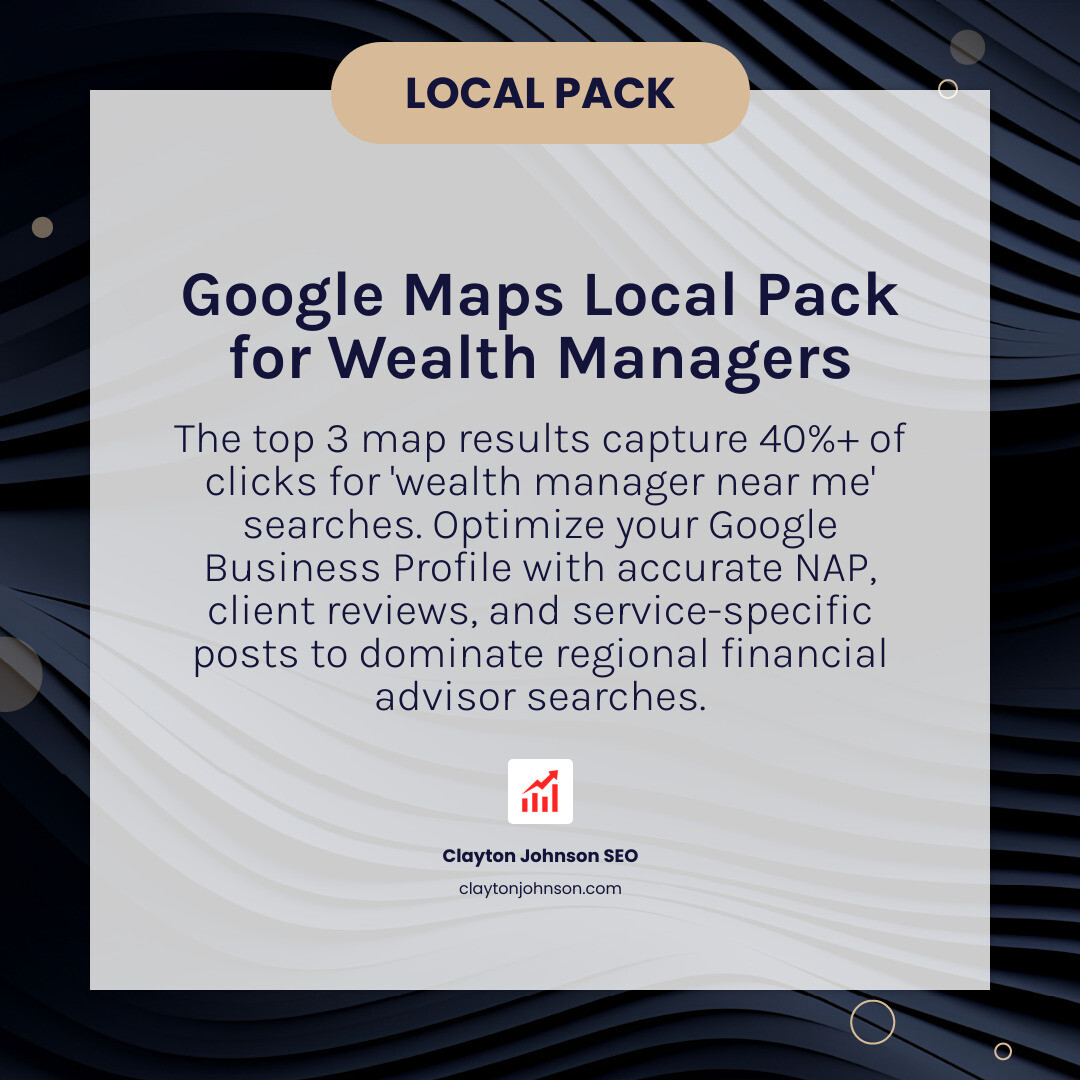
Appearing in this pack is the fastest way to generate phone calls. This requires a strong Minneapolis SEO (or your specific city) approach, focusing on local intent and geo-targeted landing pages.
Optimizing Your Google Business Profile for Wealth Manager SEO
Your Google Business Profile (GBP) is often the first thing a prospect sees. To optimize it:
- Claim and Verify: Ensure you own the listing.
- Complete Every Detail: Add your hours, services, and a detailed bio.
- Manage Reviews: With the recent changes in the SEC’s Marketing Rule for Investment Advisers-1), many firms can now leverage testimonials and reviews with proper disclosures.
- Post Regularly: Share market updates or firm news directly to your profile.
The Importance of NAP Consistency and Social Signals
NAP stands for Name, Address, and Phone number. If your business is listed as “Smith Wealth Management” on your website but “Smith & Associates” on Yelp, Google gets confused. Consistent NAP data across online directories is a foundational ranking factor.
Furthermore, social media supports your SEO efforts indirectly. While a LinkedIn post might not change your ranking overnight, the average internet user spends 141 minutes per day on social platforms. High engagement signals to search engines that your brand is active and relevant. Instagram now indexes post content, meaning your captions can actually show up in Google search results!
Technical Excellence and Wealth Manager SEO
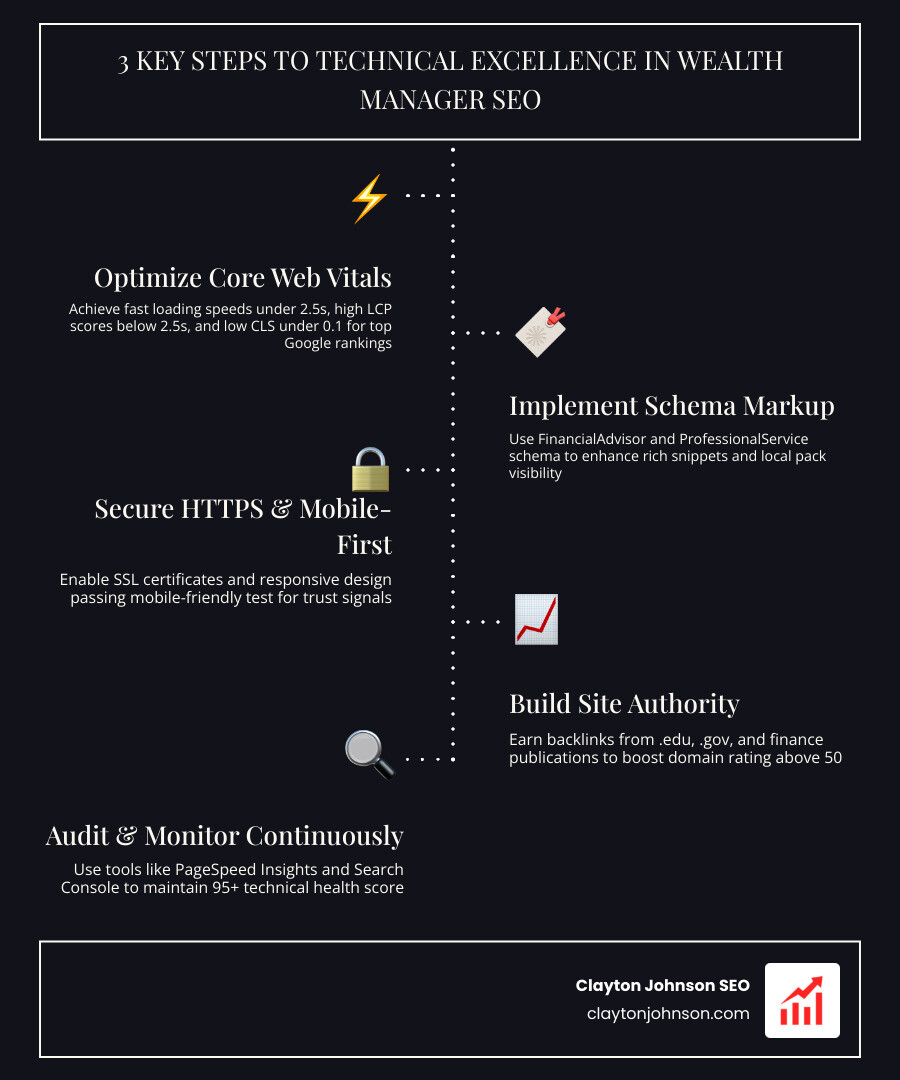
Technical SEO is the “plumbing” of your website. If your site is slow, broken, or insecure, Google will penalize you, regardless of how good your content is.
A critical statistic to remember: mobile devices now account for over 70% of all online sales and searches. If your site isn’t mobile-friendly, you are invisible to the majority of your prospects. We use tools like PageSpeed Insights and Google’s Lighthouse to ensure sites load in under 2.5 seconds.
Key technical priorities include:
- HTTPS Security: Essential for financial firms to protect user data.
- Core Web Vitals: Google’s specific metrics for speed, responsiveness, and visual stability. You can find the full Core Web Vitals documentation to see how Google evaluates your site’s health.
- Site Architecture: A logical hierarchy that makes it easy for users to find your “Retirement Planning” or “Tax Strategies” pages.
Adapting to AI-Powered Search and Voice Queries
The search landscape is changing with Google’s Search Generative Experience (SGE) and AI-powered answers. Users are moving away from short keywords toward conversational, long-form questions like, “Who is the best fiduciary wealth manager for business owners in my area?”
To stay ahead, we follow the no-nonsense guide to AI SEO by implementing:
- Schema Markup: Code that helps search engines understand your services, location, and credentials.
- Structured Data: Highlighting FAQs so AI can easily extract your answers.
- Conversational Content: Writing in a natural, authoritative tone that mirrors how people speak to Siri or Alexa.
Measuring Success and Choosing the Right Provider
How do you know if your wealth manager SEO is actually working? You must track the right metrics via Google Search Console and Google Analytics.
We focus on:
- Keyword Rankings: Are you moving up for “wealth manager”?
- Organic Traffic: Is the number of visitors from search increasing?
- Conversion Rate: Are those visitors actually booking calls?
- Lead Quality: Are the leads high-net-worth individuals or just general inquiries?
When choosing an SEO provider, avoid those who promise “Rank #1 in 30 days.” Instead, look for partners with financial industry experience who understand compliance. Verify their claims using tools like SE Ranking, Semrush, or Moz. If you’re ready to scale, our SEO services are designed to turn your website into a growth engine.
Creating Authoritative Content for YMYL Rankings
In the financial world, content is your silent salesperson. But not just any content—it must be high-quality and authoritative. According to an Edelman-LinkedIn Report, 64% of buyers say thought leadership is a more trustworthy basis for assessing a firm than its marketing materials.
We recommend a strategy of “firing bullets, then cannonballs,” a concept made popular by “Good to Great” author Jim Collins. Start by testing small content ideas (bullets) like blog posts or social updates. Once you see what resonates with your audience, invest heavily in a comprehensive guide or whitepaper (the cannonball).
Our SEO content marketing approach includes:
- Client-Focused FAQs: “Should I do a Roth conversion this year?”
- Educational Whitepapers: “The Executive’s Guide to Liquidity Events.”
- Content Repurposing: Turning one long webinar into five blog posts and ten LinkedIn clips.
- Compliance-Friendly Blogging: Ensuring every post includes the necessary disclosures required by your compliance team.
Frequently Asked Questions about Wealth Manager SEO
How long does it take to see results from wealth manager SEO?
While you may see technical improvements and minor ranking shifts within 90 days, significant organic lead generation typically takes 6 to 12 months. SEO is a long-term investment that builds compounding authority over time.
What are the most important keywords for wealth management firms?
The most valuable keywords are “high-intent” phrases. While “financial advisor” has high volume, phrases like “fiduciary wealth manager for physicians,” “estate planning for high-net-worth families,” or “wealth management firm [Your City]” often lead to better client conversions.
Is local SEO more important than content SEO for wealth managers?
They work together. Local SEO (Google Business Profile) helps you capture people searching in your immediate area right now. Content SEO (blogging and guides) builds the trust and authority necessary to convert those visitors into long-term clients and allows you to reach prospects outside your immediate zip code.
Conclusion
The digital landscape for wealth managers is no longer a “nice to have”—it is the primary battlefield for new AUM. By building a system rooted in clarity, structure, and leverage, you can move away from fragmented marketing and toward compounding growth.
At Clayton Johnson SEO, we specialize in building these durable systems. Whether it’s technical SEO architecture, AI-augmented workflows, or strategic intent modeling, our goal is to turn your website into your most productive employee.
If you are ready to stop chasing tactics and start building a scalable traffic system, schedule a consultation with us today. Let’s make your wealth manager SEO pay dividends for years to come.